
Water Kefir Versus Kombucha – Which one is better?

This post may contain affiliate links. Read my full disclosure here.
Would you like to save this?
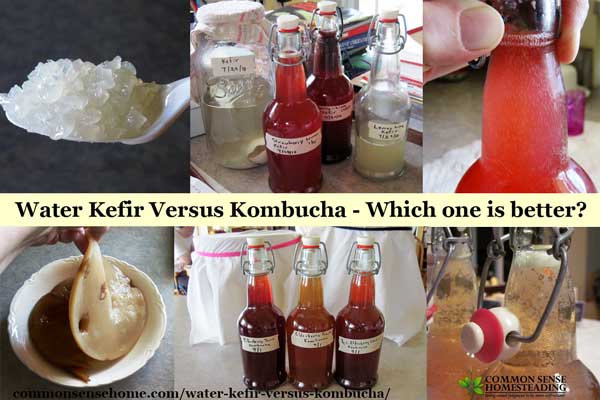
Water kefir verus kombucha, which is better?
This is a question I’ve heard a number of times. My kids like the flavor of water kefir soda better than kombucha tea, but I generally prefer the kombucha myself, and my husband will drink either, depending on the flavor.
Water kefir is quicker to brew than kombucha tea – unless you do a continuous ferment, in which case you can draw off kombucha every day. Some people find water kefir is more consistent, my kombucha tends to be more consistent. Some people feel guilty about excess scobys, I have been able to give most of mine away, or I simply compost them. A few I’ve used to treat skin ailments, such as my son’s cradle cap. (Read The SCOBY Cure.) (DON’T FLUSH YOUR SCOBY! It may just be able to grow in your septic system and cause big problems.)
So, other than personal preference, what is the real difference between water kefir and kombucha? Both start with a base of sweetened liquid (kombucha with sweetened tea, water kefir with sweetened water). I did a lot of hunting, and what follows are some of the best explanations I found on the Net. First up, kombucha.
What is Kombucha?
Kombucha is also known as Kombuchal, Gerbstoffe, Combucha, Kum-Cha, Fungus japonicas, Fungojapon, Indo-Japanese tea fungus, Pichia fermentans, Cembuya orientalis, Combuchu, Tschambucco, Volga spring, Mo-Gu, Champignon de longue vie, Tea Kvas, Teakwass, Kwassan, Kargasok, Kocha kinoko, Tibetian mushroom and more.
From the forums at Wild Fermentation:
The bacterial component of a kombucha culture usually consists of several species, but will almost always contain Gluconacetobacter xylinus, which ferments the alcohols produced by the yeast(s) into acetic acid. This increases the acidity while limiting the alcoholic content of kombucha. G. xylinum is responsible for most or all of the physical structure of a kombucha mother, and has been shown to produce microbial cellulose.
From the Happy Herbalist (which I highly recommend – tons of great information):
The classification of kombucha vinegar according to Traditional Chinese Medicine is Sour, Bitter and Warm, and milder than alcohol which is Hot (alcohol contributes to phlegm and stagnation). TCM uses vinegar (kombucha) to break stagnation and to move the blood and Qi. Thus improving circulation and contributing to the general feeling of well-being.
As a Pro-biotic: Acidic kombucha, pH 2-3.5 aids the Stomach (both in the TCM and western sense) in the breakdown and digestion of food ingested. Beneficial bacteria and yeasts, that comprise the Live K-T or Pressed Extract (as opposed to pasteurized, neutralized, alcoholic or dead kombucha) compete with and help remove (suppress) harmful bacteria, yeast, parasites. … Then due to the synergism of the stomach acids and kombucha (Acid and Alkaline meets Yin and Yang, Herman Aihara ISBN 0-918860-44-x), kombucha transforms into an alkaline forming substance. Now the transformed Alkaline kombucha pH 7+, aids the Spleen (function in TCM), intestines, gall bladder and pancreas (function in western speak) in metabolizing and distributing that digest throughout the body. Thus IMHO, kombucha truly holistically balances and harmonizes the body.
And finally, from the Heal Thyself Forums:
Kombucha also has the effect of increasing detoxification in the liver. This is beneficial, unless pregnant or nursing, or excess mercury stores. You also need your detox pathways to be open first for effective detox.
So, kombucha acts as an immediate digestive tonic, much like apple cider vinegar. It colonizes the guts with friendly bacteria and yeasts. It detoxifies the liver, and generally cleans and rejuvenates the digestive system as a whole.
What’s in Kombucha?
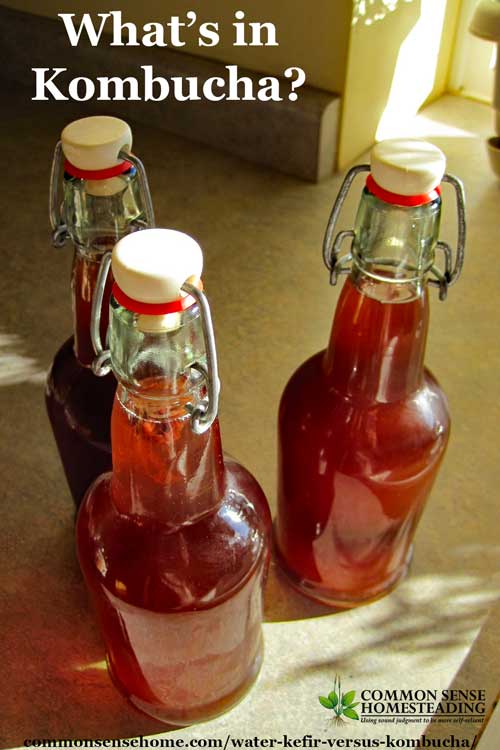
The Happy Herbalist contains links to a number of kombucha studies at http://www.happyherbalist.com/analysis_of_kombucha.htm. On this page, they state that the typical composition of kombucha may include:
Bacterium gluconicum
Bacterium xylinum
Acetobacter xylinum
Acetobacter xylinoides
Acetobacter Ketogenum
Saccharomycodes ludwigii
Saccharomycodes apiculatus
Schizosaccharomyces pombe
Zygosaccharomyes
Saccharomyces cerevisiae
Acetic acid
Acetoacetic acid
Benzoic acid
propenyl ester
Benzonitrile
Butanoic acid
Caffeine
Citric acid
Cyanocobalamin
Decanoic acid
Ethyl Acetate
Fructose
d-Gluconic acid
Glucose
Hexanoic acid
Itaconic acid
2-Keto-gluconic acid
5-Keto-gluconic acid
2-Keto-3-deoxy-gluconic Lactic acid
Niacinamide
Nicotinic acid
Pantothenic acid
Phenethyl Alcohol
Phenol, 4-ethyl
6-Phospho gluconate
Propionic acid
Octanoic acid
Oxalic acid
Riboflavin
d-Saccharic acid
(Glucaric acid)
Succinic acid
Thiamin
plus 40 other acid esters in trace amounts.
Cultures for Health Kombucha Discussion
Cultures for Health highlights key kombucha elements in their Q &A section:
Not all kombucha cultures will contain the exact same strains, but generally, these are some that you might expect:
Acetobacter: This is an aerobic (requiring oxygen) bacteria strain that produces acetic acid and gluconic acid. It is always found in kombucha. Acetobacter strains also build the scoby mushroom. Acetobacter xylinoides and acetobacter ketogenum are two strains that you might find in kombucha.
Saccharomyces: This includes a number of yeast strains that produce alcohol, and are the most common types of yeast found in kombucha. They can be aerobic or anaerobic (requires an oxygen-free environment). They include Saccharomycodes ludwigii, Saccharomycodes apiculatus, Schizosaccharomyces pombe, Zygosaccharomyes, and Saccharomyces cerevisiae.
Brettanomyces: Another type of yeast strain, either aerobic or anaerobic, that are commonly found in kombucha and produce alcohol or acetic acid.
Lactobacillus: A type of aerobic bacteria that is sometimes, but not always, found in kombucha. It produces lactic acid and slime.
Pediococcus: These anaerobic bacteria produce lactic acid and slime. They are sometimes, but not always, found in kombucha.
Gluconacetobacter kombuchae is an anaerobic bacteria that is unique to kombucha. It feeds on nitrogen that is found in tea, and produces acetic acid and gluconic acid as well as building the scoby mushroom.
Zygosaccharomyces kombuchaensis is a yeast strain that is unique to kombucha. It produces alcohol and carbonation as well as contributing to the mushroom body.
Kombucha also contains a variety of other nutrients, particularly various acids and esters that give the drink its characteristic tang and fizz. Included in these components is gluconic acid, which is the primary difference between the makeup of kombucha and the makeup of apple cider vinegar!

Now, water kefir:
What is Water Kefir?
Water Kefir is also known as Japanese Water Crystals, sugary-kefir grain (SKG), Sugary Fungus, Tibicos, Ginger Beer Plant, California Bees, Water Kefir Grains, tibetan mushroom grains, snow lotus, water crystals, tibi, Kephir, Paris, Kephir, kefir fungus, kefir d’aqua, and more.
From Yemoos Nourishing Cultures:
(Water kefir) is loaded with valuable enzymes, easily digestible sugars, beneficial acids, vitamins and minerals. Water kefir is also generally suitable for some diabetics (though personal discretion is advised). It also is a nice option if you are trying to avoid the caffeine present in kombucha, but still seeking a probiotic drink. Water kefir supplies your body with billions of healthy bacteria and yeast strains. Some store-bought probiotic foods or supplements can help, but they are not as potent, and do not contain the beneficial yeasts usually (just bacteria).
Within your body there are already billions of bacteria and yeast. Your internal microflora support proper digestion, synthesis of vitamins and minerals, and your immune system by warding off foreign and harmful bacteria, yeast and viruses. It has thus long been known to promote and aid in digestion and overall health. Some studies show it may be anti-mutagenic and help manage free radicals in the body. Folic acid (and B vitamins) increases as the length of the ferment increases. Some people let the strained kefir sit on the counter or the fridge another day to increase the folic acid and B vitamin content before drinking (this will increase the acidity too).
Kefir may also help reduce blood pressure and cholesterol. As with most things we’ve personally found, food and health is too difficult to reduce to facts and statistics. While kefir is not a magic bullet for health (what is) we believe kefir has a myriad of possible health benefits, and those will be individual for everyone. Some feel it helps them digest better, others get colds and viruses less often, some get more energy, and some people feel nothing much in particular, but enjoy the taste and value of it over store-bought yogurt, kombucha or kefir.
From Heal Thyself
Pat at Heal Thyself includes more information and a word of caution (she leans to the kefir side of the discussion):
Kombucha has Saccharomyces boulardii which displaces and replaces candida albicans in the gut. Candida binds mercury to keep it out of circulation. When you kill off candida in the gut, stored mercury is released back into circulation to redeposit into other organs and the brain.
Kefir does not do this similarly. Some people get GI symptoms if they start kefir too much too fast due to the microbial shift in the gut. Kefir has many beneficial microbials. You only need 1 tablespoon to equate to a whole bottle of probiotics.
So, water kefir is loaded with probiotics that colonize the entire digestive tract, doesn’t contain caffeine (although if you use continuous brewing, caffeine in kombucha can be significantly reduced), may help with free radicals and boost the immune system. It doesn’t produce a significant detox effect.
What’s in Water Kefir?
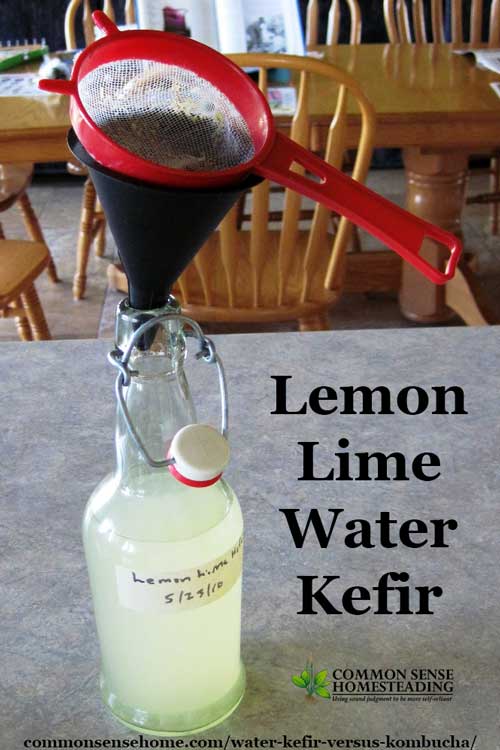
So what do you find in a typical glass of water kefir or kombucha?
Cultures for Health lists the following bacteria and yeasts as potentially occurring in water kefir:
Bacteria
Species Lactobacillus
L. acidophilus
L. alactosus
L. brevis
L. bulgaricus
L. casei subsp. casei
L. casei subsp. pseudoplantarum
L. casei subsp. rhamnosus
L. casei subsp. tolerans
L. coryneformis subsp. torquens
L. fructosus
L. hilgardii
L. homohiochi
L. plantarum
L. psuedoplantarum
L. reuterietc
L. yamanashiensis
Species Streptococcus
S. agalactiae
Sr. bovis
S. cremeris
S. faecalis
S. lactis
S. mutans
S. pneumoniae
S. pyogenes
S. salivarius
S. sanguinis
S. suis
S. viridans
Species Pediococcus
P. damnosus
Species Leuconostoc
L. mesenteroides
Species Bacillus
B. subtilis
B. graveolus
Yeast
Species Saccharomyces
S. bayanus
S. boullardii
S. cerevisiae
S. florentinus
S. pretoriensis
S. uvarum
Species Kloeckera
K. apiculata
Species Hansenula
H. yalbensis
Species Candida
C. gueretana
C. lamica
C. valida
Species Torulopsis
T. insconspicna
Basically, when you compare water kefir versus kombucha, it seems to me that water kefir acts primarily as a wide spectrum probiotic, whereas kombucha acts as a digestive aid, a probiotic and detoxifier.
Water Kefir Versus Kombucha – Which one do I prefer?
I think both are valuable, but if I only had to choose one I would probably stick to kombucha. Both of them simply help your body to do what it needs to do – they are not miracle cures. Some sites warn not to use both, so keep that in mind. It’s best to start with small doses until you body acclimates to the new inhabitants. I think it gets down to individual taste preference, and individual body chemistry. I encourage you to try both if you have the opportunity and see which works better for you.
Note: If you are dealing with candida overgrowth, note that ferments may contain candida species. Ferments may make some sensitive individuals worse, and some individuals better. Pay attention to how your body responds and adjust accordingly. Please check with your healthcare provider if you are on prescription medications, as fermented foods may affect how your medication is absorbed.
You may also enjoy:
- Healthy Homebrew – Kombucha – How to brew kombucha
- Kombucha Q and A and More Flavoring Ideas – More flavoring ideas and all the Q and A from the comments in a more readable format
- How to Make Coffee Kombucha – Using coffee instead of tea to brew kombucha
- Holiday Kombucha Flavors– Ideas for holiday flavor blends such as pumpkin spice and cranberry collins
- How to Brew and Flavor Water Kefir
- The Dark Side of Water Kefir – Root Beer Water Kefir
Originally posted in 2011, updated in 2017.
Thanks for the article! Wonderfully informative and well written. I make Jun, similar to kombucha but you use green tea and honey versus black tea and sugar. The Scoby has slightly different bacteria and yeast because of how it feeds off of the honey. If you ever wanted to switch from sugar to honey you would need to gradually add honey to your sugar otherwise your Scoby won’t digest the sugars properly. I have passed along extra Scobys to friends and have recommended that if the couldn’t do honey then start with ¾ cup honey to ¼ sugar, gradually getting to ½ & ½,and so in till completely switched over. Jun also produces a lot more yeast (which settles at the bottom) and has slightly higher alcohol content (hence why you don’t see it regularly sold in stores, except in maybe beer and wine stores).
Thanks for the tips on transitioning a scoby over to honey. I’ve read about Jun before, but have not tried it yet. It’s amazing to me how many kombucha products are now available in stores, though quality varies. Many have additional carbonation added, which I personally don’t prefer. I like a little natural carbonation, but excess carbonation doesn’t sit well in my stomach. Maybe at some point Jun will become more available, too.
Is water kefir can reduce allergies like itchy skin psoriasis etc? Is it good for liver problems.
It may help with both, but it depends. Every person is different.
The probiotics in kefir can potentially help restore gut health, which may in turn improve psoriasis. That said, some people react poorly to it, and in some cases you may need more than kefir.
When I had a bad psoriasis outbreak, I eventually figured out that mine was linked to candida overgrowth. I used diet, herbs, supplements and other lifestyle changes to get it under control. For a while I stopped using fermented foods and used probiotic pills instead, so I knew for sure that I was only dealing with specific strains of microbes. Now we are brewing again, and I enjoy in moderation.
More on the diet and supplements I used here – https://commonsensehome.com/anti-candida-anti-psoriasis-diet/
I didn’t find much research specifically linking kefir and the liver, but there was one mouse study that indicated the kefir improves NAFLD (non-alcoholic fatty liver disease).
“Kefir improves fatty liver syndrome by inhibiting the lipogenesis pathway in leptin-deficient ob/ob knockout mice.”
I’ve been consuming Jun kombucha and water kefir daily for a few months now. You mentioned that doing both is not recommended by some people. Can you explain why?
As I understand it, there’s some concern that it’ll basically turn your guts into a round of dueling banjos, probiotic style, if you overdo consumption of the different microbe families. A little is good, more is not necessarily better. Probiotic foods and beverages should complement your own gut microbes, not overwhelm them.
I’m confused. I had been doing fermented veggies, water kefir, and kombucha, but my functional medicine doctor said I was too acidic and took me off these and told me to eat only homemade yogurt. Does anyone know why? I thought fermented veggies and drinks were alkalizing?
Are you sure your doctor took you off because they were acid forming, or was there another reason? Everything I’ve read indicates fermented foods to be acidic before consumption, but alkalizing in the body. For example – http://bodyecology.com/articles/acidic-foods-and-acid-forming-foods-do-you-know-the-difference
If you have candida, home fermented foods might be limited, especially kombucha, because kombucha may contain candida yeast. You can learn more about candida at Candida – Missing Link to Healing Psoriasis and Other Illness.
I have seen that kombucha and water kefir may contain cyanocobalamin —B12. Isn’t this incorrect? Shouldn’t it be methylcobalamin as cyanocobalamin is man made? Or is it a misnomer – much like calling all gelatin “Jello?”
I’m not familiar with all the science of the fermentation, but in the comments of the article “Which type of vitamin B12 is best–cyanocobalamin, methylcobalamin, or hydroxycobalamin?”, there’s a discussion of how cyanocobalamin is produced:
So perhaps the Cyanocobalamin is produced by the yeast of the scoby during the fermentation process? I’m really not sure and don’t have a lab to test.
Wait, whaaat? Kefir commonly contains Streptococcus pyogenes? That’s freaking me out a little. Ok… a LOT. Like a lot, a lot.
Well, this makes me feel a little bit better:
http://www.ncbi.nlm.nih.gov/pubmed/15848295
“Potentially”, not necessarily commonly, but apparently the mix keeps it all in check, as we’ve never had any issues with strep infections while consuming kefir.
Toxic shock syndrome just scares the bejeezus out of me. Always has. And yeah…. I know that contaminants from the GI tract *shouldn’t* wind up in the vaginal canal…. and yet they sometimes do (hence vaginal yeast infections). I don’t know. I really want to try kefir, so I’ll probably just do it anyway. 🙂
I suspect most yeast infections have as much to do with a compromised immune system and/or off kilter body chemistry as they do with opportunistic bacteria, since not everyone who has fecal contact with their vagina area ends up with a yeast infection.
Kombucha can fuel candida
Hey, Sam. That’s something I’ve been looking into lately also. I loooove kombucha, but have recently discovered that I have a candida overgrowth issue and have given up the “booch.” It makes me sad. I’m hoping that maybe water kefir will be a healthy alternative, but still doing some research on that also.
I have not made either kefir or kombucha but I did purchase kombucha @ my co-op. I thought – green tea/ginger. How could this be wrong. Oh it was so wrong. I could not drink it. I had not had kombucha before so not sure what I was expecting but it sure was not what came out of that bottle. I asked at the co-op and several of the volunteers loved that brand so it isn’t the brand or even the flavor – just me. So I thought I would like to try water kefir as I don’t eat dairy due to intolerance. Have not been able to find a water kefir to purchase so will need to buy the grains and try it myself. That being said, I do ferment my own sauerkraut and other fermented foods for the probiotics and love fermenting.
Thanks for a wonderful post.
There’s a huge variation of flavors possible with kombucha, so don’t give up on it entirely. I tried a few really awful purchased ones before I started brewing my own.
Thanks for your comment.
Can you give a link for more info on why kombucha isn’t good when nursing? Or for people with metal fillings? I’ve seen it on several posts around the net, but haven’t seen why. Thanks!
Here’s a good article from Kombucha Kamp on kombucha consumption while pregnant or nursing – http://www.kombuchakamp.com/2011/06/kombucha-tea-pregnancy-safety-probiotics-fermented-foods.html
Here’s a reasonable discussion of some of the potential issues with kombucha and amalgam fillings – http://www.mothering.com/community/t/1247669/kombucha-causing-headaches
Hello, and thanks for a great read. I’ve started my first batch of Kombucha a week ago….tastes very high in vinegar. I didn’t have starter tea (well i did but my jar tipped and emptied!!) so made a mix of passionfruit green tea brewed in R/O remineralized water, organic cane sugar and added vinegar. My SCOBY is growing well but the Kombucha is a really strong vinegar taste. Do you have a basic starter tea recipe that you don’t mind sharing? Or does the second ferment with fruit really help? I’m thinking ginger peach….
Today I purchased water kefir grains as well. I’m particularly excited to try this as its a quick process. I used organic peach in one jar and organic cherries in another jar. I included a tiny amount of unsulphered molasses to keep the grains working….and organic cane sugar, of course! I’m wondering, can water kefir grain go towards milk kefir? I look forward to hearing back from you 🙂
Kombucha tastes too much like vinegar = too long ferment. If it’s warm, the fermentation process will be accelerated. You can start tasting after a few days and see when the flavor is right for you. The basic tea recipe is 1 quart water, 1/4 cup sugar and 1 tablespoon (or two tea bags) or tea. There are links at the bottom of the post to more detailed instructions.
You can salvage a batch of kombucha that has gone too acidic by adding some freshly brewed starter tea when you bottle. The flavor won’t be the same, but it will be more palatable. A second ferment with flavorings will help some, but not as much as fresh tea.
I usually ferment my water kefir with only sugar water and mineral drops to start, and then add fruit or juice for the second ferment.
Sometimes water kefir grains can be successfully adapted to milk kefir, sometimes not. It depends on you particular kefir strain. Using grains that have been grown in the medium of choice produces more reliable results.
I don’t think water and milk kefir grains are the same. They look very different. I use both.
Milk kefir is my favorite. It’s very easy to find grains on the internet. I have a glass morning and night and use it in fruit smoothies. Love it!
Acidity & Tongue
I’ve been brewing for a 3 months now (kt & water kefir) and find that, while I LOVE it!!!!, the acid is burning my tongue. I’ve cut it almost all out this week (noticing the gut difference seems happier when drinking it), and my tongue is slowly healing, but not there yet.
My guess is that it’s either the actual drinking of the acidic drink (kombucha), or it is coming back as acid reflux while I sleep, or my body is getting too acidic.
So my tongue feels burnt, all the time now. How can this acid be good for the inside of my body? Do you water your’s down? I’m torn, because my tongue feels this way for a few weeks now.
Anyone else have this?
(KT brew: black and/or green tea. …7-8 days. or 14 days (but that is way vinegary) 2nd fermentation 2-3 days, …usually with ginger, passion fruit, raspberries, blueberries, pineapple… refrigerate)
(water kefir brew: 1-2 days. Refrigerate)
Are you on any medication? That and other factors influence how your body will react to the kombucha. A burning mouth is something I would try to avoid. In warmer temperatures, the fermenting will progress much faster, and you may need to shorten your fermentation times and/or reduce the amount you are drinking. In hot temps 3-4 days primary ferment with 1 or even a half day 2nd ferment may be plenty of time. I drink less if it is stronger, or add some unfermented sweetened tea to cut it.
Pineapple can do that, due to the strong enzymes in it.
Thanks so much for spelling it out. I just ordered my water kefir grains, and my coworker’s gonna make kombucha. We’ll see who gets healthier, haha.
I personally wanted to avoid the potential caffeine of kombucha, & didn’t love the idea of loose mercury floating around because I lacked candida all of a sudden. Even if it’s “just” a probiotic, and isn’t the detoxifier and digestive aid that the kombuchu is!
PS I never knew, candida can be a good thing, in that it binds with mercury?!
Crazy, isn’t it? Our bodies are very complex.
There does not have to be caffeine in Kombucha. I almost always use an herbal tea blend for my base and then use maple syrup for the sugar. I get great results and haven’t had an issue with my SCOBY. I have been doing it this way for more than 6 months now.
I also remember reading an article one time when the author said they noticed a thin film on top of their Kefir, so they saved them up and were able to make a batch of Kefir just a good as with the grains.
I wonder if the major difference between the two is the aerobic vs anaerobic fermentation process and that one has a tea base while the other is usually a water base.
I find that I have to boil(not just wash in hot water) my jars and equipment for kombucha else I get fuzzies (probably a form of mold.) Does anyone else have trouble making their kombucha?
Also, I looked everywhere for a SCOBY before I found they can be made from kombucha from the grocery. Is there a tip for finding the crystals for making water kefir?
That’s interesting. I just wash like normal dishes and air dry thoroughly. My bottles I either set on the back of the stove or in a sunny window to make sure they dry completely. What part of the country are you in? I’m in Wisconsin, so may have different conditions.
I haven’t seen anything about growing your own kefir grains.
So, I got a scoby from a friend last month and have been thoroughly enjoying a half cup or so (mixed with juice) each day and although being 6 months pregnant have a ton of energy- so now I am nervous- should I cut down or cut out kombucha until after I am done nursing. I really love it, and have been making milk kefir (a bit, I am casein allergic, but can tolerate a little) and just today started water kefir. I am loving all these but am a bit uncertain about continuing the kombucha. Thanks for your input!
I am not a doctor or trained health professional, but I think in small amounts the kombucha should be fine.