
Purslane – One of the Most Nutritious Plants in the Garden

This post may contain affiliate links. Read my full disclosure here.

Did you know that a “weed” may be one of the most nutritious and useful plants in your garden? We’ll share the health benefits of purslane for food and medicine, plus how to use is as a companion plant in the garden.
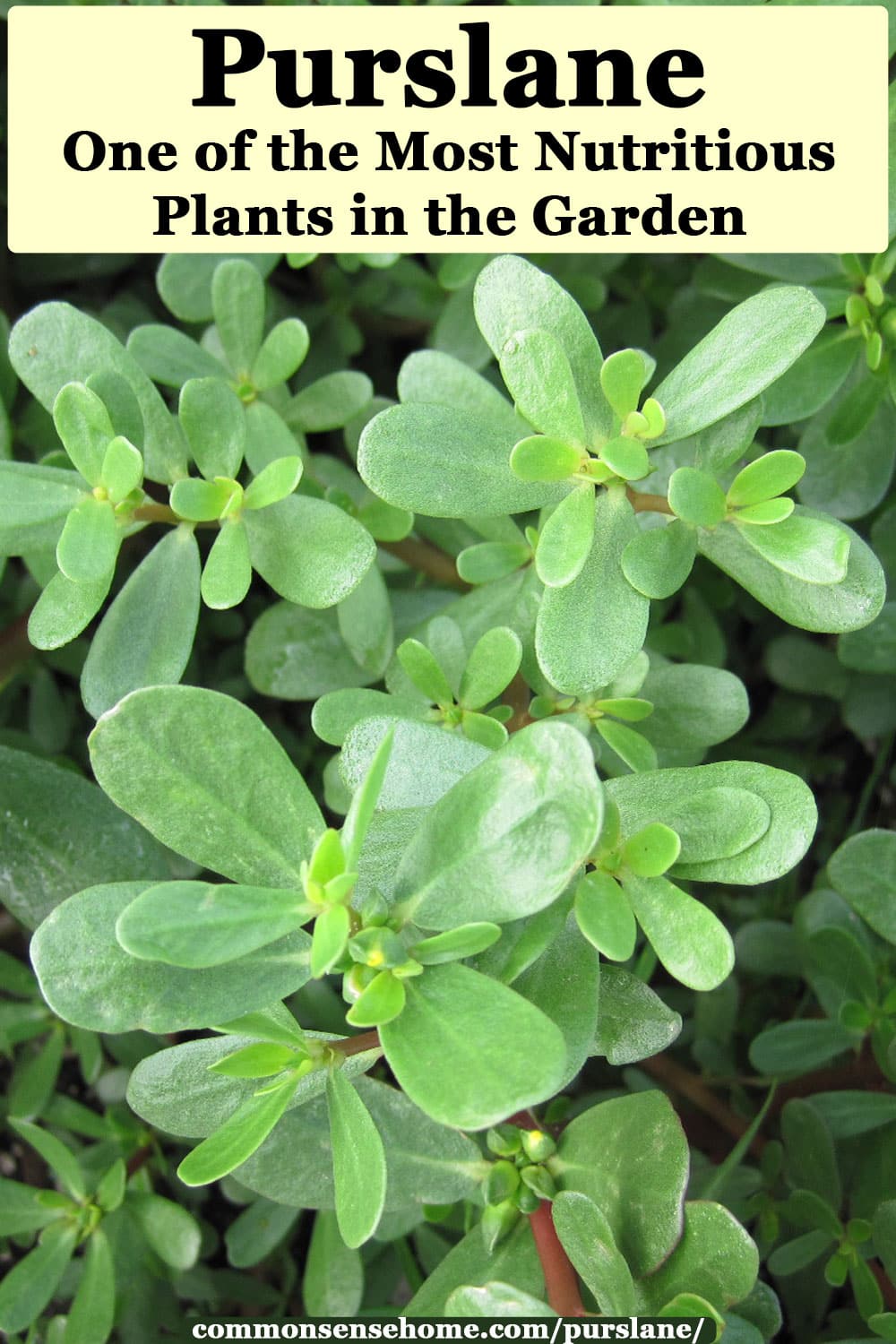
Common purslane (Portulaca oleracea) is also known as Verdolaga, Pigweed, Little Hogweed, Pusley, Rigla, Pourpier, pussly, and “rose moss or moss roses”.
Note: Portulaca oleracea bears a slight resemblance to hairy stemmed spurge (Euphorbia vermiculata), which is poisonous. Spurge stems are hairy, not smooth, and it has white sap.
Where to Find Purslane
Native to India and the Middle East, purslane now grows around the world, including the United States.
Purslane grows in gardens and disturbed areas in soils deficient in calcium and phosphate. (Source: Building Soils Naturally.) If you can’t find it in your yard, you can order seeds online or try your local farmers market.
It needs heat to germinate, so summer is the season for growth. As a succulent, it prefers full sun and also tolerates drought.
Leaves and Stems
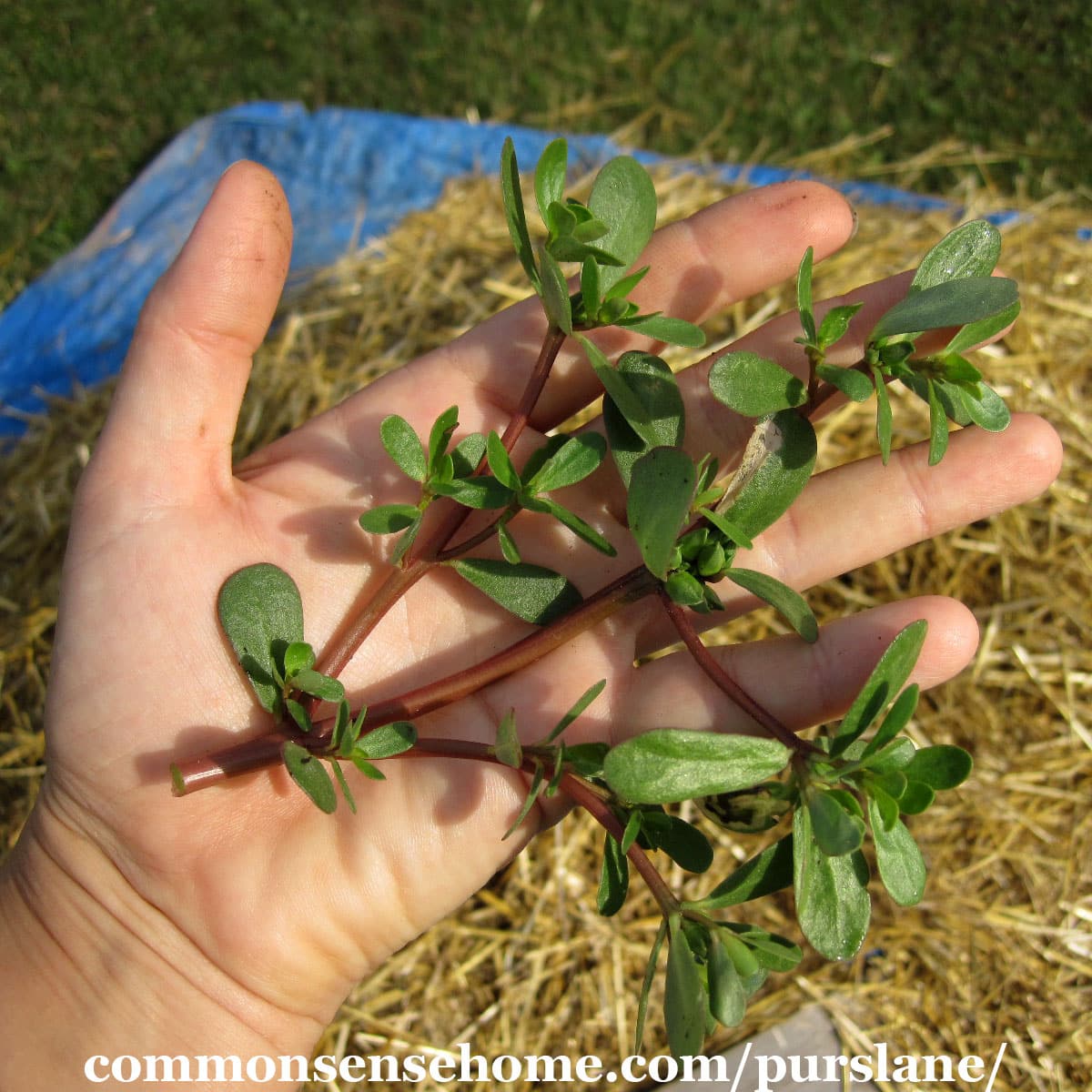
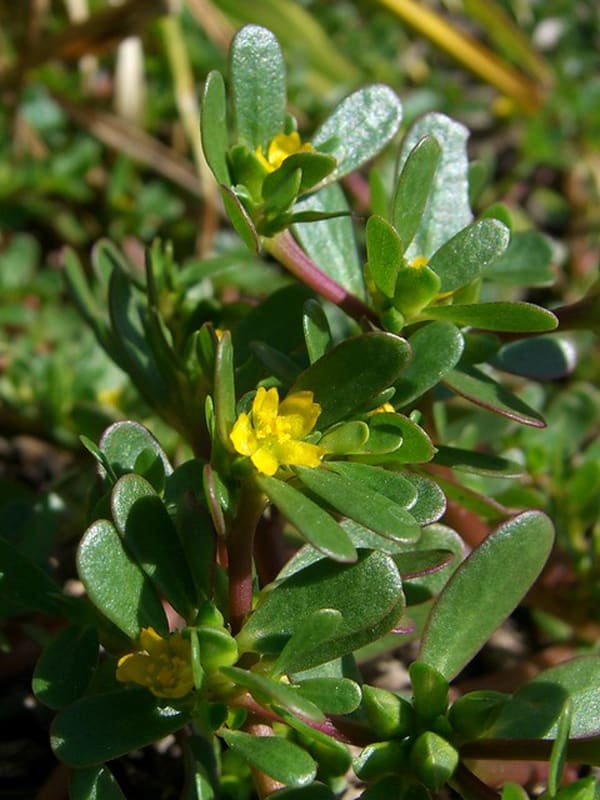
The leaves are paddle shaped, broad and flat, with thick red stems. They are about the size of a fingertip or smaller.
It grows low to the ground, forming a living mat of groundcover. Individual plants may spread up to two feet across.
Flowers
The yellow flowers of purslane occur singly at leaf axils or stem tips. They have five petals, and open only on sunny mornings.
Seeds
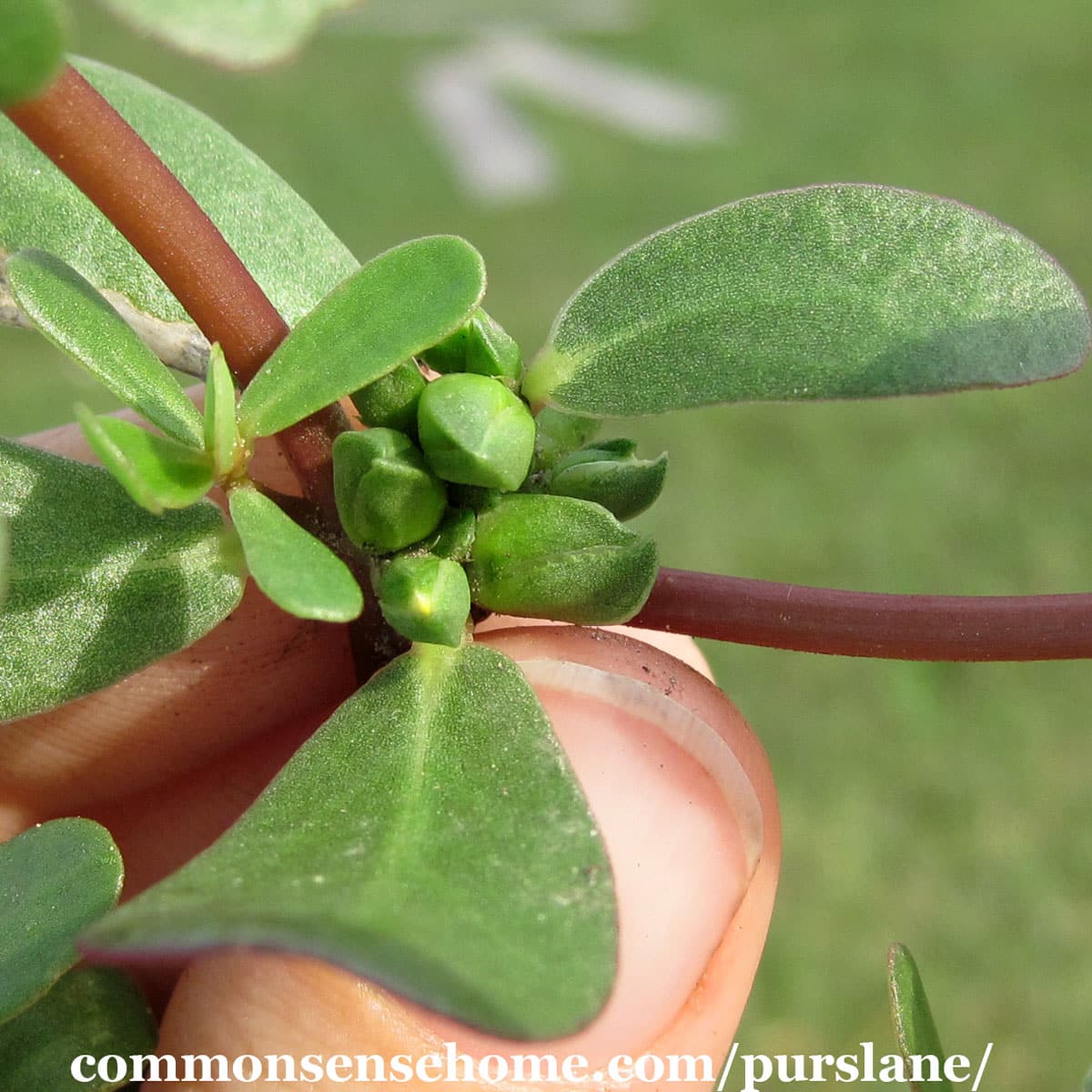
Portulaca oleracea is an annual, and produces up to 200,000 seeds per plant in as little as 40 days. The tiny, black seeds are scattered throughout the plant in small capsules that resemble flower buds.
What Part of Purslane is Edible?
Purslane leaves, flowers, stems and seeds are edible. Eat it when young, as the stems toughen with age. It has a mild sour and salty taste that blends well in most salads.
Cooked purslane is mucilaginous, like okra. Don’t overcook, or it may get a slimy texture. Purslane seeds can be ground into flour or boiled and made into porridge.
Try the young leaves and stems in juice blends, salads, stir fries, soups and regional dishes.
Nutrition
Purslane is a rich source of magnesium, calcium, iron, riboflavin, potassium, phosphorous and manganese. (See USDA food data)
It’s very high in vitamins A, C and E. It’s also a source of omega-3 fatty acids, with 300-400 mg per cup, and has more beta carotene than carrots (seven times more).
It does have fairly high levels of oxalic acid, so it’s best not to consume in large quantities daily.
Always exercise caution when using any wild plants and make sure you have positively identified the plant.
This cucumber purslane yogurt salad plays with the flavors of tzatziki. The yogurt reduces the amount of oxylates, improving digestion.
Cucumber Purslane Yogurt salad
5 large cucumber, peeled, seeded and cut into quarter-round slices
1/4 pound purslane, large stems removed, washed and drained well
2 tablespoons each, fresh chopped mint, cilantro and chervil
4 cups whole milk yogurt
1/4 cup virgin olive oil
3 cloves garlic, finely chopped
2 teaspoon ground coriander
kosher salt and ground black pepper, to taste
Place the cucumber, purslane and herbs into a large bowl. In another bowl, stir together the yogurt, olive oil and garlic, coriander, and season to taste with salt.
Would you like to save this?
Add the yogurt mixture to the vegetables and mix well. Add a pinch of ground black pepper. Taste the dressed salad for seasoning, adding a little more salt if needed. Serve chilled.
Food for Animals
A variety of wildlife enjoy purslane. Pollinators visit the flowers, birds and rodents eat the seeds, and herbivores munch on the leaves.
It’s is safe for livestock, such as chickens, as part of a mixed diet. A “purslane only” diet can be toxic due to the oxalic acid content.
Someone tried to raise goats exclusively on purslane and killed them. You can have too much of a good thing.
Health Benefits of Purslane
The study: “Purslane Weed (Portulaca oleracea): A Prospective Plant Source of Nutrition, Omega-3 Fatty Acid, and Antioxidant Attributes” notes that purslane:
- may offer protection against heart disease, cancers, and a number of chronic diseases and conditions throughout the human life.
- is a very good source of alpha-linolenic acid – 5 times more than spinach. Alpha-linolenic is an omega-3 fatty acid which plays an important role in human growth and development and in preventing diseases.
- is rich in vitamin A, which is a natural antioxidant. It can play role in vision healthy mucus membranes and to protect from lung and oral cavity cancer. Purslane contains the highest content of vitamin A among green leafy vegetables.
Drugs.com states that no contraindications have been identified.
This site is for general informational only, and it not meant to replace the advice of a healthcare provider.
Purslane as a Companion Plant
In the book, “Weeds: Guardians of the Soil“, the author talked about how the corn grew better where the purslane and poorly where there was no purslane.
This led me to try it as a regular companion plant in the garden. When it volunteers, I let it spread between garden plants to protect the soil.
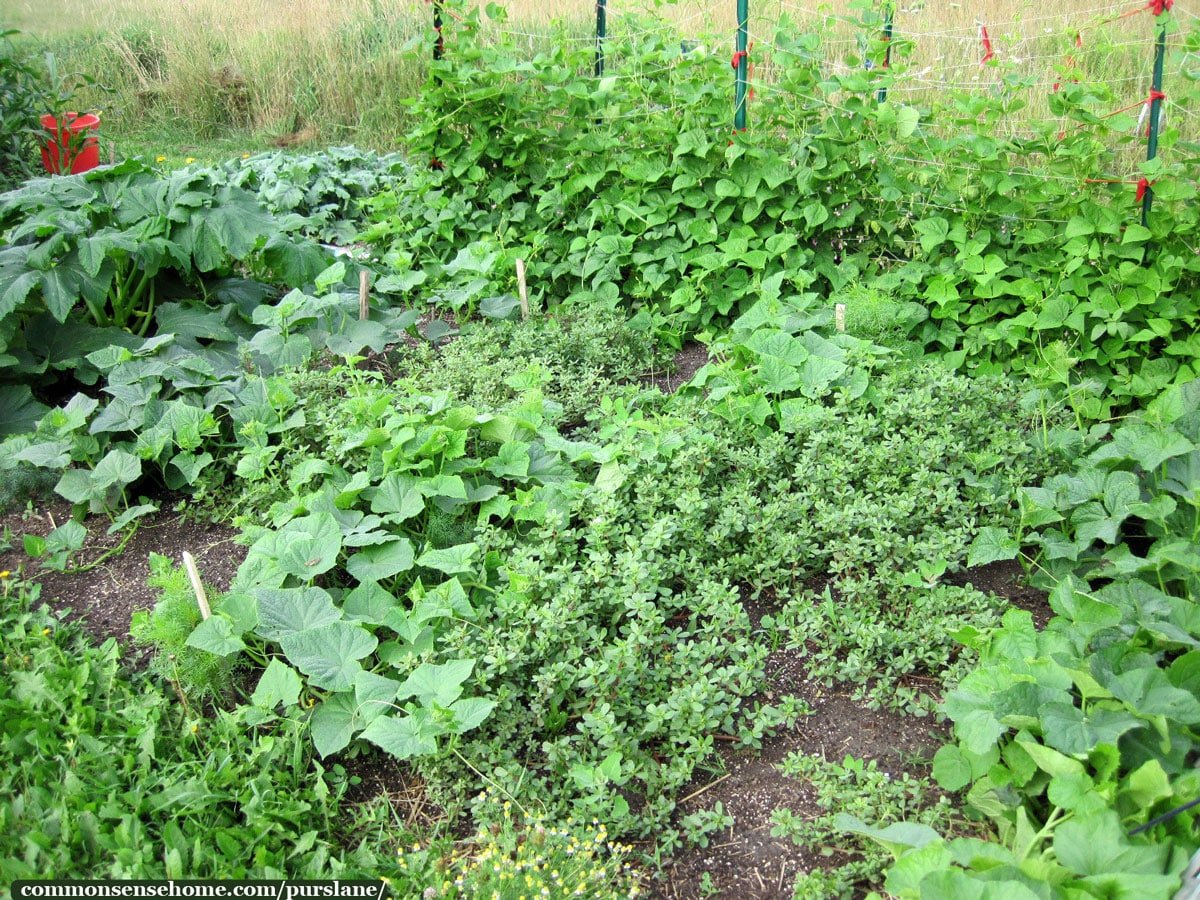
Vine crops like cucumbers crawl over the top of it. Taller crops like corn or peppers eventually shade it out. It’s easy to trim or pull as needed.
Once you pull a plant, seeds continue to ripen. Plant segments may also grow new roots. If you want to get rid of it, pull it before it gets to seed stage.
How to Get Rid of Purslane
It’s been brought to my attention that not everyone appreciates purslane as much as we do. Specifically, some folks are upset about purslane taking over the garden.
In our garden, we used to have purslane all over, which prompted me to use it as a companion plant. Now, I only get a few plants here and there.
What changed?
The garden is still in the same location, and the seeds can hang out for years in the soil waiting to grow.
The difference is in the soil.
In the book, “Weeds: Control Without Poisons“, the author notes that, “Calcium and phosphate levels are always low in purslane territory.”
He gets into further discussion about cation balance, and an excess of potassium and magnesium. Purslane like dry soils, too, and recent years have been wet. Finally, compacted soils can also increase the problem.
Add some gypsum to your garden for calcium, and rock phosphate for phosphate. Use compost and other organic materials to build the soil. Over time, your purslane problems will disappear.
Learn to Use Your Weeds
This post is #28 in the Weekly Weeder series, which is devoted to helping you use and manage wild plants.
Other posts in the series include:
Recommended Wildcrafting Reference Books – Weekly Weeder #1
Stinging Nettle – One of Most Useful Wild Plants – Weekly Weeder #16
Marvelous Milkweed – Answers to 21 Common Questions About this Useful Plant – Weekly Weeder #10
Originally published in 2012, last updated in 2020.
Good day
I thoroughly enjoy all the info shared – we bought a small holding in Calvinia Northern Highlands South Africa and we have allot of lambs, qaurers ,mallow purslane ect so I am learning how to work with all the above that we a so blessed with because no seeds where planted it all just came up. Looking forward to all your emails Chantel Bosch
Excellent information. Thank you. This stuff grew in my yard for years and I could not kill it. Then finally I cover it with plastic. And it was gone. Saw it at the farmer’s market… couldn’t believe it. Then eventually hear it was good for the body. Now with all the rain, that old patch has come back. I’m giving it another chance. Thanks again.
Seeds of wild plants generally last for decades in the soil, waiting for the right conditions. Glad you can put it to use this time around.
Thanks for the info. It grows plentifully up here in North Idaho. I considered it a nuisance but now I’ll start adding it to salads!
It can be a nuisance when it tries to take over everything, but probably managed, it’s a useful part of the garden.
I have had small amounts of purslane in my gardens at different locations throughout the years in KY and now in southern Indiana. It’ a beautiful plant and I like watching it grow, so I usually let it be. This year has been very hot and dry early on and my 12′ x 70′ garden is covered in it! Thank you for the very informative article, we will be eating some tomorrow night!
I can tell you how many years I spent trying to irradicate this weed from my harden then last year I discovered it’s nutritional benefits and am now planting it.
It is so easy to plant, all you need it one section of a leave and viola, a plant.
If it ever tries taking over your garden, adding calcium and phosphate to the soil will help keep it in check. You can learn more about nutrient sources in the post https://commonsensehome.com/organic-fertilizer/
Hi Laura,
Do you have any idea where I might be able to buy purslane seeds? I know that may sound rediculous since it is such a “common” weed. In fact, I’ve probably picked bushels of these “weeds” in my lifetime.
However, it is not something I’ve seen here in my backyard in Texas and would love to plant some in my container gardens this year.
Thanks,
Hi Suzanne.
Did you see the highlighted text in the post that says “buy seeds”? That’s an amazon link to buy purslane seeds. This is the short link – https://amzn.to/2PSbExN
The little display ad right below that text (assuming you don’t have an adblocker running) also offers a “Buy Now” button and displays the current price.
We used to have more purslane volunteer in the garden, but as the soil improves, it shows up less.
Is there any market for this? I left it to grow this year & have an overabundance! Even with it taking over my garden, everything is growing great. The only exception is carrots. I’ve sown different seeds twice & nothing is sprouting.???? ????
In some areas they sell it as a gourmet salad green. I think you’d need to educate customers on how to use it, because most people are reluctant to try unusual foods.
Carrots can be fussy germinators, and the seed doesn’t last long in storage. You can check out more carrot growing tips here – https://commonsensehome.com/growing-carrots/
Yes, there is a market for it. A family friend regularly ate purslane salads in London restaurants. Maybe you could find a local restaurant to supply?
Purslane, is it the same as spurge? I am learning what is in my area. Moved here 2 years ago.
No. There are a number of different spurge species, but purslane isn’t one of them. Plants in the spurge family have milky white sap, more like milkweed. Purslane has clear, slippery sap.
It is my understanding spurge is toxic, not edible.
Spurge is often mistaken for Purslane, as it will grow in the same places and looks similar to the untrained eye.
Prostrate spurge (Euphorbia maculata) somewhat resembles purslane, but it’s toxic—it won’t kill you, but it can make you ill.
Spurge has a similar growing pattern (low on the ground). But the leaves are thinner and smaller, and sometimes they have a spot of reddish coloring at the center of the leaf. The stems of the spurge are hairy and the flowers look different.
The foolproof way to differentiate between the two is by breaking a stem. The stem of the spurge oozes a milky white sap, as has been said above. If there is white sap, it is not purslane!
I have let select purslane weeds grow in areas near things like my peppers. It acts as a shade cover to the soil here in the desert. lol… I know I really have gotten behind in my watering when the PURSLANE is folding it’s leaves up to protect it from the sun. It also protects the soil from wind erosion. I like to have communities of at least 5 plants or so in every garden bed. Purslane is a filler for me. This year, it’s peppers, pole beans, basil, a zucchini, a rosemary, a few Mexican Feather Grass (weedy but beautiful volunteers), Pineapple Sage, and the purslane (4 X 15 foot row). That’s a Summer Community in a desert environ. Last Winter, I let two Lambsquarter (sometimes also called pigweed or goosefoot?) grow with potatoes, mustard greens, alyssum flowers, iceland poppies, and a wildflower for Monarch butterflies (forgot it’s name) (4 X 12 foot row). And yes, late in the growing season even a few purslane showed up. (I successfully grew potatoes this year: Jan to May harvest in S. Calif desert) I just love allowing nature to fill the tiny vacancies in my soil so that life abounds everywhere. It creates a fuller food web that not only feeds me; but also the critters (my hens nibble on both ‘weeds’), and even wildlife (reptile and mammalian), and the pollinators. It works for me. Happy Gardening!
That’s great! Most “experts” talk about weeds “stealing nutrients”, but I’ve found, as you have, they often make great companion plants and ground covers. My garden is “messy”, but it’s productive. 🙂
I use to see purslane, chickweed, and plantain everywhere, couldn’t walk along the roadside without seeing these “weeds”. Back then I just saw them as worthless weeds. But now I see them in a different light. Thanks for the great article.
Thanks for the comment. They have gone from “just weeds” to “old friends” for me.
Ahh.. I love purslane! Back in turkey there is two types, wild and cultivated. Cultivated ones are sold in bunches in farmers market through out the summer. But the wild ones are much more delicious. We usually cook it with tomato and add a little bit rice or bulgur wheat. One of my friends send me some seeds and my attempts yielded only one plant! And that fell victim to some termites excavating soil from their pot. It is good to know that seeds are ripening even after post-mortem (for a lack of better word) I still keep the plant which was about to bolt.
Interesting to see what I used to be allergic to. I went thru 5 years of immunotherapy because of that little plant.
Wendy – just purslane, or a variety of plants? I didn’t come across anything indicating it was prone to cause allergic reactions, but everyone is different. If there’s a particular component of it that causes troubles, I’d appreciate it if you’d leave a note and let me know so i can add that to the post to warn people.
Also severely allergic to purslane. I ate it as a kid and I was fine. But I found out two years ago I was allergic. Since then, I took a bite of purslane salads without realizing (it was covered in yogurt) and turned bright red / broke out in hives.
I have a chronic bronchial asthma (COPD). For the first time I ate raw purslane mixed with my food in the evening/ My breathing became shallow and difficult soon after and kept me awake for six hours before I could lie down and get to sleep. My albuteral nebulizer and rescue inhalers didn’t give as much relief as they normally do. I like the idea of eating the purslane but don’t want to chance another exacerbation of this problem. I am 90 years old but in good physical shape. Any input, suggestions, etc?
It is possible that the purslane you are could have been contaminated with some type of spray? I’ve never heard of an allergic reaction to purslane in texts, but anything is possible. You could try eating some form another source earlier in the day, but the safest option would be to avoid it.
Thanks Laurie,
I don’t use any chemicals in my garden and it’s likely that the purslane wasn’t the cause.
It would probably be best to avoid it if you had a severe reaction. Breathing is important.
Wow! I had one of these pop up in a container of mine, and I never pulled it because I thought it was rather interesting looking – now I finally know what it is! Thanks!