
Lambs Quarters – Wild “Spinach” that Tolerates Hot Weather

This post may contain affiliate links. Read my full disclosure here.
What if I told you there were wild greens that you can use like spinach, which are even more nutritious than spinach, and you can get them for free? Lambs Quarters (Chenopodium album) is a favorite wild food because it’s easy to identify, harvest, and use.
Would you like to save this?
We’ll share tips for identification and how to use it. If you have trouble with it taking over your garden, we have help for that, too.
Lambs Quarters is also known as pitseed, white goosefoot, goosefoot, pig weed, wild spinach, fat hen, bathua, and huauzontle. It is alternately spelled as lambsquarters or lamb’s quarter.
Is lambs quarter the same as pigweed?
Maybe – it all depends on which pigweed you’re talking about. Some people do call lambs quarter pigweed, but it’s not the only pigweed. This is why including scientific names is important.
Redroot pigweed (Amaranthus retroflexus) is another common weed in my garden also known as pigweed. It’s related to amaranth.
The article “Pigweed Identification (a quick guide)” gives details about five different plants also known as pigweed.
Where is Lambs Quarters found?
Lambs quarters is found throughout North America and around the globe, except for arctic regions. You can find it along roadsides, in fields, and in home gardens.
It likes some warmth, so look for the plants after the danger of frost has passed.
There are over 100 related species in the genus Chenopodium, all of which are edible in some form.
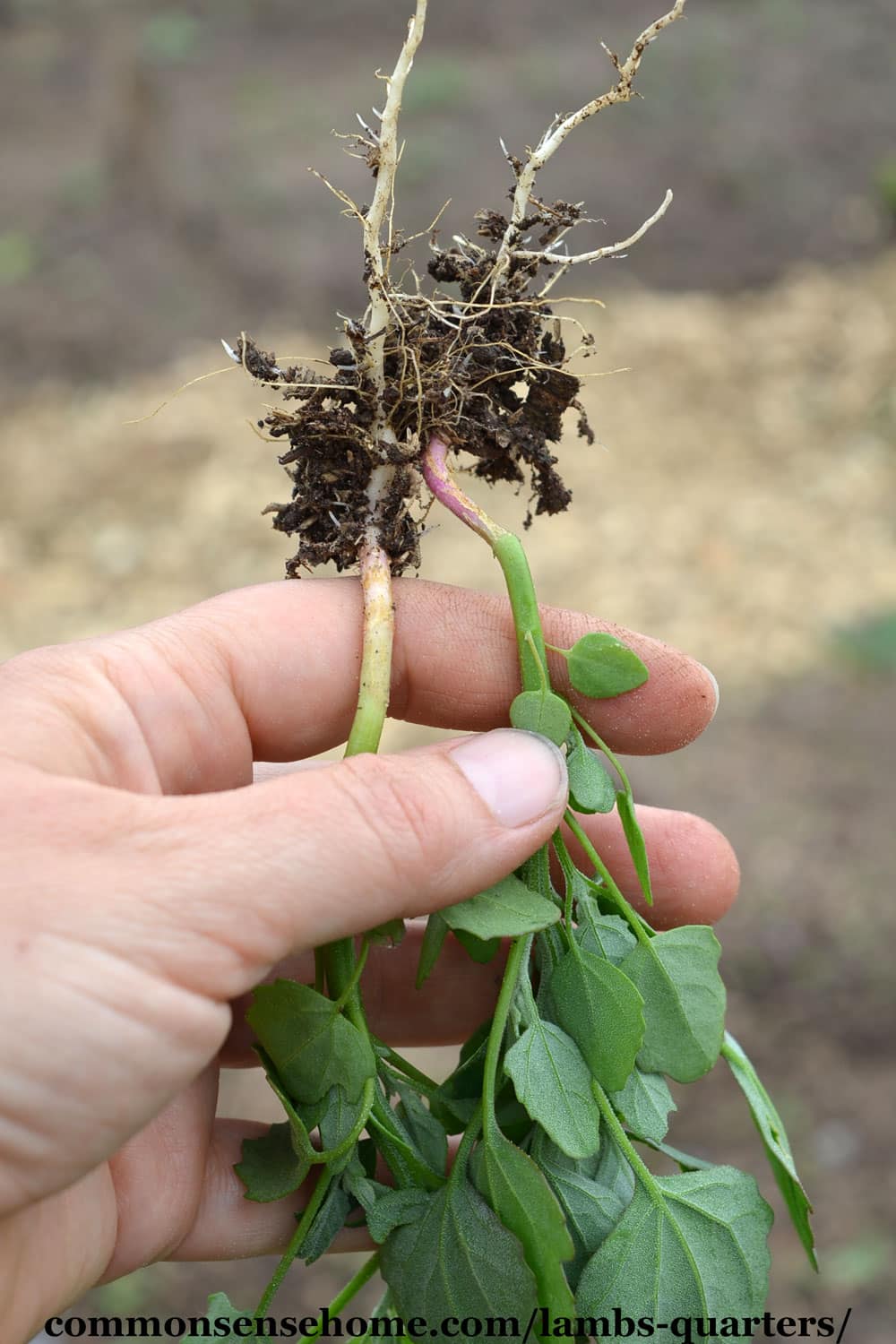
Lambs quarters loves rich soil, spreading thick and green, but it also grows in rough soil conditions. The deep tap root pulls up nutrients, making it an excellent green manure crop.
Identification
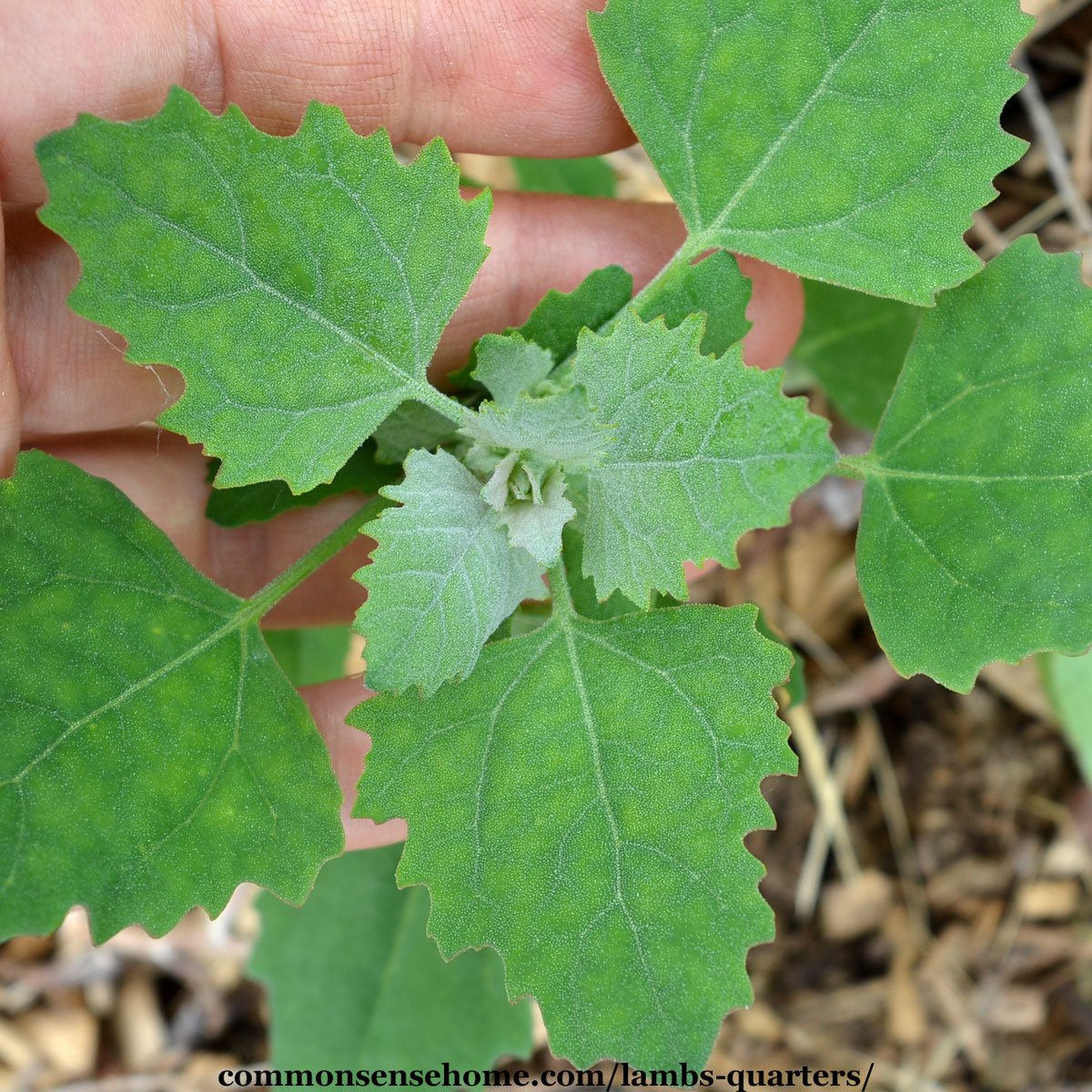
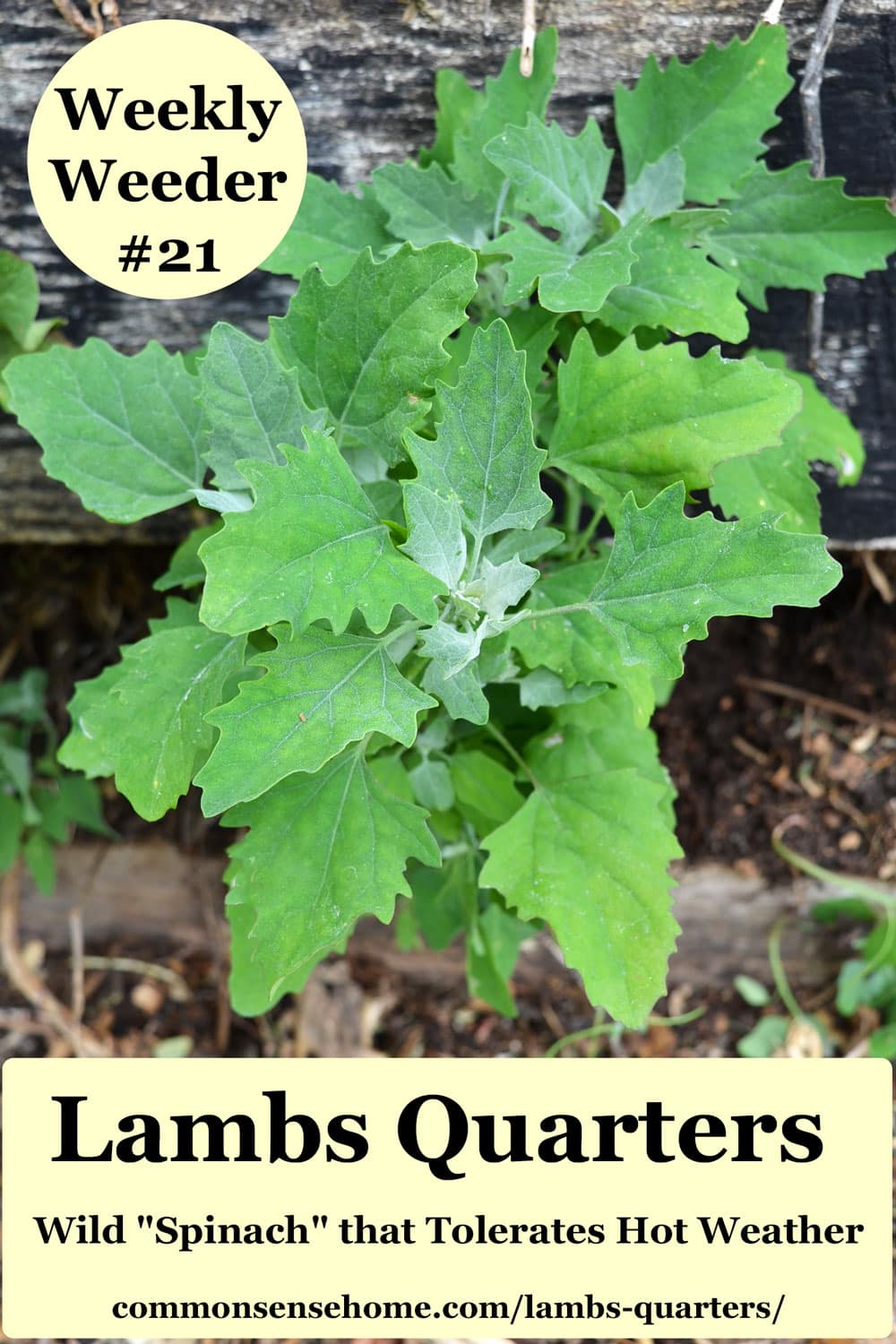
The plants can grow up to 7 feet tall, although 3-5 feet is typical. In my garden, they like to bush out and grow shorter. Stems often have a reddish tint, especially near the leaf joints.
Leaves alternate up the stalk, and are up to 4 inches long. They are lobed farther down on the plant and more lancelike towards the tip.
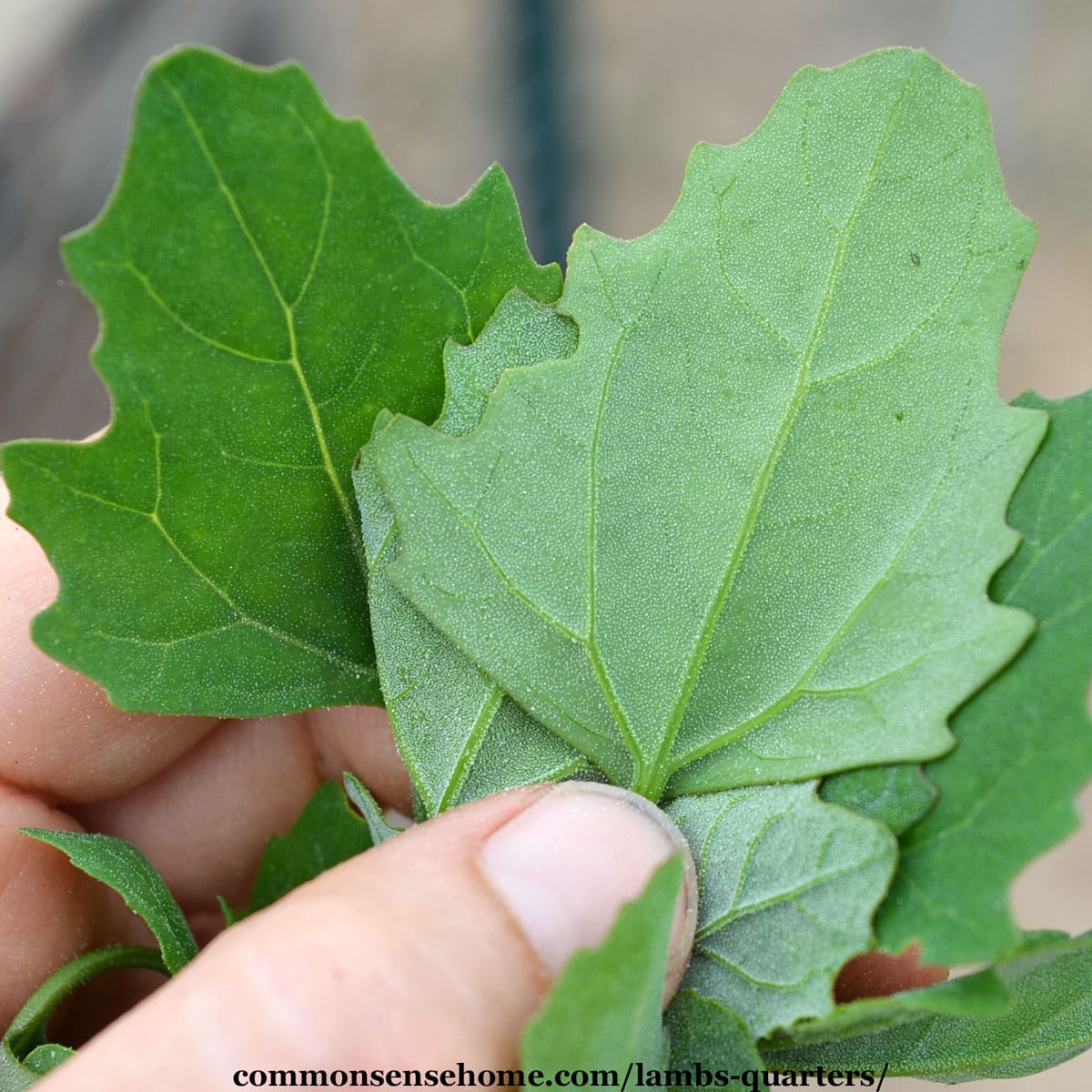
You’ll notice a white coating, especially on the young leaves and under sides of mature leaves. This is a natural mineral accumulation.
Flowers are small and green, and cluster at the growing tip of the plant. The seeds are small and round, either brown or black.
The plant is an annual, sprouting from seeds each year. A single plant produces of 75,000 seeds, so remove them before they seed out if you don’t want a lambs quarter patch.
I recommend reading The Forager’s Harvest for more detailed descriptions of different varieties and related species.
How to Cook Lambs Quarters
Lambs quarters has a long history of cultivation for its leaves and as pseudograin (grain-like plant). It’s related to quinoa and kaniwa.
Lambsquarter Greens
What does lambs quarters taste like?
Lambs quarters taste similar to spinach – except unlike spinach, they don’t bolt in the summer heat.
1 cup of lambsquarter greens contains about 73% of the recommended daily allowance of vitamin A and 96% of the RDA of vitamin C. It’s also high in iron and B vitamins, including thiamine, riboflavin, and niacin, and has over 600 mg of calcium.
Some people experience mild tongue irritation from the silvery powder that covers the leaves. I suggest trying a small sample the first time you eat them. Cooking usually eliminates this reaction.
The young shoots and top leaves of older plants are the most tender. Harvest leaves before the plant flowers, pinching off tops of older plants or gathering young plants whole.
Eat the leaves raw as a salad green, or cooked. Use the leaves like you would use spinach or other greens.
Try them:
- Steamed
- Stir-fried
- Sauteed
- As part of green juice blends
- In omelets, quiche or lasagna
- As a wild edible pesto blend with garlic mustard or purslane
You may also enjoy this recipe for Goosefoot (Lambs Quarters) Pie.
Store lambs quarter leaves by pressure canning, drying, or blanching and freezing.
A Word of Caution About High Levels of Oxalic Acid
In Healing Wise, Susun Weed states:
The goosefoot family (cheno is goose, pod is foot) includes lambs quarters, quinoa, spinach, red beets, sugar beets, and Swiss chard (silver beet).
Lambs quarter seeds are totally safe to eat, but there are two cautions to keep in mind when eating lambs quarter leaves.
All edible plants in this family — including spinach and chard — concentrate oxalic acid in the leaves. And oxalic acid can interfere with calcium utilization unless eating with a good source of calcium, such as cheese or yogurt, at the same meal.
Katrina Blair notes in The Wild Wisdom of Weeds that the natural calcium in lambs quarters may be enough to compensate, but advises caution when using older plants.
Seeds and Roots
Lambs quarters seeds are labor intensive to harvest, but high in protein. It’s easy to gather seed heads, but removing the chaff takes time.
Once you have your seeds, you can cook them into porridge (grinding first may help) or use them to grow sprouts or microgreens.
Lambsquarter roots are high in saponin, and can be used to make a natural soapy liquid. Katrina provides recipes for soap and shampoo in her book.
Medicinal Use
Like plantain, lambs quarters can be used externally as a poultice for insect bites, scrapes, sunburn and other minor inflammation.
Internally, leaf tea treats inflammation such as diarrhea and stomach aches.
To make tea, place about 1 tablespoon of chopped fresh leaves in a mug. Cover with about 8 ounces of boiling water and steep for about 10 minutes, covered. Strain and sweetened with honey, if desired, before serving.
Lambs quarter in the Garden
If you have lambs quarter coming up as thick as hair on a dog’s back, odds are you have excess nitrogen in your garden soil. Too much manure is a common trigger.
Ease up on the fertilizer, and cultivate regularly or apply mulch. These plants often come up thick, but they’re easy to remove.
Learn More About Using Wild Plants
This is post #21 in the Weekly Weeder series.
You may also enjoy other posts in the Weekly Weeder Series, including:
- Recommended Wildcrafting Reference Books
- Broadleaf Plantain – The “Weed” You Don’t Want to Be Without
- Common Mallow – Nutrient Dense and Pain Relieving
The Herbal Academy also offers a Botany & Wildcrafting course that provides detailed in depth herbal study.

This post is for general information and is not intended to diagnose or treat any illness. Be careful when using wild plants and make sure you have positively identified the plant.
Please share this post or leave a question or comment if you enjoy the Weekly Weeder series.
Originally published in 2012, last updated in 2020.
Thank you!
Questions
1. Is the iron in a form easily usable by the body?
2. Des the oxalate content make lambs quarters a risk for people who produce calcium oxalate kidney stones? (I have heard that foods containing higher oxalate content (rhubarb for example) are u a risk.)
To maximize bioavailability of the iron, cook the greens, and add some vitamin C (like lemon juice).
If you are on a low oxalate diet, yes, these are not a best choice. The younger leaves tend to have less of the coating, and some of it will wash off. Heat breaks down the oxalates, and they are water soluble, so you could boil the leaves and drain them to largely eliminate oxalates, if needed.
We need do get back to the old ways of living and eating. Our Creator, YHWH, has given us all we need to be healthy. In this day and age with food supply disruptions, food shortages, adulterated food, GMO’s, etc., it is crucial that we learn these lost arts of foraging for wild edibles, medicinal plants, etc. We are going to need these skills.
Hello! I am a very beginner blogger. I had no idea about google copyright law, and I used your photo of the roots of the Lambsquarters in one of my posts. Am just requesting permission to use your photo. If no, I will take it down immediately and replace it. If I may use it, thank you very much! Feel free to respond via email. I put my email address in the slot.
Please excuse me for using comment section for this, as I could not find your email address. Thanks and safe foraging!
Hi Eligh.
I allow the use of one image with proper attribution and link back to the site.
One note – you should delete the example posts on your site before moving forward, and add privacy policy, terms of use, and disclosure statements that are accessible from all pages on the site, per current safe browsing guidelines.
In Spanish it’s called Quelites”
ive been eating lambsquarters for 50 years, love them fresh n raw or steamed or boiled
better than spinach for flavor, just pick the young leaves and tender stalks
they are my favorite hiking snack when i see them, just pick and eat
but what i love best is doc keeps testing my cholesterol.. i have none of the bad
just a nice level of the good, been that way since they started checking it
I use this ‘weed’ too. Hope I haven’t shared this earlier, since the post is a few years old?
I have a strategy to select a few that can grow really tall; that provide some summer shade in the garden. When they’re a few feet tall, I begin removing the bottom stems so they don’t overcrowd the crops; but grow taller. I begin just pulling off the unwanted branches; but as the plant grows into a 15 foot tall tree, I need to use clippers to remove the poorly located brances. After all, the ‘weed’ is allowed to live to serve my garden, not take it over. The tall pigweed also makes a nice place for the hen and cats to rest in the shade later on. It gets really hot here, and the light shade it creates is welcome. The hens like to nibble on the leaves. I like to make up a batch of ‘spinach’ once or twice a year from the leaves. I just boil it, drain it, add butter. Nothing fancy. It tastes yummy. There is so much nutrition, that I don’t even worry about all the nutrients that get drained off. However, it takes ALOT to make one meal. It’s nice to get a ‘free’ vegetable from the garden, by just weeding or removing the lower branches of larger plants. (be sure to use tender leaves and not ones that look ‘old’)
Wow! You get some big lambsquarters! My tall ones get about 5 feet or so. That’s a good way to use them creatively in the garden.