Aug 252012
 

Honey as Medicine @ Common Sense Homesteading

Did you know you can use honey as medicine?  If I had to choose only one medicine I could have in stock, I think it would be honey. These days, specialty wound-care centers might agree.
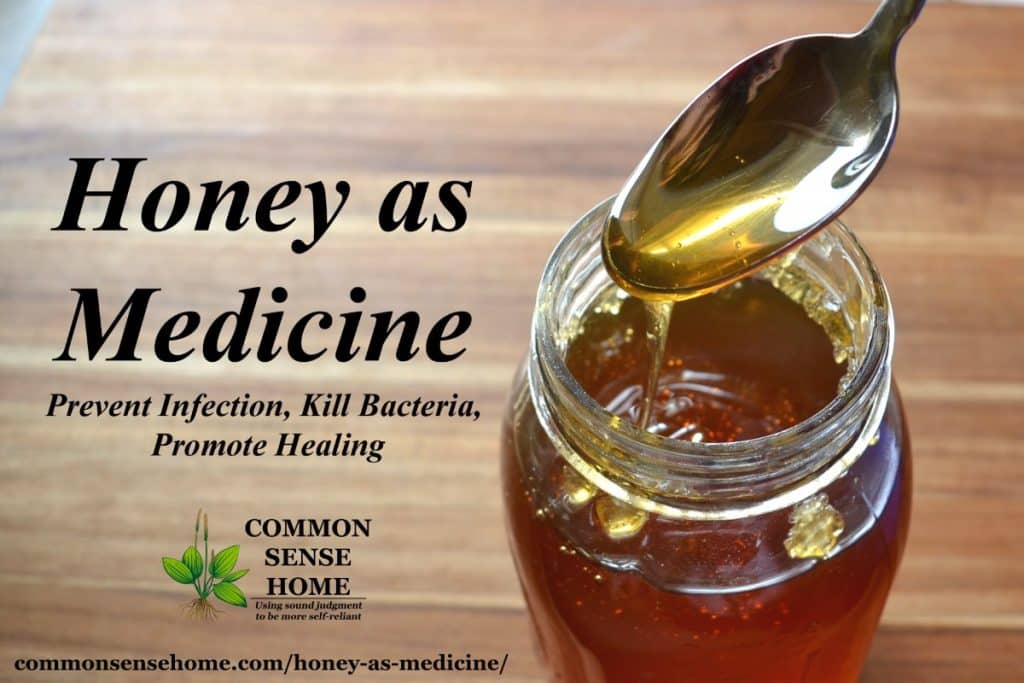
Honey has become a staple for those hard-to-heal wounds, such as diabetic leg ulcers, burns, even wounds with gangrene. It kills bacteria resistant to other antibiotics and actually heals tissue, nursing the skin back to health. Not only that, but it can decrease the pain.

But here’s the catch. Some types of honey work better than others. Before we get into that, let’s go over the basics, like …

How Honey Prevents Wound Infections

  • It seals the wound from outside contaminants.
  • It’s a mild acid. Most bacteria can’t grow well in that.
  • It has a low water content. Bacteria don’t like that either.

How Honey Kills Bacteria

  • It dries them up. The high sugar content dehydrates bacteria.
  • It produces hydrogen peroxide. When diluted with, say, body fluids, enzymes in the honey create a small amount of hydrogen peroxide. Enough to kill bacteria.
  • Its enzymes create antibacterial chemicals we’re just beginning to isolate. Some types of honey produce more of these chemicals than others. Some don’t produce much at all.

How Honey Heals

Honey has been shown to speed up the growth of various body tissues. It helps form new blood vessels, collagen, and the epithelial cells that cover the underlying tissue. The way it does this is:

  • It seals in the good tissue fluid containing enzymes and proteins that promote healing.
  • It provides nutrition to the tissue.
  • It decreases inflammation and swelling in a yet unknown way.

Some studies have suggested honey even decreases scarring.

Some Concerns About Using Honey

Even with all its antibacterial properties, honey can contain a few bacteria. Although some can cause bad skin infections, I can’t find a study where any have. Still, physicians worry because it’s possible.

We do know babies have died ingesting honey that contained a few botulism spores. This is thought to be due to their still developing digestive system. To my knowledge, no one over 12 months old has ever even gotten sick from these sparse spores.

Okay, now for the finale.

Honey as Medicine @ Common Sense Homesteading

Manuka Honey fights infections

Some Types of Honey Fight Bacteria Better Than Others

Even though all types of honey are acidic and dehydrate bacteria, and most types create hydrogen peroxide in varying quantities, not all contain those other antibacterial chemicals we’re just now discovering.

Have you heard of Manuka honey? It’s made in New Zealand, and it’s known as the most effective honey and the one with the most antibacterial chemicals. That may be because it’s been studied the most or because it’s been marketed the most, or just maybe because it really is the best bacteria fighter.

Medihoney is Manuka honey that’s been zapped clean of bacteria (including botulism). The zapping may kill the peroxide-creating enzymes but apparently doesn’t harm the antibacterial chemicals. It’s the honey the wound-care centers use.

I hoped to find a study comparing the antibacterial potencies of various U.S. honeys but could only find studies on honeys made abroad.
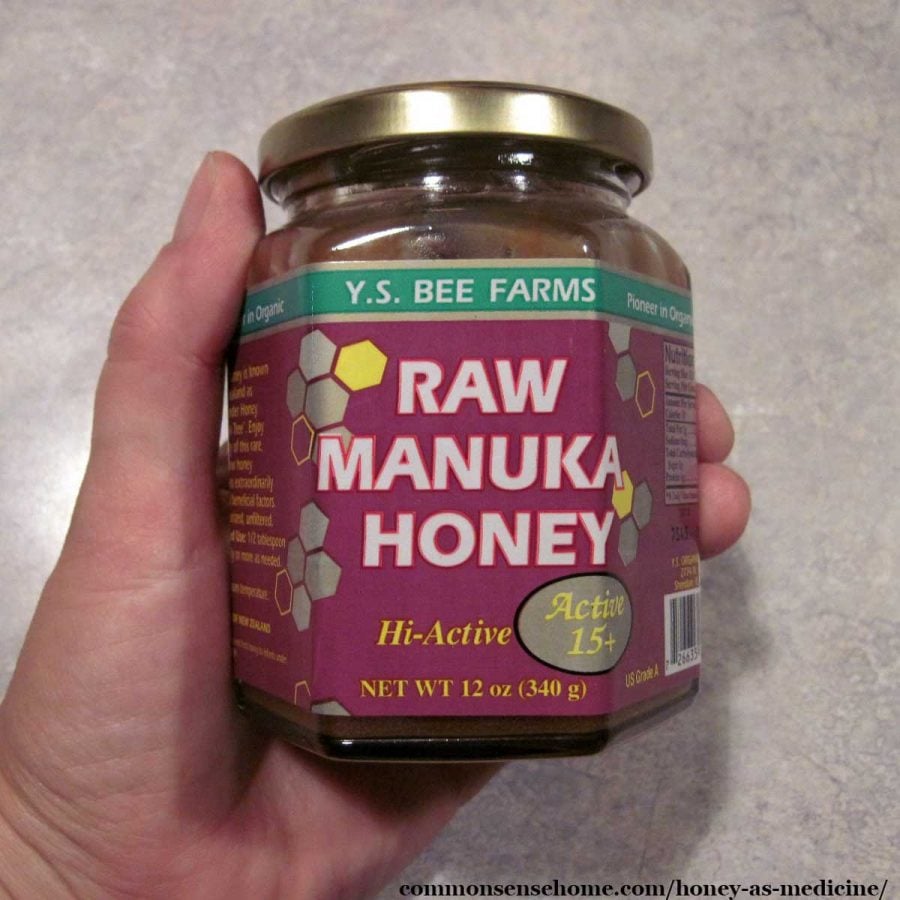
Honey as Medicine – Which Honey Should You Stock for Medicinal Use?

  1. I’d get some Medihoney for the medical survival kit. It’s more expensive, but it’s not going to spoil. (Actually no honey is going to spoil.)
  2. I’d have some good-tasting local honey for extra stocking supplies. Use it to eat, for coughs, etc., and for an antibacterial in a pinch. (Learn more about using honey for coughs in my blog post, “The Safest Cough Medicine“. Don’t feed it to babies.  Laurie’s note:  you can also use honey to make simple cough drops.)
Honey as Medicine @ Common Sense Homesteading

Honey makes a safe cough medicine

Important caution: Never try to treat a bad wound by yourself when you can get medical help. For one thing, even with honey, it could turn into a very serious limb- or life-threatening infection.

How to Use Honey on Wounds

After cleaning the wound, put honey on one side of gauze or a clean cloth, and lay it onto the wound. Or pour a thin film of honey directly onto the wound and put the gauze over that. Either way, seal the honey in with surgical or duct tape on the edges of the bandage. Clean and repeat twice a day. If supplies are scarce and the dressing stays clean, you could cut that back to once a day or even a bit longer.

Have you ever used honey for a skin infection? What type? Do you have some stored just in case?

Is Manuka Honey Safe to Use on Pets?

Update by Laurie:  Several people have asked whether it is safe to use manuka honey on pets.  The answer is “yes”.  You can read more about treating pets with honey at “Using Manuka Honey for Dogs, Horses, and other Animals

This is a guest post by by James Hubbard, M.D., M.P.H.  Dr. Hubbard teaches down-to-earth, improvisational survival medicine for disasters at his blog TheSurvivalDoctor.com. He’s been a family physician for over over 30 years.

Learn more about how to survive a bad wound when you can’t get medical help in Dr. Hubbard’s new e-books The Survival Doctor’s Guide to Wounds and The Survival Doctor’s Guide to Burns.  (Follow the link to enter to win a free copy of these books.)

Disclaimer: This post is for general information only and not meant to be your only source of information on the topic. Use at your own risk. Please consult your health-care provider for personal advice.
  27 Responses to “Honey as Medicine – Prevent Infection, Kill Bacteria, Promote Healing”

  1. I have used both regular (raw) honey and Manukah honey for healing. We have some of the Manukah on hand for emergencies, especially for large wounds and for burns, because it hydrates while taking away the oxygen of all the bacteria. The reason Manukah is “better” (and yes it is, at least imo) is because the bees feed on the manukah flower, which grows only in NZ. The flowers are used for medicinal purposes, too. :) But the honey is a miracle thing.

    Personal, first hand story. I had a friend who had a major groin hernia. It was removed, but they had to do a lot of reconstructive stuff with wire mesh and such, to keep his “bits and pieces” all inside. The wound was huge – about 4 inches across. I could almost get all four of my fingers inside it. They stapled him and gave him the standard antibiotics (he’s a heart patient). After six weeks of antibiotics, both oral and ointment, he still had a gaping wound, only now it was infected.

    I went in to the doc with him and asked if he knew about Manukah, and he said no. I asked if there was any reason I should NOT try it. He thought about it quite seriously, wrote down all the information I had, then said go for it. At this point, my friend was told that he would heal but would always have a gaping hole in his side. Not a bad scar – an actual HOLE. Because it hadn’t healed up right. The doc said there was nothing to lose.

    Two weeks later, the wound was closed almost entirely. It had a puckered, nasty looking scar, but there was NO gaping, no hole. That doc now prescribes Manukah to all his post-op patients. True story. :) The wound eventually closed with only a minor scar, basically a lighter colored line that was the original four inches long. But no puckering, no huge nasty stuff, no oozing, no infection.

    All we did was pack the wound with Manukah honey and cover it with the sterile gauze the hospital gave us. We’d tape it on and leave it for 24 hours. Next day we’d do it all again.

    We use Manukah honey on scrapes, scars, warts, burns… just about anything. Just one note about burns – wait for the initial burn to be over with (ie at least 48 hours). The honey, like any other viscous liquid, can lock in the heat, causing the burn to be worse. Once you’ve reached the stage where any blackened skin has come off, and where you are no longer having to pack with cold water and ice, then you put the honey on.

    Note: I am not a doctor, nor do I play one on television. I just happen to be extremely accident prone and into natural healing. :) Please don’t take the above as a doctor’s advice… though if you’re stuck and have no hope of medical care, give it a try. Or do it with your doctor’s okay – you may convert him or her!

    • Thanks so much for sharing your story – amazing!

      Last year my husband had a bad burn on his hand, and we used honey to heal it, too. It dried non-sticky, and the burn healed surprisingly quickly (it was pretty deep, with a blister over 1 inch long and 1 inch across).

  2. The only “sugar” that I consume, if at all, is raw, unheated, organic honey :) :) It’s so good. It doesn’t cause my body any problems…and I really do believe it has some sort of healing properties for the body :) :) Plus, I love to mix it with some organic peanut butter and organic, shredded coconut. It’s a nice treat :)

  3. I’m a beekeeper. I eat at least a tablespoon of raw honey every day. For simple wound care, I mix one part local, raw honey with one part aquaphor ointment. A fellow beekeeper who is also a wound-care nurse taught me that and it works like magic. I also wash my face with honey and then use coconut oil as moisturizer. I am in my 50′s and am always told that I look like I’m 30something.

    Honey never spoils, unless you add a lot of water to it. You could eat honey from King Tut’s tomb and not get sick!

  4. When you say the Medihoney is ‘zapped’, do you mean to say it has been irradiated? Do you use propolis?

  5. Laurie, have you tried making those honey cough drops personally? I’d sure love to hear how yours turned out. I tried it yesterday and ended up with a bunch of black, burned honey goo. It seemed so simple…

    (I felt bad, wasting so much honey, but we set the burned goo out by our bee hives. I have no idea if they’ll eat or not but I guess we’ll find out! LOL)

    • No, I haven’t tried them yet. Did you leave a comment for Jay over at Better Bee? I’m sure he would help troubleshoot. It sounds like you overshot hard crack stage. Did you use a candy thermometer and a double boiler? Those would give you more control.

  6. Thanks for the post. Yes we have had great results with medihoney, my dad had a huge diabetic ulcers on legs. The wound specialist we got was awesome. She used Medihoney taught me how to do it in between visits. Cleared it up. Took a bit but worked! Not much scaring. Now when he starts a skin tear, I use it right away. Interesting part here, the insurance was not willing to pay for it as care. We fought them and they did send some. We paid 50%. Really! I now use it one my family, and also on my face too. Great stuff. Need to try

  7. Nope, meant to leave a comment over there as well but didn’t get to it. (We had our local beekeeping association meeting last night and I should have thought to ask there as well but didn’t. Duh.) Yep, used a candy thermometer and just hit 300* per the directions but didn’t use a double boiler.

    I’ll let you know if I ever nail this!

    • I may have to give them a try once harvest season calms down. I haven’t worked much with hard candies, but do have a candy thermometer that’s been collecting dust, and a stash of honey.

  8. [...] Honey as Medicine [...]

  9. I used manuka honey on my cat and it worked. Whenever he got scratched or bitten by another cat his wounds tended to abcess. That meant a trip to the vet or me spending alot of time and effort keeping the wound from closing over and getting even more infected (cats skin tends to close over wounds then get infected and pus doesn’t drain and it builds up). So I started putting manuka on his wounds right away, about 3 times a day for 3 days, and the wounds never got infected or abcessed. He’d lick at the honey but enough of it stayed on to work great!

  10. I use honey in my home made cough syrup, I always use local and it seems to do the trick! I usually take a few doses and I’m feeling amazing the next day. I boil echinacea, licorice root, onion, garlic and a few other dried herbs known to help with inflammation/antibacterial/ or any other ailments, for about 4 hours strain and add honey and brandy. Sometimes it even tastes yummy! Thanks for all f the information! I’ve always wondered what else honey does!

  11. I have had some problems with teeth and gums. I think I have some sort of infection. Will the honey help this?

    • Nancy – I’m not a doctor or dentist, so if you have something serious going on in your mouth you should probably seek professional help. For my part, honey is still a sugar, plus it would be pretty tough to keep it where you need it in your mouth, so it wouldn’t be my first choice to treat a mouth problem. I have used oil pulling with coconut oil to address minor gum irritation and inflammation – http://www.oilpulling.org/oil-pulling/ Diet changes (such as increasing herbs and anti-inflammatory foods) may also help address minor infections.

  12. [...] – Don’t forget to check out the post Honey as Medicine to learn about more uses for [...]

  13. [...] aureus, Pseudomonos aeruginosa, and herpes simplex virus type 1 and type 2.  Aloe and honey are two of the most effective treatments for burn victims when applied externally to speed wound [...]

  14. My Dad was a beekeeper so needless to say honey was a staple in the house. We used it to cure just about everything. Our cough syrup was simple. It was Lemon and honey. I remember also adding a small amount of whiskey, brandy or whatever you had on hand. Also in the winter, you could add hot water( or a tea bag) and have a great drink.(minus the liquor!) My Mom used to make a candy that was out of this worlk. She lost the recipe but it was very simple. It consisted of powdered milk, peanut butter, honey. Formed into balls, rolled in powdered sugar. Then placed in the freezer to set.

    • Thanks for sharing your memories, Becky. I’ve found a number of variations on the honey candy, the basic one being:

      1 C Powdered Milk
      1/2 C Honey
      1/2 C Peanut Butter

      A lot of folks mix in things like graham crackers, coconut or crisped rice cereal, too.

  15. Absolutely the one thing I will never be without is honey. We use it for people and animals here on the farm, inside and out. I sliced my fingernail open with a t-post – honey. Hubby sliced his hand moving some metal sheeting – honey. My daughter cut her hand on a cat food can, which of course was filthy – honey. My youngest daughter had a fairly severe injury to the inside of her mouth – cottonballs soaked in honey and warm water, packed them between her teeth and cheek and the wound had healed with no visible injury at all within 48 hours. In all cases, the wounds healed incredibly fast with little to no scarring.

    Just this past week I wrote on my farm blog about coming home from town and a couple days later I knew I was getting sick. I drank honey and cinnamon tea with orange peels (anti-bacterials and vit C), all day long for two days and beat the illness back.

    I am not selling anything, and I am not a beekeeper. Just a mom who has seen the amazing healing results using honey.

    I would guess that any local raw honey is just as good as that highly marketed Manuka honey. I’ve never had anything but remarkable results with local honey, and I’d rather spend my money with my local beekeepers!

    Thanks for the great article.

    Tina

    • Thanks for sharing your experience, Tina. I use almost all local honey, but I do keep one jar of the manuka around, just in case I need more “oomph”. I figure it’s so shelf stable that it will last virtually forever, so one jar goes a long way.

Sorry, the comment form is closed at this time.