
Grandma Called it Medicine Leaf – Plantain Weed Remedies

This post may contain affiliate links. Read my full disclosure here.
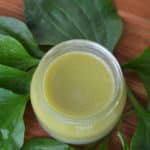
Plantain weed is good medicine, from seed to root. In this article, I’ll share how I came to know plantain, and how to use the fresh leaves and dried leaves for natural remedies such as salve and tea.
Would you like to save this?
Table of Contents
Plantain Weed – Grandma’s “Medicine Leaf”

When I was a little girl, my father’s mother, Catherine, and I were very close. Mom was awfully busy trying to raise six kids and run a farm by herself, so I spent a lot of time with grandma (I’m the baby of the family).
Grandma had ever-bearing strawberries that she would pick as soon as they showed a blush of red, so the birds didn’t get them. There were always hollyhocks and poppies, the yellow transparent apple tree, lilacs, roses and a small vegetable garden.
Grandma and I would dance and sing on the front lawn, and every Saturday night we had a “date” watching HeeHaw.
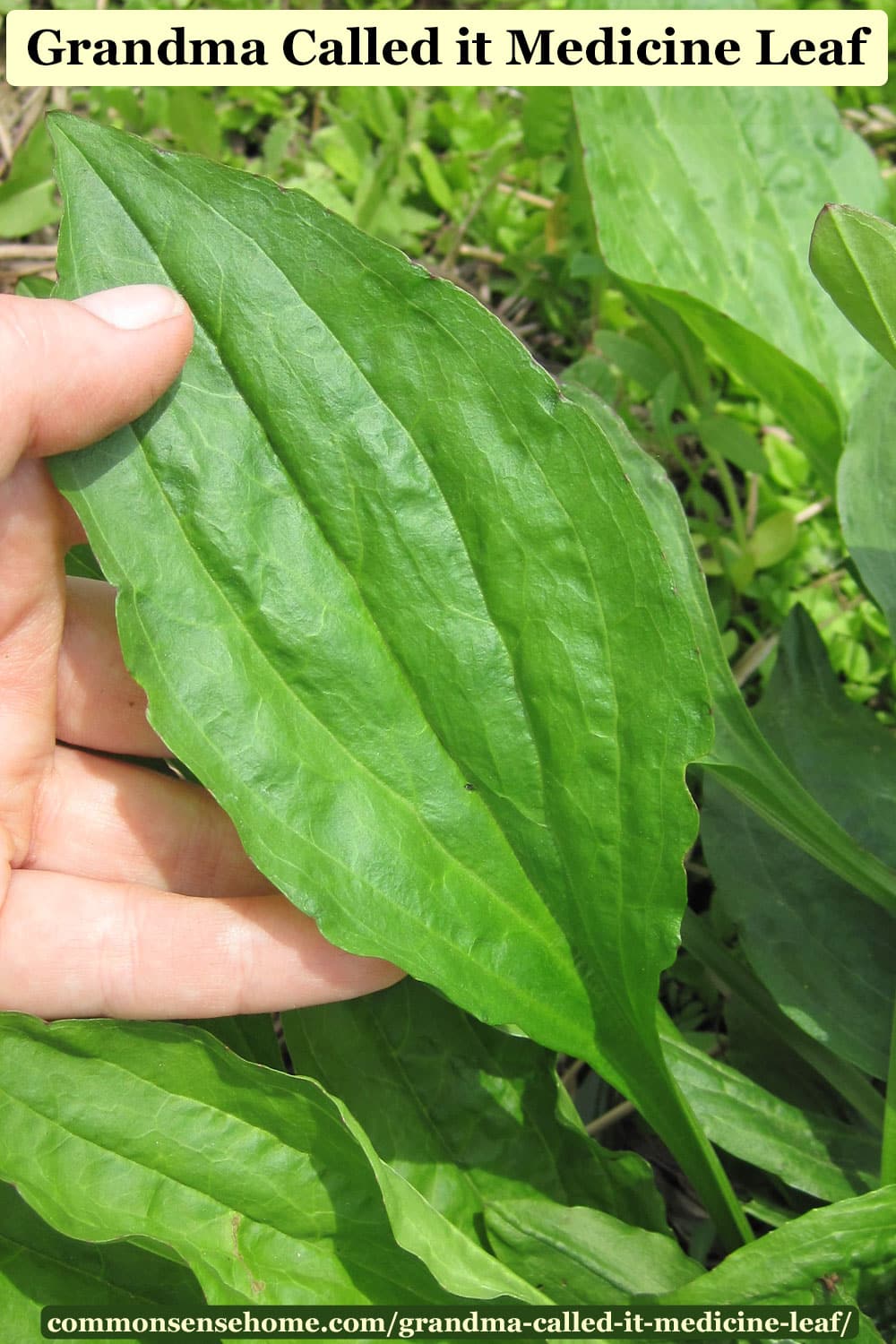
I remember grandma pointing to a broad leaf plant in the yard and calling it “medicine leaf”. She told me the Native Americans use to use it for medicine, but we never used it ourselves.
A New Look at Old Medicine
Fast forward about 30 years. I started hanging out with the grandmother of some boys in our local homeschool group, and she showed me how to use plantain leaf to make an infused oil.
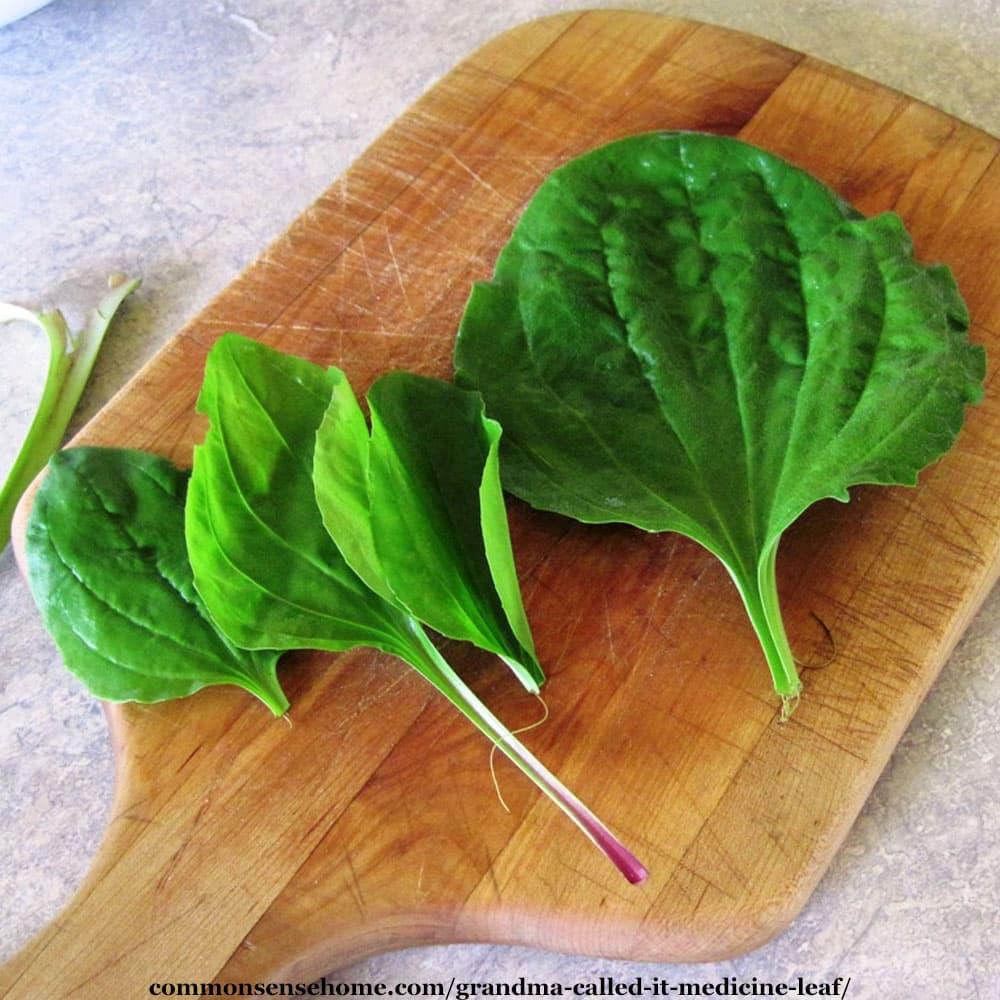
It turns out grandma’s “weed” was actually broadleaf plantain (Plantago major), and it’s close to miraculous for treating bug bites, stings and many other ailments.
Using plantain weed opened the door to my curiosity about the use of many common weeds. It truly changed my life, and that’s why I chose it for the logo of the website.
Now I look at wild plants with fresh eyes. (Many of them were carefully carried by settlers as food and medicine.) It’s a great feeling to know that I can find simple remedies almost anywhere.
I’m not the only one taking notice of plantain. The 2018 study “Plantago major in Traditional Persian Medicine and modern phytotherapy” looks at a wide range of medicinal uses of plantain, including treatment of:
- epilepsy
- eye disease
- toothaches and other oral health problems
- earaches
- pulmonary disorders
- gastrointestinal trouble
- liver disease
- urinary tract issues
- skin diseases
Note: For more detailed information on how to to identify plantain and food uses of plantain, see “Broadleaf Plantain – The “Weed” You Won’t Want to Be Without – Weekly Weeder #14“.
How to Use Fresh Plantain Leaf to Treat Insect Bites, Stings and Other Skin Irritation
The first time I put plantain weed to the test was for treating a wasp sting.
I was at my Great Uncle’s house scrubbing egg off a plate with a metal scouring pad, when “the pad” stabbed me. I set the scrubber down and out crawls a large black wasp. (Bill told me after the fact that, “Oh yes, he had seen some of those around.” I guess it didn’t like being used to scrub plates.
My finger started swelling and burning. I ran cold water on the sting, and yelled for my son to run outside and grab some plantain. He came back in a matter of minutes with a nice, healthy leaf, and into my mouth it goes. Chew, chew, chew – spit it out – onto the bite.
The worst of the pain subsided within minutes. I wrapped the green blob onto my finger with a band-aid and left it there for the rest of the afternoon and evening. (Plantain tastes very green, in case you’re wondering.)
Here’s what the sting looked like at the end of the day:
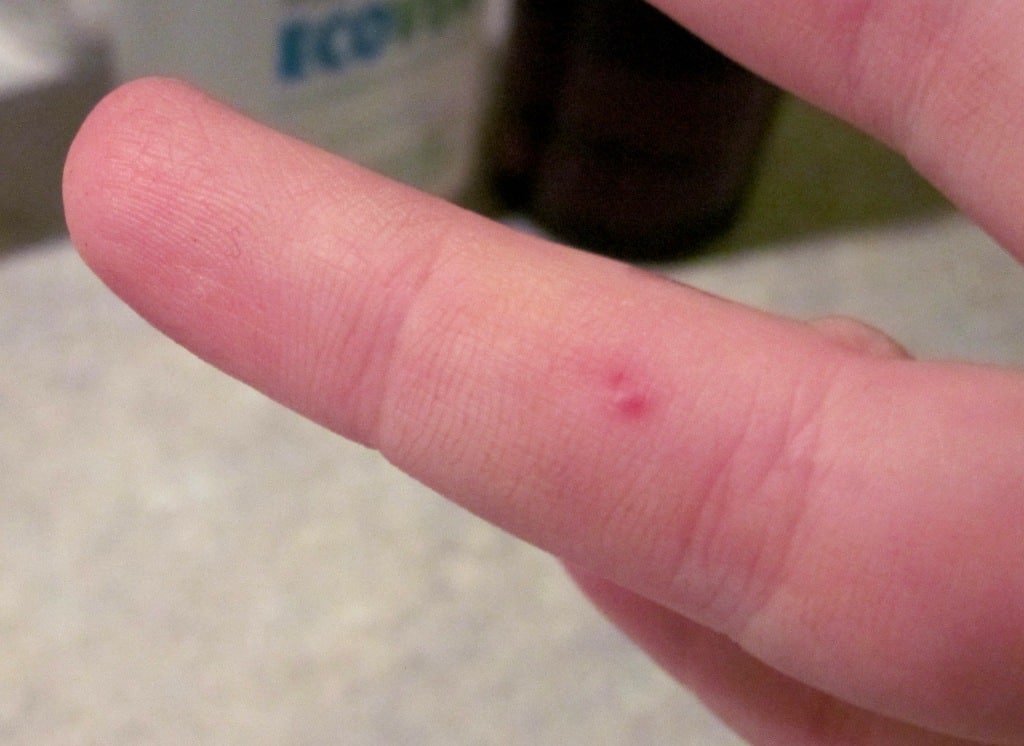
Note: insect damage is very clear, but there is no sign of inflammation or swelling (no welt). There was no pain at all the following day. The last time I was stung, the welt lasted for several days. This was so much better.
To use Plantain Leaves for Bites and Stings
- Find a clean leaf
- Chew or otherwise mash it to release juices
- Apply to affected area until pain/itching subsides
A plantain poultice also helps to heal cuts and incisions.
Plantain Weed for Slivers
Plantain has a natural drawing and anti-inflammatory action. This helps to reduce swelling, but it also helps to draw out slivers.
Simply crush or chew your plantain leaf, place it over the area with the sliver, bandage and leave overnight. In the morning the sliver should easily pop out.
You can use fresh plantain juice to treat poison ivy, sunburn and other skin irritations, but infused oil or salve is easier to apply.
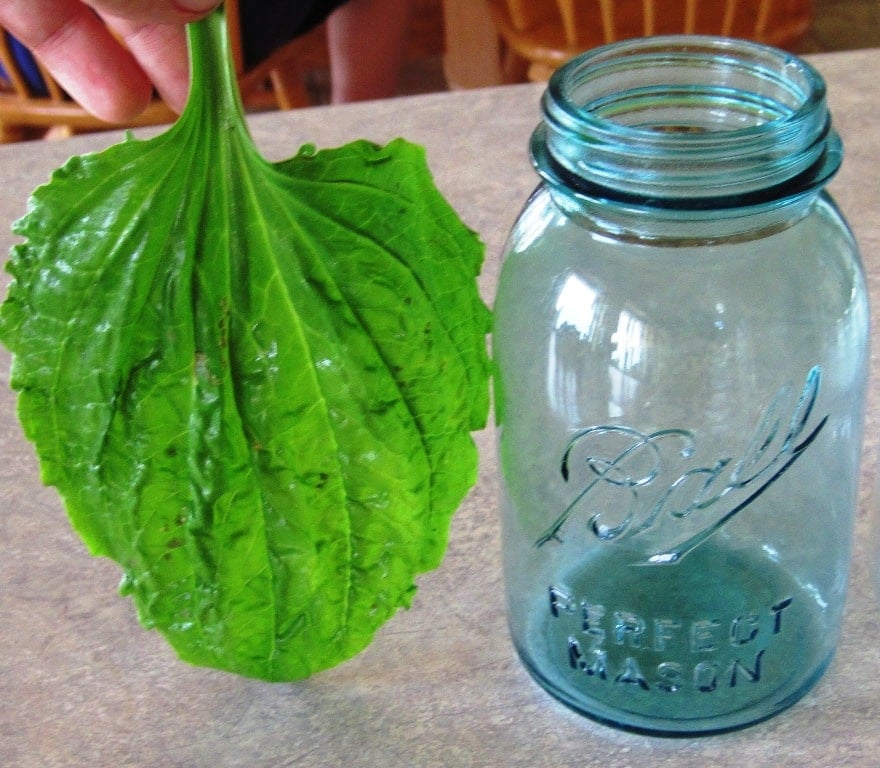
I visited my brother recently and he had some enormous plantain weed leaves. (My brother now lives in grandma’s old house.) Some of the leaves were nearly the size of a sheet of paper. Here’s one of them next to a quart Mason jar for comparison.
How to Make Plantain Infused Oil
Gather Plantain Leaves
First, gather up a bunch of plantain leaves. Minor damage is fine, but avoid mold or other signs of spoilage. Pick enough leaves to fill your container of choice. (Small jars work well.)
Wash and Prep Leaves
Wash the leaves and dry thoroughly. (I run mine through the salad spinner and pat dry with a towel.) You want these as dry as possible to help prevent mold in your infusion.
Finely chop the leaves and pack them into your jar until full. Cover leaves with olive oil or fractionated coconut oil. Poke/stir with a chopstick or other implement to remove air bubbles. Place lid on jar, label and date.
Infuse the Oil
I keep the jar in a sunny window for at least two weeks (usually four to six weeks), stirring daily to make sure the leaves stay below the oil. After several days it will start to smell like pepperoni – this is normal.
Sunlight exposure during this stage helps to prevent mold, but you don’t want the oil to get extremely hot.
Decant and Pack for Storage
Decant the oil (strain out the plant material) in four to six weeks. I use my jelly bag strainer. The oil is now ready to use.
For longer storage, allow the decanted oil to settle for a few days, then bottle the finished oil in dark jars. You may get sediment or water in the bottom as the oil settles – try to keep this out of your finished product by pouring off the oil carefully.
Seal the bottles, label, and store in a cool, dry, dark place.
Using Plantain Infused Oil
My first test of plantain oil came after an evening in the garden with a voracious cloud of mosquitoes. I rubbed catnip on my exposed skin, but they bit right through my shorts!
I must have had at least 20 bites on my tush. Oh man, did it itch! I took a quick shower and coated all my bites with some plantain oil. Again, within a matter of minutes, the pain and itching subsided.
Simple Plantain Weed Salve
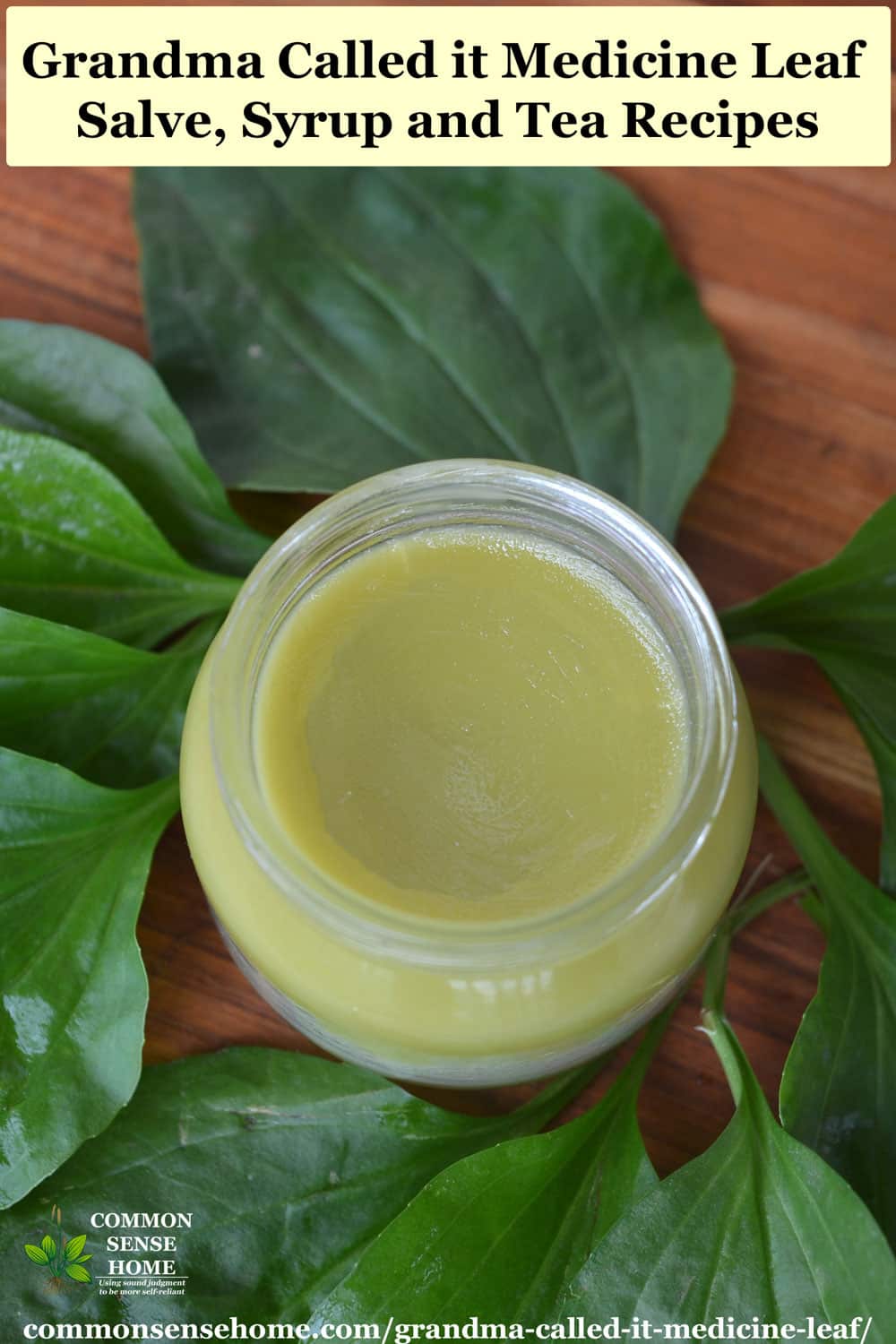
Plantain infused oil is great for covering larger areas, but plantain salve is nice for spot treating bites, stings or hemorrhoids.
Use 1 tablespoon of finely chopped beeswax for every ounce of plantain infused oil. Stir the oil and wax together over low heat until the oil is melted.
For more details, see “How to Make a Salve with Infused Oils“.
Plantain Leaf Tea
For internal use, try plantain leaf herbal tea.
Place one heaping teaspoon of crumbled dried leaves or one to two fresh leaves in a mug. Cover with boiling water and infuse for ten minutes. Strain and drink, adding a little honey for sweetness, if desired.
Drink a mug of plantain tea three times per day to help clear out colds and soothe digestion.
Plantain Juice with Honey
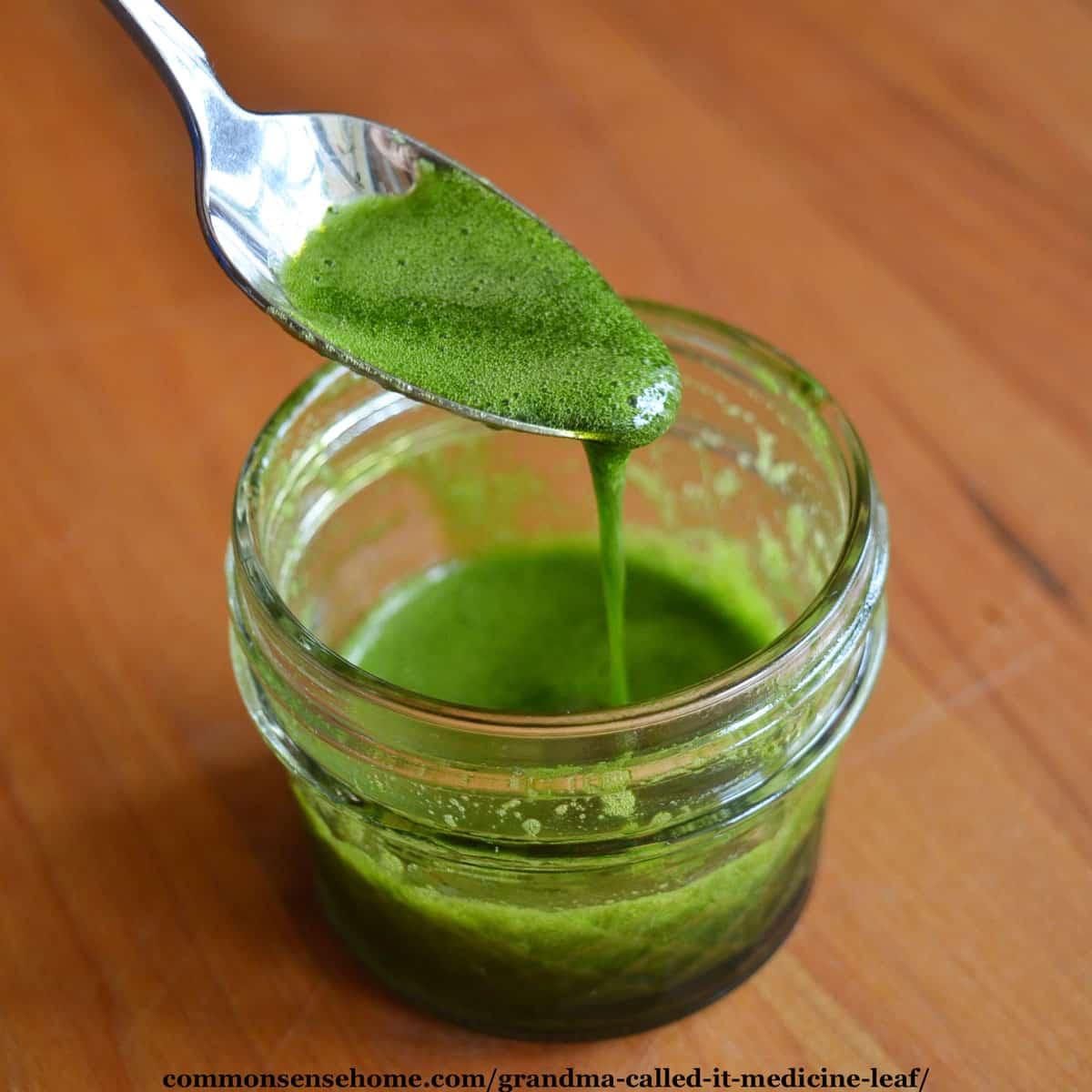
This plantain weed remedy is recommended in Backyard Medicine for coughs and stomach ulcers. It can also be used externally for ulcers and other sores. (Honey also has a long history of medicinal use.)
Juice fresh plantain leaves and mix the juice with an equal amount of honey. Pour into sterilized bottles and keep in a cool location.
Dose: 1 teaspoon as needed for coughs, 1 tablespoon three times daily for stomach ulcers.
Note: Ribwort plantain (Plantago lanceolata) works best for juicing, but any plantain variety has similar medicinal properties.
Dig deeper into the wonders of plantain in The Wild Apothecary series – volume 1.
Get Plantain Products and Seeds Online
Want someone else to prep the oil for you, or don’t have plantain readily available?
You can get plantain infused oil, plantain seeds, dried plantain leaf, powdered plantain, plantain extract, and plantain infused lip balm.
Have you used plantain? Do you have a favorite recipe or tip to share? I’d love to hear from you.
You may also enjoy:
- 15 Ways to Naturally Reduce Cholesterol
- Easy Homemade Cough Drops for Treatment of Sore Throats and Coughs
- Natural Remedies for Colds and Flu to Help You Feel Better Faster
Originally posted in 2010, updated in 2019.
great info don’t they use this leaf for your eyes also
There have been some studies on eye drops made from Plantago species.
Here’s an excerpt from “Plantago major in Traditional Persian Medicine and modern phytotherapy: a narrative review“:
Hello, I noticed you use broadleaf plantain, I have that but I also have the skinny long leafed plants around too. Can I use the second plant as well as the broadleafed plant with the same effects? Thank you
Yes, the Plantago family plants have similar medicinal and edibility properties.
Interesting
Hello, quick question here. If I want to use dried plantain leaf to add it to my homemade skin butter, can I just add it to my oils when I heat them over a double boiler and leave them in there? Must I strain them out?
I’d strain them out, as plant bits left in will make the product more likely to spoil.
I make a salve of comfrey, calendula and chamomile with fractionated coconut oil and beeswax that heals most everything skin related on us and the animals too. It’s wonderful stuff! I’ve been collecting and freeze drying a bunch this year but, reading your site makes me wonder if it’s going to be medicinally active with all the rain we’ve been getting. The only contraindication is not using it on deep wounds as it can heal the top layer and seal in germs. Happy to find your site!
Comfrey salves are great, but yes, as you mentioned, it’s best to be careful with deep wounds. I’ve put the salve around deep wounds while avoiding the wound itself, like when one of our hens was badly gouged by a hawk. She had a huge, deep hole in her side. At first I thought she wasn’t going to make it, but she kept pounding down food like it was her last meal, and resting in a corner. After a while, it was pretty clear it wasn’t her last meal, and she went back to her regular routine. The wound healed and created a deep scab shaped like a long, thin funnel. I pulled it out like pulling a plug when I noticed small creepy crawlies living in it. The wound healed over neatly the rest of the way and she’s been fine ever since.
Drying should help to concentrate the active compounds, but you may find the salve to be less potent.
If stored in dark bottles in a cool, dark place, what is the typical shelf life of the infused oil?
I aim to make fresh infused oil each year. You’ll notice an off odor when your oil starts to go rancid.
Someone asked if plantain could be eaten, my answer is yes. When I was a child my mother would pick wild greens every spring and plantain was one of the plants she would always use.
Yes, plantain is edible raw or cooked, though the older leaves tend to be a bit chewy.
Hi, Laurie – I just found this website. I’ve been studying plant medicine and edibles for a year, and did a search and found your page. I have a question. I know it’s been a long time since the last post, hope you are doing great.
QUESTION:
Years ago, decades ago, my friends and I decided we weren’t going to go to the beach in Florida, but for hs graduation, we’d go to central Ontario and go camping in the wilderness. A week in of a 2 week adventure, I was swimming in the lake, before supper, and got bit by a lot of black flies afterwards. I broke out in a terrible body rash that burned and itched terribly. My friends were going to take me to the nearest emergency care station, but at the ranger station/store back down the 6 mi jeep trail, the ranger’s wife said she had a bad rash like that once, and the old indian out back in a little cabin, knew a plant that would fix me right up, it did for her. So, the old indian told me about a plant that had no side veins, so went went all the way back to camp, I picked a bunch of plants about a foot high, and as told, crushed them and rubbed the juice on my skin. In seconds, the burning and itch stopped, and by the next morning, most of the rash was gone. I’m retired now, and never knew the plant I used. I found some in N. Michigan – could that have been plantain??? “Lady’s Thumb” does the same, but it doesn’t look like what I used.
It could very well have been one of the plantain varieties. It’s amazing for bites. There’s broadleaf and narrow leaf in northern Michigan. I’ve seen good stands of it while up there visiting my husband’s side of the family. (Strangely, they didn’t understand my fascination with weeds…)
I’ve used it on single black fly bites (thankfully we don’t have them at our place, but I got bit by a friend’s place), mosquito bites, wasp sting, bee stings, yellowjacket stings. Plantain is amazing.
I always knew to use plantain for stinging nettles but did not know it’s other uses. I am asthmatic and very allergic to the midges (biting micro flies) here in Scotland. I am going to infuse the plantain and make some salve for the bites and making tea for the asthma. On the allotment I manage for a local charity is full of both types of plantain.
I am very happy to have found your site. Can you tell me any info on drying the plantain and also the plant self heal.
To dry plantain, you simply rinse (if needed) pat dry and either spread to dry or use the dehydrator of your choice. Keep the temperature low (95F/35C) to gently dry the plant.
I don’t have a post on self heal on the site yet, but will make a note of your request.
Exactly how is this used for Epilepsy?? I am Epileptic & always looking for an herb to help.. Not that I rather have that than my medicines.. But kinda like a back-up.. To take with my medicines..
Thank you
If you visit the study linked in the post, they don’t give specifics dosing instructions, they only mention that it has been used, and link to more sources.
The section on epilepsy notes:
And in the table:
Neurologic Leaves Foodstuff with lentil, Plaster on Forehead Epilepsy Effects GABA system and reduces seizure
So the leaves are eaten with lentils and applied as a plaster/poultice on the forehead, but I don’t know how much, or for how long, or how frequently.
Thanks I’ll look into it!!
You’re welcome, and I hope you find what you need. At the very least, it should be no harm.
In 1974 in kentucky , I had a c-section after 36 hrs of hard labor to deliver twins. I was in the hospital for a week and came home with a very nasty staff (sp) infection. I went to stay with a married couple who were farriers. Don was the shoeing Saddlebreds that showed in Madison Square Garden, and Ardith shod horses around the area. Ardy, as we called her, opened up my incision between each stitch with a Q-tip and cleaned it out twice a day. To no avail. Antibiotics were not even working. She came home one day and told me she had been called in to look at a colt’s leg wound that they could not get rid of the infection in. She poulticed it with plantain and cleared it up. Did I want to try it? Well I was more than tired of loosing half a Q-tip in my gut! She broke up the leaves, put them in hot water and then into a large piece of gause and onto my incision, with a hot water water bottle on top. OMG! It pulled the infection out so dramatically that it actually hurt. We did this twice a day for something like a week. What the doctors had not been able to do, the plantain did . Now in Georgia, this last spring I saw a plant, and moved it into my herb garden . I did not know it was good for so many things, though. Thank you for such an enriching article!
That is amazing, Karen. Thank you so much for sharing your story.
I am convinced that this is the best go to for any skin issue I come across. I made a salve last year and so far it has advanced my healing of mosquito bites, poison ivy, broken skin around my nails, any small cut or wound and a stye on my eye lid.
I just cut about 2 gallons of leaves and juiced them with my juicer. This yielded about one cup of juice that I plan to mix with a cup of honey to begin using as a tonic three times a day for my cough, lungs and hopefully bad gut.
Has anyone had luck with the tonic use? Does the leaf pulp have any medicinal use after juicing…maybe dry it for tea?
I know that plantain has been used internally with good results, but we don’t have enough plants to try juicing it.
While the dried leaf pulp wouldn’t be as potent as fresh leaves, I don’t see any harm in drying it and using it for tea.
My family live in a remote area in NZ, no road access and two hours by boat. They used to have tethered goats and one day one got very tangled and managed to rip a horn off, taking the root out, leaving a bloody cavity in its head.
With limited resources and a trip to the vet not being an option Mum decided to use a poultice of honey and macerated plantain leaves (the long leaved variety grown for fodder in NZ) to pack the wound and left nature to take its course. They were pleasantly surprised that the wound completely healed, the poultice shriveled and fell out. The horn never grew back but there was no infection or or other negative side effects.
Wow! That is fascinating. Thank you so much for sharing this story, and I’m glad the goat healed well.
I was living in Hawaii, on the Big Island and while out snorkeling I touched a sea urchin and got a spine in my finger. I got the spine out but the infection didn’t respond to triple antibiotic cream or betadine. A nurse friend recommended plantain, and the bad infection, which almost sent me to the hospital, cleared up overnight! I love this plant! Thanks for the sweet article!
Wow – that’s wonderful! Thanks for sharing your experience.