Jun 152012
 

What you need to know about sunchokes @Common Sense Homesteading

It all started innocently enough.

Somewhere I read about this native vegetable that was great for diabetics – or maybe it was that episode of Top Chef where one of the contestants made a sunchoke and spinach puree that the judges just raved about.  It could have been an article on easy care perennial vegetables.  I honestly don’t remember.  Whatever prompted me to grow sunchokes, there’s a few things I need to share with you so you don’t make the same mistakes I did.

What is a sunchoke?

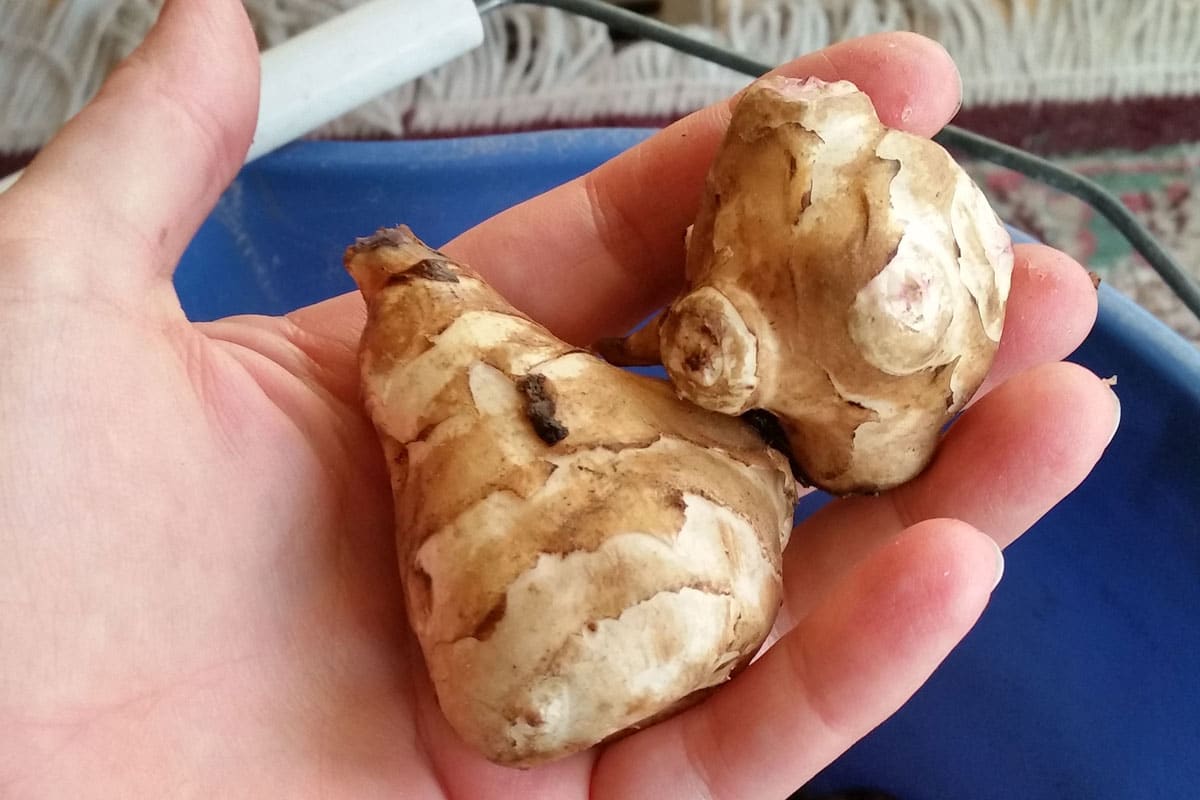
Sunchokes are native to eastern North America (see, that sounds harmless, they’re a native species).  They are also known as Jerusalem Artichokes or Sunroots.  They are not related to Artichokes, they are related to sunflowers.  The whole “Jerusalem” thing is supposedly linked to the Italian word girasola, which means sunflower.  While they do have pretty yellow flowers, they are grown for their edible roots, which are high in inulin.

Inulin is a type of starch that although not digestible by humans, acts as a prebiotic in the digestive tract, feeding our beneficial bacteria.  It’s become a widely use filler in many foods to bump up the fiber counts.  (Sounds great, right?) It also increases calcium absorption in the body, and doesn’t spike blood sugar.  (See the book “Perennial Vegetables” for all the dirty details.)

Some sources claim that eating a large amount of sunchokes may lead to mild gas for those who are not used to it.  I can testify that eating a large portion of boiled sunchokes (that no one else in your family liked) will give you horrible, gut-racking gas like you have never experienced before…well, except for the that one time when you were pregnant and thought it was a good idea to eat prunes, cheese curds and cucumbers in large amounts all at the same time.

The flesh of the sunchoke is crisp like a water chestnut.  After a light frost, they take on a somewhat nutty flavor.  For my part, they taste best raw after a frost.  As a potato substitute, I think they fail miserably.  I don’t believe there is any way that sunchoke/spinach dish could have been creamy  – there is no creaminess in these roots.  Crunchy, yes, creamy, no.  Stir fry – yes.  Boiled and mashed – plain awful.  Roasted, they look a bit like little turds, or perhaps grubs.  The Perennial Vegetable book suggests mashing them with potatoes, or using them in soups.  If you’re feeling adventurous, there’s a blog devoted to Jerusalem artichoke recipes.

“Easy to grow” and “disease-free through heat and drought” are code words for “You will Never Get Rid of this Plant!”

With stars in my eyes, I skimmed over the note in the Moose Tubers catalog that said “they will spread and may be invasive” and placed my order for one pound of sunchokes.  (How bad could they be?)  I planted them late in spring, nine rather wrinkled little roots, in one corner of a garden bed.  I didn’t think they would all survive.  Not only did they survive, they thrived.  We tried to harvest the whole patch that first year, but must have missed a few.

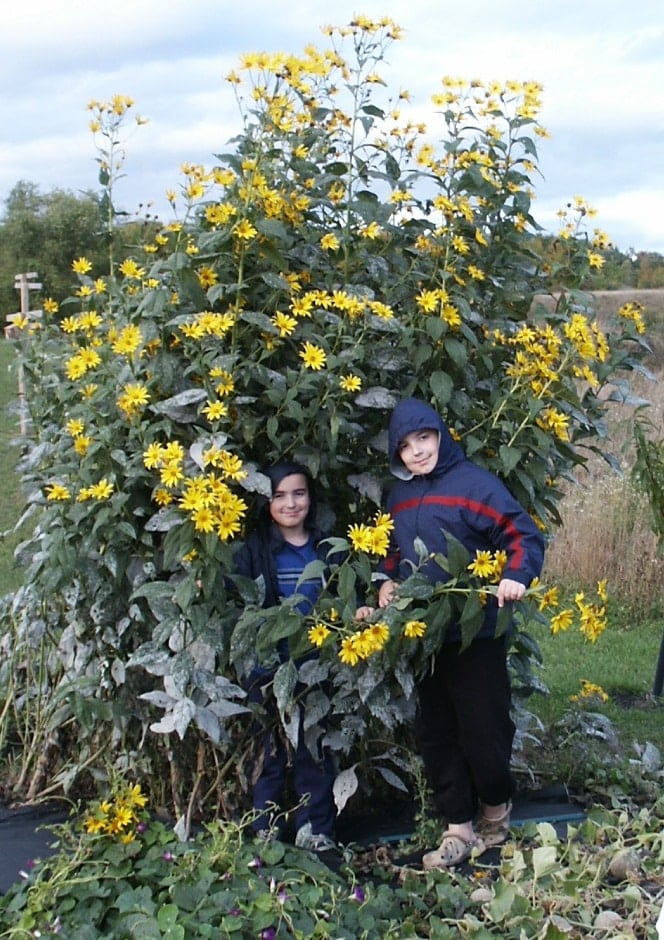
The next spring they were back, and they were spreading.  We tried to keep up eating them, but the fall was muddy and we couldn’t get into harvest.  By the third season, we had the lovely thicket of 12 foot tall flowers you see at the post.  As I was digging them in fall, I tossed some damaged roots off into the tall grass away from the garden.

Fast forward to spring.  Those root bits haphazardly thrown into the weeds – they’ve now sprouted into plants.  There’s a new sunchoke colony.  I decide I need to get rid of some of the sunchokes, and invite anyone who would like some to come dig them.  Two friends come over.  Four different adults attack the patch. Bushels and bushels of sunchokes are hauled out of the garden.  The patch size is reduced roughly by half to start the spring.

Time passes.  The bed is worked up again by my boys.  They remove more sunchokes from the same area that the adults have already gone over.

Before I put the transplants in, I work over the same area one more time.  THERE ARE STILL SUNCHOKES COMING UP!  This area has been gone over by four adults and two kids, and there are still sunchokes hiding in the dirt.

Here’s the main patch.  You can see the smaller outliers in the foreground.  That area should be clear.
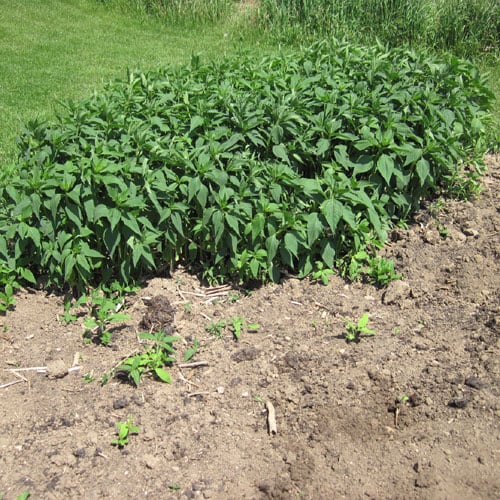
Sunchoke patch @ Common Sense Homesteading

Sunchoke patch

Here’s a nice, innocent looking sunchoke seedling.
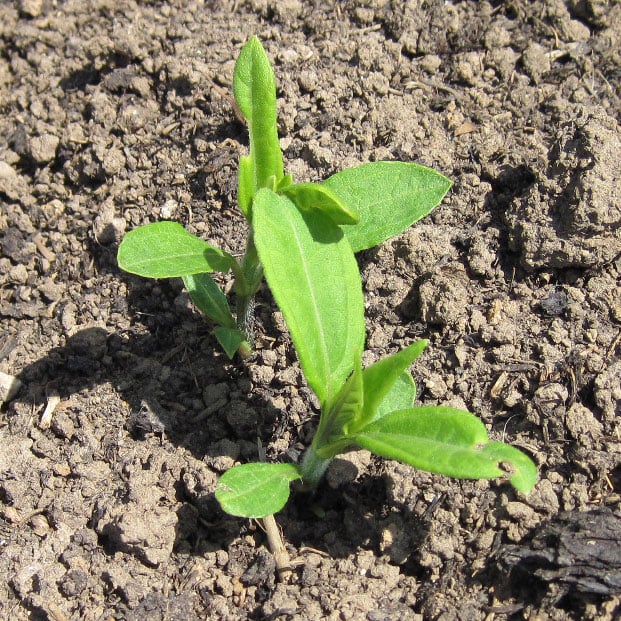
Sunchoke seedlings

Once we dig it up, we see that this single tuber is trying to regrow an entire sunchoke thicket.
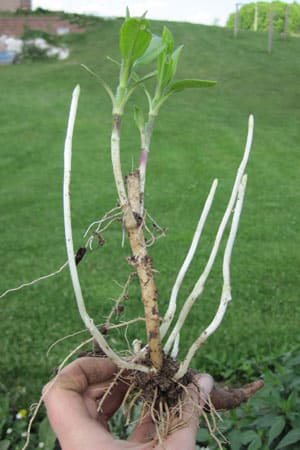
Sunchoke root

Even tiny pieces, no bigger than the tip of my thumb, can regrow entire large, vigorous plants.
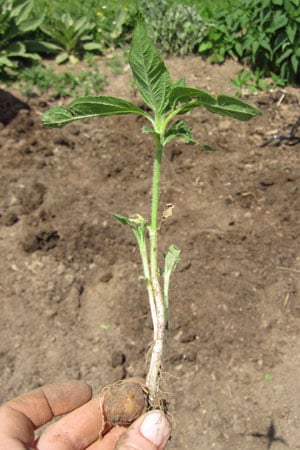
Demon sunchoke

It’s virtually unstoppable. Weeks later, and I’m still digging up shoots from amongst my cabbage seedlings.

I urge you, do not plant sunchokes in a standard garden bed, or field, or anywhere else you might like to grow other plants at some time in the future.  You will spend very large amounts of time attempting to remove them if you do.  Plant them in their own area, that can be mowed around, to keep them under control.  A dwarf variety like “Dwarf Sunray” might even work well in a large container.  (I haven’t been able to find these for sale in the US, only on UK sites.)  *Note:  My neighbor says her horseradish plants are the same way.  Plant both at your own risk.  Maybe next to each other, to see which one wins.

Sunchokes are reasonably good for you,they look pretty, taste okay, and are quite expensive to buy in many areas, if they are available at all – a “perfect” choice for a new exotic vegetable to try.  I just wanted to let you know that you’re likely to have a lifetime commitment with them once they enter your garden.  Don’t say I didn’t warn you.  ;-)

Any other plants you’ve grown that want to take over your garden?  Leave a comment to warn other gardeners before they end up fighting them, too.  Also, if you could include in your comments roughly what area you are from, that would be great, because some plants will spread in some areas but not in others.


  44 Responses to “Before You Plant Sunchokes, You Need to Read This Post”

  1. Good to know, thanks!

  2. We planted these this summer, and I was just going to post my photos when I saw your article! They are growing fast and I cannot wait to see the beautiful flowers and hubby cannot wait to eat them =D

  3. Please, Please, Please, don’t plant comfrey I rue the day that I planted that one innocent plant I shall never be rid of it! It has taken over much of my herb garden(only with constant weeding has it not devoured it) it has spread to other areas around my yard, a huge patch next to the shed, it is coming up in the marshy area in the back yard, it is coming up in my peonies, it has come up in the ditch out by the road . . . you get the drift. You can’t dig it out any miniscule speck of root grows a new plant & believe me they are hardy & they also reseed freely, JOY!

  4. “Plant both at your own risk. Maybe next to each other, to see which one wins” Love it! Thanks for the warning. I just planted some mammoth sunflowers, hopefully I can keep those under control. :-)

  5. Chickens love them we have them in there yards and they don’t last.

  6. When we moved into our home there was a nice patch ( 4′ x 4′ )of an attractive tall growing plant that shielded our back patio nicely from view of the street and neighbor. The next year it was larger, and the third even larger…nearing 10′ in landspace. We called it the ‘bamboo’ because it looked somewhat similar in the stalk though the leaves were entirely different. I tried a couple of nurseries in hopes of discovering what this wonderful plant was, it grew so tall and quickly, birds would nest in it in summer and the chickadees loved it in winter.
    Then I saw it in the backyard of a friend. She hated it. She said she liked it at first too when she moved in, but noticed that it doubled in size every year and so the 4th year she tried to exterminate it, but it kept coming back. This made me start to wonder. But still, I was unable to have someone correctly identify it for me, and my spouse was quite attached to it’s privacy features.
    One spring I saw flyers in several nurseries warning about Buckthorn, a plant I was familiar with on property and wanted to get more info on. So I looked it up on the internet, was brought into our state’s DNR Invasive species plant website (something I recommend everyone to do now, to familiarize oneself. It’s amazing how many invasive plants are being sold in nurseries), and lo and behold, I discovered a picture of my mystery plant.
    Japanese Knotweed.
    Edible, but will take over your yard, and can break up your sidewalk, driveway and yes…even your house and is more or less next to impossible to get rid of, a task that takes many years.
    And here, my hubby was encouraging it’s growth for it’s wonderful neighbor-view blocking properties!
    When it got to be over 20′ in landspace with shoots popping up in the yard 20′ away, he started listening to me. So we’ve been attempting to get rid of it, and it’s just sending shoots further and further out into our yard. We can only keep cutting them down and limiting it’s height with weed killer. Apparently just one little teeny sliver of a root is enough to get this thing going, and the roots spread underground up to 60 feet away.
    Nice. |:-\
    The good thing that has come from this, it has decreased my frustration with the thistle problem we have. THAT is controllable compared to *this* thing.
    http://www.mda.state.mn.us/plants/badplants/knotweed.aspx
    (I did sauted up a batch of young stalks, like asparagus. It was fine, but my hatred for the plant now prevents me from considering it digestable)

  7. I planted a guara. It is drought tolerant, grows by runners much like the sunchoke, has lovely white and pink blooms in a meadow effect. It is night-blooming, VERY FRAGRANT, and WE ARE ALL ALLERGIC to it! It gives us horrid headaches, and it is right outside the front door, and when the door opens, the fragrance enters the house. It has plagued me for 17 years now! I have solarized, hacked it out completely, repeatedly, etc. Still comes back.

  8. Hey! Thanks for the warning! Here in Australia the plant that’s giving me headaches is the Oyster plant (also known as Bear’s Breeches). It looks nice and shiny and big and has pretty purple flowers but their roots are long and tuberous and impossible to just “pull” out of the ground. They don’t respond to any form of weed killer. If you leave even a tiny bit of root in the ground (and you’re bound to, these things snap easily and are really, really long, and dense) it’ll come back as another plant. One small little shrub will grow into another bush, which roots itself along the ground and spreads fast. A plant can become several very quickly, and can take over the yard. They’re drought tolerant, frost resistant and aren’t daunted by full shade or full sun. The only way to rid yourself of them is to dig up the dirt – all of it, about a meter each side of the plant, and under – remove, discard somewhere SAFE (like the bin), and replace the soil in the garden. Or do what I’m doing, which is removing each peice of root I find when it sprouts. It’s not fun. I’ve heard quite a few americans in forums say “oh, but I’d love that plant, it’s so lovely!” – Listen to me. NO YOU DON’T. Trust me. This advice may save your garden.

  9. Wow! My mom planted these once… she told me that they were called “faux sunflowers”. She planted a few in a flower bed right next to the side of her house, right in front of her dining room windows. They were very effective at blocking said windows from getting any kind of light! Anyway, that was 10 years ago and she is still pulling a few up every spring. Her “crop” was much smaller though probably because it was in a contained spot.

    They sure are pretty!

  10. I have heard that pigs like these and they are about the only thing to be able to find and dig them all up. If I get pigs in the future I may plant these to give them something to root for.

  11. Lemon Balm. The bane of my existence. The previous occupant of our home had a small garden last year. In one corner was a lemon balm plant. I left it there and it came back this spring. With a vengeance. I have since removed it from my garden because it was trying to overtake everything and it is happily thriving in my flower bed now. The garden, I fear, will never be the same. I have baby lemon balm sprouting up everywhere. Crowding out my veggies and even growing throughout the beams surrounding the garden. Anyone want some lemon balm? I have a never-ending supply!

    • Isn’t lemon balm in the mint family? Need I say more?!?!?! BUT you can rub the leaves on your skin to repel bugs. I actually tried to grow some this year in my veggie garden but it didn’t come up.

      • I’ve got lemon balm wandering all over the garden, but it doesn’t bother me much. I use handfuls of it (along with catnip) to mulch other plants to keep bunnies away. It is indeed a member of the mint family.

  12. THANK YOU for letting us know! I was thinking of planting some….now I’ll find another plant.

    Most gardeners already know that mint can be rather invasive. But it is one plant that I enjoy mowing and weeding because it smells so good!

  13. Oregano. We planted oregano, sage, & thyme about a foot apart from each other. The oregano spread, and we weren’t dilligent, so the thyme & sage lost & didn’t come back after a few years. We finally tilled the area, and I’m going to be dilligent in pulling out the oregano this time. There is even some oregano growing 6+ feet away in the pathway. I’ll leave a little of that, because we just mow the pathways down every so often and I can always choose to harvest a little oregano before we mow it.

  14. It sounds like sunchokes would be a perfect survival food &/or beginning plant for someone with poor soil &/or lack of growing experience…as long as they can mow them down if needed, right? :)

  15. I have heard that if they are left alone and get to the point where they can’t spread, they will crowd themselves out. We live on limestone. Every time we plant a tree or bush, we have to dig out rock. And gardening is easiest done with raised beds.

    So I have my chokes in a raised bed. Something I have found, though, is that if the small birds don’t eat the tiny seeds that form on those tiny sunflowers, they will come up from the seed that scatters with the wind. I’ve had chokes come up in unusual places that could only be from the seed, either being scattered by wind, or deposited after going through the birds’ digestive system. Sorta like mulberry seed.

  16. you can add catnip/catmint to the list. I find it everywhere on the property. Doesn’t really bother me though as it has not actually spread to our veggie or flower gardens.

    Have you tried spraying the sunchokes with vinegar? Maybe you can kill them that way.

    • They’re coming up right next to my other seedlings, so I don’t want to do anything that might damage the other plants. I have catnip all over, too, but I like that – as do the cats. I use it for mulching new seedlings to keep the bunnies away.

  17. Oh my! Oh my! I planted chuffa seeds in pots (as I had read that they were incredibly invasive,) and after reading the comments and looking at my pots I am praying that they don’t some how escape! We have at least 6 acres that is tilled ground with out anything planted on it! I would have a chuffa invasion for sure! I planted them in hopes of finding a healthy snack for my husband who is diabetic!

  18. I am amazed. I still have the very same ONE row that I originally planted several years ago???? It is in the back of my garden and I love it . LOL Maybe mine behaves because our place is so hard to grow a LOT of things??? Too many walnuts trees!

  19. EIGHT years ago we built a little house in the woods and ran out of money for landscaping. Some nice person gave me free Yarrow. “Deer won’t eat it” they said. It has now taken over parts of my yard. Do not ever plant yarrow or snow on the mountain no matter how much money you do not have….agh! Have Mercy!

  20. Sometimes you just have to reach for the herbicide because nothing else works.

    An active glyphosate (Roundup is most common) *should* do the trick since they are systemic. Try to avoid ones made in China as they are often weaker mixes than they claim.

    I would mix more concentrated than the directions say, especially if you have hard water. One or two applications should do the trick if there are no seeds waiting to re-establish the plant.
    Wait at least a month between applications and don’t worry if you don’t have immediate results overnight as it takes days to work.

    If you don’t want to use chemicals that’s fine. Just be prepared to deal with that plant in your garden forever.

  21. Let me guess, you have no background in farming. Well, I grew up in a farming family so I have some first hand experience on the subject. My father was also an agronomist technician for a major university and conducted experiments with herbicides including glyphosates. I currently have many friends and family in agriculture. I also have some first hand experience with university “research” groups from when I was in college.
    Now, where do I begin with what is wrong on that page…

    The research that page is based on, focuses on “heavy use” in agriculture, which is year after year after year, not just once or twice as in your application and the quoted researcher DH, conveniently leaves some omissions out of his statements and makes some misleading statements as well.

    Any time you plant the same crop in the same location year after year, you have an increased risk of fungal infection whether you use herbicide or not.
    That’s why farmers have to rotate crops and why you should alter the arrangement of your garden. It prevents carry over of plant diseases.
    The researcher fails to mention the rise in fungal infection rates could be due to farmers planting the same crops on the same land repeatedly to take advantage of high crop prices and/or to maximize the use of their irrigated land. The key omission here is that under the given conditions, an increase in fungal infection would happen even without the use of glyphosate. The research mentioned completely fails to acknowledge this as a potential factor. Until glyphosate came along, it wasn’t possible to kill “volunteer” crops or weeds and then replant with the same crop so quickly. Glyphosate will kill the host “volunteer” plants that carry the fungus, but it does not kill the residual fungus in the soil that will still be there when the farmer plants the same crop a few days after applying glyphosate. And irrigating the soil may allow the fungus to survive longer even if you plant something resistant to the fungus before replanting with the previous crop. Basically, summer fallow and tillage to eliminate weeds used to give the fungus time to die off before the farmer re-planted, but the rise in no-till farming has led to the eliminated those steps.

    The impact on animals is definitely a potential problem, however, if you read his comments carefully, you will see he makes no mention of the toxicity of glyphosate itself on the animals. In fact, the toxicity DH mentions is NOT due to glyphosate toxins at all, it is fungal toxins. These toxins have been known to cause these effects in animals for centuries and such toxicity occurred long before glyphosate existed. Another convenient omission on his part and he was very careful to mislead you as to the cause.

    The potential accumulation of glyphosate in the soil and damage to future cops is important. What DH doesn’t directly mention is accumulation is caused by use year after year or even use of large amounts multiple times in a single year. Glyphosate bonds with calcium and other minerals in the soil. If those are not replaced along with the repeated use, they eventually become depleted and some glyphosate could remain active in the soil to damage future crops, or crops could be depleted of nutrients. DH appears to ignore the fact that when farmers add calcium, manganese and other minerals back to the soil with their fertilizer, the residual and accumulative impact on soil and potential health effects depleting minerals can cause, do not exist. One of the most basic rules of farming is what you take out of the soil, you have to replace. The research also fails to mention that wheat, corn, and many other plants planted in the same ground repeatedly will deplete the nutrients all by themselves anyway even without glyphosate use. That compounds the problems caused by not rotating crops. Not only do you risk exposing the plants to the fungus by not rotating crops, you make them more vulnerable to it and glyphosate isn’t even required for this to happen. DH never addresses whether the farmers in question had their soil analyzed and replaced minerals as they were depleted. Most likely, they tried to stretch out the number of plantings between having fertilizer applied or didn’t have the soil analyzed so they could apply the proper minerals with the fertilizer they used. Soil analysis and proper fertilization has been around longer that I have. The fact that DH fails to mention any of this is beyond me… unless he has some reason not omit the information.

    You will notice that DH doesn’t call for a ban of glyphosate. If he finds glyphosate directly toxic, a ban is in order and his research doesn’t need to continue. He didn’t do that, he calls for “judicious use”. If he finds glyphosate safe, there is no need to conduct more research. He didn’t do that either. He said “There are a lot of serious questions about the impacts of glyphosate that we need answers for in order to continue using this technology. I don’t believe we can ignore these questions any more if we want to ensure a safe, sustainable food supply and abundant crop production.” He is clearly more interested in keeping the controversy going so he can extend his 20+ years of research further. At $100,000+ per year on his grant money for 20 years that comes to at least a couple million dollars in his pocket at the taxpayer’s expense… and counting. Odds are he made even more than that by listing himself as a full time head researcher on multiple grants during that period of time. After what I witnessed in college I will never trust one of these researchers again, especially one that makes omissions and misleads people into making assumptions that are not true. Especially when he advocates “further research” which he himself will benefit from greatly.

    Using glyphosate on a few plants once or twice will have none of the long term effects mentioned and certainly qualifies as “judicious use”. You are spraying directly on the plants and not on the surrounding soil as you would in commercial agriculture. You will remove the plants once they are dead instead of working them into the ground, unlike commercial agriculture. Any trace amounts of glyphosate that get on the soil or in the soil through the roots should easily become inert without depleting the soil by a measurable amount. Throw on some bone meal and compost if you are worried, it certainly couldn’t hurt what you grow there in the future.

    • James – let me guess, you didn’t take the time or courtesy to look at my bio page before launching into your lecture?

      I was raised on a dairy farm in northeast Wisconsin. A small farm, to be sure, but a healthy one. The cows were on pasture during warm weather, and we raised most of their food (and our food). My brother and I spent many long hours in the the fields and ponds, catching frogs. It used to be one of our favorite pastimes. Maybe you’ve noticed that frog populations have been devastated in recent years? Glyphosate is toxic to frogs, and I have a number of frogs and toads in my garden working pest control, so thanks, but no thanks, I’ll skip the RoundUp.

      Maybe you’ll like these links better, since you have a beef with Dr. Huber – http://www.savethefrogs.com/actions/pesticides/index.html

      Check out these deformed leopard frogs – http://www.pca.state.mn.us/index.php/living-green/living-green-citizen/for-kids/deformed-frogs/photographs-of-deformed-frogs.html?menuid=&redirect=1

      As for Dr. Huber’s “lies of omission”, I may be mistaken, but I personally figured that much of what you mention is simple land stewardship that any farmer or gardener should know, and doesn’t necessarily need to be spelled out.

      RoundUp and other chemical inputs, from my perspective, encourage the use of poor land stewardship, because rather than addressing underlying nutrient deficiencies in the soil with long term solutions, the farmer is encouraged to simply treat the plant with chemical XYZ. If this was not the case, then we should be gaining instead of losing fertility in our soils, which last time I checked, wasn’t happening.

      It’s already well established that the extended use of glyphosate produces weeds that are resistant to glyphosate, which it turn has led to the development of even stronger weed killers, perpetuating the farmer’s dependence on the chemical company. My sunchokes are a nuisance, not something I feel I need to eliminate at any cost.

      I really can’t imagine that the DH qualifies for nearly as many grants as those who support the heavy use of GMOs, herbicides and pesticides. Monsanto et al have a lot of money backing up their interests. More than once they’ve effectively shut up those who were in open opposition. Is it wrong that DH wants to save his job and his own *ss by speaking cautiously?

      BTW, I was in college, too, even managed to get a couple fancy pieces of paper to prove it. Quite well aware of the games that are played to keep grant money flowing in the door.

      I choose not to use glyphosate, even though the risks may be minimal, because I don’t like the system that it is a part of and I’d like to keep my frogs.

  22. Italian Arum! The previous owners planted it in the flower beds and it is unstoppable! It grows everywhere. It’s spreading into the lawn. It has teeny, tiny bulbs and you can never find all of them. My husband is done playing nice. There is one main area that it is spreading out from. We are considering covering it over with a tarp for several months.

  23. We plant sunchokes along our back fence to block us from the view of the neighbor’s dogs. They bark incessantly when they see us; the pretty sunchoke “privacy fence” helps to keep them quiet. We have eaten them fried (like potatoes) and made into a pureed soup (again, like potatoes); husband and I liked them both ways and plan to try other ways. They are spreading a little, but it doesn’t seem to be problematic (yet).

    As for gas, it did cause some, but nothing painful like you described. I have heard them nicknamed “fartichokes”…guess there’s a reason for that.

    • I didn’t have a problem with the sunshokes until I tried to remove them. In a spot where they were in their own area, they might be okay. With the gas, I hadn’t eaten many of them before, and I wasn’t yet eating live culture foods, and I ate a *whole* lot in one sitting. Very bad combination.

  24. Maybe you could check out the web site http://www.gardensalive.com They might be able to help you get rid of the sunchocks WITHOUT heavy chemical use.

  25. Orange Trumpet Vine! I planted it in front of a wall with a pretty wrought-iron trellis in a small planting area near my front door. It grew like MAD attaching itself to my siding and even slipping up under it. I had to cut it back all the time and the darn thing never flowered ONCE. I finally pulled it out after a couple of years and planted some climbing roses. The darn thing keeps growing back! It even traveled under a concrete sidewalk to a larger planting bed. My husband thinks it’s hilarious. Now I’ve decided that I don’t like the climbing roses there either. I should have planted a rose bush, not climbers!

  26. In the arid mountains of southern AZ, I’m trying to keep my sunchokes alive. I’ve planted them in an 8′ X 8′ area taken over by Maximillian daisies, one of their relatives with less palatable tubers and stems. The Maximillians have an accomplice — Creeping St Johnswort. I’m letting them duke it out, but give the sunchokes a little help by occasionally ripping out a few of the other daisies and St Johnswort. I’m rooting ( bad pun) for the Sunchokes, but only time will tell.

    As for my other least favorite invasives, pennyroyal was a huge mistake to plant. It turned out not to be a good medicinal herb and it was worse than mint at taking over a large area. The problem was made worse because it looks like oregano — you need to crush and smell to tell it apart before yanking it out in handfuls. We also bought ‘straw’ for mulch one year. It was apparently made of foxtail barley with a few oat stems for show– it took us almost 10 years to eradicate it from out yard. The sharp hulls penetrate everything, including your dog’s feet, ears, etc. Several expensive vet bills added to the misery.

  27. Good to know about the sunchokes, and I read this at just the right time. I have fond memories of my mom’s patch of sunchokes in the 50s and 60s, and it helped keep our family of eleven fed at the time. So I was actually considering a patch – until I read your post. Thank you!

    Avoid Pampas Grass. It’s been declared a pest by New Zealand, and Hawaii has it on its Noxious Plant list.

    Great to find your site. I’ll be adding you to my Community links (blogroll) page in the Advice section and will contact you asap for an appropriate image for the link display.

    Best,
    Casey

    • Sunchokes would be perfect for a family of eleven. I think under the right conditions they are okay (where they can be mowed around, and will be eaten in quantity) – I just would never plant them in a standard garden bed.

      Thanks for the note on the Pampas grass, and the invitation to your site.

  28. I posted earlier about planting chuffa. Just wanted to let you know how they turned out. We harvested them and washed them repeatedly and are snacking on them through thhis winter. They taste kind of like fresh coconut. Just a touch sweet and a bit nutty. Will plant again. Purchased the seed from Baker’s Creek heirloom seeds. Love that place!Your boys might like harvesting them. But plant them in good soil and in containers!
    On a new note, do you think sunchockes would do ok in fifty gallon barrels cut in half? A friend gave me some and I do like them. But we have LOTS of winds where we live. I don’t want them speading all over
    Enjoy your web site very much. I have a lot to learn and have learned a lot from your site. Thanks for the great work you do. I know it takes a lot of your time to share with us all that you do.

  29. New here! Found you while googling, “Can sunchokes be used as animal feed.”

    Thanks for the article and the link for where to purchase. My husband and I have a small farm in Olympia, Washington. We have zero farming background though so I rely a lot on great posts like this! We’re trying to grow all our animal’s feed and I think sunchokes would work nicely…I originally thought just for our pigs, chickens and ducks but now I’m reading that the goats and sheep will eat the tops…

    Do you know, when should I put this plant in? There seems to be a lot of information about harvesting but not so much about when to plant? Would appreciate your thoughts! Thank you again!

    • I planted mine in spring, but I threw discards into the weeds in early spring, summer and fall, without planting – and those all grew new plants. I’m guessing any time the ground isn’t frozen would work.

  30. Not a plant that would cause too much consternation, I think, but here in Ohio I planted Morning Glories around our shed to “pretty up” the view. Those babies live EVERYWHERE now. They invaded our beans this year, which I wasn’t too happy about. At the time we planted them, someone told me not to because they were a native wild plant and would grow like crazy. I’ve never checked that claim, but they definitely grow like crazy. Pulling them out of the ground in fall makes no difference!

Sorry, the comment form is closed at this time.