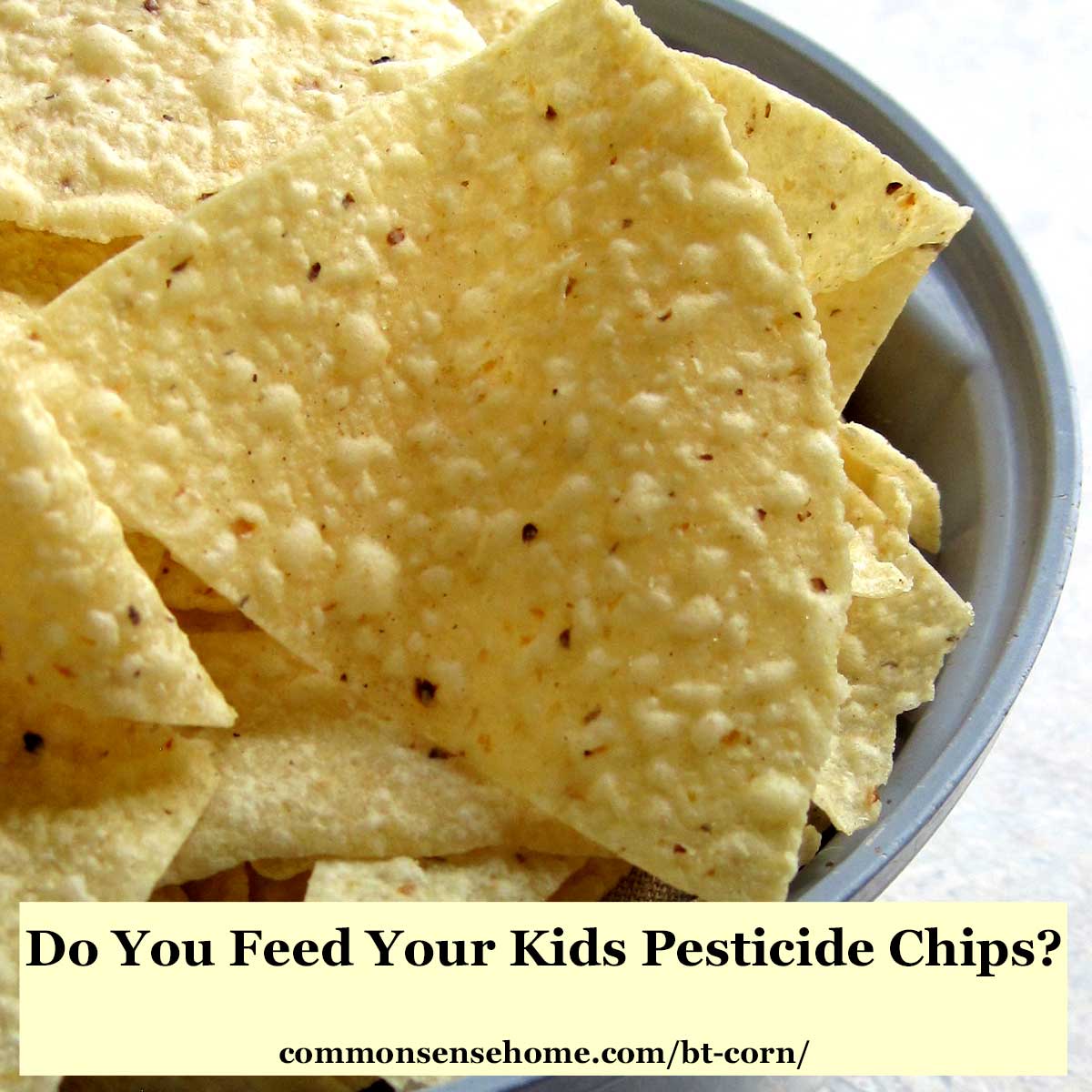
I did purchase pesticide chips for my kids, but I won’t be buying any more. Let me explain. I read A LOT about food. I’m reasonably sure that some would classify me as OCD about the whole thing. I’ve made a lot of positive changes in our family’s diet. Still, there were a few old “favorites” that we hadn’t given up, the above chips being one of them. Then I read this information from an article in India Today:
Fresh doubts have arisen about the safety of genetically modified crops, with a new study reporting presence of Bt toxin, used widely in GM crops, in human blood for the first time.
Genetically modified crops include genes extracted from bacteria to make them resistant to pest attacks.
These genes make crops toxic to pests but are claimed to pose no danger to the environment and human health. Genetically modified brinjal, whose commercial release was stopped a year ago, has a toxin derived from a soil bacterium called Bacillus thuringiensis (Bt).
Till now, scientists and multinational corporations promoting GM crops have maintained that Bt toxin poses no danger to human health as the protein breaks down in the human gut. But the presence of this toxin in human blood shows that this does not happen.
Scientists from the University of Sherbrooke, Canada, have detected the insecticidal protein, Cry1Ab, circulating in the blood of pregnant as well as non-pregnant women.
They have also detected the toxin in fetal blood, implying it could pass on to the next generation. The research paper has been peer-reviewed and accepted for publication in the journal Reproductive Toxicology. The study covered 30 pregnant women and 39 women who had come for tubectomy at the Centre Hospitalier Universitaire de Sherbrooke (CHUS) in Quebec.
None of them had worked or lived with a spouse working in contact with pesticides.
They were all consuming typical Canadian diet that included GM foods such as soybeans, corn and potatoes. Blood samples were taken before delivery for pregnant women and at tubal ligation for non-pregnant women. Umbilical cord blood sampling was done after birth.
Cry1Ab toxin was detected in 93 per cent and 80 per cent of maternal and fetal blood samples, respectively and in 69 per cent of tested blood samples from non-pregnant women. Earlier studies had found trace amounts of the Cry1Ab toxin in gastrointestinal contents of livestock fed on GM corn. This gave rise to fears that the toxins may not be effectively eliminated in humans and there may be a high risk of exposure through consumption of contaminated meat.
I’ve suspected that this might be the case for some time, that the pesticides persist in the GI tract, but I didn’t really want to acknowledge it. It’s a lot easier to just eat what you like. Those chips are whole grain, right? They must be good for you.
The thing is, even the government and agro-industry acknowledges that these crops are not food. The Pesticides Action Network explains:
Is Bt a food or a pesticide?
The regulatory authorities in the US have classified Bt crops as pesticides, thus placing responsibility with the Environmental Protection Agency (EPA) rather than the Food and Drugs Administration (FDA) which is responsible for genetically engineered organisms. However, Bt crops are not any old pesticide. The Bt poison is not an application like a chemical pesticide but a poison that is produced throughout the life of the plant. In practice, neither the existing pesticide nor the genetically engineered organism legislation is up to the task. The latest consequence of this shortcoming is an undignified row between the EPA and the FDA now that the first Bt potatoes are in US supermarkets. The FDA is responsible for labeling genetically engineered food but refuses to label the potatoes because they are classified as a pesticide. The EPA says that it cannot label the potatoes because they are being sold as a food. This is no doubt good news for Monsanto but hardly helpful to consumers who might understandably object to eating a pesticide when they thought they were buying a food.
Update: Bt potatoes are no longer being sold in supermarkets. The Non-GMO project states:
Genetically modified NewLeaf potatoes were introduced by Monsanto in 1996. Due to consumer rejection several fast-food chains and chip makers, the product was never successful and was discontinued in the spring of 2001. There are no genetically engineered potatoes in commercial production, and potatoes are considered “low-risk” by the Non-GMO Project Standard.
In the same post, Non-GMO Project identifies the top risk agricultural products (please visit their website for more information):
High-Risk Crops (in commercial production; ingredients derived from these must be tested every time prior to use in Non-GMO Project Verified products (as of December 2011):
- Alfalfa (first planting 2011)
- Canola (approx. 90% of U.S. crop)
- Corn (approx. 88% of U.S. crop in 2011)
- Cotton (approx. 90% of U.S. crop in 2011)
- Papaya (most of Hawaiian crop; approximately 988 acres)
- Soy (approx. 94% of U.S. crop in 2011)
- Sugar Beets (approx. 95% of U.S. crop in 2010)
- Zucchini and Yellow Summer Squash (approx. 25,000 acres)
ALSO high-risk: animal products (milk, meat, eggs, honey, etc.) because of contamination in feed.
This regulation system that classifies Bt crops as pesticides rather than food crops has been used in court to force municipalities to allow the growing of Bt crops within their jurisdiction. They can ban food crops, but they can’t ban the use of pesticides. Pesticide use is controlled by the EPA, and the EPA says Bt crops are fine. Well, they’re not food, but otherwise they’re fine. I remember reading about how the pollen from Bt corn kills monarch butterflies, and there is evidence that it’s contributing to colony collapse in bees. When I started digging a little more, I found out that Bt crops have been killing larger animals, too:
In India, animals graze on cotton plants after harvest. But when shepherds let sheep graze on Bt cotton plants, thousands died. Post mortems showed severe irritation and black patches in both intestines and liver (as well as enlarged bile ducts). Investigators said preliminary evidence “strongly suggests that the sheep mortality was due to a toxin … most probably Bt-toxin.” In a small follow-up feeding study by the Deccan Development Society, all sheep fed Bt cotton plants died within 30 days; those that grazed on natural cotton plants remained healthy.
In a small village in Andhra Pradesh, buffalo grazed on cotton plants for eight years without incident. On January 3rd, 2008, the buffalo grazed on Bt cotton plants for the first time. All 13 were sick the next day; all died within 3 days. Bt corn was also implicated in the deaths of cows in Germany, and horses, water buffaloes, and chickens in the Philippines.
In lab studies, twice the number of chickens fed Liberty Link corn died; 7 of 20 rats fed a GM tomato developed bleeding stomachs; another 7 of 40 died within two weeks. Monsanto’s own study showed evidence of poisoning in major organs of rats fed Bt corn, according to top French toxicologist G. E. Seralini.
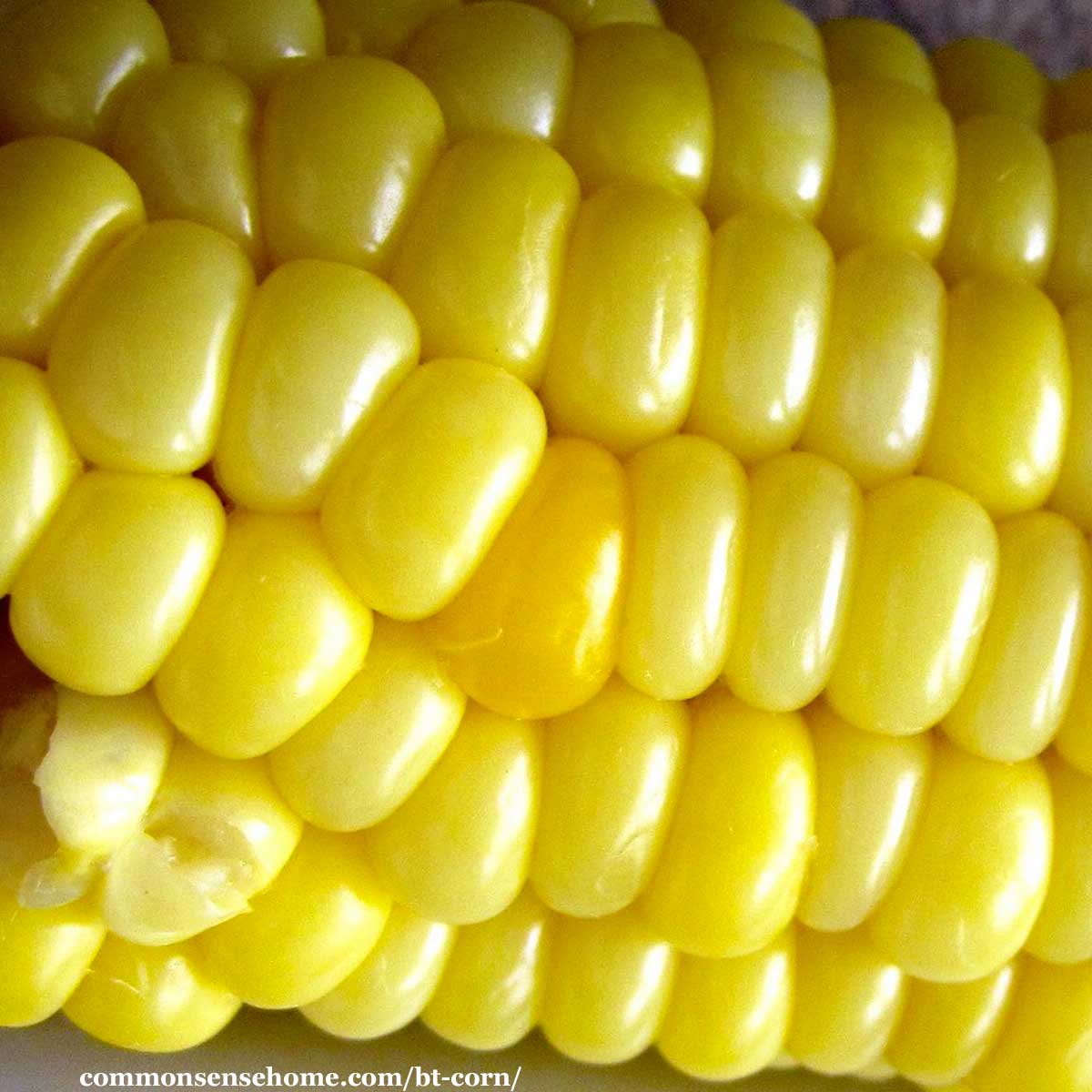
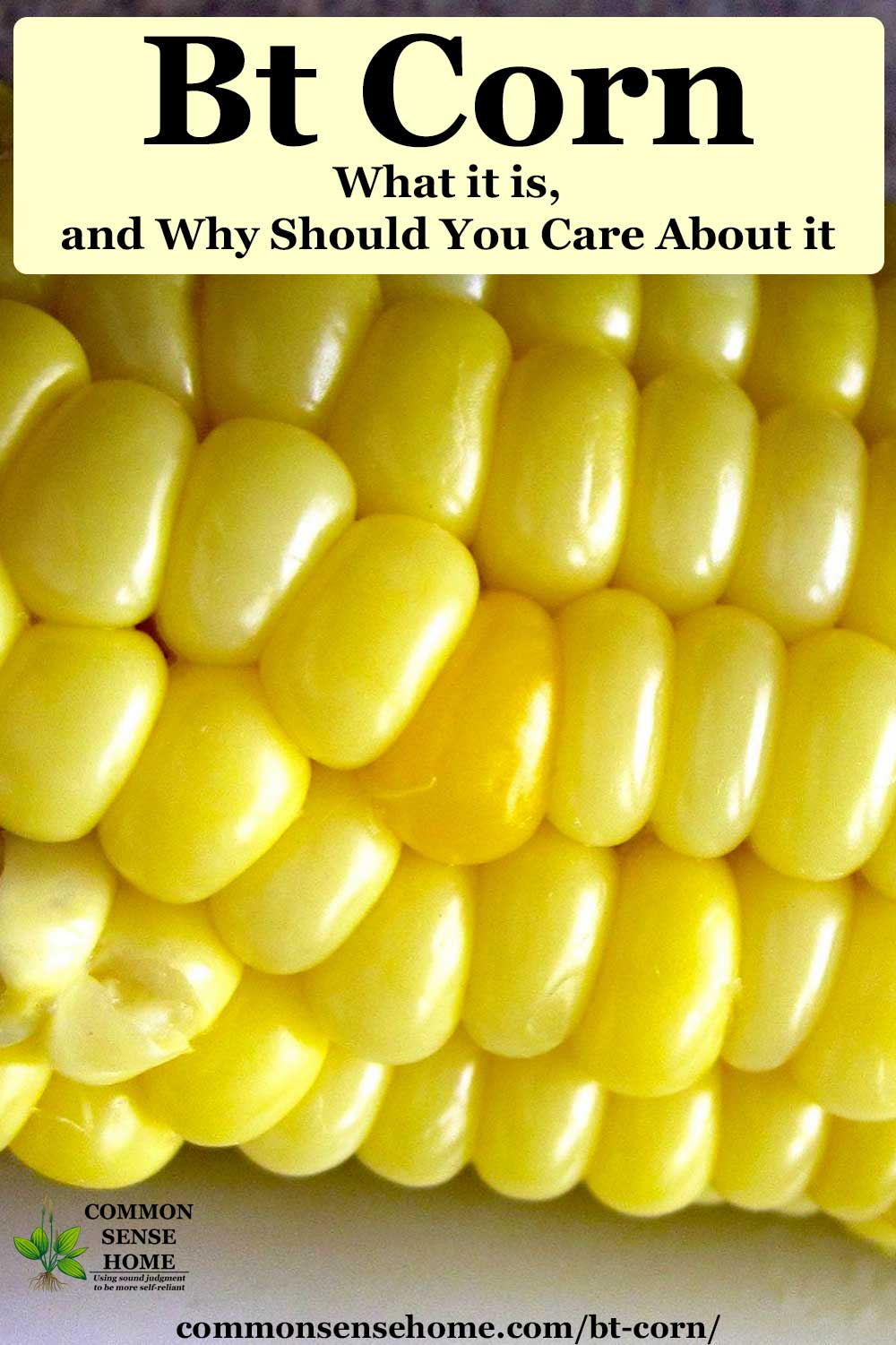
How likely is it that you’ve eaten Bt corn? About 65% of the corn grown in the United States is genetically modified to include Bt (Bt hybrids). The South Dakota Corn folks give some estimates of how much corn we eat:
According to the Corn Refiners Association, nearly 4,000 food items in a typical grocery store contain corn ingredients. And that number doesn’t include all the products—milk, eggs, meat, poultry—that come from corn-fed animals. Or the sweet, whole-kernel corn that comes in cans and freezer bags, and on the cob.
We’re getting a double whammy - remember, it’s been proven that the Bt toxin stays intact within the digestive tract.
So this is my latest food goal – get the pesticide chips out of the house, and work to eliminate the rest of the potential pesticide “non-foods”. This isn’t easy if you buy anything pre-packaged, as corn can hide in an amazing number of ingredients. This link gives a LONG list of potential corn allergens. Right now, organic products can not use genetically modified ingredients (hopefully that won’t change). Going grain free is another option, but I appreciate the long storage life of grains and still use them in moderation.
26 Responses to “Would You Feed Your Kids Pesticide Chips?”
Sorry, the comment form is closed at this time.

I saw this post on The Monday Mania over at the Healthy Home Econimist and I just HAD to read it and I'm so glad I did! We do not purchase anything that is not organic, unless it's local and I know how it was farmed/raised/grown. I'm definitely OCD about avoiding GM foods. I've watched so many documentaries and read tons of books. My heart truly breaks when my family rejects the notion that GM foods are bad and think that they cannot be that horrible and will help feed the hungry. Sigh. I wish I had more friends who I could talk to about these issues. Please write more, I would love to read your thoughts on all of this
Thanks for taking the time to leave a comment. I think the best thing that all of us can do is led by example and try to tell those who are willing to listen what we know. The internet is a powerful tool, and eventually it's my hope that we can make a difference by getting the word out and voting with our dollars.
Thanks so much for this. We have been changing our diet over the last 2 years or so and I am still amazed at how deep the deception goes when it comes to packaged food. We are doing a 30-day grain-free challenge and I'm shocked at how addicted I am! I'm subscribing to your blog – thanks so much for the great info!
Stephanie – I hear you! I get so frustrated when I buy a food that I think is "safe", only to get home and read the label in more detail and find it's not what I expected. I've cut back on grains, but going completely grain free would be really tough, especially for the whole family (at least for us). Good luck on your journey.
Wow love popcorn, just got organic kernels from the store, as I was popping my mom's non-organic orville redenbacher's kernels in the small jug. They say that corn is one of the most important stuff to avoid getting gmo (along with soy and wheat, i believe), but I never knew that the pesticide gene thing was a part of it!! Not to mention, gm crops are unethical, so I choose it because of that. so crazy to learn that one reason why you weren't doing something has more reasons why it's right. happens a lot when you take the plunge into making the better choice.
Cecile – yes, often "bad" food is bad on many levels.
As we adjust our food budget and slowly make changes, I realized that we eat a lot of tortilla chips, so they are now only organic! Thanks for this informative post; eye opening!
Danielle – we eat chips quite regularly with homemade salsa, too. I know I could make them myself, but there are only so many hours in the day, so meanwhile I'm buying organic.
I hate that I can't get chips anymore. The organic ones cost more than I am willing to expend on junk food, and the other ones are not, as you've pointed out, food. And now evil Monsanto is trying to ruin other things, too. Good grief, our yard is too small to grow wheat.
Laura – I've been experimenting with drying veggie "chips" in the dehydrator. Once harvest slows down, I may try blending up some corn and seeing if I could make some chips out of that. Any chance you could buy in bulk somewhere, or join a natural foods buying club? These are both ways I keep our food budget in line, but I know it can be tough.
Oh hell I am not sure I can take this. So much info and a bit freaked out just found your site a week or so ago and I agree, but am not sure how to manage it. I have been sick (am still sick) for a long time and I think it is from toxins that my body has been exposed too. I need basic 101 detox etc…..
Kathy – did you see the detox post? http://commonsensehomesteading.blogspot.com/2011/09/autoimmune-epidemic-can-detox.html
I'll be adding more as I explore options myself, but this seemed like a safe place to start.
This stuff drives me crazy, too. Poison food in the name of profit.
Costco sells organic tortilla chips at a very reasonable price and they are yummy!
[...] If you’ve got open water, mosquito dunks may be helpful, but a screen works just as well if not better. The active ingredient in mosquito dunks is “Bacillus thuringiensis subspecies israelensis” (Bt), which attacks the larval stage of mosquitoes. This is a naturally occurring soil bacteria. There are concerns that Bt will be loosing its effectiveness due to it being genetically engineered into corn. [...]
Just to add another twist to this (since you’re OCD and will probably want to research this as well) Bt is used (and approved) in organic farming. It isn’t without controversy, but it is another ugly twist to the whole issue. Also Bt is in mosquito dunks. I use mosquito dunks in my self watering containers that I grow my veggies in and it ultimately ends up in my veggies. From what I’ve read there are many variations of Bt, but my head spins when I try to figure it all out.
Cyndy, yes, Bt is used in organic farming, but it’s used very sparingly, by comparison, as a topical treatment, rather than impregnating the plant itself. Since it is basically a naturally occurring bacteria, it makes sense that their would be a variety of strains. Would there be a practical way to screen the standing water in your self-watering containers to keep the wee beasties out? Something else that might be worth experimenting with would be putting a couple drops of catnip essential oil in each container. Catnip oil is supposedly 10 times more effective than DEET as a mosquito repellent, and all natural – http://www.sciencedaily.com/releases/2001/08/010828075659.htm
Since oils naturally float on water, I suspect it would coat the water surface, making it less inviting for the little pests. The oil is fairly expensive, but a little goes a long way.
You can find catnip essential oil online at Mountain Rose Herbs (http://www.mountainroseherbs.com/index.php?AID=120969&BID=10697) or other online herbal sites. Mountain Rose and Frontier are typically my “go to” sites for oils and herbs, which is why I became an affiliate, to a recommend company I trust. (Frontier doens’t currently have an affiliate program.)
Just do the best you can with what you have, and slowly keep improving as opportunities arise.
Thank you! I like the idea of experimenting with catnip oil. Yes, a bit pricey, but when I decide to order it, I will come back and order through your page.
I really appreciate the info you pull together. It keeps my head from spinning less.
I bought my self watering containers a few years ago and now see improved designs which will keep the mosquitoes out. Slow improvements.
Looks like I missed this the first time around. (Thank you, Facebook!) I avoid corn products like the plague unless they’re organic. For now, I’m letting that be my guide. Of course, I know that there’s a problem with GMO contamination. And trusting the FDA to get it right is not 100% safe. But goodness. I find myself paralyzed sometimes when I’m at the grocery store! Plastic containers, GMOs, BPA, chemicals…
(I was also disturbed to read that GMO potatoes are on the market! Up til now I’ve been avoiding corn, canola, cotton, soy, sugar beets, and GMO papaya. The list keeps getting longer…)
I know! It’s just crazy going shopping. I figure that the less processed food we eat, the better off we are, but I try not to stress too much about every detail, because stress isn’t good for you, either. One day, one meal at a time.
Yo are the WOMAN. OCD be damned. I appreciate all the hard work you do for us!
I just get overwhelemd soetimes and don’t have good gardening skills.
So what is a girl to do? Buy all organic?
Bobbi – life’s a marathon, not a sprint. Just do the best you can, where you are, with what you have. If you change out just one food for a cleaner alternative, you’re better off than you were before. Every day, every week, every year that goes by I learn something new. Sometimes we still eat stuff that we shouldn’t, but we do it less and less. Baby steps are easier than a complete overhaul.
Did you ask the chip company if they use GM corn?
At the time of this writing, certified organic foods in the US are not allowed to use GMO crops. Given the prevalence of GMOs in certain crops, the odds of other non-certified organic products containing GMOs is extremely high. One woman filed a lawsuit against Frito Lay for advertising their products as “natural” while using unnatural (GMO) ingredients – http://readersupportednews.org/news-section2/312-16/9289-woman-sues-frito-lay-for-marketing-gmo-snacks-as-all-natural.
[...] Chopped Onion Sour Cream 2 bags tortilla chips, preferably organic (here’s why) Shredded Cheddar cheese Chopped [...]
[...] The best oils to use for infusions are pure plant oils such as olive, sunflower or almond oil. The oil I use most is olive, because it has a longer shelf life at room temperature. I wouldn’t advise the use of canola, corn oil or “vegetable” oil. Most of these will be made from genetically modified crops, which I do not recommend for consumption. (Read more here.) [...]
[...] you want to learn more about genetically modified organisms? You can visit my posts “Would You Feed Your Kids Pesticide Chips?” and “Is What We Eat and Drink Making Us Sicker and Dumber?” , or visit Say No to [...]