
5 Things You Need to Know Before You Buy a Wood Burning Stove

This post may contain affiliate links. Read my full disclosure here.

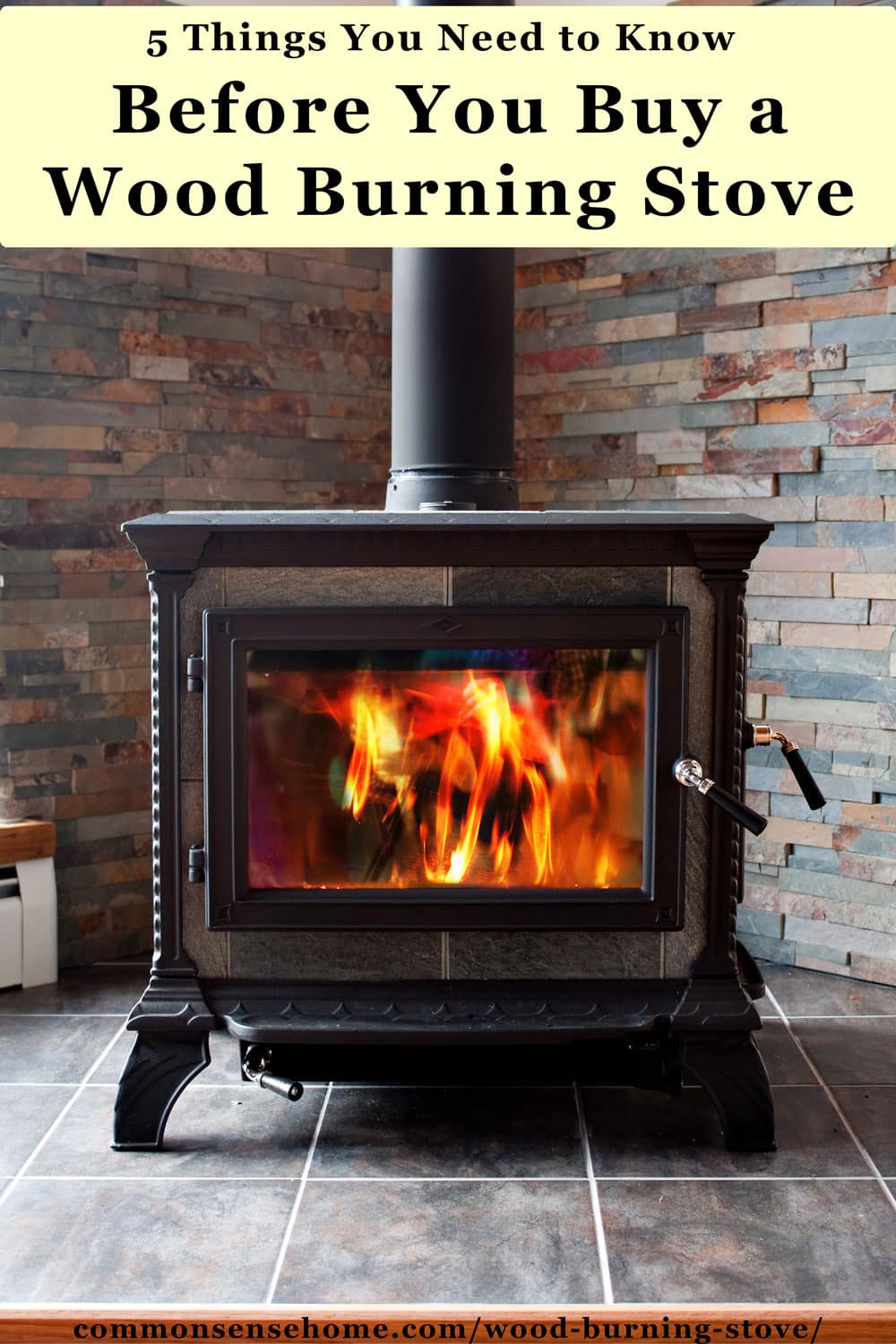
If you’re considering wood heat, here are a few things you should know before you invest in a wood burning stove, wood fireplace insert or wood cookstove. With rising fuel costs, wood heat can be a money saving investment, but you need to plan ahead and make good choices.
Would you like to save this?
Table of contents
- #1 – You Must Have an Ample Supply of Clean, Dry Wood for Your Stove
- #2 – You Need to Plan for Proper Wood Storage
- #3 – Heating with Wood Burning Stove is Labor Intensive
- #4 – Wood Burning Stoves are Not Cheap
- #5 – There are Risks Involved in heating Your Home with Wood
- The Satisfaction of Heating with a Wood Stove
- Related Articles
#1 – You Must Have an Ample Supply of Clean, Dry Wood for Your Stove
Some of the best trees to harvest for fire wood include:
- sugar and red maple
- hickory
- any of the oaks
- beech
- hornbeam (ironwood)
Hardwood species (like those listed above) will give you the best return on your investment of labor by burning longer and producing a lot of heat. These species are readily available in northern Wisconsin, but you’ll need to do some research to find what’s available in your area. For a detailed listing of the BTU content of various woods, visit FirewoodResource.com.
A wood lot can produce from 1 to 2 face cords of fire wood per acre each year. You may also be able to salvage some wood from tree trimming services, yard waste centers or storm damage.
I burn everything that dies in the woods at my house. This includes elm, aspen and birch, but not much softwood (such as pine). Softwoods burn quickly and produce less heat, which means that you need to refuel frequently and use a lot more wood overall. (Note: Pine does make good kindling for a quick start to your fires.)
Firewood should be “seasoned” or dried for at least six months to a year before you burn, to reduce creosote in the chimney and air pollution. Green (unseasoned) wood will burn slowly and produce a lot of smoke and particulates. When these build up in your chimney, it increases the risk of a chimney fire. This means you should be planning for next winter a year in advance.
#2 – You Need to Plan for Proper Wood Storage
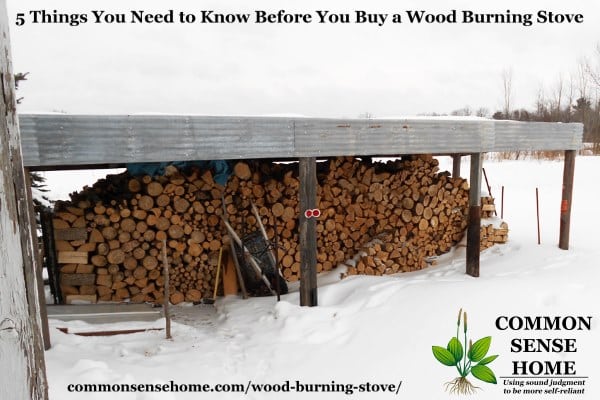
To cure (dry), wood needs good air circulation. This means a shed without sides or rows with tarps. Personally, I’m not a fan of tarps or plastic because the wind and the sun will tear holes in them in short order, and water will leak in.
You should also find something to stack the wood on to keep it off the ground. Old treated 4x4s are a favorite of mine. It doesn’t have to be fancy – salvaged materials used correctly can get the job done just fine.
Above is a picture of my wood shed. You might recognize it from the post about natural back pain relief.
#3 – Heating with Wood Burning Stove is Labor Intensive
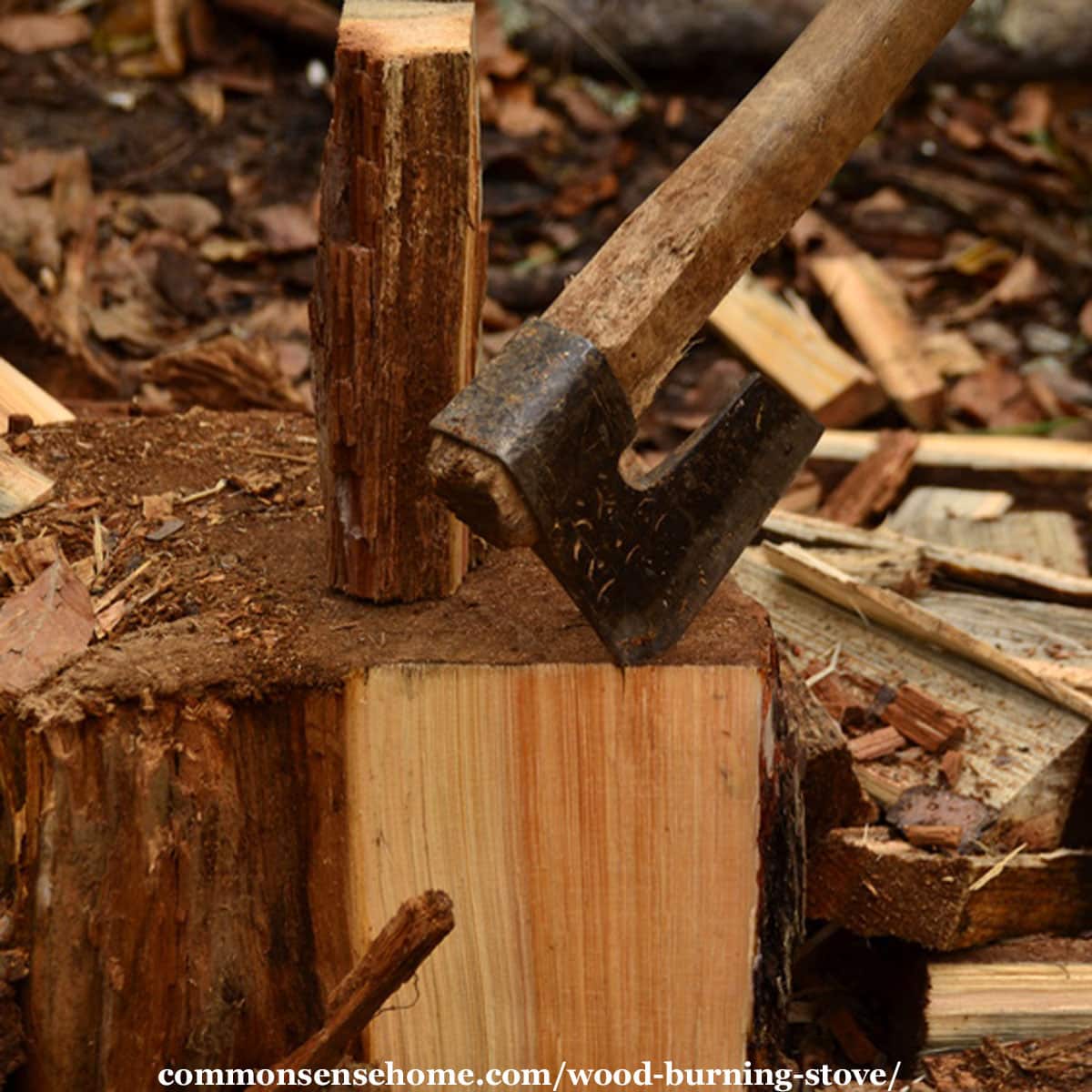
One thing that most people don’t think about is how much time you will have to invest in cutting and splitting wood to heat your home. If you cut a cord or two of wood, split, and stack it, you will be doing a full day’s work.
If you have back problems or other health problem you might want to consider buying your wood from a logger. There is also the task of keeping a fire. Most wood burners will require attention every 6 to 8 hours, maybe longer if you have a good furnace or outdoor boiler.
*Editor’s note – Our masonry stove is fired only once or twice per day, but burns a little different than a conventional stove.
On the plus side, you can skip the gym membership and get your workout at home.
#4 – Wood Burning Stoves are Not Cheap
The initial cost of a wood furnace will be about $3000 plus installation. Resale value drops quickly, so if you don’t think you are in it for the long term, any savings will be negated by the initial cost. (You *might* be able to get a deal on a used unit, but don’t count on it. Most people hold on to their stoves.)
Quality wood cutting tools cost money, too, and with tools, you generally get what you pay for – it’s worth the extra money to get tools that last. This is an investment – so make good choices.
Pellet stoves may be a better choice for urban areas, because you don’t need to dry and store a year’s worth of fuel.
Outdoor boilers are another option. You will lose some BTU’s because if the stove is outside the home, the water has to travel underground and be transferred to the home via a heat exchanger. If you choose an outdoor boiler, radiant heating is preferable to a forced air system, which would reduce your efficiency even further.
Masonry heaters are another option, but they may be more expensive than regular wood stoves or pellet stoves. See “What You Need to Know About Masonry Heaters for Radiant Heat” for more information.
#5 – There are Risks Involved in heating Your Home with Wood
Make sure your home owner’s insurance will cover you if you have wood heat, and what restrictions they have on heating with wood. Clean your chimney every year and check for problems.
Improper ventilation can lead to carbon monoxide build up, which can be deadly. (A carbon monoxide detector is a good investment for nearly every home, but especially those with combustion appliances.)
Creosote and Chimney Fires
Creosote build up is another concern. Mastersweep.com explains:
What most people think of as “smoke” is better termed “flue gas.” This “smoke”, or flue gas is released by the initial fire: the “primary combustion.” Flue gas consists of steam, and vaporized but unburned carbon based by-products (vaporized creosote).
As the flue gas exits the fireplace or wood stove, it drafts upward into the relatively cool flue where condensation occurs. Like hot breath on a cold mirror, the cool surface temperature of the flue causes the carbon particles in the warm vapor to solidify.
The actual cause of creosote condensation, is the surface temperature of the flue in which the flue gas comes in contact. This resulting carbon based condensation which materializes inside the flue is creosote. It’s usually black in appearance. It can be the fine black dust called soot, (1st stage creosote); or porous and crunchy, (2nd stage: see photo on left); or it can be tar-like: drippy and sticky, until it hardens into a shiny glaze, (3rd stage).
All forms of creosote can occur in one chimney system. Whatever form it takes, creosote is highly combustible. If it builds up in sufficient quantities – and ignites inside the chimney flue: the result is a volcanic chimney fire.
Several conditions encourage the buildup of creosote:
- A flue too large for the wood burning appliance, (e.g.. unlined insert)
- A restricted air supply
- Unseasoned or rain-logged wood
- Cooler-than-normal surface flue temperatures, (e.g.. metal fireplace chimney)
Please note the phrase “volcanic chimney fire” – ‘nuf said. Clean the chimney.
Chain Saws and Other Cutting Tools
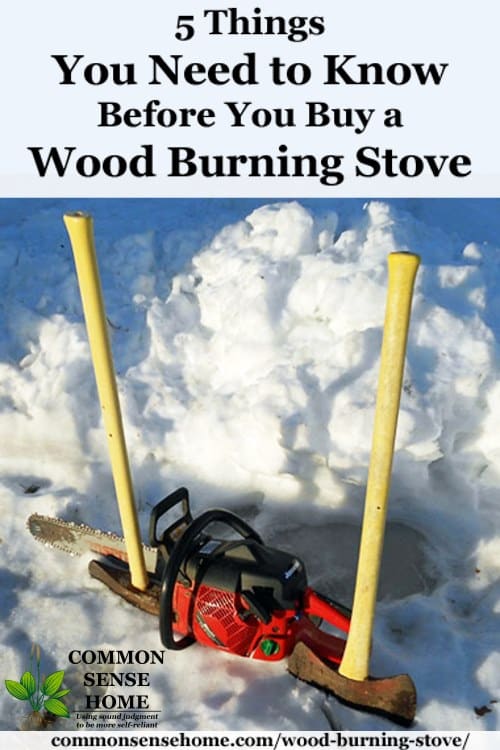
Chain saws and other wood cutting tools are dangerous. Anything strong and sharp enough to take down a tree can also go right through you. The chain saw is a tool the demands the utmost respect – poor judgment can leave scars that last a lifetime.
You should also invest in steel toed boots, logger’s chaps, safety glasses and a hard hat. Every year professional loggers die in the woods. It is definitely not something to do with the boys and a few beers.
The Satisfaction of Heating with a Wood Stove
I hope this post hasn’t scared you off of using wood heat. I’ve used it as my primary heat source for years, as have many friends and family members. It’s a good feeling to look out at a well-stocked woodpile and know that whatever happens to fuel prices, your home will be warm without breaking the bank.
Wood heat isn’t drafty and dry like a forced air system. The radiant heat from a wood stove soaks right into your bones. And, like the old saying goes, it’s the heat source that warms you more than once.

This post is by Laurie Neverman’s brother, Richard Poplawski. Since his service in the Marines, Rich has been a mechanic, fabricator and “fix just about anything” guy for over 20 years. He lives in northwest Wisconsin in the farmhouse that was owned by his grandparents, and maintains a large orchard and perennial plantings, as well as a vegetable garden. He loves spending time with his grandkids, introducing them to gardening or getting in some fishing with “Papa Rich”.
Richards other articles
- How to Grow the Best Raspberries You’ve Ever Tasted
- How to Grow Beautiful Blueberries
- Car Won’t Start in the Cold? Check Out these Troubleshooting Tips
Related Articles
Originally posted in March 2012, updated in 2016.
One thing you didn’t touch upon, the size of the wood to give max. heat. When my husband stocks the stove he uses the largest piece of wood he can fit into the stove. That is ok if all you want is to burn a log.BUT I use small and medium ( together ) for heat. He says that is wasteful because one very large piece burns longer
( Doesn’t give much heat ). How big around should the wood be to burn for max. heat ? Who knows, I may be wrong !!!
The btus contained in wood per unit volume does not change based on the size of the wood chunks. If you have the same amount of wood, in bigger or smaller pieces, it will contain the same number of btus.
What can change is how fast those btus are produced.
Small to medium pieces of wood will burn more quickly, putting out more btus in a shorter amount of time.
Larger pieces of wood burn more slowly, spreading the btu production over a longer period of time.
If you want more heat, faster, smaller pieces are the way to go – but you will burn more wood to keep producing heat at that higher level of output.
If you want to make the wood last longer and don’t mind a little less heat, then bigger pieces are the better choice.
With our masonry stove, we burn very small diameter pieces – very hot and very fast. Then we close down the fresh air feed and the chimney, and the heat of the fire is trapped in the masonry of the stove. The masonry stays warm for over 24 hours, radiating the heat to the room, but it’s hottest during and immediately after the burn.
How far away from a wood stove should you keep a computer, monitors and a TV? Having trouble finding the answer?
Hi Debbi.
It varies, because the temps around stoves vary.
If it’s too hot for you to sit in the spot where you’d like to place the electronics, then it’s probably too hot for the electronics as well. Computers, especially, generate a lot of heat (thus the cooling fans). Placing a computer in an uncomfortably warm location will shorten the life of the device.
Try sitting in the spot with the stove going and see how you feel, and adjust as needed.
I have been thinking about getting an outdoor wood furnace. It is good to think about how I should have somewhere to store the wood. Right now I wouldn’t have anywhere that would keep the wood dry.
Dry wood is very important for a clean burn.
You must MAKE a place for your dry wood before you get a wood-stove.
Place it where you can walk to it conveniently in winter, as carrying cord wood to the house is part of your wood stove “experience”.
You will have to make or buy a wood store. / wood-shed, / lean-to / log store –(google all these and price compare) You can buy them online, and I think they make DIY kits. Earlier in this blog woodpiles were discussed.
I run a flat top “woodie” great to put lidded pots of water on for slow boils for coffee , dishwashing ,shaving etc Free ..!! Ialso always run a magnetic thermometer ‘250 C’ — 500 F’ good burn temp soon attained with dry wood.. Lucky I’m a tree an (arborist) so have a good choice of wood but say to any one ,you can burn any wood if it dry ‘, for fun I say I can even burn water !! he he. lastly I would (wood?) suggest. Giving your local tree man a call for timber as if like me its great to dispose of locally & a little bit of gas & beer money easy covers it ( Gotta cut it tho!)part of the fun tho eh?? Gareth UK.
As long as the local tree guy doesn’t use all the wood or stock family and friends. 🙂 We have some fellows who do clearing nearby, and they are great for wood chips, but use the trees themselves.
the article is good and blunt about yhe need to put in yhe work with a wood stove. the one thing that i did not see is that everyonr should purchase an EPA certified woid stove. if yhd stove is a cheap chinese stove that is not certified then the stove will smoke when burned. Smoke leads to creasote. An EPA certifird wood stove burns that smoke and produces 30 to 50% more heat from each piece of wood. so you need less wood to heat yhe same space. no one is getting any younger so less wood usage is a good thing. also anyone yhinking of burning woid should look at Woodheat.org for tips from preparing wood to burning it better. its a good place to be reminded of all of the stuff that we forgot about burning wood
We are considering a wood stove. Why? We have twelve acres of trees that need thinning. More importantly, our propane furnace has an electric ignition and fuel regulator. If we get a good storm, that furnace will be as useful as a swimming pool in January. A back up plan is smart when you live way out in the country and help is a long time coming.
If you have the wood as a resource, it surely makes sense to use it.