
Common Ragweed – Tips to Beat Ragweed Season – Weekly Weeder #7

This post may contain affiliate links. Read my full disclosure here.
Today’s featured Weekly Weeder plant is common ragweed, Ambrosia artemisiifolia. In this post, we’ll explain what ragweed is, identify prime ragweed season, share some ragweed pictures, and talk about ragweed allergies and control.
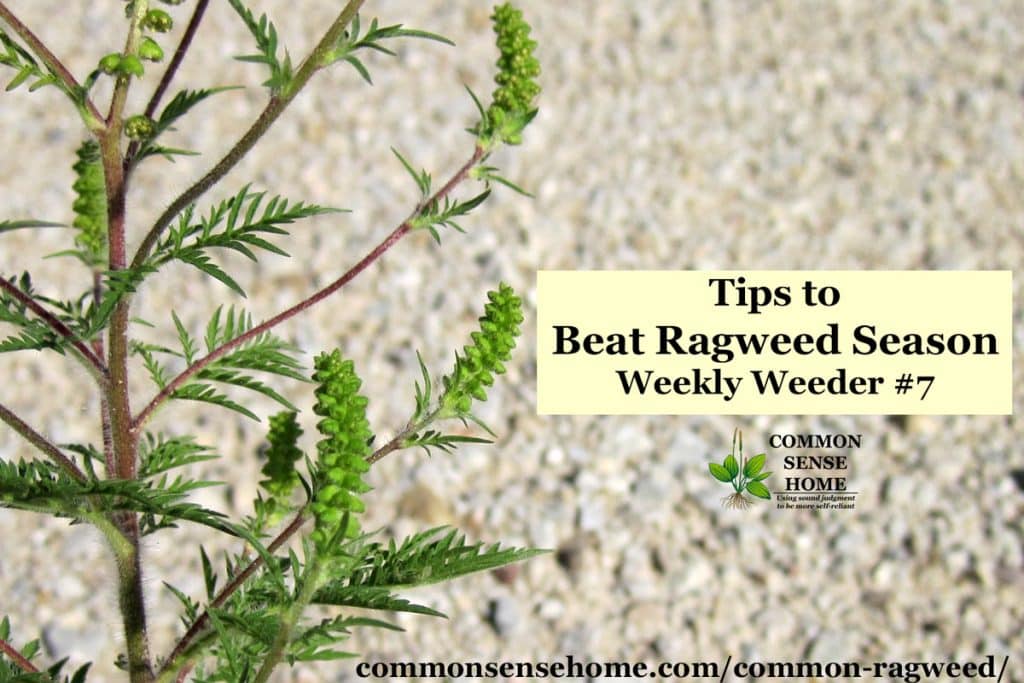
Common ragweed is also known as ragweed, hayfever weed, bitterweed, bloodweed, crownweed, mayweed and bane of allergy sufferers everywhere. Some other common ragweed species include bur ragweed, giant ragweed and western ragweed.
Table of contents
What is Ragweed?
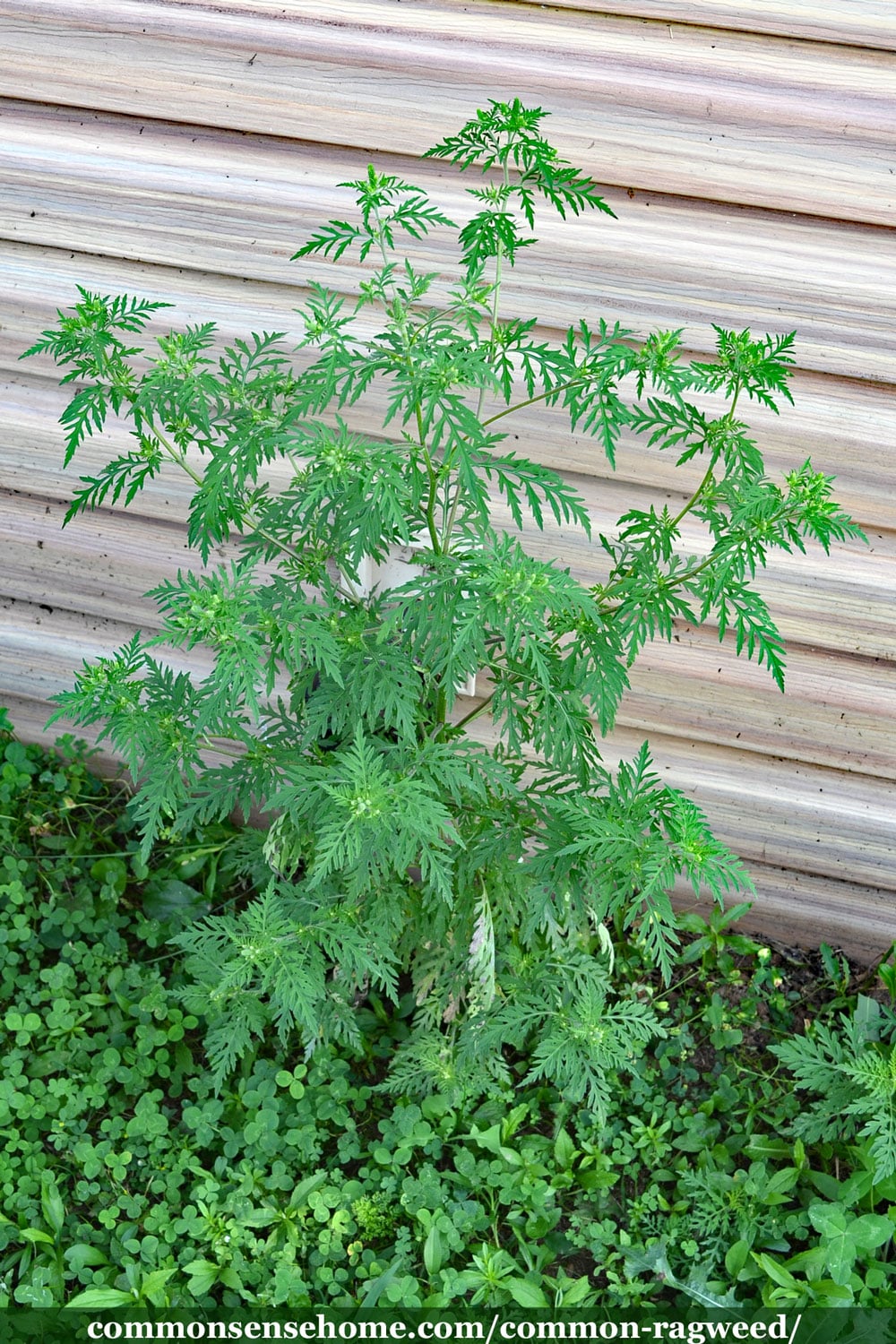
Ragweeds are common weeds that thrive in disturbed soils. Giant ragweeds can get up to 18 feet tall, but common ragweed typically ranges between a few inches and a few feet. It can hide out along the edge of a lawn or driveway, get mowed, and still manage to flower. When it does flower, it releases an amazing amount of pollen, which is the primary culprit in pollen-induced allergies in the United States.
The seeds of this amazing plant can lie dormant in the soil for over 40 years, waiting for the right conditions. Ragweed specimens are showing up that are resistant to glyphosate (Roundup), so standard weed killers won’t knock it out.
Where Does Common Ragweed Grow?
Common ragweed is native to North America, and is found throughout the United States and most of Canada (See USDA map below). (Aren’t we lucky?) It has also spread over much of Europe, where it has become a problematic invasive species.
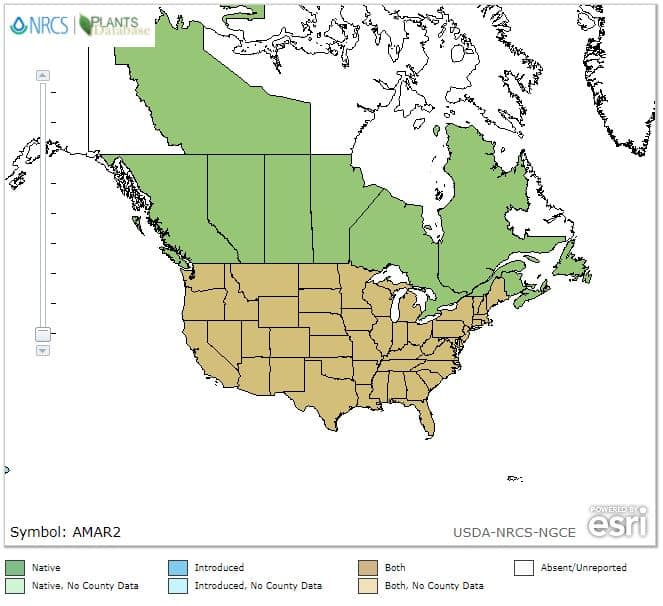
Ragweed thrives where other plant struggle – wastelands, vacant lots, aged pastures, stubble fields and other disturbed soils. It prefers full sun, disturbed and slightly acidic soil, and can tolerate (and thrive in) drought.
Where drought or poor soil moisture transfer make potassium unavailable, conditions favor ragweed growth.
Common ragweed is an annual, but it produces thousands of seeds that last virtually forever. Up to 32,000 seeds have been recorded on a single plant.
What does Common Ragweed look like? Ragweed Pictures
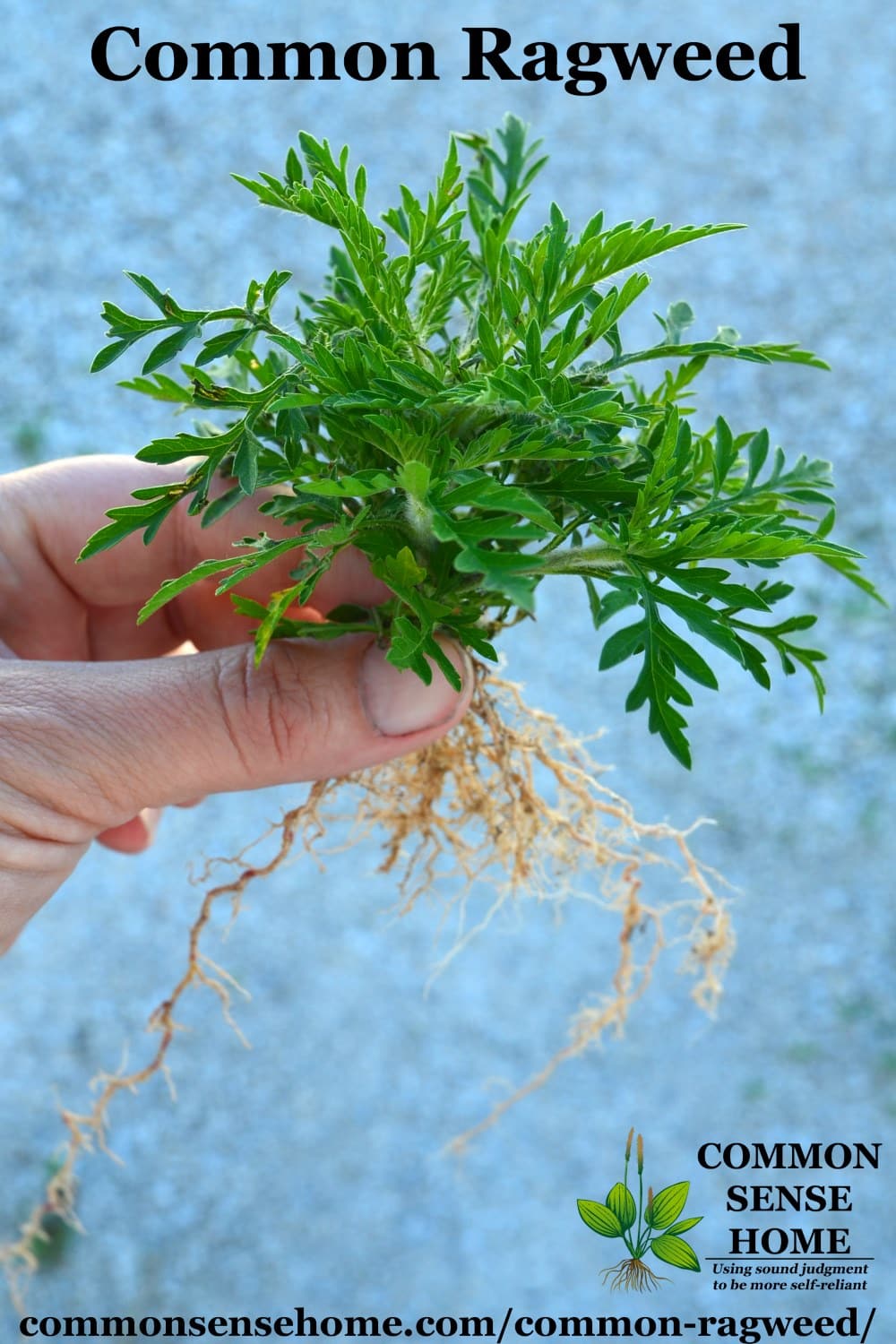
The individual leaves are fern-like. It looks pretty innocent when it’s small.
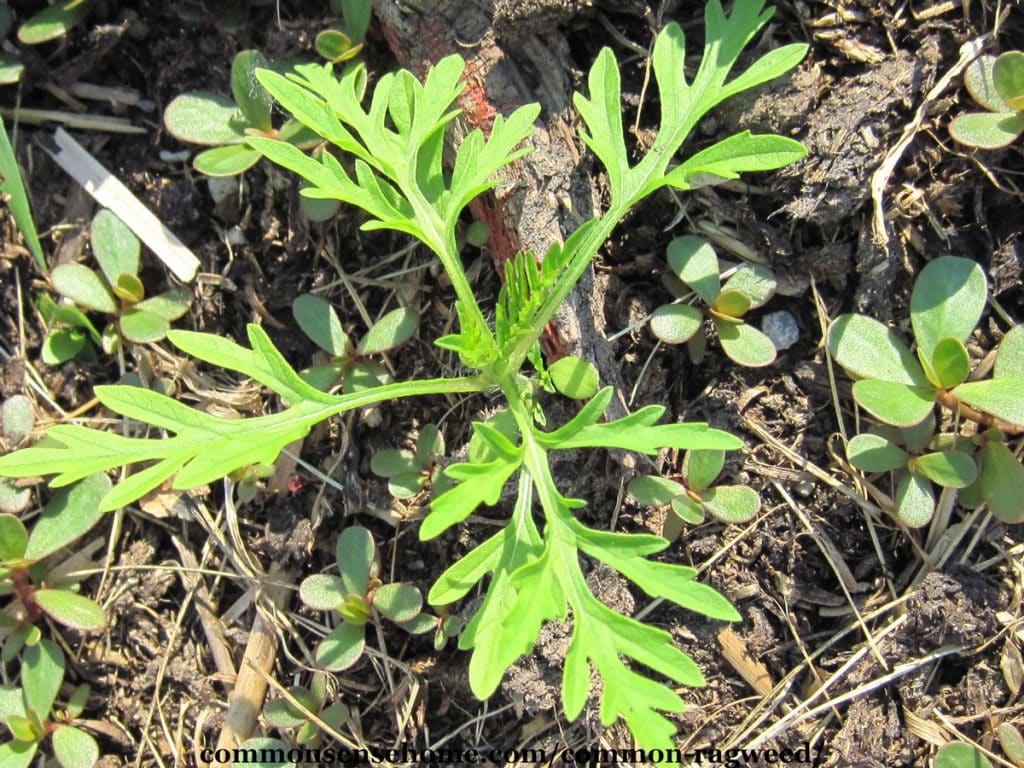
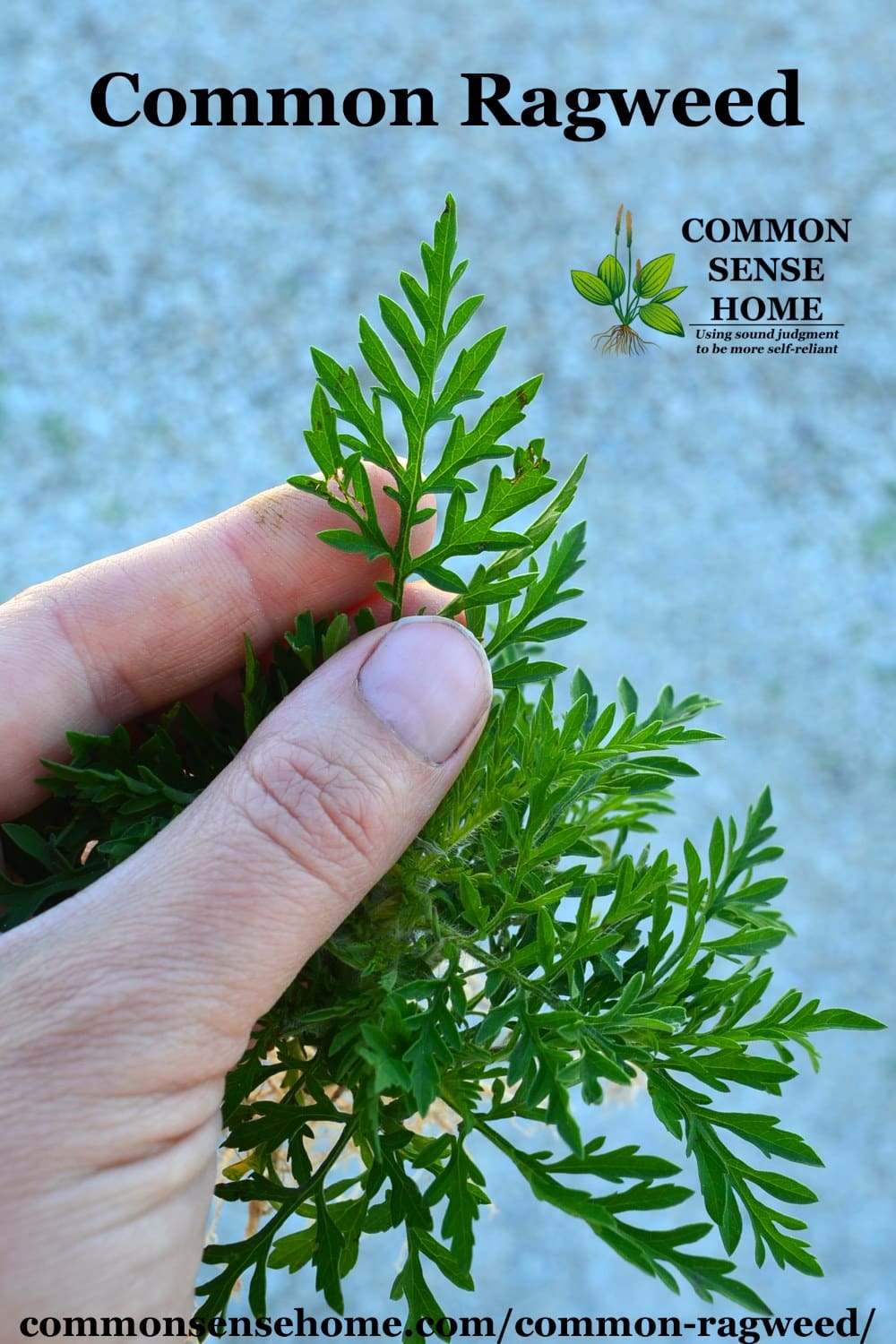
Common ragweed stems are fuzzy. The stems are filled, not hollow.
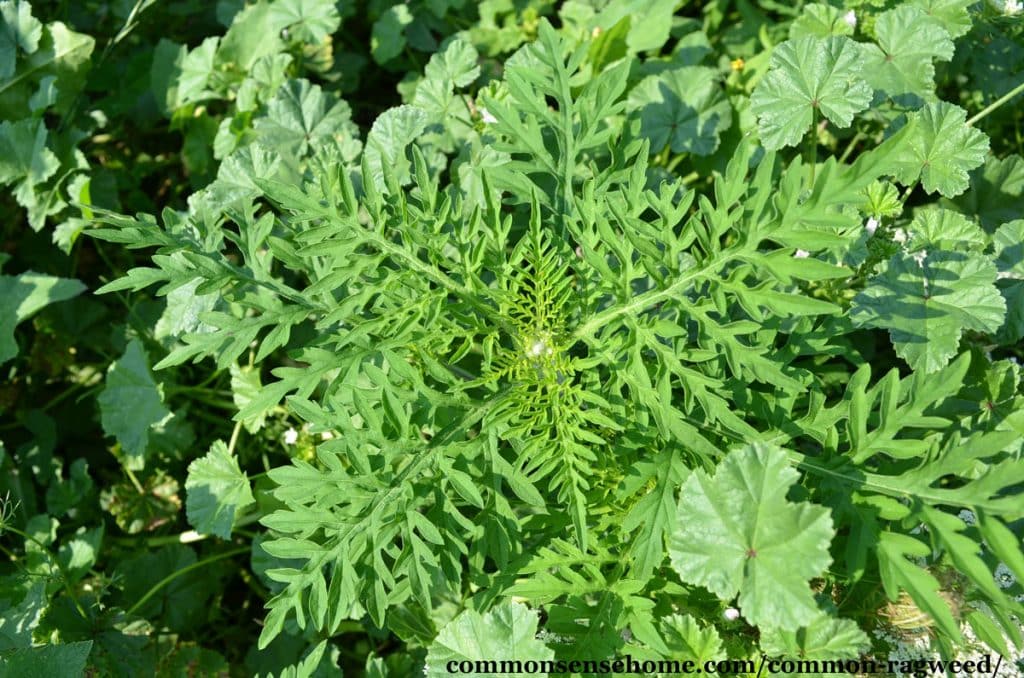
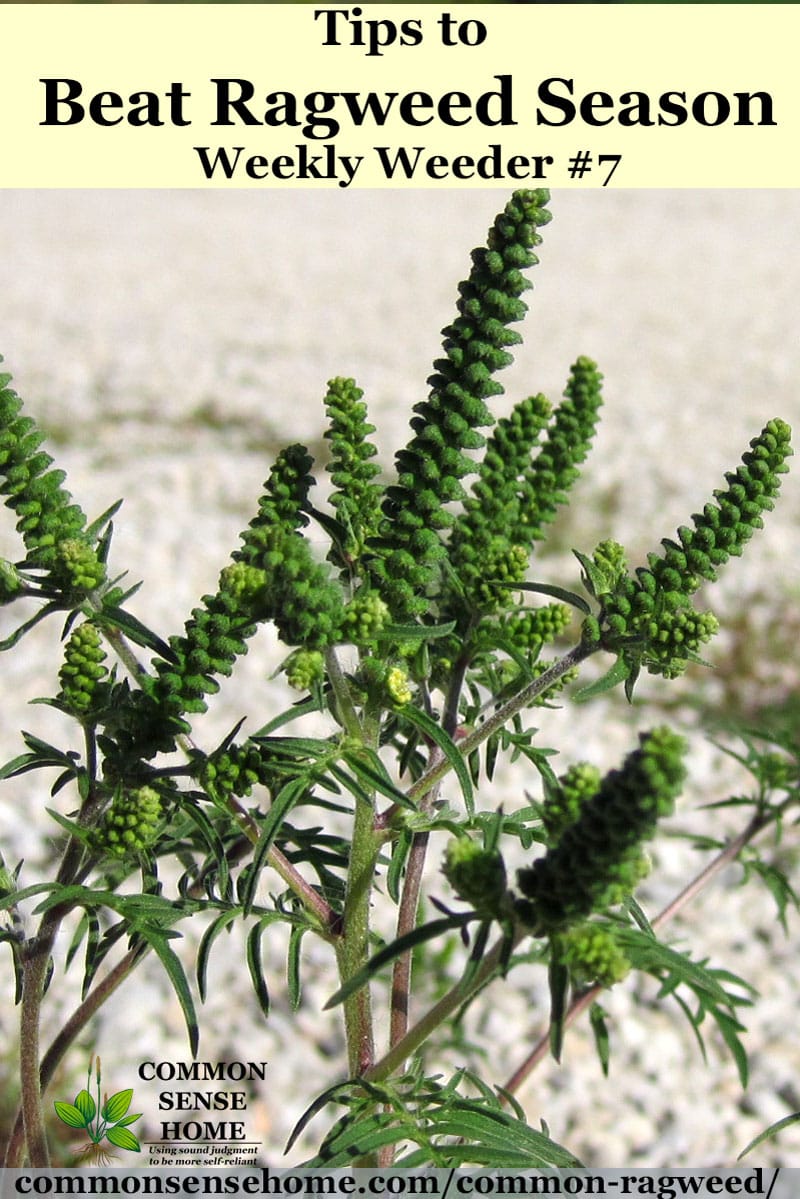
Ragweed plants are in the genus Ambrosia in the Aster family, which means they are related to daisies, asters, dandelions, chamomile and many other flowering plants. Unlike their showy cousins, ragweeds have drab green flower spikes.
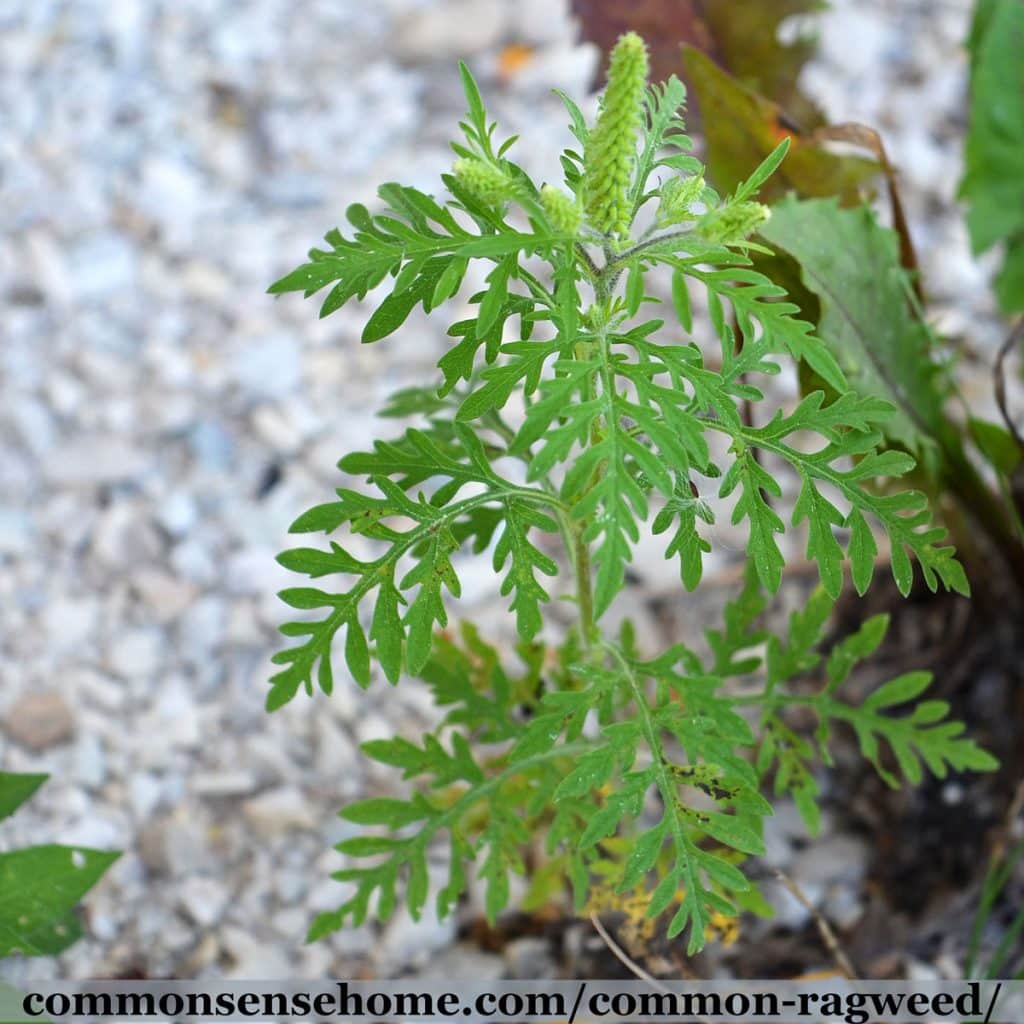
When is ragweed season?
Ragweed season peaks in fall, typically around mid-September. The pollen development in ragweed species occurs when temperatures drop below 60 and the nights get longer. August through November are the worst months for those affected by ragweed allergies.
Ragweed plants are killed by hard frosts. With some locations having later fall frosts, those areas are also experiencing a longer ragweed season.
Even if you don’t have ragweed growing in your yard, ragweed pollen is small and light. It can travel up to 400 miles on the wind, sometimes triggering ragweed allergy season in areas where the ragweed isn’t in bloom yet.
Ragweed Allergy
Some studies indicate that ragweed produces up to 90% of the allergy causing pollen in the United States.
Ragweed allergy symptoms include:
- Sneezing
- Runny nose
- Nasal congestion
- Headaches
- Eye and throat irritation
- Aggravated asthma symptoms
- Other cold-like symptoms
If you are one of the folks who suffer from a ragweed allergy, unfortunately there is no cure. There are pharmaceuticals available to help treat ragweed allergy symptoms (some of them made from ragweed). These are often started before ragweed season hits.
In the article “Like Treats Like: Ragweed to Treat Allergies”, they discuss several historical uses of ragweed as an allergy treatment, including one from Matthew Wood’s Earthwise Herbal:
“Wood recommends that the fresh leaves fresh be tinctured 1:2 in 95% alcohol watered down to 70%. He recommends giving only one drop initially to determine sensitivity. If there is no adverse reaction or an improvement in symptoms, five to 10 drops be given every two to three hours.”
As noted above, ragweed is in the same genus as chamomile, so if you suffer from ragweed allergy, it’s best to avoid chamomile tea.
Those who are sensitive to ragweed may also suffer from oral allergy symptoms that make them sensitive to certain foods, including cantaloupe, banana, zucchini, mango, beans, celery, hazelnuts, potatoes and various other foods. Peeling or cooking these foods may help.
Would you like to save this?
Managing Ragweed Allergies
If you are one of the folks who is bothered by ragweed pollen, unfortunately there is no cure. I’ve noticed that when I watch my diet (plenty of fat to keep nasal and lung membranes well lubricated, plenty of live culture foods, less sugar), my allergy symptoms are much milder. For more help, see 15 Home Remedies for Seasonal Allergies and Hay Fever Symptoms.
Ragweed pollen counts tend to be highest in the morning, so plan your outside activities accordingly. Keep windows closed and use a good whole house filter and/or a room air filter in your bedroom for better sleep. Pollen sticks to clothing, pets and line dried laundry, so swap clothes and wash up after exposure. Skip line drying.
There is some good news for folks living in coastal areas – humidity levels above 70% cause ragweed pollen to clump, reducing the amount that goes airborne.
Ragweed Rash
I found out the hard way that direct skin contact with ragweed plants can cause mild contact dermatitis, AKA ragweed rash. About a day and a half after a pulling number of ragweed plants bare handed from the side of the driveway, I woke up with a palm full of small, itchy bumps. DermNet NZ confirms I’m not the only one with this reaction. I put some plantain oil on the ragweed rash and the itching subsided.
Ragweed vs Goldenrod
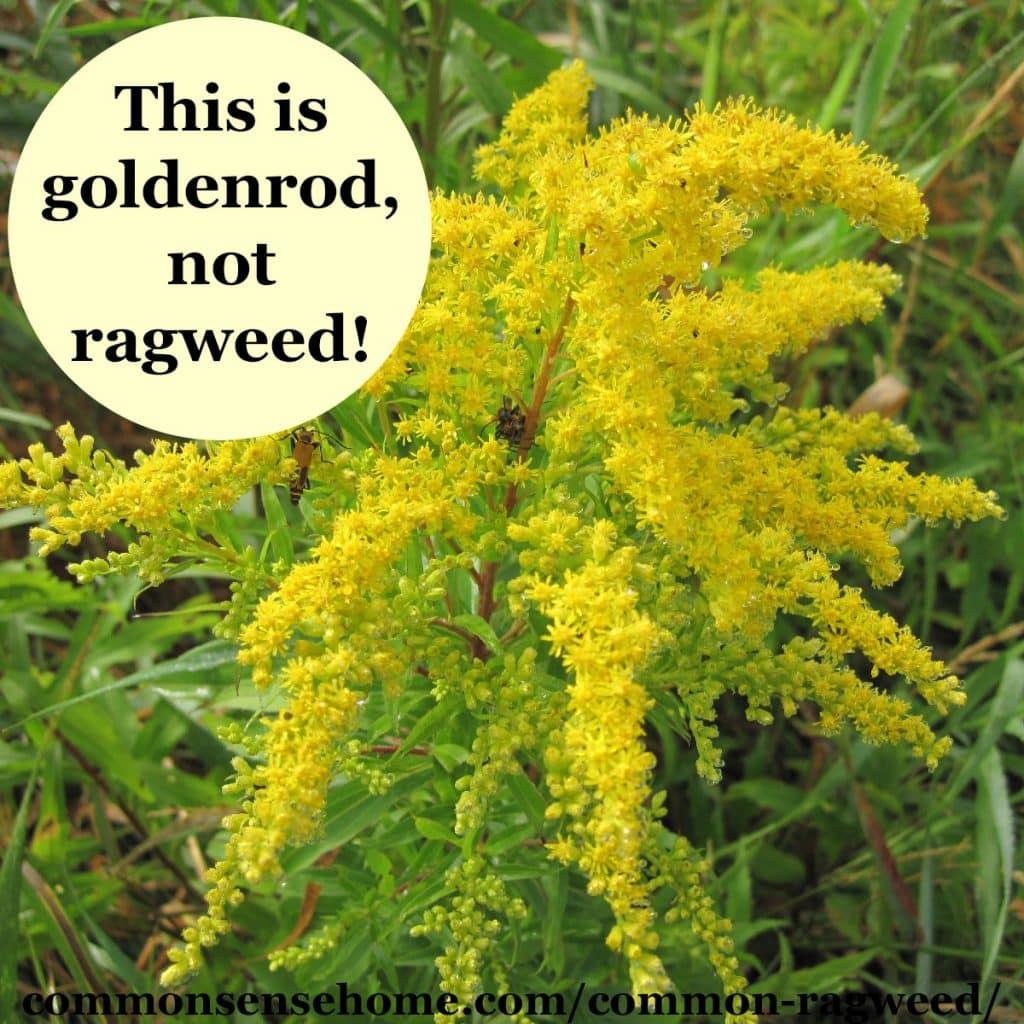
Because ragweed and goldenrod both bloom in the fall, many people mistakenly blame their ragweed allergy symptoms on goldenrod, because the flowers are more visible. I even saw allergy sites posting photos of goldenrod and calling it ragweed while researching this article.
While it is possible to have a goldenrod allergy, it’s much less common. Goldenrod has larger pollen grains that don’t easily get carried on the wind – or up your nose.
Medicinal Use of Common Ragweed
Judith C. Evans states in her article “History and Medicinal Uses of Ragweed”:
Ragweed’s medicinal properties include: astringent, antiseptic, emetic, emollient, and febrifuge. Early American physicians recognized ragweed’s medicinal uses, and Native Americans valued it as a topical and internal remedy. Healers and herbalists prepare remedies from the roots and leaves. Crush the leaves and apply the juice to soothe insect bites and poison ivy rashes. Native Americans prepared a poultice from crushed leaves to relieve swelling and prevent infection.
Ragweed also provides aid for internal ailments. Herbalists value ragweed root tea as a remedy for nausea, fevers, and menstrual disorders; Native Americans used the root tea as a laxative. For years, Ozark herbalists have treated diarrhea with tea prepared from the leaves. Ragweed pollen is used in homeopathic remedies for treatment of hay fever symptoms.
I would suggest care with internal use of ragweed, especially if you have any type of allergic reaction to the pollen. Next time I get a mosquito bite, I may try the sap to see if it does indeed soothe the itch.
Ragweed as Food and Habitat for Wildlife
Believe it or not, ragweed is useful. It produce seeds that are rich in oil and provide winter food for birds and small mammals. Fairfax County Public schools website states that “Ragweed is a good source of food and cover for wildlife. Eastern Cottontails eat the plants, and insects, such as grasshoppers, eat the leaves. Some animals which eat ragweed seeds include: Meadow Vole, Dark-eyed Junco, Brown-headed Cowbird, Northern Bobwhite, Purple Finch, Mourning Dove, American Goldfinch, and Red-bellied Woodpecker.”
(Side note – the seeds of giant ragweed are edible for humans, too. They have 47% crude protein, more than other cultivated grains, and were once cultivated by Native Americans for food.)
Note: Ragweed gives milk an “off” flavor, so it’s best to limit ragweed growth in pastures. (See below.)
Ragweed Control
In the book “Weeds: Control Without Poisons“, the author notes that ragweeds proliferate where drought and lack of moisture availability in the soil makes potassium unavailable. Hardpan, gravel, compacted soils, crusty soils are all prime ragweed territory. As soil improves, other plants will likely out-compete the ragweed.
In my yard and garden, the usual soil measures (adding compost and organic fertilizers, mulching) have virtually eliminated the ragweed. The primary spots we still see it are around the edge of the driveway, and on compacted, dry soils.
For control in fields and pastures, “Weeds: Control Without Poisons” specifies: “Manage ragweed with manganese, copper, vitamins C and B-12, calcium, phosphate and sugar in a solution. Determine quantities on site according to test readings.” The author also encourages tillage and mowing to knock back the growth.
Why Weeds?
The word “weeds” often has a negative connotation, but I think of them simply as plants not purposefully planted. They are often useful, and fill a spot where something needs to grow. (If you don’t plant, Mother Nature will.)
Our weeds hold the soil in place, plow compacted subsoil, draw up nutrients, provide medicine, feed wildlife (and people) – they are a treasure, not a curse. As you tend your yard and garden and the soil improves, unwanted volunteers will either disappear on their own, or be much easier to manage.
Recommended resources:
- Wildflowers of Wisconsin
- Nature’s Garden: A Guide to Identifying, Harvesting, and Preparing Edible Wild Plants
- The Forager’s Harvest: A Guide to Identifying, Harvesting, and Preparing Edible Wild Plants
- Backyard Foraging: 65 Familiar Plants You Didn’t Know You Could Eat
- Edible Wild Plants: Wild Foods From Dirt To Plate
Thanks so much for stopping by to visit. Help stop the overuse of herbicides by spreading the word about putting our weeds to work and sharing this post.
You may also find useful:
- Top 10 Edible Flowers, Plus Over 60 More Flowers You Can Eat
- The Weekly Weeder Series
- My Favorite Wildcrafting Resources
Originally published in 2011, updated in 2017, 2018.
My father used to work outside all day long. At the end of a hot, humid day he would sometimes get a heat rash under his arms. (sometimes elsewhere, I wont say where…)
He said if you grab a handful of ragweed, crush it a bit between your hands and stick it in your shirt pocket (or jean pocket, depending on the location of the heat rash) it would heal the rash within a day or two.
He swore by this. My grandparents all did the same thing for heat rash.
I’ve never tried it because I wasnt sure which weed was ragweed. I didnt want to grab a handful of poison ivy and crush it up.
Just wanted to throw in my two cents worth.
That’s the first I’ve heard of that remedy. Thanks for sharing, Julie.
Thx,, you guys are so sweet! What About adding potassium? You mentioned earlier in the article.
Ragweed Control
In the book “Weeds: Control Without Poisons“, the author notes that ragweeds proliferate where drought and lack of moisture availability in the soil makes potassium unavailable.
Alot to think about. Ragweed is about 2 inches tall right now. I will have to harvest some. I am converting a field back to natives and wondered what creatures benefitted from ragweed . I had not considered that the one benefitting could be me. I have alot of birds that could eat the seeds.
But we also have allergies.
And that seed bank becomes very evident after a burn!
I read a lot about ragweed in foreign languages as well for medicinal use. The good things I learned were almost hard to believe. So having IBS I felt always good having Glutamin and bitters like milk thistle extract etc. I also discovered that quite a few bitter based alcoholic drinks were available in liquor shops.
COMMON RAGWEED also has bitter flavour extracted from young leaves and found recounts telling about how the young leaves can be chopped up and used in salads or simply chewed if one can put up the bitter flavour.
Well I felt brave enough to experiment with the young leaves , by FIRST just chewing and swallowing a fraction of a leaf. Experiencing no unpleasant reaction the following day I went on chewing (slowly sucking) and swallowing a whole young leaf. As a result I felt somewhat stronger ( I am 71) in all my joint and encouraging regularity in my stool frequency without the usual urgency feeling.
Well I said to myself perhaps it’s pure psychology!!! Nevertheless I persisted the regular ONE leaf on empty stomach every morning. In 3 months I kept chewing the bitter leaves and I felt a lot younger man and my IBS magically subsided. I continued on combining milk thistle with my Common Ragweed intake. Then I thought when winter comes I won’t have young CR (common ragweed) leaves to chew so I decided to harvest the leaves of young plant dehydrated them in the open air but not in full sunshine and built up a huge jarful of CR tea. This way I switched to sipping CR teas 3 times at least during the day. (simply poured boiling water over the dry leaves let it soak for 1 hour or even overnight).
Well this is my personal experience with my cherished friend the CR. Some people call it enemy because it causes allergy. Apparently its pollen lodged in the nasal passages when sprayed with the sulfuric exhaust fumes of car emissions triggers the allergic condition and not the pollen by itself.
I do not sneeze, my digestion 100% improved, I am not concentrating on IBS when I am out and about, feel much more energetic, ask my wife.
For me CR experience was a god-sent event and the cheapest pharmaceutical bill. Some people and authorities hate it others like me call it best friend who helped improve my problems. Some local authorities spray it with poison to exterminate it as vermin, so be alert and KNOW how to identify the plant, do not collect them from the car exhaust poisoned roadsides or the Council sprayed locations.
We have lots of medicinal plants right under our feet but please always call on herbalists to identify the plant that you want to use. There are serious poisoning dangers involved. I took the risk and it worked out for me and it might not be a solution for you. Remember we are all different in spite of the shared scientific genome identity covering all humans.
Thanks for sharing your experience, Frank. The more I learn about “weeds”, the more I’m convinced that they can teach us a lot about healing the earth and ourselves, if we’d only take the time to pay attention (like you did).
That so called healing weed would kill me if I ever dreamed of ingesting it. It is damn near killing me now. If you don’t know what you are doing it is best to not play around IMHO. I wish this rag of a weed were exterminated from the face of the earth!
Thank you Frank, I’m a bit chicken to try new herbs. Hence your personal experience is very reassuring.
We’re in the month of April, littler ragweed covers my garden like a green carpet, the little red beets that I planted are barely visible. I spent a couple hours on my knees pulling the little weeds out from around my beets. My niece asked me if I was praying. I had the pile, a few pounds of weeds in a large pan. She cooked them up with the other potherbs I usually bring in from the garden and we ate them.
About one serving of the greens and I was full. It tasted strongly of chlorophyll. I felt energy from the plants all afternoon and we both worked weeding the garden till dark, came in and then I looked up this blog to find out about what I have been eating that gave me so much energy. Ragweed is not delicious but tolerable with other potherbs such as lambs quarter, small asparagus and kale, but it sure provide for an active day.,
thanks for sharing your experience. i haven’t tried eating the young greens yet, but this may be the year I get daring. My tastes are changing as I get older and shift my diet.
My husband has farmed for 60 years and he says the definition of a “weed” is any plant growing out of place. ie an oak tree growing in a corn field is a “weed”! Through mans ignorance many healthy ‘weeds’ are killed!
Who knows? Maybe one day we’ll find out ragweed is a miracle cure for something?
Have you ever heard of Chuffa? I got the seeds from Bakers Creek. They are grown like corn, and are a ground nut similar to peanuts kind of. Was interested in find out the nutritional values. We planted ours in pots as we don’t want it to take over the world. It is said to be very invasive. Give me some thing unusual…and I have to plant it!
lol – that sounds like my experience with sunchokes. Be careful! Those things are trying to take over my garden, and they regrow from the tiniest bit of plant.
I’m glad you trade with Baker Creek, they are the best! I live near their farm in Missouri and grow rare seeds for them.
Wonderful! It’s so important to keep unique breeds cultivated.
Thank you, Heidi, for taking time to comment and spreading the word about the blog. I'll bet your classes are very interesting.
I have been going to school for three years for plant biology/crop science and I really enjoy your blog. I always learn something from you. I added your button to my blog today. Thanks for taking us all to school for FREE each week. I appreciate it.
I didn't find out what it was myself until a few years ago when friends were visiting and pointed out that I might want to remove the big, healthy patch of it near the front door….whoops! We had a lot of disturbed grounf because we had just built, which is ragweed heaven. The pollen grains are covered in tiny spines, too. Ugh!
So that is what that plant is!! I am the worlds worst gardener… well maybe not the worst as things do grow.. but I dug up a plot of land and occasionally throw some flowers in it that I see at the store. After a few years I have no idea what is really a plant and what is a weed. I've seen this pop up from time to time, and now at least I know what it is.
This is one weed I don't feel bad about removing from the yard and garden. With seeds that stay viable for over 40 years, I'm pretty sure I'll always have a new crop. Please stop back and leave a note if you find it successful in being something other than a nuisance and critter food.
Good article! I didn't realize ragweed was good for anything, but irritating my allergies and my skin! I will have to see what I can do with it (while wearing gloves of course!)
"changing weather patterns"…words like that send a chill up my spine…so right that such things affect us in untold ways. I've had to step up my allergy regimen. no fun!!