
Chicory – Prebiotic, Coffee Substitute, Health Tonic

This post may contain affiliate links. Read my full disclosure here.

Welcome to the Weekly Weeder series. Today’s featured plant is chicory, Chicorium intybus. The wild and domesticated varieties of chicory have a long history of use for food and medicine, and as a forage crop for livestock.
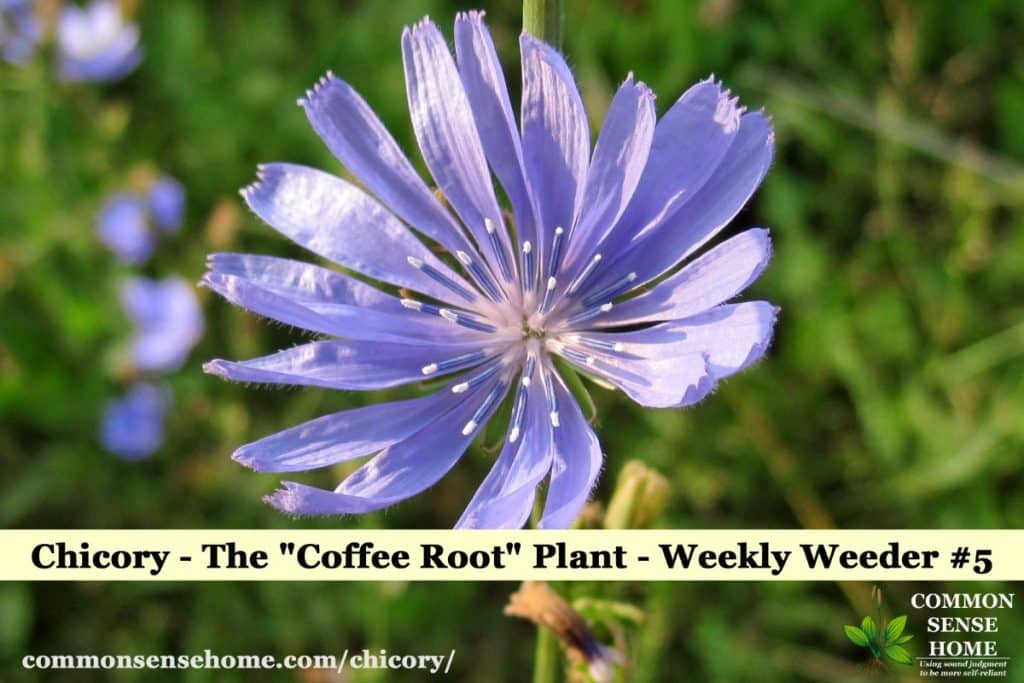
Chicory is prized for its long taproot, which is roasted and used as a coffee substitute or coffee additive. The roots are also high in inulin, which is used as a sweetener and prebiotic. The plant contains compounds such as flavonoids and coumarins that may help fight disease.
What is chicory?
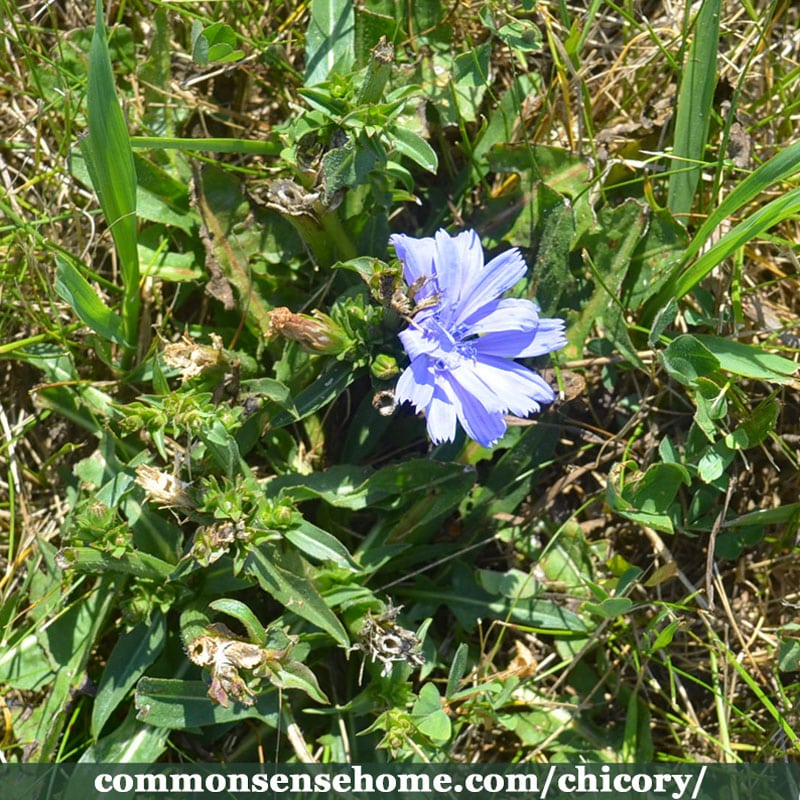
Chicory is a perennial plant that has a basal rosette with long, toothed leaves similar to a dandelion (thus the name “blue dandelion”). It grows 1-4′ tall, with ground level leaves that are 3-6″ long. The leaves that alternate up the flower stalk are much shorter, 1/2 – 1″ long, and wrap around the stem.
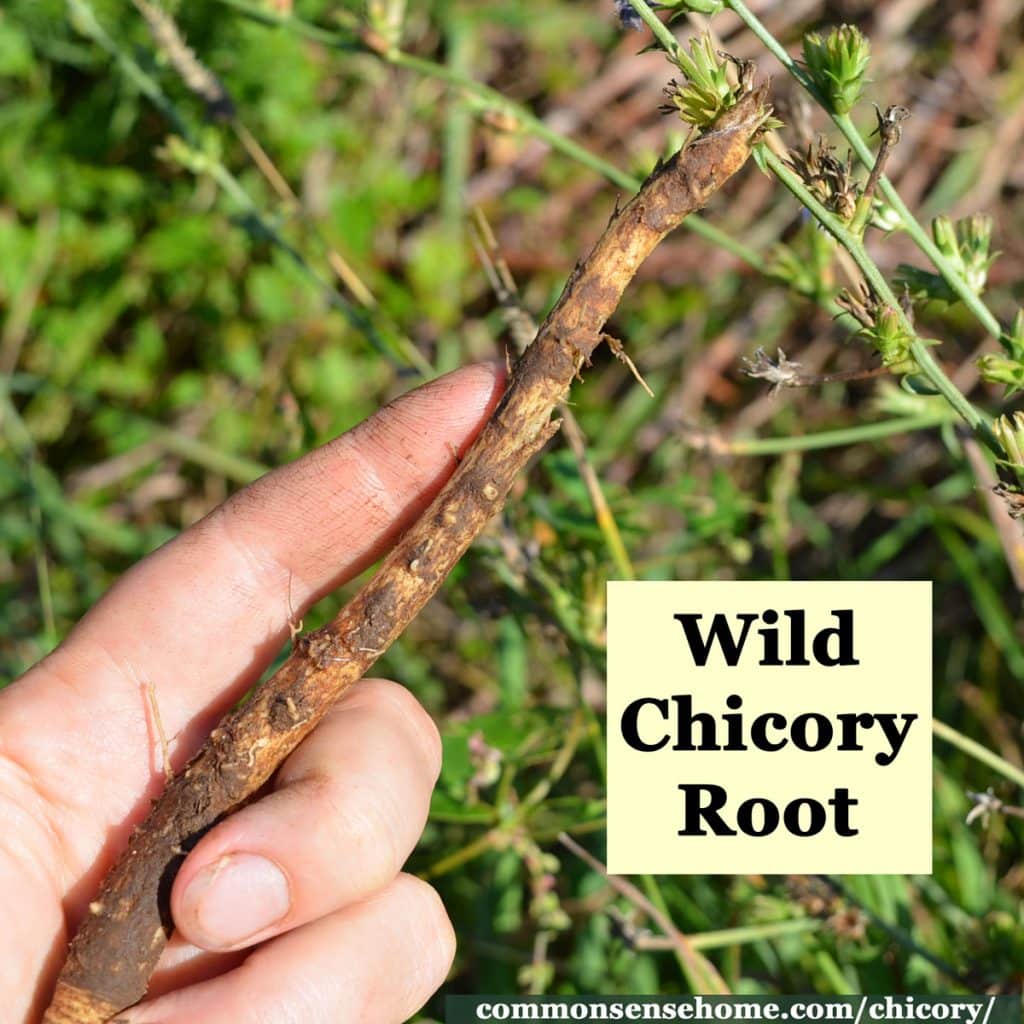
The plants have a long taproot that can punch through some of the toughest soils. The domesticated varieties have a thicker, more substantial root, something like a sugar beet. (The domesticated plants are cultivated and harvested much like sugar beets.)
The roots of some varieties of domesticated chicory (Witloof chicory) are forced to produce a vegetable known as Belgian or French Endive.
Chicory Flowers
Bloom time is summer and fall, from July through October. Chicory flowers are roughly 1.5 ” across with up to 20 petals. They open in the morning and close by early afternoon. Each petal is tipped with a tiny bit of fringe, like a scarf. Flower color ranges from white to pink, but in our area I have only seen blue..
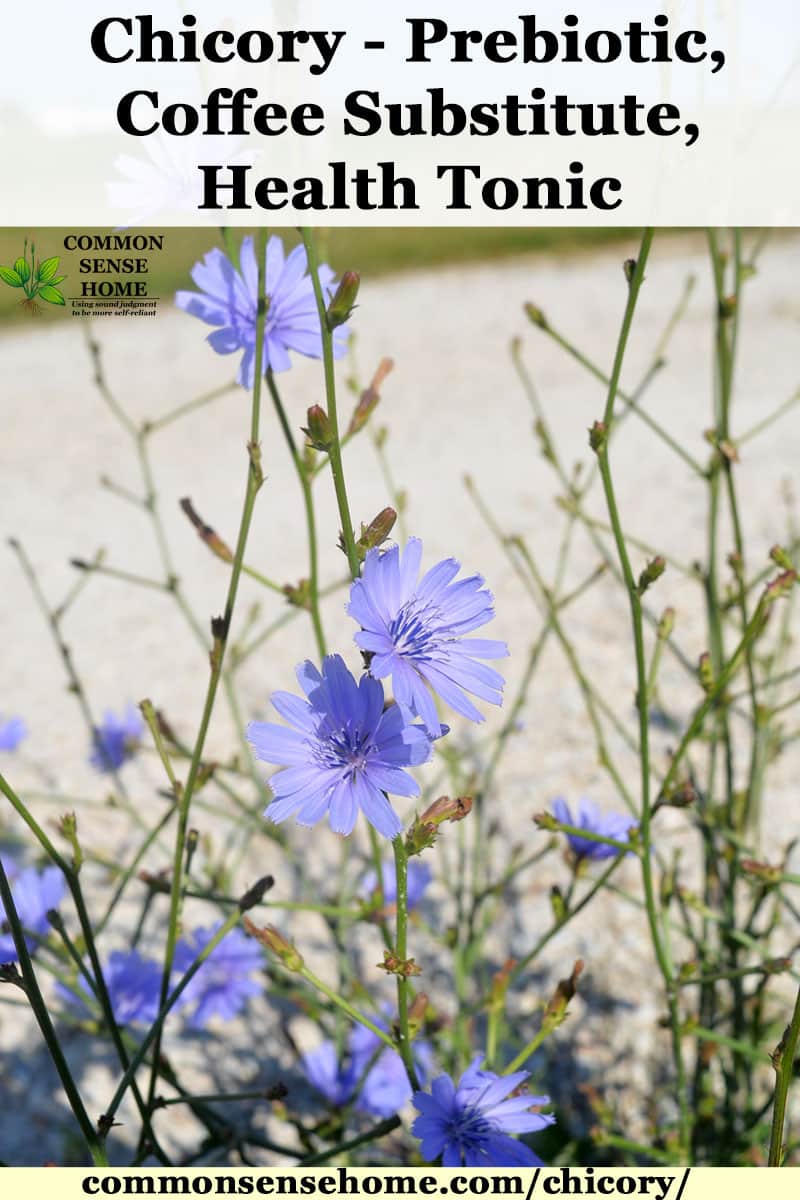
When chicory flowers, it shoots up a long stem with multiple blossoms that open one at a time and last only one day. Although not as striking as some flower displays, thick clumps of chicory still make a lovely splash of blue in the countryside. The flowers don’t smell like much. When my great niece and I went out to smell them, she said, “It smells like barnyard”. Yes, perhaps a bit, but the odor is faint.

You probably don’t want to let the flowers go to seed in large numbers in areas where you frequent. They produce hooked seeds that latch onto clothing, somewhat like burdock burrs. These seeds are oblong, flat and about 1/4 inch long. I once let a large patch of them go to seed on our rock wall at our old place (the flowers were so beautiful!), and that was a mess.
Where Does Chicory Grow?
Chicory is believed to have originated in Europe, but is now common in North America, China and Australia. Around here, chicory grows in large clumps and is common along country roads, combining with birdsfoot trefoil to paint the countryside with bold swaths of blue and yellow. Its long taproot punches down through clay, gravel and compacted soils, thriving in rough conditions. The USDA range map shows that is common throughout the United States.

Chicory Health Benefits
The article “Studies on Industrial Importance and Medicinal Value of Chicory Plant” lists a wide array of studies noting the use of chicory for digestive issues, heart disease, as an anti-thrombotic and anticorcinogenic, to reduce arthritis pain, to reduce constipation, as an immune system booster and promoter of kidney health. Most of the featured studies focus on chicory root extract, but drinking chicory root tea or coffee or consuming chicory may also have some positive impact on these conditions. The list below highlights some of the medicinal uses of chicory.
Note: As mentioned above, most chicory studies focus on chicory root extracts or compounds that could be measured and replicated in lab experiments. Chicory may be helpful for the listed conditions, but you should always consult a trained healthcare provider, especially in the case of serious illness.
Acts as a Prebiotic
The inulin in chicory acts as a prebiotic, supporting the growth of healthy bacteria in the gut. Specifically, chicory promotes the growth bifidobacteria. These probiotic bacteria are found in cultured foods such as yogurt and cheese.
May Improve Bowel Movements and Delay or Prevent Diabetes
Chicory root extract may help you poop better and delay or prevent the onset of diabetes.
May Inhibit Cancer
A 1999 study examined the growth of cancer tissue in mice and found that those mice placed on a diet consisting of 15% oligofructose, inulin or pectin reduced tumor growth. The control group was fed only starch as their carbohydrate.
May Relieve Arthritis Pain
Chicory root extract was tested on patients with osteoarthritis in the hip or knee, and found to provide some level of relief from pain and stiffness.
May Promote Weight Loss by Increasing Satiety
In another study, the introduction of oligofructose (OFS) such as chicory derived inulin led to lower levels of ghrelin, the so called “hunger hormone” that stimulates appetite and better weight management.
Chicory has Antibacterial Properties
Chicory extracts were tested against gram positive and gram negative bacteria, including Staphylococcus aureus and Salmonella typhi. The chicory extracts were found to be more effective at inhibit bacteria growth than other materials tested.
Sources:
- Prebiotic effects of chicory inulin in the simulator of the human intestinal microbial ecosystem
- Effects of the extract from roasted chicory (Cichorium intybus L.) root containing inulin-type fructans on blood glucose, lipid metabolism, and fecal properties
- Influence of Inulin and Oligofructose on Breast Cancer and Tumor Growth
- Phase 1, placebo-controlled, dose escalation trial of chicory root extract in patients with osteoarthritis of the hip or knee
- Oligofructose Promotes Satiety in Rats Fed a High‐Fat Diet: Involvement of Glucagon‐Like Peptide‐1
- Phytochemical and Antibacterial Studies of Chicory: (Cichorium intybus L.) – A Multipurpose Medicinal Plant
Medicinal Uses of Chicory
Gardens Ablaze gives the following suggestions for medicinal use of chicory:
Chicory teas taken internally are believed to be effective in treating jaundice and liver problems. Additionally, as with many other herbs, a tea made from roots or leaves appears to be useful for those with digestive problems.
Save a little tea and try dipping a cotton ball into it for a refreshing and soothing eye wash. You can also add a spoonful or two of honey to thicken and use as syrup for a mild laxative for kids. For long-term use, try drying and pulverizing Chicory leaves into a powder for use in capsule form. Please see How to Make Herbal Capsules for more information.
For external use, bruise fresh Chicory leaves and apply to areas affected by gout, skin eruptions, swellings, skin inflammations, and rheumatism.
Would you like to save this?
Chicory Side Effects
Consuming small amounts of chicory in food is likely safe for most adults. Large amounts may cause gastrointestinal distress. The inulin ferments in your digestive tract, producing excess gas and associated issues. (Eat an “energy bar” loaded up with chicory and you’ll see what I mean.)
If you are allergic to members of the daisy family, such as ragweed, be cautious with chicory, as it may also cause an allergic reaction.
Don’t use medicinal quantities of chicory while pregnant, as it may induce a miscarriage.
For those with diabetes, large amounts of chicory may lower blood sugar. Avoid medicinal amounts of chicory before and after surgery. It may interfere with blood sugar control.
If you have gallstones, chicory may cause problems, as it stimulates the production of bile. (Source)
How to Make Chicory Coffee
Chicory roots are dried, roasted and ground, and then brewed like coffee. A good family friend who recently passed away, Mike Jacisin, used to be a regular chicory “coffee” consumer. Mike was one of my early wildcrafting inspirations.
To make chicory coffee:
- Dig roots in early spring or late fall, when they are not flowering.
- Scrub the roots well and trim off tops.
- Chop and dehydrate the roots using a commercial dehydrator or air drying. If you chop the roots into smaller pieces before dehydrating, they will dry faster. (Think small rounds or bits, roughly even in size so they will roast evenly in the oven.) Air dry on a rack for a week or two at room temp, or dehydrate at 95°F (35°C)in a commercial dehydrator for 12-14 hours.
- Roast the dried roots for 20 to 60 minutes at 325°F (163°C), until they are brown and brittle. Think “coffee roast color”.
- Grind in a coffee grinder, spice mill or blender.
- To brew chicory coffee, you may use it as you would regular coffee in a dip coffee maker or French press. Alternatively, boil 1-2 teaspoons of ground, roasted root in one cup of water for about three minutes. Pour into coffee strainer or French press and let drip or strain.
- Store roasted roots, ground or unground, in an airtight container.
For more herbal coffee ideas, check out the post 8 Herbal Coffee Alternatives.

Eating Chicory
Chicory leaves are edible and rich in nutrients, like dandelion leaves, but extremely bitter. If you can find them, the small rosettes of early spring are the most palatable. Those who don’t mind bitter greens can use the young greens raw (sparingly) in a salad. Cook older leaves with a couple of changes of water. They’ll still be bitter, but less bitter. The white bases (or crowns, as Samuel Thayer calls them) of older plants can be trimmed of the bitter green leaves and eaten. The white base is somewhat less bitter than the green leaves.
In The Flower Cookbook, Adrienne Crowhurst makes pickled chicory flowers. I have not tried this, but the recipe sounds interesting.
PrintPickled Chicory Flowers
A unique wildcrafted condiment for the adventurous eater.
Ingredients
- 2 cups chicory flowers or flower buds
- 3 cups white wine vinegar
- 1/2 teaspoon salt
- 1/4 teaspoon ground ginger
- 1 cup brown sugar
Instructions
Wash the chicory buds or flowes in ice cold water; drain. Place them in a sterilized canning jar (or jars). In a saucepan, bring the vinegar, salt and ginger to a boil. Simmer for five minutes. Remove mixture from heat and add the sugar; stir until dissolved. Pout this liquid over the flowers and buds in the jar(s). Seal and store in a cool place for at least one week before using.
Chicory Forage
The Ohio State University Extension document “Use of Forage Chicory in a Small Ruminant Parasite Control Program” notes that chicory contains secondary plant metabolites called sesquiterpene lactones, which may help to reduce the parasite load of small ruminants. Some varieties are more effective than others, and may prove to be a viable alternative to chemical dewormers.
The study “Chemical Composition and Nutritive Benefits of Chicory (Cichorium intybus) as an Ideal Complementary and/or Alternative Livestock Feed Supplement” cites the benefits of chicory inulin for livestock digestive health, reduced parasite loads with ingestion of chicory, and increased reproductive rates of sheep on chicory forage, among other benefits.
Wildlife and Forage Uses
Illinois Wildflowers shares the faunal associations of Chicorium intybus:
The flowers attract short-tongued bees and probably other insects. Both nectar and pollen are available as floral rewards. The foliage of Common Chicory is eaten by Melanoplus bivittatus (Two-Striped Grasshopper), Melanoplus femurrubrum (Red-Legged Grasshopper), and probably other grasshoppers. The larvae of a lizard beetle, Acropteroxys gracilis, bore through the stems of this plant, while the caterpillars of the moth, Pyrrhia exprimens (Purple-Lined Sallow), feed on the the flowers, buds, and developing achenes.
While chicory does provide a nectar source for bees, it produces a yellow, bitter honey.

Other Names for Chicory
Chicory is also known as Achicoria, Barbe de Capucin, Blue Daisy, Blue Dandelion, Blue Sailors, Blue Weed, Bunk, Cheveux de Paysans, Chicorée, Chicorée Sauvage, Cichorii Herba, Cichorium intybus, Cichorii Radix, Coffeeweed, Common Chicory, Cornflower, Écoubette, Herbe à Café, Hendibeh, Hinduba, Horseweed, Kasani, Kasni, Racine de Chicorée Commune, Ragged Sailors, Succory, Wild Bachelor’s buttons, Wild Chicory, Wild Endive, Wild Succory,Witloof and Yeux de Chat.
Sources: Ohio Perennial and Biennial Weed Guide and WebMD.
Learn to Use and Appreciate the Weeds
“Weeds” are just plants that grow without planting – or where you may not want them. They serve a purpose. I always tell the boys, “Nature abhors a vacuum.” If there is an empty niche, nature fill it. Our weeds hold the soil in place, plow compacted subsoil, draw up nutrients, provide medicine, feed wildlife (and people) – they are a treasure, not a curse. As you tend your yard and garden and the soil improves, unwanted volunteers will either disappear on their own, or be much easier to manage.
Recommended resources:
- Wildflowers of Wisconsin
- Nature’s Garden: A Guide to Identifying, Harvesting, and Preparing Edible Wild Plants
- The Forager’s Harvest: A Guide to Identifying, Harvesting, and Preparing Edible Wild Plants
- Backyard Foraging: 65 Familiar Plants You Didn’t Know You Could Eat
- Edible Wild Plants: Wild Foods From Dirt To Plate
Thanks so much for stopping by to visit. Help stop the overuse of herbicides by spreading the word about putting our weeds to work and sharing this post.
You may also find useful:
- Top 10 Edible Flowers, Plus Over 60 More Flowers You Can Eat
- The Weekly Weeder Series
- My Favorite Wildcrafting Resources
Originally published in 2011, updated in 2017, 2018.

Laurie, thanks for all the information you provide. I have been a subscriber to Common Sense Home for multiple years and never delete before reading, unlike many other articles in my inbox :).
Many articles have been saved or pinned for later accessibility. I was interested in the herbal coffee idea, I had not heard much about it, although I was familiar with chicory. Thanks again for your information and insight into living well.
Pat (Virginia)
You’re welcome, Pat, and thanks for not deleting my emails!
I started drinking chicory ‘coffee’ when I had to give up regular coffee for the heavy acid. Don’t know if chicory is as acidic, but it doesn’t bother me. I love the nutty taste!!