Sep 302011
 

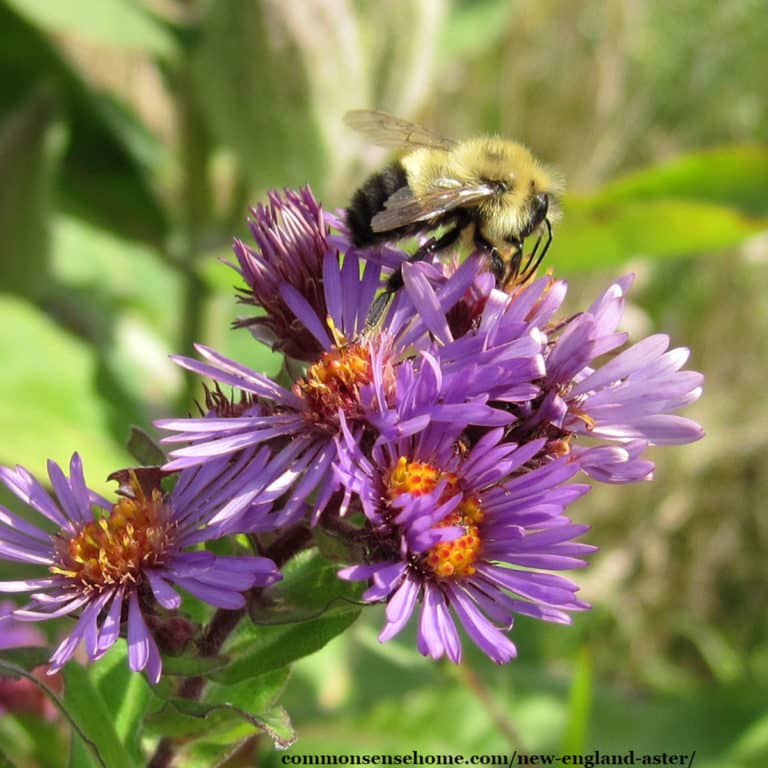
Today’s featured plant is New England Aster, Aster novae-angliae or Symphyotrichum novae-angliae , also known as starwort, blue chamomile, blue daisy, New England aster, fall-rose and frostweed.

Range and Identification of New England Aster

The New England Aster is native to North America east of the Rocky Mountains, but is now found throughout much of North America and in Europe. The USDA Natural Resources Conservation Service provides a range map.  The plant prefers full sun and well-drained soil, and is commonly found in prairies and along roadsides and streams.  It can grow in poor soil, but prefers a sand or clay loam.  If you are cultivating the plant in a garden bed, most sources recommend dividing it every few years because it can be “aggressive”, but mine just pop up in small clumps here and there in the prairie.

Plant height is 3-7′ (90-210 cm) (by my place they tend to be fairly short, as we get a lot of wind).  The leaves of the New England Aster are smooth and lance-shaped.  Leaf attachment is alternate and leaves are 1-5″ (2.5-12.5 cm) long, clasped directly on the stem. (See in the photo below how the leaf wraps around the stem?)   The author of Wisconsin Wildflowers points out that the lower leaves often fall off early, leaving “naked legs”.

Flowers are abundant, with 25-100 per plant, typically with bright purple petals and a yellow center, although they can also be pink, lavender, blue and white.  Flowers stalks are coated with sticky hairs (very mildly sticky, as far as I could tell, not like pine tar or other really sticky plants).  The plant is perennial, which means it comes back year after year.  (Wildflowers of Wisconsin) Propagation instructions can be found in The University of Texas at Austin Native Plant Database.

New England Aster as Food and Habitat for Wildlife

As you can see from the close up of the blossoms at the top of the post, these aster blossoms have a lovely open form that makes them an ideal nectar source for many bees, butterflies, flies, beetles and moths.  They also have a long bloom time, and are available in fall when other nectar options are limited.  They are particularly important as a nectar source for migrating monarch butterflies.  The leaves of the plant act as a larval host for Pearl Crescent (Phyciodes tharos)and checkerspot butterflies.

Illinois Wildflowers states that “The seeds and leaves of this plant are eaten to a limited extent by the Wild Turkey, while deer, livestock, and rabbits occasionally browse on the foliage, sometimes eating the entire plant. However, New England Aster isn’t a preferred food source for these animals.”  (They also have a photo of a pink blossom on this site.)

Medicinal Uses of New England Aster

Herbnet.com states:

Aster, New England (Aster novae-angliae): A poultice of the root has been used in the treatment of pain, fevers and diarrhea. The ooze of the roots has been sniffed in the treatment of catarrh. A decoction of the whole plant has been used in the treatment of all kinds of fevers and in the treatment of weak skin. Aster novae-angliae is deployed in decoction internally, with a strong decoction externally, in many eruptive diseases of the skin; it removes also the poisonous state of the skin caused by Rhus or Shumach.

Jim McDonald at Herbcraft.org gives a much more poetic and rambling explanation of the asters medicinal qualities.  He talks about eating the whole flowers as a gentle sedative and anti-asthmatic, and teas and tinctures made from the roots and flowers having a similar effect. He states:

(The New England Aster) is uniquely antispasmodic for the lung tissue; it relaxes and dilates the respiratory passages.

One of the options he suggested was steam inhalation using the aster blossoms for treating congestion.  Given that I’ve had a lovely cold for several days with symptoms that include moderate to heavy congestion, I figured I had the perfect opportunity to give this one a try.  To do a steam inhalation, you simply place a small handful of blossoms in a heat resistant bowl, and pour boiling water over the top.  Then you hold your head over the bowel and make a nifty tent with the decorative towel of your choice.  Inhale the steam for around ten minutes.

Here we have our blossoms – I picked them late in the day, so they were already closed.  Not optimal, but I wanted to try this for the post, and I was congested.

Here we have me, with my head under a towel, breathing flower steam. (I do my own stunts. :-)

Guess what? It actually worked!  At first, I felt things loosening up primarily from the steam, but as I’ve been sitting here typing, I can feel my head and chest relaxing and the sinus pain/pressure letting up.  Cool beans!

Food Uses of New England Aster

Edible Wild Food.com states:

Flowers can be eaten fresh and added to a salad as can the leaves. When harvesting in September or early October be sure the plant is dry (dew is gone) and cut stem about 10 cm above the ground. Hang upside down in a cool, dark location until totally dried (crumbles easily). Most of the flowers will become white and fluffy but they can still be used. Add dried plant to salads, main dishes or make a cup of tea.

Other Uses of New England Aster

Like the wild plants butter and eggs, Canada goldenrod and many others, New England Aster can be used for dying fabric.  Herb Rowe writes, “The stems, leaves and flowers of asters will produce a yellow-green with alum as a mordant, brassy gold with a chrome mordant, greenish-gold with a copper mordant, bright yellow-gold with a tin mordant, dark grey-green with an iron mordant and a yellow-green with no mordant.”

The Aster in Folklore

The West Virginia DNR site shares an interesting story about the aster in “Nature’s Last Hurrah” By Nanci Bross-Fregonara.

The word aster comes from the Greek word for star, which suggests the shape of the lovely flowerhead. According to legend, the aster is linked with the travels of the Wise Men to Bethlehem . It is said that when the three men arrived in the quiet town of Bethlehem they were surprised that there were no celebrations, which they would have expected with the birth of a new king. They thought, perhaps, they had the wrong town. But one of the Wise Men saw a star-shaped flower near the stable, its shape reflecting the star that had guided them from Persia , and proclaimed it as a sign that they were indeed at the right place.

Thanks for stopping by, and if you’ve enjoyed the post please pass it along.  I’ll put up at least a few more post this season, while I’ve still got plants instead of snow.

This post has been added to Fight Back Friday at Food Renegade.
Sep 172011
 

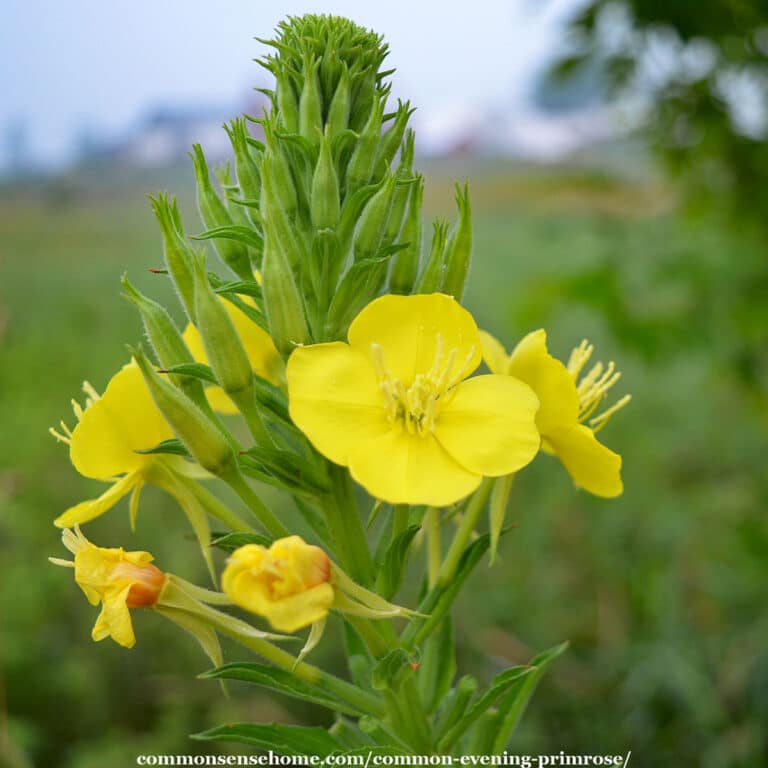
Today’s featured plant is Evening Primrose, Oenothera biennis.

Evening Primrose is also known as common evening primrose, hoary evening primrose, common primrose, German rampion, King’s Cure All, Fever Plant, Field Primrose, Night Willow-herb, hog weed, Primrose, Scabish, Scurvish, Sun Drop, and Tree Primrose.

Range and Identification of Evening Primrose

Evening primrose is native to North America, but is now found in Europe, Asia, New Zealand and Australia. The USDA Natural Resources Conservation Service provides a range map. The plant can be found throughout most of the U.S. and Canada, except the far north and some of the Rocky Mountain states.  They are listed as potentially invasive/spreading, but I haven’t seen this in my yard.

The plant is a biennial, which means it grows over the course of two years.  The first year it grows a small rosette at ground level, like a dandelion or chicory.  The second year, it shoots up a flower stalk, commonly with multiple stems.

Blossom start opening at the lower end of the stalk first, working their way towards the top (similar to a hollyhock or gladiola).  Flowers open in the evening (thus “evening primrose”), and last until about midday the next day.  They are a favorite of sphinx moths, who pollinate them at night.

Leaf type is simple, leaf attachment is alternate, leaves are 4-8″ (10-20 cm) long and lance shaped .  Oblong seed pods form along the stem as the flowers fade (you can see them just below the flower in the top photo).  Plant height is 2-5′ (60-150 cm).  Flowers have four heart shaped petals, flowers are regular and round, a bright sunshine yellow color.  (Wildflowers of Wisconsin)

Evening Primrose as Food and Habitat for Wildlife

Evening primrose flowers are a nectar source for sphinx moths and other moths, and hummingbirds visit the flower both for nectar in insects to eat.  The seeds provide winter food for a variety of birds.  Small mammals will graze on young shoots and leaves, deer will graze on larger foliage.  Japanese beetles are supposed to prefer this plant over garden plants – I haven’t seen this in my garden.

Medicinal Uses of Evening Primrose

Yes, this is the evening primrose that you see in supplement areas.  Evening Primrose seed is very high in gamma-linolenic acid (GLA), in fact, it has the highest content of any known food source.  Alternative Nature Online Herbal states:

GLA is an essential fatty acid that the body does not manufacture. This fatty acid is known to help prevent hardening of the arteries, heart disease, eczema, cirrhosis, rheumatoid arthritis, menopause, PMS, multiple sclerosis, and high blood pressure. It has a positive effect on sex hormone response including the hormones estrogen and testosterone, aids in lowering cholesterol levels, and is important in treating cirrhosis of the liver. Research also demonstrates that primrose oil helps relieve pain and inflammation. The oil also has a positive effect on the uterine muscles, nervous system and metabolism. The bark and the leaves are astringent and sedative. They have proved of use in the treatment of gastro-intestinal disorders, whooping cough and asthma. A tea made from the roots is used in the treatment of obesity. A finely ground powder made from the flowering stems is used cosmetically in face-masks to counteract reddened skins.

The Complete Herbal gives guidelines for harvesting seeds:  “The seeds ripen from August to October and should be collected when ripe and pressed for oil. To be effective the seeds should contain 30-40% moisture.”  To collect seeds, simply gather the seed heads in a clean bucket, break them open along the side, and pour the seeds out.  You can sprinkle them over salads or on top of other dishes.  They are mild in flavor.

Food Uses of Evening Primrose

Every part of the plant is edible, from root to flower. Roots should be harvested from one year old plants in early spring, like parsnips.  In The Forager’s Harvest, Samuel Thayer gives detailed instructions how to prepare the various plant parts.  He recommends boiling the root, as the flavor is very spicy.  The growing flower stalks can be cut, peeled and gently cooked.  Young flower buds can be used in soups and stir frys.  The flowers are also edible, and make a bright addition to summer salads.  As mentioned above, seeds can be sprinkled on just about anything “as is”, or they can also be lightly roasted.

To roast evening primrose seeds: Rotate and press dry seed capsules to release seed, roast in oven for 15 to 20 min. at 350 deg. Use on bread or in salad, sprinkle over any dish like pepper.

The only place I’ve been able to find evening primrose around here is at the edge of my driveway, so I’ve been hesitant to use those plants, but I’ve been on the lookout for cleaner spots and have spread some of the seeds around hoping that they will catch.  This is a bit problematic, as the seed like open soil, but we’ll see what happens.  If you’d like to read a rather fascinating article on the origins of evening primrose and its potential as an oil seed crop, check out “Evening Primrose – Origins and Cultivation“.

Thanks for stopping by, and if you’ve enjoyed the post please pass it along.

Featured at Homestead Barn Hop #28 at Homestead Revival and
Wildcrafting Wednesday #10.

Sep 072011
 
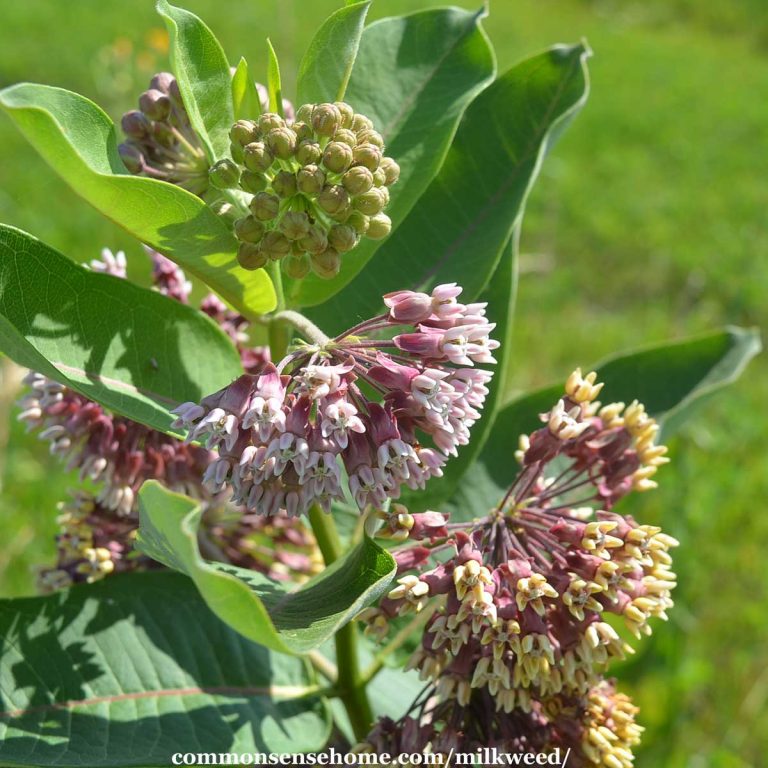
Common Milkweed in bloom

Today’s featured plant is Common Milkweed, Asclepias syriaca

Common milkweed is also known as Butterfly flower, Silkweed, Silky Swallow-wort, Virginia Silkweed, Milkplant, silk grass, common silkweed, cottonweed, milkweed, wild cotton, Virginia-silk, and algodoncillo.

Range and Identification of Common Milkweed

Common milkweed can be found throughout most of the central to eastern United States and Canada (see USDA map) and is native to North America.  There are over 2,000 milkweed species worldwide (Wildflowers of Wisconsin).  Illinois Wildflowers states:  “Habitats include moist to dry black soil prairies, sand prairies, sand dunes along lake shores, thickets, woodland borders, fields and pastures, abandoned fields, vacant lots, fence rows, and areas along railroads and roadsides. This plant is a colonizer of disturbed areas in both natural and developed habitats.”

Common milkweed plants grow between 2-5′ (60-150cm) in height.  Their leaves are large (4-6″, 10-15 cm) and oval shaped with smooth edges, and are attached in opposing pairs on the stem.  When the stem or leaf are damaged, they ooze white, sticky sap.  Flowers are pastel pink, about 1/2″ (1cm) wide, and are found in clusters up to 2″ (5 cm wide).  Each flower has 5 downward-pointing petals and a 5-part pointed crown (Wildflowers of Wisconsin).  The flowers also smell quite lovely, very sweet but not cloying.

The plants spread by seed and by creeping rhizome, so it is quite common to find the milkweed plants in clumps or clusters like this one.

Seed pods form in fall, and are elongated, green and somewhat spikey.  As they ripen, these pods turn pale brown, split open, and release seeds attached to silky, hair-like fuzz that carries the seeds on the wind.


Common Milkweed as Food and Habitat for Wildlife

Common milkweed provides food for many different types of insects, both through its nectar and its leaves.  IllinoisWildflowers.info gives a long list of critters that enjoy the milkweed’s hospitality:

The flowers are very popular with many kinds of insects, especially long-tongued bees, wasps, flies, skippers, and butterflies, which seek nectar. Other insect visitors include short-tongued bees, various Milkweed plant [Seedpods of Common Milkweed] bugs, and moths, including Sphinx moths. Among these, the larger butterflies, predatory wasps, and long-tongued bees are more likely to remove the pollinia from the flowers. Some of the smaller insects can have their legs entrapped by the flowers and die. Common Milkweed doesn’t produce fertile seeds without cross-pollination.


The caterpillars of Danaus plexippes (Monarch Butterfly) feed on the foliage, as well as the caterpillars of a few moths, including Enchaetes egle (Milkweed Tiger Moth), Cycnia inopinatus (Unexpected Cycnia), and Cycnia tenera (Delicate Cycnia). Less common insects feeding on this plant include Neacoryphus bicrucis (Seed Bug sp.) and Gymnetron tetrum (Weevil sp.)…).


Many of these insects are brightly colored – a warning to potential predators of the toxicity that they acquired from feeding on milkweed. Mammalian herbivores don’t eat this plant because of the bitterness of the leaves and their toxic properties.

Fibers from old stems are used by orioles for making nests.

monarch caterpillar on milkweed

Monarch caterpillar on milkweed

Medicinal Uses of Common Milkweed

The Woodrow Wilson Foundation Leadership Program for Teachers highlights cultural uses of milkweed:

Common milkweed has been used traditionally a tea prepared from its root as a diuretic for kidney stones, a laxative, and an expectorant. It has been used to treat asthma and bronchitis and it induces sweating. The sap has been used for chewing gum, which is considered very dangerous because of the presence of cardioactive compounds in the plant. The sap has also been used as a topical remedy for worts, ringworm and moles. Some Native Americans used milkweed as a contraceptive. It was also a folk remedy for cancer. Today, milkweed has limited medicinal use; other milkweed species, such as the swamp milkweed, have more widespread use. Parts of the milkweed plant can be eaten, but the similarity of this plant to toxic look-alikes would serve as a caution against this practice. It is used by some as an emetic, a potion to sooth the nerves, and as a stomach tonic. It is also believed to kill parasitic worms.

Note:  Please exercise caution when using this or any other wild plant internally. 


Food Uses of Common Milkweed

The leaves, new shoots, flower buds and firm seed pods of the milkweed are all edible. Gather leaves and shoots in early spring when they first open/appear. Seed pods are gathered in late summer.  In The Forager’s Harvest, Samuel Thayer states that:  “Common milkweed has one of the most mild, neutral and agreeable flavors of any vegetable you’ll ever find, wild or cultivated.”  While I haven’t always agreed with Mr. Thayer’s flavor descriptions, at the very least the plant is certainly generally safe to eat in moderate quantities.  You can read an excerpt from The Forager’s Harvest online, including more detailed instructions for the recipes below.

Recommendations include:

Milkweed Shoots -
Milkweed shoots appear asparagus-like, except they have a few pairs of small leaves clasping their sides. The smaller they are, the better they taste – but as long as they bend easily and break off when pinched they are good to eat. Normal size is three to six inches.

Just boil the shoots in salted water until they are tender, which is usually twenty minutes or so. (All milkweed parts are cooked in roughly the same manner.) Despite the rather long cooking time, these shrink far less than most green vegetables. Milkweed shoots are almost universally liked. They are often compared to asparagus, but I think the flavor is highly reminiscent of green beans. As the plants grow taller, you can still eat them, using only the top few inches and removing all but the smallest leaves. At this stage they are never quite as good as the younger shoots.

Milkweed flowers -
In midsummer the unopened flower buds can be gathered. They look like miniature heads of broccoli but are softer. Dice up a small handful of these and toss them into a soup, casserole, pasta dish, stuffing, or stir-fry to excellent effect. To eat larger servings of the flower buds alone, boil them, drain the water, and season. Many people consider this the best part of the milkweed plant. I think they taste almost identical to the shoots and the pods. There is one small warning that must be made with milkweed flower buds: sometimes they are full of tiny monarch caterpillars.

Milkweed pods -
Milkweed pods are excellent in stew, stir-fry, or eaten as a vegetable side dish. They are delicious with cheese and bread crumbs. The pods can also be made into pickles, but they become soft after boiling.
The best time to gather milkweed pods is late summer (from early August to early September around here). The size of the pods varies greatly from one plant to the next. An immature pod on one specimen may be larger than a full-grown pod on another, so determining which pods are immature can be tricky. The pods that are too old tend to be rougher on the outside than the young pods. They also tend to have more pointed, curved tips. These are tendencies, not rules, however. There are a few more reliable ways to determine the age of pods.

There is a line running the length of each pod, along which it will split open to release its seeds when mature. If you pull apart on both sides of this line and it splits open easily, the pod is probably too old to use. For the beginner, it is best to open up several pods and examine the insides to get an idea of which ones are in the proper stage for harvesting. In an immature milkweed pod (one that can be eaten) all of the seeds will be completely white, without even a hint of browning. The silk should be soft and juicy, not fibrous. It should be easy to pinch through the bundle of silk or to pull it in half. Immature pods are also plumper and harder than mature ones. Don’t let this seem more complicated than it really is – with time you will know, at a glance, which pods to collect.

A few times each season I gather a large quantity of milkweed pods. I work my way through my favorite patch and fill a cloth bag, which doesn’t take very long, since milkweed often grows in large, prodigious colonies. I leave the tiny pods for next time, and ignore those that are questionably old. When I get home I sort through the pods, keeping all of those less than about 1.5 inches long to be eaten whole. If I do not use these immediately, I can or freeze them (after parboiling). Milkweed pods, after they are picked, begin to toughen in a few hours, and may become unpalatable in a day or less.


Common Milkweed @ Common Sense Homesteading

Milkweed pods were gathered for life preservers in WWII.

Other Uses of Common Milkweed

Candle wick made of milkweed silk burns cleaner than a wick made of cotton.  During WWII, milkweed pods were gathered for their silk to make filling for life preservers.

W.I. DeWees, an assistant professor of agriculture from Illinois State Normal University, was state superintendent for the floss collection program. With labor – both in the city and countryside – at a premium, schoolchildren were enlisted in the cause. This was a time before the complete mechanization of the farm and school consolidation, so there were many more children and many more schools in the Illinois countryside than today.

Therefore, it was schoolchildren who spent the untold hours walking fencerows, roadsides and railroad right of ways looking for milkweed, which before the war was considered little more than a weed.

Onion sacks were distributed to carry the collected pods, and children received 15 cents per bag, with an additional 5 cents if the pods were dried. Two bags of pods contained floss for one life jacket. The U.S. military called for the collection of 2 million pounds of floss nationally, enough to fill 1.2 million life jackets.

Harvesting the floss was simply a matter of picking the pods before they cracked open and released their seeds. Consequently, the pods doubled as handy storage units before the naturally buoyant fiber could be processed into lifejacket stuffing.

Read the full story at Pantagraph.com.

Thanks for taking the time to visit, and I hope you’ll be back again soon.  As always, if you’ve enjoyed the post, please pass it along.  Let me know if you try out any of the uses, too.

Aug 312011
 

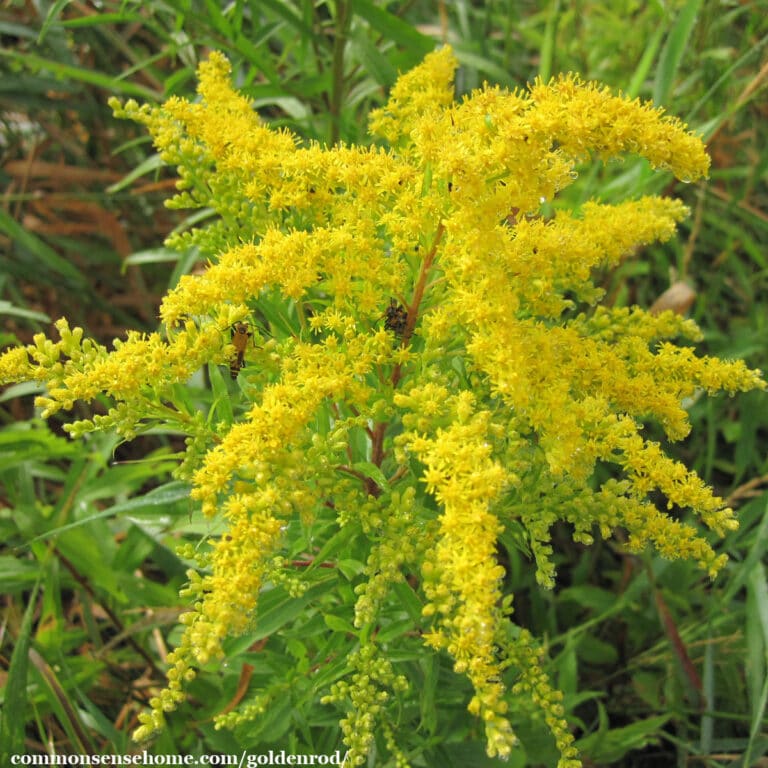
Today’s featured plant is Canada goldenrod, Solidago canadensis.

Canada goldenrod is also known as common goldenrod or Aaron’s rod.

Range and Identification of Canada Goldenrod

This common weed is found throughout most of North America, from Alaska to Texas and all of Canada, not including a small portion of the southeast United States (see range map here).  There are over 100 types of goldenrod in North America, and many of them look similar, so they can be difficult to identify.  It is very common, growing along roadsides and other dry, sunny locations.  It spreads through rhizomes, forming dense clumps that can create a monoculture in prairie areas.  As a perennial, it returns year after year, spreading a little (or a lot) each year.

The plants are around 2 to 5 feet (60-150 cm) tall, leaf type is simple, leaf attachment is alternate.  Leaves are narrow and up to six inches (15 cm) long, and have teeth along the edges.  Flowers are composite, and are borne in clusters along spikes.

Canada goldenrod as Food and Habitat for Wildlife

Wildflowers of Wisconsin states, “Goldenrod is pollinated by insects, including beetles, ambush bugs, flies, midges and bees, which are attracted to the flower’s abundant nectar.”  Can you spot all the bugs in the photo below?  The bush was literally humming when I took the photo.

The stems of goldenrod are often invaded by insect larvae (see below), causing bumps or galls in the stem.

Harvesting Galls on Canada Goldenrod for Free Fish Bait

I first read about using the insect larvae found in goldenrod stems in Countryside magazine.  I haven’t tried this myself (I don’t fish much), but you can harvest these bumpy stems for free fishing bait.  The video below explains how to identify and harvest the larvae.  These replace the mealy worms typically sold for ice fishing.


Medicinal Uses of Canada Goldenrod

Although it is commonly blamed for hayfever and allergies because it blooms at the same time that many people experience these symptoms, only 1-2% of autumn airborne pollen is from goldenrod (see Wildflowers of Wisconsin).  Ragweed is generally the real culprit.  Some people may have a mild skin reaction (contact dermatitis) when exposed to goldenrod.  I have not.

The Gardens Ablaze post “Medicinal Uses of Goldenrod” states:

Goldenrod has been an abundant, well-known medicinal herb for centuries, both in the Americas and in Europe, and has been used internally to treat a variety of ailments, including kidney stones, urinary tract infections, bladder inflammation, digestive problems, colds and flu, sore throat, laryngitis, fatigue, and surprisingly, hay fever and allergies. Externally, Native Americans boiled leaves and used them topically as an antiseptic and astringent for wound healing and relief from eczema, arthritis, and rheumatism.

At this point in time, some research has been done on Goldenrod, and indeed, many of the medicinal qualities attributed to it through history seem to have some basis in fact. Although, in America we don’t use Goldenrod much medicinally, the German Commission E (an expert committee formed to evaluate herbs and herbal combinations) has approved Goldenrod for bladder and kidney stones, and as a diuretic to help flush out urinary infections, and it is widely accepted in Europe for these problems. It has properties that do make it useful topically for wound healing, eczema, arthritis, and rheumatism, and as a tea or gargle, it has properties that make it a likely valid remedy for colds, flu, sore throat, and laryngitis. Tea made out of the leaves of Goldenrod (called Blue Mountain Tea) has been used by herbalists in the Appalachians for many years to relieve exhaustion and fatigue.

Contraindications are few for Goldenrod, although those who are pregnant or have serious heart or kidney problems should steer clear. There are no known side effects either alone or with other drugs or herbs, but this has not been studied extensively. Minor allergic reactions could occur in some people.

To make a tea to use internally, please see the How to Make Herbal Tea section of this site. Dosage is 2-3 cups per day, or as often as needed if using it for gargling. The tea is actually rather tasty, with an anise-like taste and aroma. For external use, either crush the leaves and rub them on the skin, or visit the How to Make Herbal Oils and Ointments section of these pages. Again, some people may have a minor allergic reaction if rubbing crushed leaves or a preparation directly on the skin so proceed with appropriate caution.

Please do visit their site for additional information.

Other Uses of Canada Goldenrod

Canada goldenrod can also be used to dye fabrics.  Dot’s Fibre to Fabric site has a lovely article entitled “Dyeing with Goldenrod” where they share their experience dying with goldenrod using the techniques described in “A Dyer’s Manual“.  The range of colors shown in the photos is very interesting.

In the post “Goldenrod:  Miracle Wild Food Source“, EatWild explains how you can eat all the parts of goldenrod, from the flowers to the roots:

Throughout winter, late-blooming goldenrod flowers, goldenrod seed and even goldenrod leaves (albeit browned) are available. All three can be picked on demand and used to make an infusion (like a tea), or boiled in a variety of soups. The best soups are vegetable soups and other thin soups, but the taste of cream soups is greatly enhanced with a handful of goldenrod flowers or pulverized seeds.

In the spring, as soon as the frost is out of the ground (or in the early fall, after the nutrition and liquids of the plant have partially retreated), harvest the roots. Wash them thoroughly, dry them and grind them coarsely for use in soups and batter.

In the spring and summer, pick up to one third of the leaves of each plant for use in salads, or, again, use in soups. Leaves and flowers can be air-dried and stored almost indefinitely, or the leaves and flowers may be frozen with a little water for use later.

The stalks, too, can be used, although they tend to be tough. With care, they can be peeled, or harvested when young. By dipping them in a little honey or sugar/water mix and then baking in the oven at 225F for up to forty-five minutes, you can make a crispy sweet snack that can be broken into smaller pieces and carried with you on hikes, for quick nourishment.

I encourage you to view the post in its entirety, as they also include goldenrod recipes.

Thanks for taking the time to visit, and I hope you’ll be back again soon.  As always, if you’ve enjoyed the post, please pass it along.  Let me know if you try out any of the uses, too.

This post has been added to Wildcrafting Wednesday.

Aug 242011
 
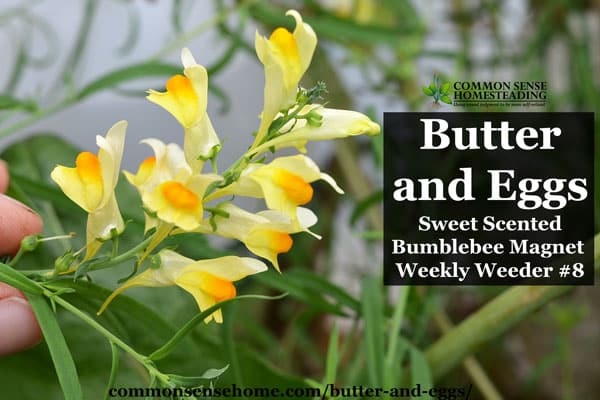
Butter and Eggs - Weekly Weeder #8

Today’s featured plant is Butter and eggs,  Linaria vulgaris,

Butter and eggs is also know as yellow toadflax, wild snapdragon, flaxweed, bread and butter, false flax, brideweed, bridewort, Jacob’s-ladder, rabbit flower, imprudent lawyer, pennywort and a host of other names.

The flowers look very similar to Dalmatian Toadflax (L. dalmatica) but that species has broad leaves.   Butter and eggs pops in in my garden and near my mailbox, and we have extensive patches of it out in the pasture.  The name “snapdragon” originates from the “popping” or “snapping” sound that is made when you squeeze it, but I’ve never tried squeezing one.  According to Wildflowers of Wisconsin, the other common name, toadflax, is based on how the flower opens wide like a frog or toad’s mouth when squeezed.  (I wonder if the name “imprudent lawyer” is linked to that wide open mouth, too?  I’m thinking “yes”.)

Range and Identification of Butter and Eggs

Butter and eggs originated in Europe and was brought over as a decorative garden plant.  It escaped, and now ranges all over North America, from Manitoba to Mexico.  (How’s that for adaptability?)  It’s commonly treated as a noxious weed, because it is a perennial and spreads by rhizomes, plus the seeds can stay viable in the soil for eight years.  I let it grow around the edges of the garden, but I avoid letting it go to seed.  (Eight years is longer than I want to be pulling volunteers.)  It is an aggressive grower, and can easily crowd out smaller plants.  It prefers a neutral pH and gravelly and sandy soil, and will happily grow in disturbed soils, along roadsides, in pastures, at the edge of woods and in your garden.

The height of the plant is between 1-2 feet.  Flowers grow in spikes and have five petals.  The orange part is known as a “honey guide”, which guides the insects along the long spur of the flower, insuring pollination (from Wildflowers of Wisconsin).  Leaves are narrow, grasslike and simple (not composite), and are attached in an alternating pattern along the stem. There are some beautiful closeups of the blossoms at all creatures.org.

Butter and Eggs as Food and Habitat for Wildlife

Around here, the fields are humming with bumblebees working over the flowers of butter and eggs.  Most sites I’ve seen dismiss it as a wildlife plant because it displaces native species, but I know the bees love the blooms,  and it is also a favorite of the hummingbird-like sphinx moth.  Smaller insects are unable to effectively pollinate the flower because they lack the weight to open the bloom.

Medicinal Uses of Butter and Eggs

Botanical.com states:

Part Used Medicinally—Cultivation. For medicinal purposes, Toadflax is generally gathered in the wild condition, but it can be cultivated with ease, though it prefers a dry soil. No manure is needed. Seeds may be sown in spring. All the culture needed is to thin out the seedlings and keep them free of weeds. Propagation may also be carried out by division of roots in the autumn.

The whole herb is gathered just when coming into flower and employed either fresh or dried.

When fresh, Toadflax has a peculiar, heavy, disagreeable odour, which is in great measure dissipated by drying. It has a weakly saline, bitter and slightly acrid taste.

Constituents—Toadflax abounds in an acrid oil, reputed to be poisonous, but no harm from it has ever been recorded. Little or nothing is known of its toxic principle, but its use in medicine was well known to the ancients.

Its constituents are stated to be two glucosides, Linarin and Pectolinarian, with linarosin, linaracin, antirrhinic, tannic and citric acids, a yellow colouring matter, mucilage and sugar.

Medicinal Action and Uses—Astringent, hepatic and detergent. It has some powerful qualities as a purgative and diuretic, causing it to be recommended in jaundice, liver, skin diseases and scrofula; an infusion of 1 OZ. to the pint has been found serviceable as an alterative in these cases and in incipient dropsy. The infusion has a bitter and unpleasant taste, occasioned by the presence of the acrid essential oil. It was at one time in great reputation among herb doctors for dropsy. The herb distilled answers the same purpose, as a decoction of both leaves and flowers in removing obstructions of the liver. It is very effectual if a little Peruvian bark or solution of quinine and a little cinnamon be combined with it. Gerard informs us that ‘the decoction openeth the stopping of the liver and spleen, and is singular good against the jaundice which is of long continuance,’ and further states that ‘a decoction of Toadflax taketh away the yellownesse and deformitie of the skinne, being washed and bathed therewith.’

The fresh plant is sometimes applied as a poultice or fomentation to haemorrhoids, and an ointment of the flowers has been employed for the same purpose, and also locally in diseases of the skin. A cooling ointment is made from the fresh plant – the whole herb is chopped and boiled in lard till crisp, then strained. The result is a fine green ointment, a good application for piles, sores, ulcers and skin eruptions.

The juice of the herb, or the distilled water, has been considered a good remedy for inflammation of the eyes, and for cleansing ulcerous sores.

Boiled in milk, the plant is said to yield an excellent fly poison, and it is an old country custom in parts of Sweden to infuse Toadflax flowers in milk, and stand the infusion about where flies are troublesome.

So while these plants have been used medicinally, do exercise caution. Botanical.com also states:  “Bear in mind “A Modern Herbal” was written with the conventional wisdom of the early 1900′s. This should be taken into account as some of the information may now be considered inaccurate, or not in accordance with modern medicine.

Butter and Eggs for Dying Fabric

Plant Supplies.com states:

This whole plant as well as the flowers has been used in traditional fabric dyeing. A range of possible colors can be produced by Linaria vulgaris including yellow-green, yellow and chartreuse. It is traditionally used to dye wool. (The mordants used for fixing the dye include: alum, copper, tin.)

If any of my crafty local friends would like to experiment with this, I’ve got several very large patches filled with flowers right now, and I’ll bet that Deb has some wool she could spare.  :-)

Thanks for visiting, and if you feel inclined to share the post, please do.

This post has been added to Wildcrafting Wednesday for August 24, 2011 at Mind, body and Soul.