|
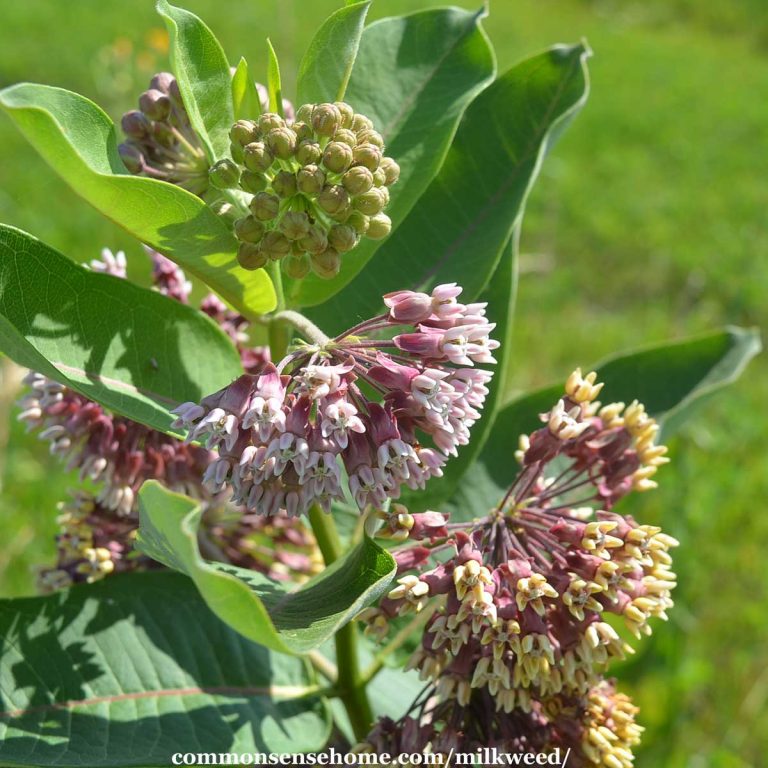
| Common Milkweed in bloom |
Today’s featured plant is Common Milkweed, Asclepias syriaca
Common milkweed is also known as Butterfly flower, Silkweed, Silky Swallow-wort, Virginia Silkweed, Milkplant, silk grass, common silkweed, cottonweed, milkweed, wild cotton, Virginia-silk, and algodoncillo.
Range and Identification of Common Milkweed
Common milkweed can be found throughout most of the central to eastern United States and Canada (see USDA map) and is native to North America. There are over 2,000 milkweed species worldwide (Wildflowers of Wisconsin
). Illinois Wildflowers states: “Habitats include moist to dry black soil prairies, sand prairies, sand dunes along lake shores, thickets, woodland borders, fields and pastures, abandoned fields, vacant lots, fence rows, and areas along railroads and roadsides. This plant is a colonizer of disturbed areas in both natural and developed habitats.”
Common milkweed plants grow between 2-5′ (60-150cm) in height. Their leaves are large (4-6″, 10-15 cm) and oval shaped with smooth edges, and are attached in opposing pairs on the stem. When the stem or leaf are damaged, they ooze white, sticky sap. Flowers are pastel pink, about 1/2″ (1cm) wide, and are found in clusters up to 2″ (5 cm wide). Each flower has 5 downward-pointing petals and a 5-part pointed crown (Wildflowers of Wisconsin
). The flowers also smell quite lovely, very sweet but not cloying.
The plants spread by seed and by creeping rhizome, so it is quite common to find the milkweed plants in clumps or clusters like this one.
Seed pods form in fall, and are elongated, green and somewhat spikey. As they ripen, these pods turn pale brown, split open, and release seeds attached to silky, hair-like fuzz that carries the seeds on the wind.
Common Milkweed as Food and Habitat for Wildlife
Common milkweed provides food for many different types of insects, both through its nectar and its leaves. IllinoisWildflowers.info gives a long list of critters that enjoy the milkweed’s hospitality:
The flowers are very popular with many kinds of insects, especially long-tongued bees, wasps, flies, skippers, and butterflies, which seek nectar. Other insect visitors include short-tongued bees, various Milkweed plant [Seedpods of Common Milkweed] bugs, and moths, including Sphinx moths. Among these, the larger butterflies, predatory wasps, and long-tongued bees are more likely to remove the pollinia from the flowers. Some of the smaller insects can have their legs entrapped by the flowers and die. Common Milkweed doesn’t produce fertile seeds without cross-pollination.
The caterpillars of Danaus plexippes (Monarch Butterfly) feed on the foliage, as well as the caterpillars of a few moths, including Enchaetes egle (Milkweed Tiger Moth), Cycnia inopinatus (Unexpected Cycnia), and Cycnia tenera (Delicate Cycnia). Less common insects feeding on this plant include Neacoryphus bicrucis (Seed Bug sp.) and Gymnetron tetrum (Weevil sp.)…).
Many of these insects are brightly colored – a warning to potential predators of the toxicity that they acquired from feeding on milkweed. Mammalian herbivores don’t eat this plant because of the bitterness of the leaves and their toxic properties.
Fibers from old stems are used by orioles for making nests.

Monarch caterpillar on milkweed
Medicinal Uses of Common Milkweed
The Woodrow Wilson Foundation Leadership Program for Teachers highlights cultural uses of milkweed:
Common milkweed has been used traditionally a tea prepared from its root as a diuretic for kidney stones, a laxative, and an expectorant. It has been used to treat asthma and bronchitis and it induces sweating. The sap has been used for chewing gum, which is considered very dangerous because of the presence of cardioactive compounds in the plant. The sap has also been used as a topical remedy for worts, ringworm and moles. Some Native Americans used milkweed as a contraceptive. It was also a folk remedy for cancer. Today, milkweed has limited medicinal use; other milkweed species, such as the swamp milkweed, have more widespread use. Parts of the milkweed plant can be eaten, but the similarity of this plant to toxic look-alikes would serve as a caution against this practice. It is used by some as an emetic, a potion to sooth the nerves, and as a stomach tonic. It is also believed to kill parasitic worms.
Note: Please exercise caution when using this or any other wild plant internally.
Food Uses of Common Milkweed
The leaves, new shoots, flower buds and firm seed pods of the milkweed are all edible. Gather leaves and shoots in early spring when they first open/appear. Seed pods are gathered in late summer. In The Forager’s Harvest
, Samuel Thayer states that: “Common milkweed has one of the most mild, neutral and agreeable flavors of any vegetable you’ll ever find, wild or cultivated.” While I haven’t always agreed with Mr. Thayer’s flavor descriptions, at the very least the plant is certainly generally safe to eat in moderate quantities. You can read an excerpt from The Forager’s Harvest online, including more detailed instructions for the recipes below.
Recommendations include:
Milkweed Shoots -
Milkweed shoots appear asparagus-like, except they have a few pairs of small leaves clasping their sides. The smaller they are, the better they taste – but as long as they bend easily and break off when pinched they are good to eat. Normal size is three to six inches.
Just boil the shoots in salted water until they are tender, which is usually twenty minutes or so. (All milkweed parts are cooked in roughly the same manner.) Despite the rather long cooking time, these shrink far less than most green vegetables. Milkweed shoots are almost universally liked. They are often compared to asparagus, but I think the flavor is highly reminiscent of green beans. As the plants grow taller, you can still eat them, using only the top few inches and removing all but the smallest leaves. At this stage they are never quite as good as the younger shoots.
Milkweed flowers -
In midsummer the unopened flower buds can be gathered. They look like miniature heads of broccoli but are softer. Dice up a small handful of these and toss them into a soup, casserole, pasta dish, stuffing, or stir-fry to excellent effect. To eat larger servings of the flower buds alone, boil them, drain the water, and season. Many people consider this the best part of the milkweed plant. I think they taste almost identical to the shoots and the pods. There is one small warning that must be made with milkweed flower buds: sometimes they are full of tiny monarch caterpillars.
Milkweed pods -
Milkweed pods are excellent in stew, stir-fry, or eaten as a vegetable side dish. They are delicious with cheese and bread crumbs. The pods can also be made into pickles, but they become soft after boiling.
The best time to gather milkweed pods is late summer (from early August to early September around here). The size of the pods varies greatly from one plant to the next. An immature pod on one specimen may be larger than a full-grown pod on another, so determining which pods are immature can be tricky. The pods that are too old tend to be rougher on the outside than the young pods. They also tend to have more pointed, curved tips. These are tendencies, not rules, however. There are a few more reliable ways to determine the age of pods.
There is a line running the length of each pod, along which it will split open to release its seeds when mature. If you pull apart on both sides of this line and it splits open easily, the pod is probably too old to use. For the beginner, it is best to open up several pods and examine the insides to get an idea of which ones are in the proper stage for harvesting. In an immature milkweed pod (one that can be eaten) all of the seeds will be completely white, without even a hint of browning. The silk should be soft and juicy, not fibrous. It should be easy to pinch through the bundle of silk or to pull it in half. Immature pods are also plumper and harder than mature ones. Don’t let this seem more complicated than it really is – with time you will know, at a glance, which pods to collect.
A few times each season I gather a large quantity of milkweed pods. I work my way through my favorite patch and fill a cloth bag, which doesn’t take very long, since milkweed often grows in large, prodigious colonies. I leave the tiny pods for next time, and ignore those that are questionably old. When I get home I sort through the pods, keeping all of those less than about 1.5 inches long to be eaten whole. If I do not use these immediately, I can or freeze them (after parboiling). Milkweed pods, after they are picked, begin to toughen in a few hours, and may become unpalatable in a day or less.

Milkweed pods were gathered for life preservers in WWII.
Other Uses of Common Milkweed
Candle wick made of milkweed silk burns cleaner than a wick made of cotton. During WWII, milkweed pods were gathered for their silk to make filling for life preservers.
W.I. DeWees, an assistant professor of agriculture from Illinois State Normal University, was state superintendent for the floss collection program. With labor – both in the city and countryside – at a premium, schoolchildren were enlisted in the cause. This was a time before the complete mechanization of the farm and school consolidation, so there were many more children and many more schools in the Illinois countryside than today.
Therefore, it was schoolchildren who spent the untold hours walking fencerows, roadsides and railroad right of ways looking for milkweed, which before the war was considered little more than a weed.
Onion sacks were distributed to carry the collected pods, and children received 15 cents per bag, with an additional 5 cents if the pods were dried. Two bags of pods contained floss for one life jacket. The U.S. military called for the collection of 2 million pounds of floss nationally, enough to fill 1.2 million life jackets.
Harvesting the floss was simply a matter of picking the pods before they cracked open and released their seeds. Consequently, the pods doubled as handy storage units before the naturally buoyant fiber could be processed into lifejacket stuffing.
Read the full story at Pantagraph.com.
Thanks for taking the time to visit, and I hope you’ll be back again soon. As always, if you’ve enjoyed the post, please pass it along. Let me know if you try out any of the uses, too.