Feb 142012
 

Garden Seeds

This is the last week to enter for free garden seeds.  I know southern folks are already planting, so I’m sorry if this comes a bit late for you.

This week’s winners are:

  • Tabitha
  • Azael Luna
  • Beth Christiansen

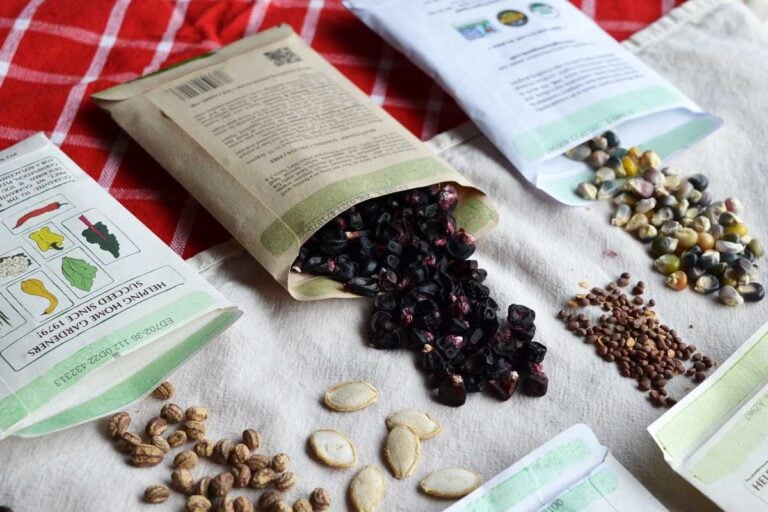
At the top of this post is one of the sets of seeds. The other sets are similar. If the winners only have a small garden and don’t think they can use all the seeds or find someone to share them with, please let me know and I will pass them along to someone else. Some thing if there’s a vegetable you know you won’t use. Let me know and I’ll find it a different home.
Continue reading »

Apr 172011
 
My Favorite Seed Sources - Plus Seed Storage and Germination Rates after Storage


In case you haven’t ordered all your garden seeds just yet, I thought I’d do a quick post about my favorite seed sources, seed storage and seed germination rates after storage.

Fedco Seeds – Fedco is where I buy the bulk of my seeds.  Their prices are very affordable, they carry a large number of varieties, and they source from ecologically sound growers – no GMOs here.  Their catalog is not flashy – it’s printed on plain newsprint, all black and white – but their variety descriptions are tops.  They point out which varieties store best, are best in certain recipes, and are resistant to various garden problems.  They also give troubleshooting tips.

Baker Creek Heirloom Seeds – I’m new to Baker Creek, but I’m a fan.  One of the best for unusual heirloom and open-pollinated varieties, plus reasonable prices.  Gorgeous photos in the print catalog and online. They’ve launched a customer review option online, but so far the feedback is minimal.  I expect it to grow over time.  Forward thinking company, also GMO-free and supporting local farmers, like Fedco.

Pinetree Garden Seeds
– Out of my top five, I’ve been ordering from Pinetree the longest.  Their prices are reasonable, and they give smaller quantities of seed in each packet so you don’t end up carrying over so much seed from one year to the next if you have a smaller garden.  I typically order from Pinetree for seeds that have a limited storage lifespan, like peppers and parsnips.  Again, another company that is GMO-free and supports healthy farms and farmers.

Seed Savers Exchange
– I love the idea of Seed Savers Exchange, and they have a beautiful and inspiring catalog – BUT – not all the seeds I’ve ordered from them have had the quality I expect from a seed company.  Germination rates have been poor, squash that were supposed to store well stored poorly (they were the first to rot in storage our of six varieties), plants have failed to thrive (right next to similar plants from other seeds sources), and tomatoes that were described as crack resistant cracked worse than any others in my garden (and I grow around 20 varieties).  When I emailed with my concerns, I received no response.  I am still a member of SSE, support their work and order from them occasionally, but don’t rely on them for the bulk of my seeds.

Seeds of Change – SOC has a beautiful catalog where they share wonderful stories about how their seeds are changing people’s lives.  Unfortunately, they were bought out several years ago by M&M/Mars company, and I have to say I miss the days of the old SOC.  They used to focus on heirlooms and unique open-pollinated vegetables developed by the likes of Alan Kepuler.  Now, I page through the catalog and see mostly hybrid varieties.  What can I say?  “Hybrid vigor” is great on occasion, but I prefer open pollinated and heirloom varieties for the most part. Update:  M&M/Mars is now introducing GMO cocoa.  Sorry, Seeds of Change, you’re now off my list for good.

How Long Can You Store Seeds?

So, once you’ve got your seeds, how long can you expect them to remain viable?  The following charts from Seedman.com lists storage and germination times for garden seeds.  My results have been somewhat different, generally with a longer shelf life than this list suggests.  I’ve started keeping records for the seedlings I start inside, listing planting date, variety, number of cells, number of seeds, year of seeds, seed company, date of first seedlings, number of seedlings, final number of seedlings and date of final count.  I pop these titles into Excel, make a grid and print it horizontally on a page.  This allows me to keep track of whether or not I need fresh seeds for a variety even if I have a lot of seeds left.  For instance, I’ve got some tomato seeds left from 2001 (ten years old) that came up great this year, and others that only sprouted one out of ten seeds.

What’s the Right Way to Store Seeds?

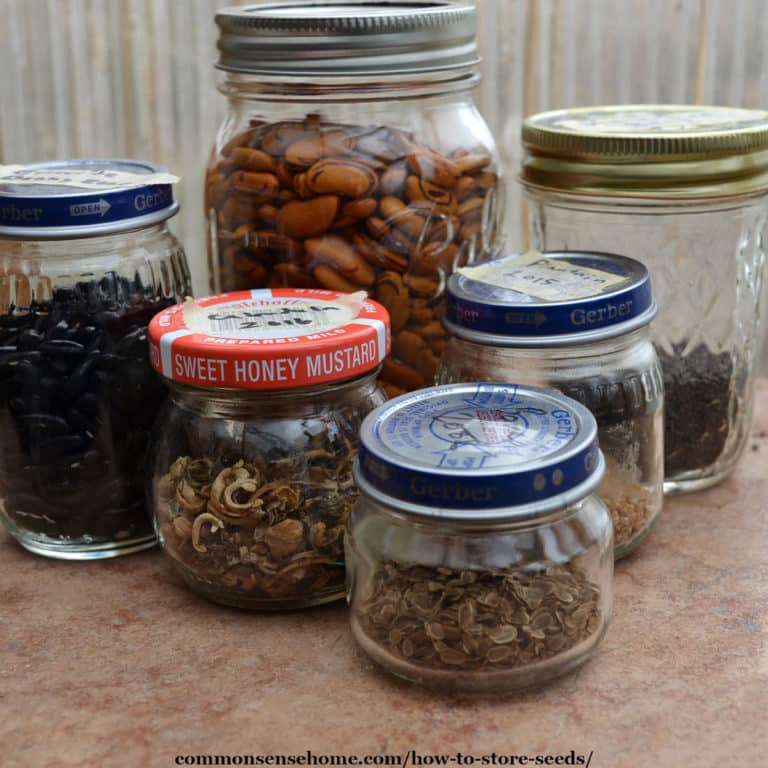
I keep my seeds in my cool, dry basement to help extend their lives, but they could be  a little cooler.  My friend keeps hers in their walk in cooler and has significantly better longevity.  I may have to bum some cooler space once most of planting is over.  Don’t leave your seeds sitting in a greenhouse or near a heat source, like near a furnace or in your kitchen! This will shorten their lives.  According to the article from Seedman.com “The dry seed should be placed in packages and stored in moisture-proof containers. Containers such as sealed cans or jars with air tight caps work satisfactorily. Storage temperatures between 35°F and 50°F are satisfactory when the moisture content of the seed is low.”

Table I. Seed weight and longevity for home garden vegetables.

Crop Seeds per Ouncea Relative Longevity under Cool, Dry Condition (Years)bc
Asparagus 700 3
Bean, Lima 25 – 75 3
Bean, Snap 110 3
Beets 1,600 4
Broccoli 9,000 5
Brussels Sprouts 8,500 5
Cabbage 8,500 5
Carrot 23,000 3
Cauliflower 9,000 5
Celeriac 70,000 5
Celery 70,000 5
Chicory 26,000 5
Chinese Cabbage 18,000 5
Cucumber 1,100 5
Eggplant 6,000 5
Endive 26,000 5
Kale 9,500 5
Kohlrabi 9,000 5
Leek 11,000 3
Lettuce 25,000 5
Muskmelon 1,200 5
New Zealand Spinach 350 5
Okra 500 2
Onion 9,000 1 – 2
Parsley 18,000 2
Parsnip 12,000 1 – 2
Pea 75 – 90 3
Pepper 4,500 4
Pumpkin 200 4
Radish 3,000 5
Rutabaga 12,000 5
Salsify 1,900 2
Spinach 2,800 5
Squash 100-300 5
Sweetcorn 120 – 180 1 – 2
Swiss Chard 1,500 1 – 2
Tomato 11,000 4
Turnip 14,000 5
Watermelon 200 – 300 5

aSeeds, The Yearbook of Agriculture. 1961. Stefferud, A., Editor. The United States Government Printing Office.
bHandbook for Vegetable Growers. 1960. Knott, Joe. John Wiley and Sons, Inc.
cVegetable Growing Handbook. 1979. Splittstoesser, W.E. AVI Publishing, Inc.

Table II. Germination data for home garden vegetable seed.

Crop Minimum Percent Germinationab Germination Temperatureb Days to Germinate Under Optimum Temperature and Moisture Conditionsc
Min °F Opt. °F Max. °F
Asparagus 60 50 75 95 10
Bean, Lima 70 60 85 85 6
Bean, Snap 75 60 80 95 7
Beets 65 40 85 95 4
Broccoli 75 85 4
Brussels Sprouts 70 80 4
Cabbage 75 40 80 100 4
Carrot 55 40 80 95 6
Cauliflower 75 40 80 100 5
Celeriac 55 70 11
Celery 55 40 70 85 7
Chicory 65 80 6
Chinese Cabbage 75 80 4
Cucumber 80 60 95 105 3
Eggplant 60 60 85 95 6
Endive 70 80 6
Kale 75 80 4
Kohlrabi 75 80 4
Leek 60 70 7
Lettuce 80 35 75 85 3
Muskmelon 75 60 90 100 4
New Zealand Spinach 40 70 6
Okra 50 60 95 105 6
Onion 70 35 75 95 6
Parsley 60 40 75 90 13
Parsnip 60 35 65 85 14
Pea 80 40 75 85 6
Pepper 55 60 85 95 8
Pumpkin 75 60 95 100 4
Radish 75 40 85 95 4
Rutabaga 75 80 4
Salsify 75 70 6
Spinach 60 35 70 85 5
Squash 75 60 95 100 4
Sweetcorn 75 50 95 105 3
Swiss Chard 65 40 85 95 4
Tomato 75 50 85 95 6
Turnip 80 40 85 105 3
Watermelon 80 60 95 105 4

aMinimum percent germination to federal standards.
bHandbook for Vegetable Growers. 1960. Knott, J.E. John Wiley and Sons, Inc.
cSeeds, The Yearbook of Agriculture. 1961. Stefferud, A., Editor. The United States Government Printing Office.


What are your favorite seed sources and how do you store your seeds?  I’m always open to trying something new.

You may also enjoy:

Seed Starting – Why I plant so many different varieties, and how I do it.

Tomato Mania – Seed Starting, Transplanting and Troubleshooting

Featured at the Homestead Barn Hop,
Simply Lives Thursday and Patchwork Living Blogging Bee .

Apr 052011
 

Alas, my ground outside is still very much covered with snow and ice, and here I am oggling greens seeds old and new.  I love the variety you can find by shopping through seed catalogs.

This years planned greens include:

  • Lettuce – Rocky Top Mix
  • Lettuce – Red Romaine
  • Amaranth – Joseph’s Coat
  • Lettuce – Really Red Deer Tongue
  • Lettuce – Blushed Butter Cos
  • Lettuce – Summerlong Gourmet Mix
  • Mache – Verte de Cambre
  • Spinach – Bloomsdale Long Standing
  • Spinach – Bordeaux
  • Minutina – Erba de Stella
  • Strawberry Spinach (saved seed)
  • Spinach (saved seed)
  • Kale – Dinosaur (Lacinato)
  • Swiss Chard – Five Color Silverbeet
  • Kale – Nero de Tuscana
  • Kale – Red Russian
  • New Zealand Spinach
  • Bok Choy – Ching Chang
  • Chinese Cabbage – Michili

To get a jump on the season, I’ve got an indoor planting bench and a small greenhouse attached to the house.  This year, I decided to try something different and pre-sprouted and grew out some pea seeds just for use as greens.  The tender tops and little tendrils make a nice salad addition.

To sprout my peas, I placed them in a wide mouth mason jar, covered them with water and the sprouting strainer lid, and let them soak overnight.  In the morning, drain and rinse and leave them on the counter for a few days, rinsing once or twice a day.  By the end of they week, you’ve got something like this:

As you can see, the peas have developed mice little root systems.  Some of them haven’t sprouted, so those get tossed.

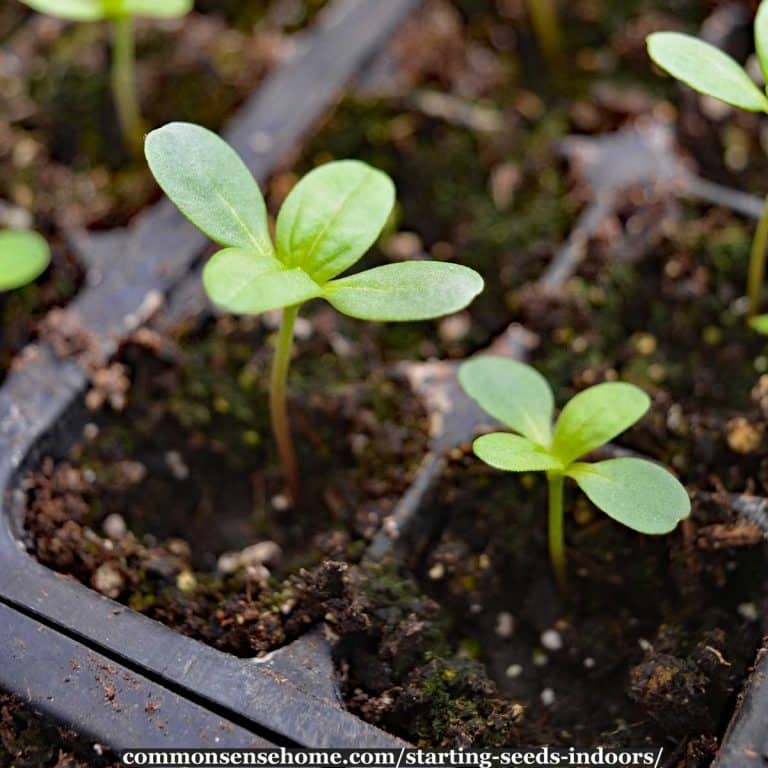
I put some potting soil in old organic salad mix trays, snuggled the little seedlings in and tucked them under the grow lights.  At the same time, I started some Rocky Top lettuce mix, some butter Cos, some spinach, some Alyssum and some Painted Tongue.

Two days later, and the peas were coming along nicely.

A week later, and the first  pea tops were ready to harvest.  The salad greens and flowers were poking up out of the soil.  As I said, it’s been really cold and dreary here, so I’m setting no records for rampant growth.  I moved all of these trays out to the greenhouse shortly after this photo, and they’ve really been creeping along.

Here’s my first bowl of pea tops.

I added them to a nice mixed salad with some organic store bought greens (a month later, and the lettuce and spinach are almost ready to harvest as micro greens – trying to be patient).  Here we’ve got some leftover shell peas from supper the previous night, greens, pea tops, soaked walnuts, raw milk bleu cheese from Nala’s, soaked sunflower seeds, dried cranberries, dried blueberries, balsamic vinegar and flaxseed oil.  I regularly enjoy having a big mess o’ salad like this for lunch.  Sometimes I’ll add sardines or pickled fish, or fresh sourdough bread slathered with plenty of butter.

Temps are finally warming up this week, so I’ll be starting more seeds inside and hopefully be able to plant outside within the next few weeks.  I decided I’m going to use my sprouting jar to pre-sprout my early peas before plating them out in the garden (these really early ones will remain inside for greens) , since I regularly have germination issues with peas when the ground is cold and wet.  I’ve got some worm castings from Whitetail Organics to top dress the soil, which adds a nice little nitrogen boost that leafy veggies love (I also add it to my potting mix).  The worm castings don’t have the potential disease issues of improperly finished compost or pathogen potential of  other manures, which is another reason I like to use vermicompost if I have it.  Most greens do well in (or prefer) cooler weather, so they are great season extenders.

What are your favorite greens?  Do you have any tips for growing them that you’d like to share?

UPDATE:  The snow has finally cleared from the garden, and I can see the semi-permanent greens bed that had just started leafing out last fall coming to life.  I’ve been letting this corner of my garden self-seed with mache and strawberry spinach.  Last fall it was getting quite overgrown with inedible weeds (the dandelions went in the salad bowl, too), so I cleaned it and added spinach.  The little plants are about an inch tall.  Yeah!

This post has been added to Simple Lives Thursday for April 7, 2011 at GNOWFGLINS.
This post has been added to Fresh Bites Fridaysfor April 8, 2011 at Real Food, Whole Health.

This post has been added to Fight Back Fridaysfor April 8, 2011 at Food Renegade.

Jun 072010
 

“Houston, we have a problem.”

Take at look at the photo below. On the right are Painted Tongue seeds planted with the fancy organic potting soil and worm castings at a ratio of 3:1. On the left are the same seeds planted in the organic potting soil only.  They didn’t come up at all.  Other seeds that did come up sat there, stunted, refusing to grow.

Now, common sense would have indicated that I do a soil test before I started planting, but I thought “Hey, this is fancy organic potting soil and it should make the plants grow really well.”  Grrrrr….

So after the fact, I did have my kiddos run a soil test on the potting soil and on the worm castings.  Here are the results.

Organic potting soil:

The pH is around 6.5 (slightly acidic), the phosphorus (P, blue) is “sufficient”, the potash (K, orange) is “adequate”, but the nitrogen (N, pink)is completely depleted – nada, zip, zilch! No wonder things wouldn’t grow.

Whitetail Organics Worm Castings:

The pH is around 7 (neutral), the phosphorus (P, blue) is “sufficient”, the potash (K, orange) is “depleted”, and the nitrogen (N, pink) is off the charts – high surplus.  So to get a full range of the basic nutrients in my potting soil, I should have probably mixed in some greensand with my worm castings and added both to the potting soil.  Live and learn.

Next season I either mix my own potting soil from scratch, starting with garden soil, which will mean planning ahead since my garden is usually very frozen when I want to start seedlings, or at the very least I test my seed starting mix before I start planting seeds in it.  Luckily I amended most of my seed flats with the worm castings, but still, it was pretty aggravating to spend extra money on what I thought was a better product, only to have to produce very poorly.

Right now I’m in the process of finishing spring planting in the garden (late, I know, but sometimes things don’t go as planned).  I’ve been harvesting herbs and greens of various sorts, and the things that have been planted thus far seem to be doing well.  Temps have been a little up and down, but we keep getting rain at pretty regular intervals, and it hasn’t been super cold (except right around Mother’s Day – it snowed :-P ).  The dehydrator is full of chamomile and there are massive amounts of catnip hung in the basement to dry.  I’ve been busting my butt trying to finish planting, so I hope you’ll bear with me as my posting schedule is likely to be quite erratic.

Mar 122010
 

Seed starting for biodiversity, pest control and fun! - Common Sense Homesteading

All the seed orders have arrived, so I have no more excuses not to get starting seeds.  I have a pretty good sized garden (not as big as some of my friends – wow!), about an acre or so.  It’s a bit of a crazy quilt.  I like to plant a lot of different things – vegetables, flowers, herbs, all jumbled together.

Reasons I Plant so Many Different Vegetables, Fruits, Flowers and Herbs

Pest Control – If the critters are going to come after my plants, I want them to have to work for for their lunch.  I recommend the book Great Garden Companions for some ideas on how to use plant families and their companion plants to boost your garden production.

Biodiversity – I believe one of the best ways to preserve biodiversity is to eat it.  We are loosing food plant varieties at an alarming rate.  Even if I only plant a couple of plants of a particular variety, I’m still helping to keep that seed in production.  I share with friends, too.  I figure every little bit helps.  (Love, love, love the book Heirloom Vegetables.)

If you look at the numbers, it’s a pretty scary situation.

The world’s food supply depends on about 150 plant species. Of those 150, just 12 provide three-quarters of the world’s food. More than half of the world’s food energy comes from a limited number of varieties of three “mega-crops”: rice, wheat, and maize.

I’ve grown everything from sunchokes to mache to quinoa (although the quinoa wasn’t very successful).  This year I’m giving peanuts and hulless oats a try.

IT’S FUN! – Why grow only russet potatoes when you can grow potatoes that are purple, yellow and red?  Why grow only red, ping pong ball tomatoes when you can grow tomatoes that pink, purple, green-striped, yellow, orange, white, turban-shaped, sausage-shaped – there are literally thousands of options.  The garden starts humming with pollinators early in spring as the companion plants lure in beneficial insects, and keeps humming until hard frost.  The scents, the colors, the flavors – it’s lovely!

Here’s what needs to go in the dirt this year.

Oh, and some of the bean seeds…

And some of the saved seeds and bulk seeds…

I’m trying out some new potting soil this year.  (No, I haven’t started mixing my own yet, maybe next year.)  I found an organic brand at one of the local garden stores (Stein’s, for those who live in the area).  I won’t use Miracle Grow potting soil any more.  In my experience, when you use Miracle Grow it’s a miracle if your plants grow.  My mom had the same problems.  I think they put so many chemicals in the stuff that it stunts and burns the seedlings.  Don’t believe me?  Take a look at this photo from a few years ago.

Both of these cell packs were planted at the same time with the same seeds (Painted Tongue flowers).  The one on the left was Miracle Grow potting soil.  The one on the right was a competitor (Schultz? – can’t remember).  I refuse to buy Miracle Grow products anymore.  I buy starter without added fertilizer and water with fish emulsion once in a while.

How to Start Your Own Garden Seeds

Choose the right seed starting mix – Along with the Organics potting mix, I’ve also got some earthworm castings from Whitetail Organics.  My nephew has gotten into the worm business and set me up with some high-octane worm poo.  I used some around the garden, but I saved a bag for seed starting.  I tried a few cells with just worm poo, some with the recommended ratio of 3 parts potting soil to one part worm poo, and some with just potting soil.  We’ll see if I can notice a difference.

Our basement was set up so that it could be used as an apartment for aging parents (or any other friends or family who may need it), so I’ve got a sweet setup in the form of a kitchenette between my root cellar and the door to the attached greenhouse.  Since we are currently without added housemates, it’s my gardening area.

I’ve got water at the ready and my mess is contained quite nicely.  Here’s a peek at the organic potting soil and the worm castings.  Potting soil is on the left, castings on the right.

Rule of thumb for planting – place seeds in dirt roughly three times as deep as the diameter of the seed.  Seed packets should give specific instructions, but if you’ve got loose seed, this is a good general rule.  Some seeds need light to germinate, so they should be planted on the surface or only very lightly covered.

I used to plant my flower seeds by lightly sprinkling them over the surface of a container full of dirt, wait for them to germinate, and then transplant the little seedlings into their own individual cells.  The resulting seedlings often ended up, as my mom would have said, “thicker than the hair on a dog’s back”.  Transplanting was a huge headache, and the roots would become so tangled that the tiny seedlings would often suffer transplant shock, slowing their growth significantly.

In recent years I’ve switched to planting the seeds in individual cells.  This is still a hassle, as these little buggers are tiny.  Check out these photos.  Here are several dozen petunia seeds.

Look at this Painted Tongue seed on the end of my index finger.  (It’s the itty-bitty brown dot.)

Planting many flower seeds is like planting grains of pepper.  If someone’s got a better way of doing this, please let me know.  While this is less work than transplanting the fragile, often overcrowded seedlings, germination rates are frequently lower than 100%, which leaves me with empty cells.  I do buy pelletized seeds for some things (like wave petunias), but they are much more expensive.

Mark your seedlings – many plants look similar when they are small.  Last Sunday I finally buckled down and started planting – three “flats” with 72 flower cells each, blue wave petunias, Painted Tongue, and Denim Blue pansies (my youngest loves blue).  I use popsicle sticks broken in half as biodegradable plant markers.  They’re very inexpensive, too.  If you’re new to planting, a general rule of thumb for depth of seeds to to plant a seed as deep as the seed is wide.  So, with really tiny seeds, they are typically just barely covered or sometimes even left on top of the soil (most packages will have directions).

Here are my first “babies”, ready to get covered to keep them from drying out while they wait to sprout.

Provide adequate light and good air circulation.  Several years ago, my husband built me a really nifty seed starting rack with lights on adjustable chains.  I park this in front of our south facing windows in the basement (it was night by the time I finished planting).

To give the plants plenty of light with some downtime at night, I use a plug-in timer on the lights.

So, a couple of hundred seeds into the soil, many hundred more to go.

If you’re looking for a chart of when to start your seeds, here’s a nice reference to get you started.  If you’re looking for ideas about where to buy seeds, you can check out my favorite seed sources.  If  you have specific questions about starting seeds, feel free to drop me a note and I’ll see if I can help.  Heaven knows I’ve made just about every mistake at one time or another – from killing seedlings by keeping them too wet, causing “damping off”, to putting them out in the nice, warm, spring sunshine a little too long the first time out (which also killed them).  Too wet, too dry, over-fertilized, under-fertilized, overcrowded, root bound…yeah, I’ve had these things happen at one time or another, too.  One of my favorite things about gardening is that if you screw up you can always try again.  :-)

If you want to know more about seeds starting, you may also enjoy the post Tomato Mania – Seed Starting, Transplanting and Troubleshooting.

This post has been added to Simple Lives Thursday #76 at A Little Bit of Spain in Iowa.