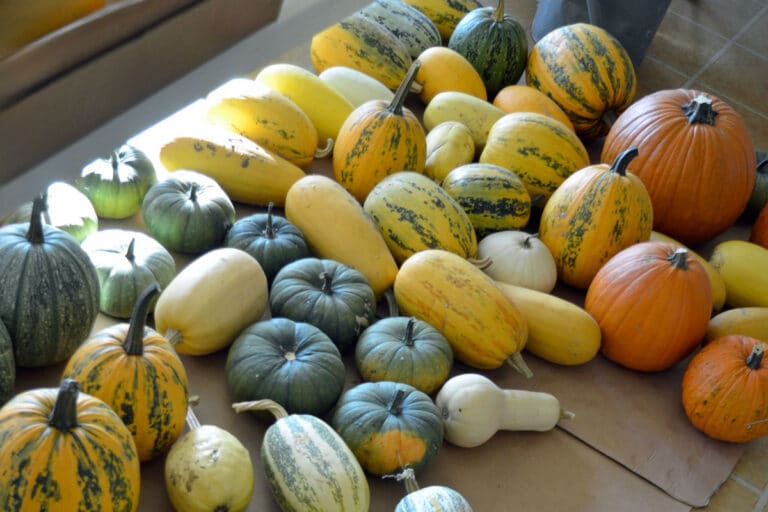
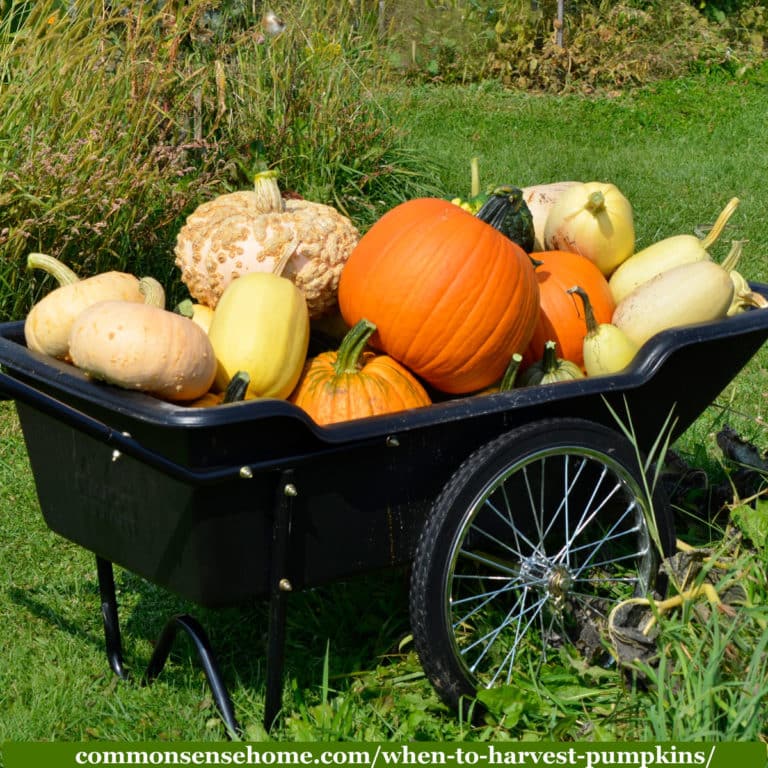
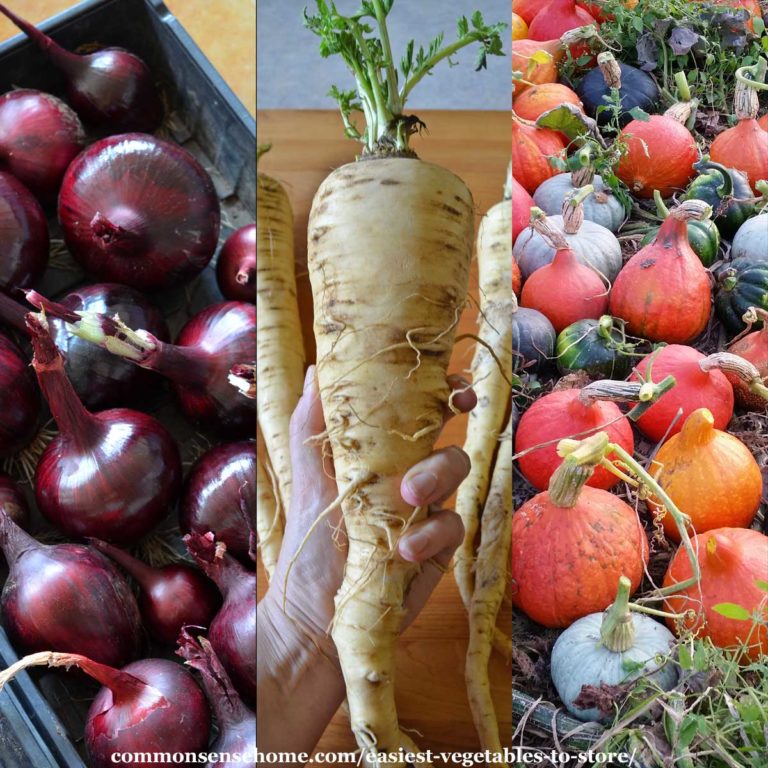
It’s harvest time! The growing season is wrapping up in Northeastern Wisconsin and farmer’s markets and home gardens are overflowing with squash, pumpkins and root vegetables. The boys and I, along with some helpful friends, have been working hard to clear everything that is not frost tolerant from the garden. The cold weather greens I planted a couple of weeks ago are coming up – we’ll see how they do with our first taste of frost. Some celery and pepper plants will be dug up and moved into the greenhouse to extend their season; others will be protected in place with cold frames.
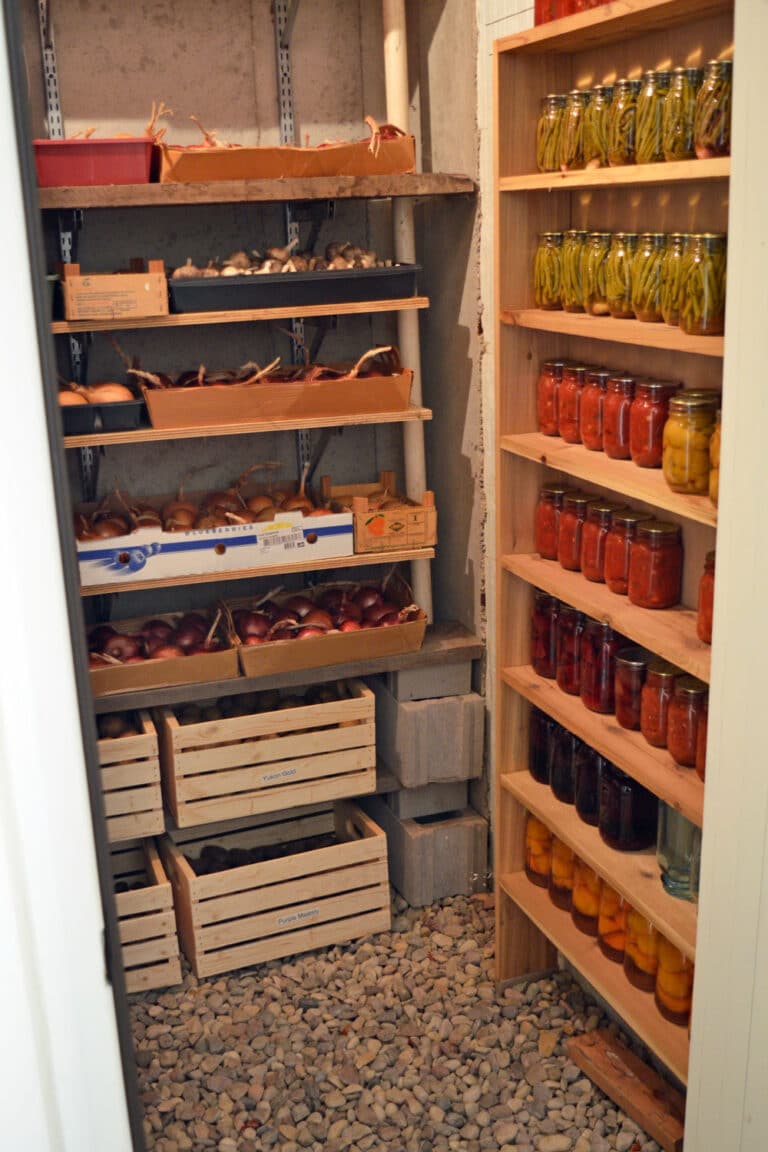
Our home includes a root cellar under the front porch and an unheated storage room in the basement. Most crops go in the root cellar (potatoes, onions, and other root vegetables), but pumpkins and squash go in cool storage along with the canned goods. If you don’t have a root cellar, an unheated basement, porch or garage can offer storage options. Pumpkins and squash can even be kept under the bed in a cool bedroom.
The best resource we have found on storing foods without processing or electricity is the book Root Cellaring: Natural Cold Storage of Fruits & Vegetables by Mike and Nancy Bubel. No matter what your location or your available space, the Bubels are likely to have a cool storage option that will work for you. It contains detailed explanations of how to store vegetables and fruits without electricity with specific temperature and humidity recommendations for each variety. There are also good photos and diagrams, which I really like.
Food prices are likely to continue to rise, so no matter what your situation, now is a good time to stock up on fresh produce. With proper storage you can take advantage of this abundance for months to come. You can learn more about our root cellar in the post “Root Cellars 101“.
Related Links:
Build a Basement Root Cellar by Steve Maxwell – Article from Mother Earth News
A Root Cellar for Your Homestead by Victoria Ries – Some basic information on the cellar, more information on the proper storage of the fruits and veggies themselves.
Save $$$ with Proper Produce Storage – For those stashing things in their fridge produce bins, a quick summary of what to put in each bin based on ethylene gas production.
Storage Guidelines for Fruits and Vegetables – From Cornell University Extension, this provides a quick summary of recommended long-term storage conditions for a variety of fruits and veggies.
How to Cook a Pumpkin to have Pumpkin Puree to Make Pumpkin Recipes – From Pumpkin Patches and More.org (a part of pick your own.org). Just in case you’ve never cooked up a pumpkin, here’s a complete “how to” with photos. Once you’ve had home-cooked you’ll never go back to the canned stuff.

Ode to Pumpkin Recipes
Pumpkin Bread
This recipe is from Candice Stauffer, gardener, baker and homeschool grandmother to a very creative and energetic group of boys.
Ingredients:
Wet:
3 cups sugar
2 cups melted butter
4 eggs
1 pound can or 2 cups home rendered pumpkin
Dry:
3 1/2 cups flour
2 teaspoons baking soda
1 teaspoons baking powder
2 teaspoons salt
1/2 teaspoon ground cloves
1 teaspoon cinnamon
1 teaspoon nutmeg
1 teaspoon allspice
Add at end: 2/3 cups water
Directions:
Preheat oven to 350 degrees. Combine sugar, oil, eggs and pumpkin. Mix together dry ingredients. Blend dry ingredients into wet ingredients. Stir in water. Pour into greased pans (2 large or 6 small loaf pans). Bake around 60 minutes. Test for doneness with toothpick in center.
NOTE: It seems to take 1 hr. baking, no matter what size the pans are. For small pans, I test at 50 min., usually still takes 5-10 min. more. This bread is very moist, so I sometimes place a rectangle of parchment paper or wax paper in the bottom of the pan to avoid sticking. The flour can be adjusted, using a portion of whole wheat in place of an equal portion of white, not over half (gets pretty heavy, doesn’t bake as well).
Pumpkin Soup from Scratch
From Pumpkin Patches and More.org. Click here for recipe with photos.
Ingredients:
3-4 cups pumpkin puree
1 Tablespoon minced garlic
1 large mild (sweet) onion, chopped
6 fresh carrots (chopped)
3 tablespoons melted butter or margarine
1/2 teaspoon salt
Dash of pepper
1 pint half-and-half
2 teaspoon thyme
4 tablespoons chopped parsley
2 stalks of celery (not 2 bunches!)
Directions:
Chop the onion and celery to about 1/8 in size. Sauté the onion and celery in butter until tender. Add remaining ingredients except half-and-half. Cover and simmer 10 minutes, stirring occasionally. Add half-and-half, and heat through. Serve warm. Makes 6-8 small servings.
Maple Pumpkin Pie Supreme
From epicurious.com, this naturally sweet pie will be a special treat at fall meals.
Ingredients:
1 1/2 cups pumpkin puree
3/4 cup packed brown sugar
1 1/4 teaspoons ground cinnamon
1 teaspoon ground ginger
1 teaspoon ground nutmeg
1/4 teaspoon ground cloves
1/8 teaspoon ground allspice
1/2 teaspoon salt
2/3 cup real maple syrup
1 1/4 cups half-and-half cream
1 teaspoon all-purpose flour
3 eggs
1 (9 inch) unbaked pie shell
Directions:
Preheat oven to 350 degrees F (175 degrees C). In a large bowl, mix together 1 1/2 cups pumpkin, brown sugar, cinnamon, ginger, nutmeg, cloves, allspice, and salt. Stir in maple syrup, half-and-half, and flour. Mix in eggs one at a time. Pour filling into unbaked pie shell. Bake at 350 degrees F (175 degrees C) for 1 hour, or until center is set.