Oct 262011
 
Ground Cherry Lemon Jelly

If you happen to raise ground cherries, you may end up finding yourself swamped with an excess of the little fruits.  This recipe will help you use up a LOT of them in a hurry.  The lemon cuts the sweetness of the ground cherries, and my family prefers a jelly over a jam for ground cherries because their large number of seeds makes a jam almost gritty.

I created this recipe when I was still using standard pectin, so there is quite a bit of sugar.  I think you could successfully cut the sugar in half if you used Pomona’s Pectin or other low sugar pectin products, but I wouldn’t cut it more than that because the large amount of lemon juice.

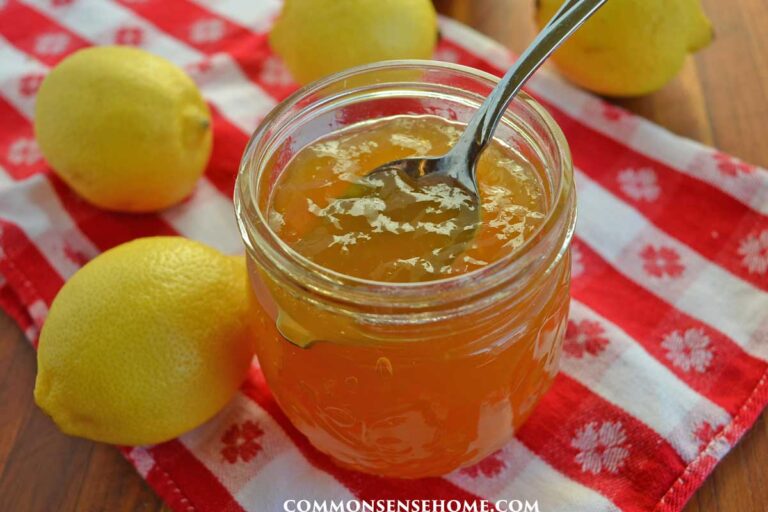
This jelly tastes like the best old-fashioned lemon drop you ever had.  Serve it on toast with a bit of honey or almond butter and you’ve got a little slice of lemony heaven.

Ground Cherry Lemon Jelly Recipe

Ingredients

3 ½ cups ground cherry juice
½ cup fresh squeezed lemon juice
1 tablespoon lemon zest (preferably organic)
¼ teaspoon butter
1 package powdered pectin (1.75 oz) (I use Sure Jell)
6 cups sugar

Directions

To prepare ground cherry juice, husk and wash ground cherries, run them through a food processor.  I used around two 11″x22″ cardboard strawberry picking flats full of ground cherries to get 3 1/2 cups of juice.

ground cherries in the husk
husked ground cherries

Cook gently for at least 15 minutes, until very soft. Drain through jelly bag for several hours or overnight. Avoid squeezing bag to keep juice clear.

Prepared ground cherry juice and lemons

Grate one tablespoon of zest from 1-2 lemon(s).  I use a Microplane zester.  Juice the lemon(s) to obtain ½ cup juice (you either need a large lemon or lemons or can substitute a little bottled juice to make up the difference).

Sterilize seven 8-ounce jars, keep hot.  Heat lids and rings in hot water, keep warm but not boiling.  Fill water bath canner and bring to boil.

Measure sugar and set aside. Combine juices and zest, stir in pectin and butter. Bring to full rolling boil over high heat, stirring constantly. Immediately add all of the sugar. Bring back to full rolling boil and boil 3 minutes, stirring constantly.

Ladle jam into sterilized jars leaving 1/4″ headspace. Wipe rims clean and screw on the lids. Process for 10 minutes in water bath canner (add 1 minute for every 1,000 feet above sea level).  Makes around 7 half pint jars. This time around I ended up with 6 1/2 jars (the half went into the fridge).

These make beautiful and unique Christmas gifts, too (you know no one has ever gotten lemon ground cherry jelly before).  Ground cherries can produce a lot of fruit in a small area, so four to six plants should be plenty for a batch or two of jelly and fresh eating.  I’m sure you could substitute Cape Gooseberries instead of ground cherries, if you have them.  I know it late this year for most folks to try them (unless you’re in the southern hemisphere), but keep this in mind for next season.

This post has been added to the Homestead Barn Hop #34 at the Prairie Homestead.
Sep 152011
 

Last week I got a call from my neighbor, Betty, about crabapples being ripe at another friends’ home.  (Everyone should have a neighbor like Betty.  :-)   Never one to let produce go to waste, I warned the boys that we were going to go pick crabapples.  My eldest, wanting to get done sooner, headed out to the wild trees at the border of out field.  These are normally so bug infested as to be inedible, but this year one had a bumper crop, and we were able to pick quite a few that were in nice shape.

My apple pickers.

I went picking over at the neighbor’s, too.  Our apples were smaller, firmer and greener.

There’s were larger, softer and dead ripe.  Just a bit past prime for canning whole, as they softened up and fell apart a bit during processing, but they were still delicious.

I canned the apples whole two ways – as honey cinnamon apples and and spiced apples.

How to Prepare Crabapples for Canning

Because the neighbor’s apples had been sprayed (not a lot, I was told, but still sprayed), I washed them first in water with a squirt of my non-toxic dish detergent, then rinsed them in water with white vinegar in it, them rinsed again with clean water (and took the water out after to water the flowers).  I worked from right to left, soap wash, vinegar rinse, clean rinse and into the dish drainer.

Cut out the blossom end of the apple, but leave the stem intact.  You don’t need to core the apple.  Both of these recipes could be made with sliced apples, too, if you don’t have crabapples available.  After removing the blossom end, poke the apple with a fork five times to allow even penetration of syrup.

Note:  You want to prep all your canning equipment and syrup before you start cutting out the blossom ends, so you can get the apples in the syrup right away to minimize browning.

Preparing Your Canning Equipment

Apples can be canned in a water bath canner.  For full instructions on water bath canning, I recommend the Ball Blue Book of Canning and PreservingCanning equipment includes:

  • your water bath canner
  • clean and sterilized quart jars (I run mine through the dishwasher and time it so they are hot when I’m ready to can)
  • lids and rings in hot (not boiling) water
  • jar lifter
  • tongs or lid lifter to grab rings
  • funnel
  • clean cloth to wipe jar rims
  • ladle
  • wooden spoon for stirring
  • chopstick to remove air bubbles
  •  syrup (recipe below)

Honey Cinnamon Crabapple Recipe

This recipe was inspired by the book Putting it up with Honey, where they feature instructions for apple slices canned with honey.

Ingredients

5 pounds whole crabapples (original recipe called for 15 pounds of apples, which were washed, cored, peeled and sliced)
1 1/2 quarts water
1 3/4 cup honey
3 cinnamon sticks

Directions

Prepare syrup by adding honey to water and heating until the honey is dissolved (this is a nice way to use crystallized honey straight from the jar).  Add cinnamon sticks, simmer five minutes.  Add apples (with blossom ends removed) to syrup.  Simmer five minutes (just to heat through), you don’t want to overcook them, as they will cook more during processing.  Apple skins will darken as they cook (think applesauce or baked apples).

Load hot apples into hot quart jars, fill with syrup to 1/2 inch headspace.  Run you chopstick or small non-metallic spatula between the peaches and the jar to remove air bubbles (metal may scratch the inside of the jar).  Add extra syrup if needed.  Wipe rim clean, screw on lid (not too tight – air must escape during processing).

* Note:  if using Tattler lids, use 1 inch headspace, tighten rings, then unscrew 1/4 inch.

Place jars on rack in canner.  When all apples are packed (you should have 4-5 jars), lower jars into water.  Make sure jars are covered by 1-2 inches of water.  Bring to boil, process (boil gently) 20 minutes.  (See peach post for photos of canning setup and jars in canner.)

When the cooking time is up, remove jars at once and place on a rack or on towels away from heat and away from any draft.  If using Tattler lids, tighten rings as soon as they are removed from the water bath.  This is not necessary for standard canning lids.

After 12-24 hours, check lids for seal.  Standard lids should be concave in the center and held down tightly.  Tattler lids should be snug if you try to pull them off.  I love listening to the “ping” as the jars seal.

Spiced Crabapple Recipe

This recipe is from my neighbor, Betty, who has been making it for years.

Ingredients

60-65 whole crabapples (enough to fill 5-6 quarts – I used 70 apples ~ 6.5 pounds, because my apples were small)
9 cups water
1/2 cup vinegar
6 cups white sugar
1 cup brown sugar
1 1/2 tablespoons whole cloves, placed in a spice bag

Directions

Prepare syrup by mixing all ingredients except apples and heating until the sugar is dissolved.  Boil one minute.  Add apples (with blossom ends removed) to syrup.  Simmer five minutes (just to heat through), you don’t want to overcook them, as they will cook more during processing.  Apple skins will darken as they cook (think applesauce or baked apples).

Load hot apples into hot quart jars, fill with syrup to 1/2 inch headspace.  Run you chopstick or small non-metallic spatula between the peaches and the jar to remove air bubbles (metal may scratch the inside of the jar).  Add extra syrup if needed.  Wipe rim clean, screw on lid (not too tight – air must escape during processing).

* Note:  if using Tattler lids, use 1 inch headspace, tighten rings, then unscrew 1/4 inch.

Place jars on rack in canner.  When all apples are packed (you should have 4-5 jars), lower jars into water.  Make sure jars are covered by 1-2 inches of water.  Bring to boil, process (boil gently) 20 minutes.  (See peach post for photos of canning setup and jars in canner.)

When the cooking time is up, remove jars at once and place on a rack or on towels away from heat and away from any draft.  If using Tattler lids, tighten rings as soon as they are removed from the water bath.  This is not necessary for standard canning lids.

After 12-24 hours, check lids for seal.  Standard lids should be concave in the center and held down tightly.  Tattler lids should be snug if you try to pull them off.

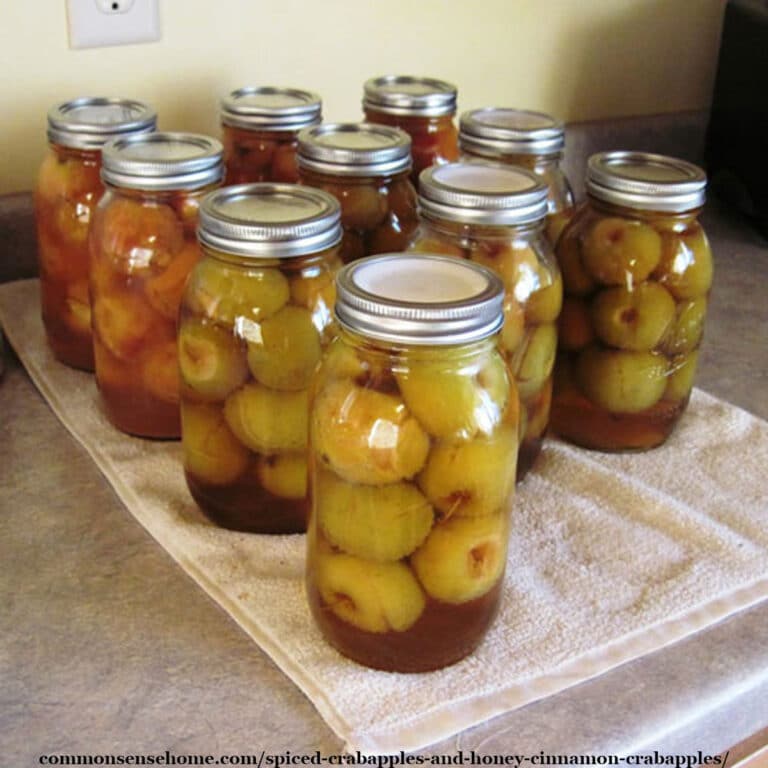
I finished with four quarts of honey cinnamon apples (and about eight apples I couldn’t squeeze into jar that I just put in the fridge) and six quarts of spiced apples.  Honey cinnamon apples are to the rear and spiced are in front.

I ended up using our home apples for the spiced apples and Betty’s apples for the honey cinnamon apples.  Our home apples were smaller, so more of them fit into a jar.  I noticed that while the honey cinnamon apples were processing, they became quite soft (some of them fell apart a bit), so I decided to process the balance of the very ripe apples into apple sauce and fruit leather.

How to Make Applesauce and Apple Fruit Leather

Apple sauce is super easy, especially when your apples are really ripe.  Just place clean apples in a heavy bottom pot with enough water to cover the bottom of the pan so it doesn’t burn.  Cook until mushy.  I noticed my apples had a lot of liquid, so I put them in a colander to drain off some of the juice before processing further.  (Save the juice in another bowl if you have an excess – it’s quite tasty.)

Employ child labor (if available) to turn crank on food strainer (my son loves turning the crank).  Load  the apples, turn the crank and you have applesauce.

We ended up with a big bowl of applesauce and nearly two quarts of juice.

If you don’t have a food strainer, you can peel and core apples and cook until soft, and them puree with a potato masher.  This will give a chunkier sauce.  A food mill or chinois will also work, but I really like my food strainer.  Add a pinch of salt and a bit of maple syrup if you like (my apples were really sweet and tasty, so I skipped this).

To make fruit leather, oil your dehydrator’s fruit leather sheet with coconut oil or other neutral oil. Spread sauce uniformly over sheet, between 1/8 to 1/4 inch thick.  Too thick and it will take a very long time to dry, too thin and it will be brittle instead of elastic.  Dry at 135 F until leathery.  I usually run my dehydrator overnight and it is done by morning.  When dry, simply peel it off the sheets and store in a sealed container.  You could refrigerate for longer shelf life, but it’s not necessary.  Ours usually doesn’t last very long anyway.  :-)

That’s my first experience with crabapples.  So far, so good.  The honey cinnamon apples are sweet with just a hint of spice.  I haven’t sampled the spiced apples yet, but they smelled good.  To eat the apples, you just nibble them off the stem and core.

Thanks for stopping by, and I hope you enjoyed the post.

This post has been added to Preparedness Challenge #26 at Homestead Revival,
Domestically Divine for September 20, 2011 at Far Above Rubies and
Simple Lives Thursday at A Little Bit of Spain in Iowa.

Sep 132011
 

We purchased two cases of Michigan peaches so far this year – one from a local supermarket, and one from a roadside market up in Door County.  I decided to can most of them, as the boys adore canned peaches.  I also dried some in the dehydrator and make some peach jam.  For canning peaches, use those that are ripe but still firm.  I use the softer peaches for jam or drying.

How to Peel Peaches

Before canning or drying peaches, I remove the skins.  The skins get really chewy after drying, and strangely slimy after canning, so I highly recommend this step.

First, prep a large pot of boiling water, a slotted spoon or other large scoop to remove the peaches from the boiling water, a basin to place them in to move them to the chilling water, and the peaches you want to process.

Next, prep your chilling and skinning area.  I like to chill mine in my wash basin in the sink, gather the skins in an old yogurt container, and place the peeled peaches into a basin of water with a couple of tablespoons of lemon juice or a teaspoon of citric acid in the water to prevent browning.

Once the boys got going, I placed another basin of cold water in the second sink, and added additional “post peeling” bowls as well.

You may also want to prep your canning equipment at this time, including:

  • your water bath canner
  • clean and sterilized quart jars (I run mine through the dishwasher and time it so they are hot when I’m ready to can)
  • lids and rings in hot (not boiling) water
  • jar lifter
  • tongs or lid lifter to grab rings
  • funnel
  • clean cloth to wipe jar rims
  • ladle
  • wooden spoon for stirring
  • chopstick to remove air bubbles
  • Light syrup (recipe below)

Once your water is boiling, place 8-10 peaches in the boiling water for around 60 seconds, depending on the size of your pot.  You want to work quickly, so no peach is in too long, otherwise they will cook and get soft.

Remove from heat and plunge into cold water (ice is helpful, cold is required).  This stops the peach from cooking so it doesn’t get too soft, and also makes it cool enough to handle to peel.

Put child labor to work peeling peaches – lots of peaches.

The skins should slip off easily at this point.  Again, working as quickly as possible is a good thing, as the longer they sit in water, the more water they will absorb.  I usually let the boys finish peeling while I prep everything else for canning.  I remove the pits and either half or quarter the peaches, depending on the jar size (I use wide mouth quart jars for peach halves) and make sure the cut edges are exposed to the lemon water to prevent browning.

How to Can Peaches

I like to work from left to right on my stove.  Fill on the left side, process on the right, unload finished jars on a waiting cloth next to the right side of the stove.  I prefer to cold pack peaches, which means the fruit is loaded in the jars at room temperature and then boiling syrup is poured over the top.  I think the peaches stay firmer and more attractive using this method, even though they float more in the jar.

In this photo I have the rings and lids at the top, sugar syrup on the lower left, water bath canner on the right.

To prepare syrup, while heating water, add sugar slowly, stirring constantly to dissolve. Bring to a gentle boil. Fill jars while syrup is still boiling hot.  For light syrup, use 2 1/4 cup sugar per 5 1/4 cups water, which will yield 6 1/2 cups of syrup.  You may use less sugar, fruit juice or honey, but these will all give your product a shorter shelf life and quicker discoloration.  Sugar acts as a preservative by binding up free water in the fruit (see The Natural Canning Resource Book).  Note: The juice from the peaches also makes a great flavoring for homemade water kefir.

Drain peaches in a colander.  Fill jars to 1/2 inch headspace (leave fruit and syrup 1/2 inch from top of jar).  Ladle on hot syrup.  Run you chopstick or small non-metallic spatula between the peaches and the jar to remove air bubbles (metal may scratch the inside of the jar).  Add extra syrup if needed.  Wipe rim clean, screw on lid (not too tight – air must escape during processing).

* Note:  if using Tattler lids, use 1 inch headspace, tighten rings, then unscrew 1/4 inch.

Place jars on rack in canner.  When canner is full, lower jars into water.  Make sure jars are covered by 1-2 inches of water.  Bring to boil, process (boil gently) pints 20 minutes, quarts 25 minutes.

When the cooking time is up, remove jars at once and place on a rack or on towels away from heat and away from any draft.  If using Tattler lids, tighten rings as soon as they are removed from the water bath.  This is not necessary for standard canning lids.

After 12-24 hours, check lids for seal.  Standard lids should be concave in the center and held down tightly.  Tattler lids should be snug if you try to pull them off.  I love listening to the “ping” as the jars seal.

Here’s round one of peaches the next day, wiped off ready to be labeled with date on contents on the lid with a Sharpie marker.

How to Dry Peaches in a Dehydrator

Drying peaches is super easy. I often dry whatever I can’t easily fit in the canner, or peaches that are too soft to can or marked up a bit.  Thinly slice your peeled peaches, dip them in the lemon water to prevent browning, then drain the slices in a strainer.  Place slices on dehydrator tray or Clean a Screen insert on dehydrator tray, or equivalent mesh insert on other dehydrators.  Dry at around 135-140 degrees F until leathery or crisp, depending on thickness of slices.  I usually dry mine overnight.

I highly recommend using the mesh inserts, as the peaches are very sticky and like to stick to the trays.  With the inserts, you just bend them and the dried fruit pops right off.

Store in an airtight container out of direct sunlight.  If I have a lot of a particular dried fruit, I vacuum seal it in mason jars with the vacuum sealer attachment.  These make great snacks and can also be added to homemade granola or fruit and nut mixes.  If you’ve got a LOT of dried fruit, Mary Bell’s Dehydrator cookbook has some good recipes for pies and other baked goods using dried fruit.

So there you go!  Peachy goodness to enjoy all year long.  If you’ve enjoyed this post, please consider passing it along.

Sep 092011
 

The Michigan Peaches have finally arrived, so I’ve been processing them canned in light syrup, dried and in jams. (I forgot to freeze some – whoops!  Hopefully I’ll be able to get some more.)

This year I tried a couple of variations on peach jam, one with added vanilla and one with added orange.  Both were pretty darn tasty, but I think the orange is my favorite.  I think the boys like the vanilla better because it’s sweeter.  :-)

I adapted the peach vanilla jam recipe from Grow It, Cook It, Can It.  It’s on the right in the photo above.  If you look closely, you can see the flecks of vanilla bean.

Low Sugar Peach Vanilla Jam with Vanilla Bean made with Pomona’s Pectin

Ingredients: 

4 c. of peeled, diced peaches (about 9 large peaches) (I threw mine in the Vitamix for a second or two, so they were pretty well chopped.)
1/3 vanilla bean
juice from 1 lemon (2 tablespoons)
4 teaspoons calcium water (included with Pomona’s Pectin)
3 1/2 cups sugar
4 teaspoons Pomona’s Pectin powder

Directions:

Sterilize seven 8-ounce jars, keep hot.  Heat lids and rings in hot water, keep warm but not boiling.  Fill water bath canner and bring to boil.

In a small bowl, mix together sugar and pectin powder.  Don’t skip this step, or your pectin will clump.  Set aside.

In a large, non-reactive pot, combine peaches, lemon juice, vanilla bean and the calcium water. Bring to a full boil.

Add sugar-pectin mixture, stir vigorously 1-2 minutes while cooking to dissolve pectin.  Return to boil and remove from heat.

Ladle jam into sterilized jars leaving 1/4″ headspace. Wipe rims clean and screw on the lids. Process for 10 minutes in water bath canner (add 1 minute for every 1,000 feet above sea level).  Jam will last about three weeks once opened.  Makes around 6-7 cups.

I found a fuzzy navel jam recipe, but it used peach schnapps, which I didn’t have in the house, and more sugar than I wanted, so I used the guidelines on the package insert of Pomona’s Pectin and made a recipe up. The fuzzy navel jam is on the left in the photo above.

Low Sugar Fuzzy Navel Peach Jam made with Pomona’s Pectin

Ingredients: 

4 c. of peeled, diced peaches (about 9 large peaches)
1 cup orange juice
1 tablespoon lemon juice
5 teaspoons calcium water (included with Pomona’s Pectin)
2 cups sugar
5 teaspoons Pomona’s Pectin powder

Directions:

Sterilize seven 8-ounce jars, keep hot.  Heat lids and rings in hot water, keep warm but not boiling.  Fill water bath canner and bring to boil.

In a small bowl, mix together sugar and pectin powder.  Don’t skip this step, or your pectin will clump.  Set aside.

In a large, non-reactive pot, combine peaches, orange juice, lemon juice and the calcium water. Bring to a full boil.

Add sugar-pectin mixture, stir vigorously 1-2 minutes while cooking to dissolve pectin.  Return to boil and remove from heat.

Ladle jam into sterilized jars leaving 1/4″ headspace. Wipe rims clean and screw on the lids. Process for 10 minutes in water bath canner (add 1 minute for every 1,000 feet above sea level).  Jam will last about three weeks once opened.  Makes around 6-7 cups.

Ta-da!  Twelve jars of peachy goodness, plus two half jars in the fridge to sample right away.

The peach vanilla is considerably sweeter than the fuzzy navel, but both are quite good. I’m not going to crow about it and say these are the BEST JAM EVER – but they are really good.  Of course, I make a lot of really good jams and jellies, and I like them all.  :-)   It’s like asking someone to pick their favorite kid.

*Note:  The calcium powder for making the calcium water is included in the boxes of Pomona’s Pectin.  One box of Pamona’s will make several batches of jam/jelly, and it has a shelf life of several years unopened.  Last year I bought a case of the pectin and split it with friends.  You could use other low/no sugar pectins as well.  Just omit the calcium water and follow their instructions.

I hope you get a chance to enjoy some peaches this year, and maybe put some away to enjoy this winter, too.  If you’ve enjoyed this post, please pass it along.

This post has been added to Homestead Happenings  and Domestically Divine .

Aug 232011
 

What your mother never told you about canning…

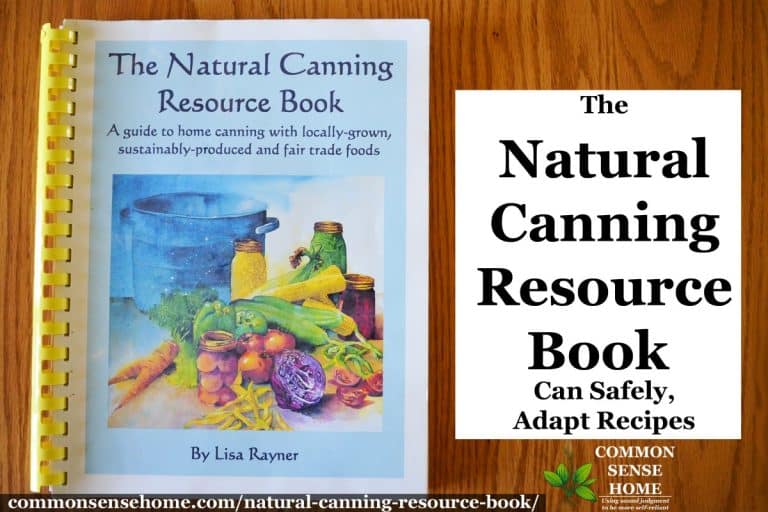
In “The Natural Canning Resource Book:  A guide to home canning with locally-grown, sustainably-produced and fair trade goods“, Lisa Rayner has answered just about every canning question I have wondered about since I started canning.

Is it safe to eat canned foods if some of the food is sticking out above the canning liquid?  Probably, if it meets certain criteria.

Can you substitute other sweeteners for white sugar?  Yes, but you may need to check the pH of the recipe.  Be careful of using maple syrup.  (Lisa explains why.)

Can I create my own canning recipes?  Yes, as long as you follow specific guidelines.  High acid foods are generally safe for the home canner to experiment with, low acid foods can be dangerous and even deadly without correct safety testing.

Is it safe to use older canning recipes?  Lisa explains what to look for in a recipe to avoid food poisoning.

What about oven canning or steam canning?  Are they safe?  These methods are no longer recommended for safe canning, and this book  gives clear examples of how each of them can lead to improperly preserved food.

What do I need to get started canning?  The book includes definitions for just about any term used in canning, as well as charts and diagrams, such as the one below specifying parts of a pressure canner.

My (grandma, mother, aunt, cousin) always canned (x, y, z) food this way and never got sick.  Why can’t I use their recipes?  Unfortunately, for a number of reasons, many new pathogenic bacteria and viruses have developed in recent years that canners didn’t need to contend with in the past.  We need to be aware of this and adjust recipes accordingly.  This book explains how.

The Natural Canning Resource Book is divided into three parts:  The Science and Economics of Canning, The Process of Canning, and Food and Canning.  These sections are subdivided as follows:

The Science and Economics of Canning

  • Why can?
  • The history of canning and the USDA
  • The microbiology of canning

The Process of Canning

  • The canning kitchen
  • Canning jars and lids
  • Canning basics
  • High altitude canning
  • Solar canning
  • Community canning
  • Developing new recipe and selling your goods

Food and Canning

  • The modern forager
  • Sugar and canning
  • Fruit
  • Preserves
  • Acidified foods
  • Lactofermented foods

There is also a Canning Safety Checklist and a long list of resources in the Appendix.

What this book is not

This book is not a recipe book, although a few recipes are included.  The author recommends using the book in conjunction with the USDA Complete Guide to Canning and Preserving and other publications.  Some of my favorite recipe books are The Ball Blue Book, Stocking Up, The Encyclopedia of Country Living, and Putting it Up with Honey.

This book does not go into detail about non-canning preservation methods.  For dehydrating, I recommend Mary Bell’s Dehydrator Cookbook.  For fermenting, I recommend Wild Fermentation.  For fermentation and traditional food preservation techniques such as salting, oil pack, alcohol pack and others, I recommend Preserving Food Without Freezing or Canning.

Is there anything I didn’t like about the book?

Yes.  In the first section, the author goes on a bit about man-made global warming.  While I firmly believe we need to be responsible stewards of the planet, I also believe the sun has much more to do with the temperature than we do.  One has only to study history to see that the climate has varied significantly over time.  The author also discusses peak oil and fossil fuels.  Again, while I agree that ending our dependence on foreign oil would be a very good thing, I do not believe that the term “fossil fuel” is completely accurate.  We find so-called “fossil fuels” (hydrocarbons) on other heavenly bodies, such as Titan.  Finally, the author expresses an interest in ramping down the level of technology used in society via the Transition Movement, which seems like yet another version of the Luddite movement.  I’m for combining the best of old and new to use less energy when possible, but also produce more energy to bring up the standard of living around the world.

Who Should Read this Book?

I would recommend this book to everyone from those just getting started with canning to experienced canners.  As I said, it has answered so many questions that I had not seen answered in any other other source.  Small batch canning, large batch canning, substitutions, community canning, selling your canned goods – it’s all covered.  If you truly want to understand exactly how canning preserves your food, this is the book for you.

If you’re into living green and walking a bit off the beaten path, this is a great resource.  There are two pages dedicated to biocompatible cleaning and polishing recipes that are safe to use with greywater systems.  Want to try making sugar from homegrown sugar beats?  Lisa gives basic instructions on how to do it.  Got lots of sunshine?  Check out the section on solar canning.

You can look inside this book at Amazon.com and preview quite a number of pages to get a better idea of the content.

I hope you’ve found this review useful.  I know my copy will be sitting at the ready on my “go to” resource book shelf.

This post has been added to Real Food Wednesday at Kelly the Kitchen Kop, Healthy2Day Wednesday at Day2Day Joys, Domestically Divine at Far Above Rubies, and Monday Mania 9/12/11 at The Healthy Home Economist.