Nov 212011
 
Creamy scalloped potatoes @ Common Sense Homesteading

Creamy scalloped potatoes @ Common Sense Homesteading

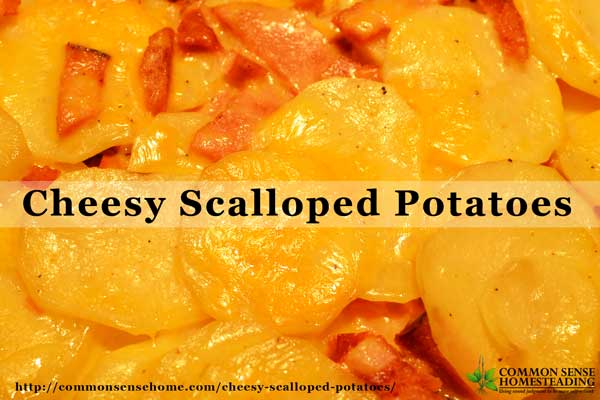
Scalloped potatoes were a holiday tradition when I was growing up.  Every Christmas Eve we would have fried fish, scalloped potatoes and oyster stew, along with an assortment of other homemade goodies.  Holidays were a time of celebration and plenty.  No matter how many people showed up, no one ever went home hungry.

The scalloped potato  recipe I use is similar to the one my mom used to make.  I hope you enjoy it, too. Continue reading »

Aug 162011
 
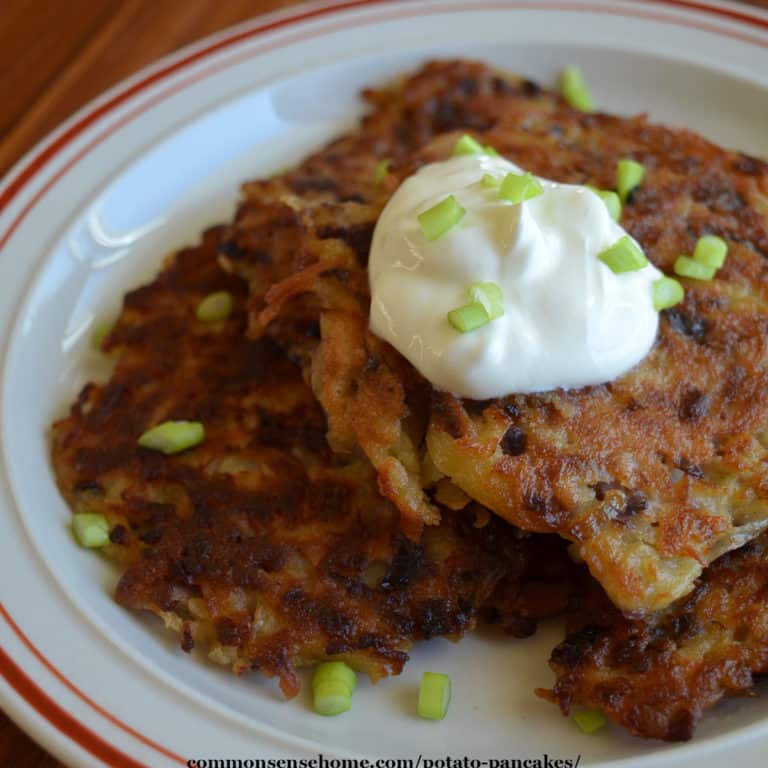
Potato Pancakes Like Grandma Used to Make @ Common Sense Homesteading

When I was a little girl, I remember my grandmother making potato pancakes quite regularly, usually on Friday nights.  (Potatoes were cheap, and stored well in grandma’s unheated basement.)  Mom made them sometimes, too, for the same reason.  Both mom and grandma always served their pancakes with homemade applesauce (and I do, too :-) .

When I was flipping through my copy of The Garden Fresh Vegetable Cookbook by Andrea Chesman, I came across her recipe for potato latkes, which were pretty darn similar to grandma’s potato pancakes.  Now that the days are getting cooler and the new crop of potatoes are coming in, I thought it was a perfect time to share my favorite recipe for potato pancakes, which is somewhat of a hybrid of Andrea’s and my grandma’s.

Potato Pancake Recipe

3 pounds Yukon Gold potatoes, or other starchy, not waxy potatoes
1 tablespoon onion, finely chopped
1 tablespoon chives, finely chopped
2 large eggs or one duck egg, lightly beaten
2 teaspoons sea salt
1/4 teaspoon black pepper
butter, for frying
applesauce, for serving

Grate the potatoes, either by hand or with a food processor.  Usually I just do it by hand, because my friend, Julie, got me this nifty box grater, which is very handy, plus it’s quieter than the food processor and easier to clean up.

As you grate the potatoes, move them into water acidified with either lemon juice or vinegar (1 tablespoon lemon juice or vinegar to 4 cups water).  (This is Andrea’s tip.)  Mix potato with water for one minute, pour into a strainer and drain well.  (At this point she pats them dry with a kitchen towel – I skip this step.)  Acidification will keep the potatoes from turning pink, then gray as they oxidize with exposure to air.

In a large bowl, mix together all ingredients except butter and applesauce.

heat your skillet up to medium-high, and lube it up with plenty of butter.  (Don’t skip on the butter – fat adds flavor and butter is good for you – honest.)  Drop the potato mixture in the pan about 1/4 cup at a time.  Fry until golden brown on the bottom, 1 1/2 to 2 minutes.  Flip, repeat.  Give each pancake plenty of room so you get nice, crispy edges.

You can keep the pancakes warm in the oven while you finish cooking, or you can just start dishing them up as you go (my preferred option).  If they sit too long, they loose that crispy goodness.  Serve with applesauce (or ketchup, if you think that’s a food group like my youngest son).  These are pretty tasty warmed up (in the toaster oven or frying pan) the next day for breakfast, too, or even eaten cold.

(lol – I’m writing this past midnight while I’m waiting for the pressure canner to finish, and boy, I sure wish I had some of these to snack on right now. ;-)

Well, it’s way past my bedtime, the canner just dropped to zero pressure, and you should have the information you need to make some pretty tasty potato pancakes.

Jul 312011
 
Potato Bread Recipe Using Leftover Mashed Potatoes @ Common Sense Homesteading

Quite often when I make mashed potatoes for supper, I end up with just a dab (less than a cup) of potatoes left – not really enough for another meal.

potatoes - mashed

So how do you stretch a small amount of potatoes into another meal sized portion?  One option is chicken and gnocchi soup, another favorite option is potato bread.

Most of the “potato bread” recipes I’ve seen used powdered mashed potatoes – not something I keep in my pantry  My husband used to be a fan of store bought potato bread when we were first married – you know kind that resembles cotton candy in bread form?  (Pretty sure they use potato flakes…) I was tickled to finally find a recipe that uses real mashed potatoes.  I throw mine in just the way I serve them – butter, milk, salt and pepper included. Continue reading »

Sep 142010
 
Root Cellars 101 - Root Cellar Design and Use
Looking into our root cellar

We built a root cellar under our front porch.  Typically, if you’re building new your porch floor is formed out of a concrete slab, you need to put a foundation wall under it anyway, so why not put this area to good use?  Even if you can’t deal with (or don’t want to deal with) traditional root cellaring (storing vegetables and fruit), you could use the space as a wine cellar, gun cabinet, place to brew beer, a battery room for your PV/Wind system or simply more storage.  I highly recommend including a root cellar as part of your emergency preparedness planning if you can, as it’s a great low-cost, no-energy way to store food and extend the shelf life of fresh produce.

Our root cellar measures about 8′x8′, which provides plenty of room for our stash of root veggies, plus gives a nice sized porch above.  We have simply shelving along the east wall (opposite the door) composed of rough cut 2″x8″ boards and cement blocks.  Produce that likes drier conditions (like onions, garlic and potatoes) is stored in trays on the shelves for better ventilation.  This way, if an onion or potato starts to go bad, they can be spotted and removed immediately before they spoil the whole batch.  My mom used to store hers in mesh sacks, but many times one bad roots would spoil a large number of those around it.  I cover the potatoes with burlap or landscape fabric or whatever else is handy to block out the light (and prevent green potatoes) but allow ventilation.  A few cabbage go on the top shelf, and apples go out in the garage.  Pumpkins and squash go on the floor of the canning pantry because they like it a little warmer and drier.

I store vegetables that need more moisture in buckets, bins or boxes packed with lightly dampened leaves.  For us this usually means beets and carrots (I overwinter parsnips out in the garden).  I tried packing these vegetables in sawdust and in sand, but prefer the leaves.  For me, sand stayed too moist and led to rotting, plus it made a terrible mess.  Sawdust was also very messy, but better than sand.  It really liked to cling in all the little root hairs.  The leaves provide moisture to keep your roots from shriveling up, but are easy to brush off with much less mess.  They can be recycled into the garden during the next planting season to enrich to the soil.  (I like to mix mine with the dirt I use to back fill my potato planting holes.  Leaves add acidity to the soil, which helps prevent scab on potatoes.)  Do use fresh leaves each year to prevent potential pathogen buildup.

View to the left

Locating the root cellar outside the footprint of the home permits the root cellar to maintain cooler temperatures more easily than a cellar located within the house, but even if you have a pre-existing home you may be able to section off a portion of your basement with good results.  Using an exterior grade door (preferably insulated) on your root cellar also helps to maintain proper temperature (both in the root cellar and in the house).  If you are building new, consider putting the root cellar door in the back of an unheated storage room so that the temperature difference is less.  You can use this room to store veggies that require somewhat warmer and drier storage than a root cellar provides, as well as canned goods and whatever else you may need to stash.

Root cellars must have ventilation!  This is one of most common mistakes that people make when designing/installing them.  Proper ventilation moves the ethylene gas that causes spoilage away from the produce, increasing your storage time and the quality of the items in storage.  It also slows down molds and mildews and other fuzzy things that thrive in dark, damp, still environments.  You need the equivalent of a low and high 2” PVC pipe, preferably placed so as to bring in fresh air low on one side and to vent stale air out high on the opposite side.    Don’t skip the vent pipes if you’re building new, or at least their penetrations, even if you’re not sure you want to use the space for a root cellar.  You can always cap them off and they’re much more difficult to add later.

The root cellar should have no “standard” heating or cooling, other than a way to introduce outside air to cool the space. A “finished” floor is optional, and in fact a simple gravel floor is probably your best option for controlling humidity.  Root cellar produce keeps best with high humidity and cool temperatures.  A gravel floor introduces ground moisture and allows you to sprinkle the floor to add moisture when needed.  A single incandescent light (switched on exterior) should provide adequate lighting (unless your room is really huge) and, if for some reason your storage gets too cold, you can always use it to introduce a little heat.

The best resource we have found on root cellars is the book Root Cellaring: Natural Cold Storage of Fruits & Vegetables by Mike and Nancy Bubel.  No matter what your location or how much space you have, the Bubels are likely to have a root cellar option that will work for you.  It contains detailed explanations of how to store vegetables and fruits without electricity with specific temperature and humidity recommendations for each variety.  There are also good photos and diagrams, which I really like.

Links

Yakhchal – Ancient natural refrigerators – who knew?

Keep Your Ice Cream Cold Without Electricity – Nifty article on a home built refrigerator substitute that uses no electricity or fuel.

Build a Basement Root Cellar by Steve Maxwell – Article from Mother Earth News

A Root Cellar for Your Homestead  by Victoria Ries – Some basic information on the cellar, more information on the proper storage of the fruits and veggies themselves.
The University of Missouri Extension Office suggests the following guidelines for storing food in root cellars:


Root Cellar storage requirements

Apples

  • Cold and moist
  • Do not store with vegetables
  • 32 to 40 degrees Farenheit
  • 80 to 90 percent relative humidity

Beans, dry

  • Cool and dry
  • Home and commercially prepared foods also need a cool, dry storage place
  • 32 to 50 degrees Farenheit
  • 60 to 70 percent relative humidity

Beets

  • Cold and very moist
  • 32 to 40 degrees Farenheit
  • 90 to 95 percent relative humidity

Brussels sprouts

  • Cold and very moist
  • 32 to 40 degrees Fahrenheit
  • 90 to 95 percent relative humidity

Cabbage

  • Cold and very moist
  • 32 to 40 degrees Fahrenheit
  • 90 to 95 percent relative humidity

Cabbage, Chinese

  • Cold and very moist
  • 32 to 40 degrees Fahrenheit
  • 90 to 95 percent relative humidity

Carrots

  • Cold and very moist
  • 32 to 40 degrees Fahrenheit
  • 90 to 95 percent relative humidity

Cauliflower

  • Cold and very moist
  • 32 to 40 degrees Fahrenheit
  • 90 to 95 percent relative humidity

Celeriac

  • Cold and very moist
  • 32 to 40 degrees Fahrenheit
  • 90 to 95 percent relative humidity

Celery

  • Cold and very moist
  • 32 to 40 degrees Fahrenheit
  • 90 to 95 percent relative humidity

Endive (Escarole)

  • Cold and very moist
  • 32 to 40 degrees Fahrenheit
  • 90 to 95 percent relative humidity

Garlic

  • Cool and dry
  • Home and commercially prepared foods also need a cool, dry storage place
  • 32 to 35 degrees Fahrenheit ideal
  • 60 to 70 percent relative humidity

Grapefruit

  • Cold and moist
  • Do not store with vegetables
  • 32 to 40 degrees Fahrenheit
  • 80 to 90 percent relative humidity

Grapes

  • Cold and moist
  • Do not store with vegetables
  • 32 to 40 degrees Fahrenheit
  • 80 to 90 percent relative humidity

Horseradish

  • Cold and very moist
  • 32 to 40 degrees Fahrenheit
  • 90 to 95 percent relative humidity
  • May be left in the ground undisturbed until needed. Digging can be done unless the soil is frozen hard. A thick layer of mulch may extend your harvest season.

Jerusalem artichoke

  • Cold and very moist
  • 32 to 40 degrees Fahrenheit
  • 90 to 95 percent relative humidity
  • May be left in the ground undisturbed until needed. Digging can be done unless the soil is frozen hard. A thick layer of mulch may extend your harvest season.

Kale

  • Cold and very moist
  • 32 to 40 degrees Fahrenheit
  • 90 to 95 percent relative humidity

Kohlrabi

  • Cold and very moist
  • 32 to 40 degrees Fahrenheit
  • 90 to 95 percent relative humidity

Leeks

  • Cold and very moist
  • 32 to 40 degrees Fahrenheit
  • 90 to 95 percent relative humidity

Onions

  • Cool and dry
  • Home and commercially prepared foods also need a cool, dry storage place
  • 32 to 35 degrees Fahrenheit ideal
  • 60 to 70 percent relative humidity

Oranges

  • Cold and moist
  • Do not store with vegetables
  • 32 to 40 degrees Fahrenheit
  • 80 to 90 percent relative humidity

Parsnips

  • Cold and very moist
  • 32 to 40 degrees Fahrenheit
  • 90 to 95 percent relative humidity

Pears

  • Cold and moist
  • Do not store with vegetables
  • 32 to 40 degrees Fahrenheit
  • 80 to 90 percent relative humidity

Peas

  • Cool and dry
  • Home and commercially prepared foods also need a cool, dry storage place
  • Airtight container
  • 32 to 50 degrees Fahrenheit
  • 60 to 70 percent relative humidity

Peppers, hot dried

  • Cool and dry
  • Home and commercially prepared foods also need a cool, dry storage place
  • 32 to 50 degrees Fahrenheit
  • 60 to 70 percent relative humidity

Popcorn

  • Cool and dry
  • Home and commercially prepared foods also need a cool, dry storage place
  • Airtight container
  • 32 to 50 degrees Fahrenheit
  • 60 to 70 percent relative humidity

Potatoes

  • Cold and moist
  • Do not store with fruits
  • 38 to 40 degrees Fahrenheit ideal
  • 80 to 90 percent relative humidity

Potatoes, sweet

  • Warm and moist
  • To keep sweet potatoes from spoiling in warm and moist storage, do not let temperatures drop below 50 degrees Fahrenheit
  • 80 to 90 percent relative humidity

Pumpkins

  • Warm and dry
  • 50 to 55 degrees Fahrenheit
  • 60 to 75 percent relative humidity

Radish, winter

  • Cold and very moist
  • 32 to 40 degrees Fahrenheit
  • 90 to 95 percent relative humidity

Rutabaga

  • Cold and very moist
  • 32 to 40 degrees Fahrenheit
  • 90 to 95 percent relative humidity

Salsify, oyster plant

  • Cold and very moist
  • 32 to 40 degrees Fahrenheit
  • 90 to 95 percent relative humidity
  • May be left in the ground undisturbed until needed. Digging can be done unless the soil is frozen hard. A thick layer of mulch may extend your harvest season.

Squash, winter

  • Warm and dry
  • 50 to 55 degrees Fahrenheit
  • 60 to 75 percent relative humidity

Tomatoes

  • Warm and moist
  • To keep green tomatoes from spoiling in warm and moist storage, do not let temperatures drop below 50 degrees Fahrenheit
  • 80 to 90 percent relative humidity

Turnip

  • Cold and very moist
  • 32 to 40 degrees Fahrenheit
  • 90 to 95 percent relative humidity

The length of time that fruits and vegetables keep well in root cellars depends on several factors:

    • Early or late crops (late-maturing crops store better)


  • Storage conditions (less-than-ideal conditions shorten storage life)
  • Fruit and vegetable condition at storage time (proper curing of damage-free produce results in longer storage life).


Vegetables and fruits should not be stored together even though temperatures and moisture requirements are similar. As fruits such as apples and pears ripen, they give off ethylene gas which decreases the storage life of vegetables. This is especially evident with potatoes which sprout early if stored near certain fruits. Also, the odor of strong smelling vegetables, like turnips and cabbage, can be absorbed by fruits and other vegetables. Store them away from other food and where the odor cannot waft into the house.

Do not allow fruits and vegetables to freeze.

This post has been added to Preparedness Challenge #7 at Homestead Revival,
Homestead Barn Hop #30 at The Prairie Homestead,
Fight Back Friday at Food Renegade
Aug 012009
 

Small Purple Rocks - Peruvian Purple PotatoesMy grandmother Catherine always said, “Try it, you’ll like it!” I’m not quite sure what she’d say about the latest culls from the garden. This year I had a number of volunteer potato plants show up (I guess we weren’t quite as thorough as we should have been last fall). Never one to pass up easy to grow food, I let the little seedlings wander on their way.

UNTIL – the seedlings were no longer little, and were on their way to turning into an impenetrable thicket, threatening to completely smother the plants that I actually wanted to grow in those beds (in this case, ground cherries, peas, broccoli and petunias).

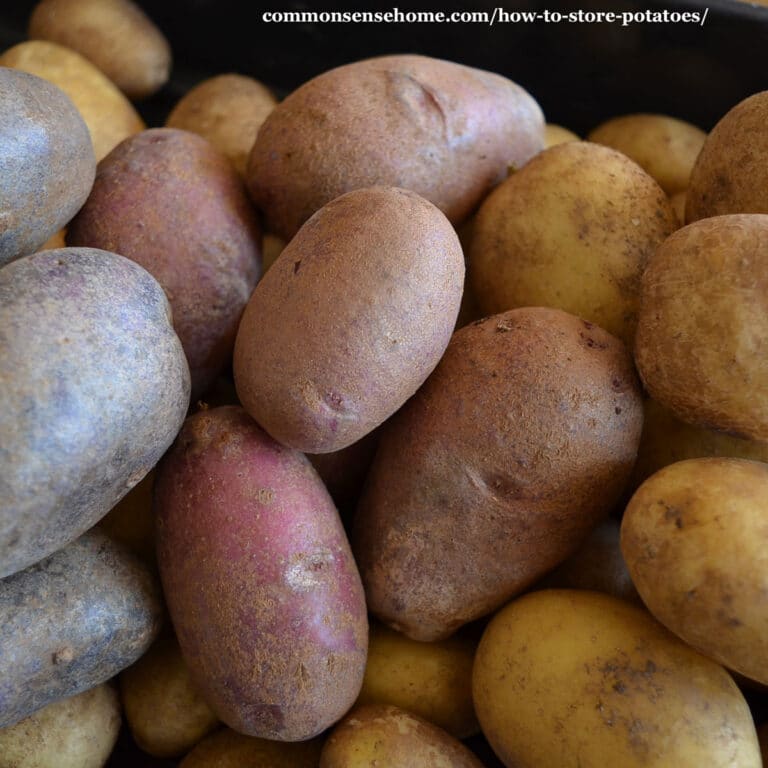
Time for some tough love – out they came. There were around a dozen plants, but it’s been really dry, so I only ended up with a few pounds of what resembled nothing so much as small purple rocks. These are Peruvian Purple potatoes – dry little fingerlings that produce no matter what kind of weather you throw at them. Hot, cold, wet, dry – bring it on! I freely admit, they are not my favorite potato in terms of taste – that honor goes to Yukon Gold – but they are tough. I plant one small bed and have enough for us and for our friends and to share with the local food pantry.

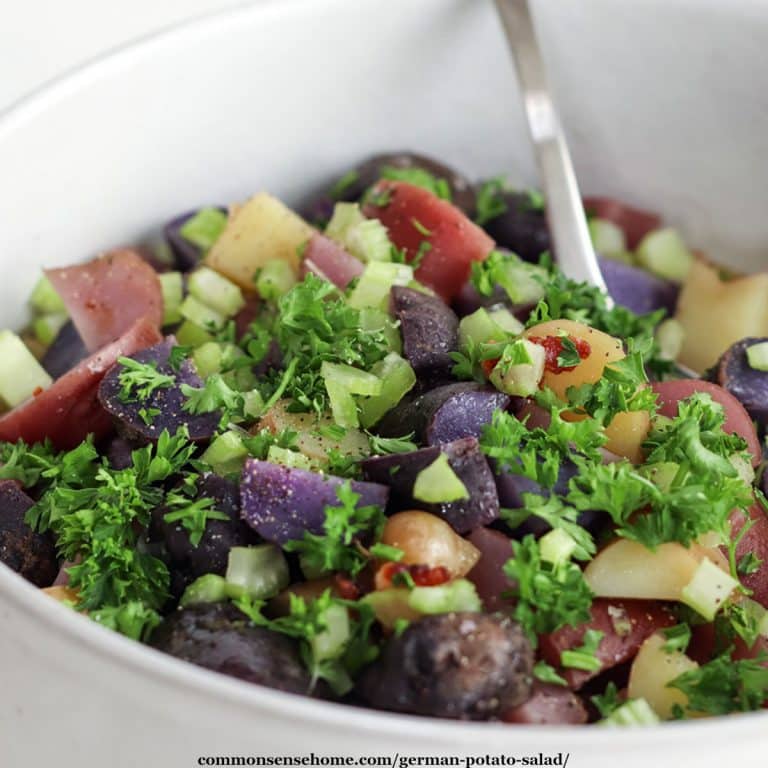
Often strangely phallic in shape when fully mature (but that’s a story for another post), these heirloom fingerlings are a deep purple color all the way through. It can be a bit disconcerting, as they sometimes cook up purple and sometimes cook up blue, depending on the dish. It gives one the bizarre impression of eating muppet chow. They make a perfectly functional potato salad or scalloped potatoes and are good for roasting. I had a taste for German Potato Salad, which was a little dry (these are a very dry potato, not a waxy, which was recommended by the recipe), but it sure looked pretty. There was fresh parsley and celery from the garden, coupled with bacony goodness….mmmm….bacon.

Here’s the recipe if you’d like to give it a try.

German Potato Salad from the Garden Fresh Vegetable Cookbook by Andrea Chesman

2 pounds waxy potatoes, scrubbed, halved and sliced 1/4 inch thick
4 ounces bacon, diced
1 shallot, minced
2 tablespoons extra-virgin olive oil
5 tablespoons white wine or red whine vinegar
1 teaspoon sugar
2 celery stalks, diced
1/4 cup minced fresh parsley
Salt and freshly ground pepper

1. Combine the potatoes with 6 cups salted water in a medium saucepan. Bring to a boil, then reduce the heat and simmer until the potatoes are tender, 5 to 10 minutes. Reserve 1/4 cup of the cooking liquid and drain. Transfer the potatoes to a large mixing bowl and keep warm.

2. Meanwhile, in a large skillet, cook the bacon over medium heat until brown and crisp, about 4 minutes. Remove the bacon with a slotted spoon and transfer to the bowl with the potatoes. Drain off all but 2 tablespoons of the bacon grease.

3. Add the shallot to the skillet and cook until slightly softened, about 3 minutes. Stir in the reserved cooking liquid, oil, vinegar and sugar. Brign to a boil. Pour the mixture over the potatoes and toss to coat. Add the celery, parsley,and salt and pepper to taste. Mix well. Serve immediately.

Serves 4-6 (I made about half a batch in the photo).

Expand your culinary horizons, eat a rainbow – eat some little purple rocks…try it, you might like it!