Tag Archives: home food preservation

Getting Started with Home Canning

"Of Course I Can" WWII poster

As I was growing up, I remember mountains of produce and days spent processing enough food to keep our family of 8 through the winter.  Mom didn’t have air conditioning or even a ceiling fan.  It was hot work and long days.  Both my mom and my grandmother kept their canned goods stashed in a dark, cool corner of the basement, away from the wood stove.  Mom told me that her mom used to do all her canning on the wood cook stove. Every fall they’d butcher and can up a mess of pork and chicken, along with the garden produce during the season (no freezers or refrigerators available back then).  Mom was a little girl during the Great Depression and WWII.  Before she passed we talked about the “ration points” mentioned in the poster above – she still had some tucked away in a bureau.

At the moment we’re not facing rationing, but food prices are expected to continue to increase.  Home canning allows you to preserve almost any food in season, and even to can entire meals that are ready to go straight from the jar.  Once your jars are sealed, all you need is a cool, dark space to stash your bounty.  Below I cover some basic canning equipment that you can buy online or in most hardware stores.  You may also be able to find some of it used.

Basic Canning Equipment

Basic Equipment Needed for Canning

Starting at top left in the above photo and working clockwise.

Water Bath CannerWater bath canners are used for canning high acid foods (having a pH of 4.6 or lower).  Fruits, most soft spreads, tomatoes, pickles and other high acid foods can be safely processed in this canner.  Different commercial options are available, but you can also use any large pot, as long as you have enough room in the pot to cover the jars with at least one inch of water.  You must not allow jars to sit directly on the bottom of the pot, or they will be more likely to break.  One option is to make a “rack” of canning rings in the bottom of the pot.  IMO, real canners are fairly inexpensive and well worth the investment if you plan to do any amount of canning.  You can use your pressure canner for water bath canning – just leave the vent open.

Jelly Strainer Bag – The white baggie thing in the middle of the photo is a jelly strainer bag.  I love this thing.  Not only to I use it for straining jellies, I also use it for straining stocks and herbal infusions.

Pressure Canner/Steam Pressure Canner – A steam pressure canner is required for all low-acid foods, such as veggies, meat, soups and stews.  I don’t recommend canning things like bread, pumpkin butter or chocolate syrup at home. Botulism can be deadly.  If I had a nickel for every time I’ve heard someone say, “Well I know so-and-so who has done it this way for years and they never got sick”, I could retire early.  All it takes is one jar of food gone bad.  What’s your family’s health worth to you?  You should get your canner tested every 3-5 years at a local extension office to make sure it is holding pressure properly.

Kitchen ScaleKitchen scales are a necessity when you get into recipes like salsas or sauces, but they also come in handy for gauging how many jars you’ll need for the amount of produce you have, for knowing how much syrup to make to cover your fruit or for measuring sugar for jams and jellies.  The one I have used to be my grandmother’s.  It’s been around a while (okay, it’s much older than my kids), but it still works just fine.

Canning Ladle – A big, stainless steel ladle that holds at least 1 1/2 to two cups of product will allow you to fill jars much faster than a standard kitchen ladle.

Chopstick or thin non-metal spatula – You need some sort of long, thin object to run around the outside of jars to remove air bubbles.  We have chopsticks on hand, so I just use one of those.  Don’t use a knife or other metal object, as you may scratch the inside of the jar and damage it.

Kitchen tongs or a magnetic jar lid lifter – Again, since I have kitchen tongs on hand, I just use those, but magnetic jar lid lifters can also be used.  You want to hold your lids in nice hot water (not boiling) to get them ready to seal.  It’s a little hot to stick your fingers into.

Jar lifter – Another must have – canning jars get wicked hot, so you really need a proper jar lifter to move them about.

Jar Funnel – A good jar funnel will make it MUCH easier to fill jars, even wide mouth ones.  Big ladle, big funnel, and you’re done filling in half the time.

Food strainer

Food strainer – useful for making sauces.  Mine get used most for marinara sauce and apple sauce.

Apple Master

Apple Peeler/Corer/slicer – I use this more for dehydrating, but if you’re interested in canning apple pie filling, this would be handy.

What Foods Are Easiest to Can?

Full sugar jams and jellies are probably the easiest foods to start with, because they process for only short amounts of time in a water bath canner and are really hard to screw up.  Low sugar versions are only a bit trickier.  Plain tomatoes or tomato juice is also very simple, as are fruits and fruit juices.

Do I Really Need a Pressure Canner?

If you want to can vegetables, meat or meals – YES.  I pressure can more green beans than anything else out of my garden.  They’re my boys’ favorite veggie.

Is It Hard to Use a Pressure Canner?

Not really.  It takes more patience than anything else.  With a water bath canner, you lower jars into boiling water and start your timer.  With a pressure canner, you must let the canner exhaust steam for ten minutes.  Then you put the pressure regular in place.

pressure regulator and pressure gaugeSee the little round black thing on the right?  That’s the pressure regulator.  once the regulator is on, you wait for the pressure to build.  Once the pressure gets high enough, there’s a little button (the air vent/cover lock) that pops up to stop steam from venting (at least on my canner).

Air vent - cover lock

Once the button sets in place, you wait for the pressure to build some more, until you reach processing pressure.  Then you hold itat pressure for the required amount of time.  Then you turn off the heat and let the pressure drop to zero on it’s own (the little button will also pop back down).  When the button is up, you can’t open the lid.  This helps prevent you from doing something stupid by either burning yourself and/or busting all your jars.  Complicated – no, time consuming – yes.  Mom told me it’s a lot faster than when gramma had to water bath can everything for a really, really long time.

Will My Pressure Canner Explode?

Not very likely, unless you use some plastique.  It may be possible with older canners, which have been damaged or were improperly forged, but recently made steam pressure canners are pretty tough.  Mine is equipped with a locking mechanism, others bolt shut.

Pressure canner lock

You can’t operate the canner unless it’s locked tightly, and that is some pretty thick metal.  It also has a little overpressure plug that will blow if the pressure gets too high.

General Canning Tips

  • Get your jars, lids and all your equipment prepped before you start preparing your product.
  • Work from one direction to the other – from right to left or left to right, depending on how your stove is set up.  Don’t cross back and forth – it gets messy.
  • Keep everything hot.  You’ll remember this tip very quickly if you lower a cold jar into boiling water, or ladle hot syrup into a cold jar.  Jars break rather impressively and make a huge mess.
  • Always check and double check the edges of your jars and your lids.  Any imperfection along the edge of a jar, and it is unlikely to seal properly.
  • Keep everything clean.  You’ll have drips and spills, sure, but remember this is food prep, so try to keep your work space clear of outside contaminants such as hair or dirt.

For additional information on canning and other home food preservation methods, see “New to Food Preserving – Start Here“.

To view canning recipes on this site, visit the Recipes page and scroll down to Canning and Preserving Recipes.

Other posts in this series:

Become More Self-Reliant – Start Here

New to Gardening – Start Here – Tips for Beginners

What topics would you like to see in our “Getting Started” series?  Leave me a comment below.  We’re planning more on home food preservation, chickens and living frugally, for starters.

This post has been added to Homestead Barn Hop #47 at the Prairie Homestead, Fat Tuesday at Real Food Forager and Simple Lives Thursday #83 at  A Little Bit of Spain in Iowa.

New to Food Preserving – Start Here

Learn to Preserve Food

A lot of us are trying to stretch our food budgets by growing our own or purchasing in bulk. Many are also joining CSAs (Community Supported Agriculture) programs, which provide them with produce (and sometimes other items) throughout the growing season.

To take full advantage of local food sources, we need to find ways to store food after harvest. This post will introduce you to the basics of food storage, so you can decide which methods will work best for you.

How Can I Store Fruits and Vegetables at Home?

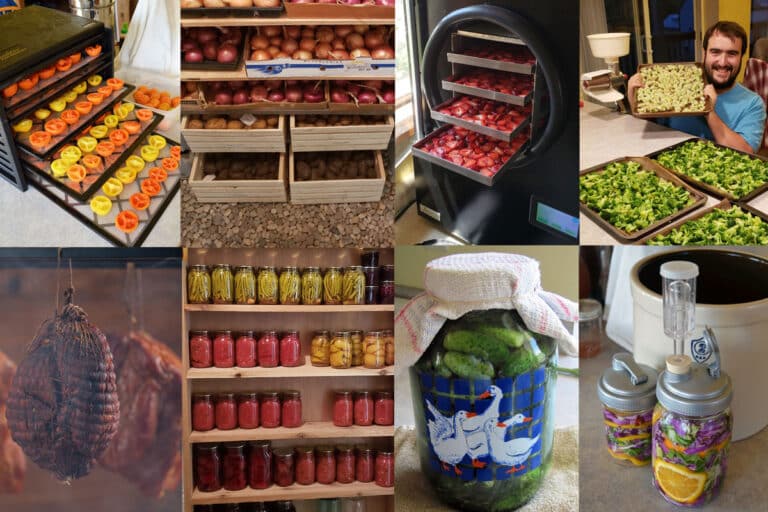
There are many ways to store produce for extended periods of time. The most common include:

Cool storage

- including cool, dry storage, such as an unheated pantry or porch, and root cellaring, i.e., cool, damp storage. “Root cellars” may include actual root cellars, unheated basement space, crawl space, in ground “clamps” (holes or trenches for food storage) and other options. Cool storage basics, including storage requirements for many crops, can be found in the post “Root Cellars 101“.

I always include storage crops that can store without much processing, such as shell beans, pumpkins and squash and root vegetables. You can read more about my favorites in the post “Planning for Storage Crops“.

Drying

- Food can be dried using a commercial dehydrator such as the Excalibur or American Harvest Dehydrator, or air dried in a solar dehydrator, on drying sheets or hang drying. Dried foods are great when storage space is tight, but dried foods loose more nutrients than root cellaring or canning. Dried foods should be stored in a cool, dry location in an airtight container for longest shelf life. The USDA recommends pasteurizing dried foods at 160F/71C for 30 minutes or freezing at 0F/-18C for 48 hours to kill insects and their eggs, but I haven’t had any insect problems with food dried in my commercial dehydrator.

Canning

- Canning is the heat processing of food in glass jars.

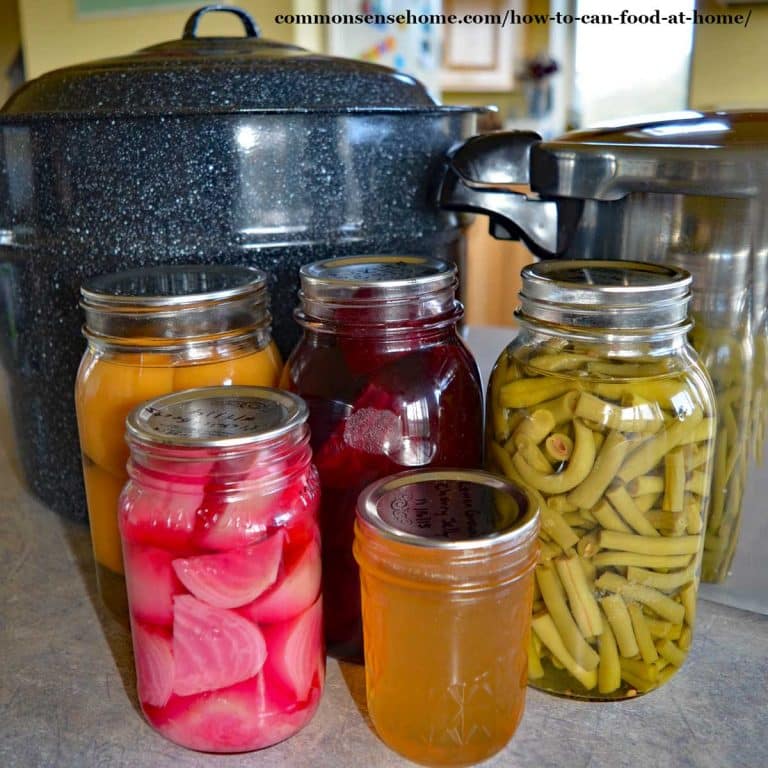
Water bath canning can be done with any large stockpot or kettle with a lid, as long as you have a way to keep the jars from sitting directly on the bottom of the pot and can cover your jars with at least two inches of water. Water bath canning is used to preserve high acids foods such as tomato sauce and pickles, and high sugar foods such as jams and jellies. If you can a pressure canner, you may use it for water bath canning by leaving the vent open.

Pressure canning must be done in a pressure canner, which processes foods using high temperature, high pressure steam. PRESSURE CANNING MUST BE USED FOR LOW ACID FOODS, such as beans, carrots, corn, soups, sauces, broth, etc.

Freezing

- Freezing foods typically produces flavors and textures most similar to fresh, and can be done without much specialized equipment. It is recommended that you blanch (briefly immerse in boiling water) most produce before freezing to stop enzyme action and insure best quality. I like to seal my frozen produce in vacuum seal bags to prevent ice crystal formation. I have found this to greatly improve the quality and storage duration for most crops.

LactoFermentation

- Natural fermentation can be used to change low acid foods into high acid foods, giving them a longer shelf life to store “as is”, or allowing them to be canned in a water bath canner instead of a pressure canner. Through the use of salt, whey or specific starter cultures, food is fermented, improving its digestibility and nutrient content. It becomes what is referred to as a “live culture food”.

Because fermentation involves substances such as lactic acid and specific microbes, the flavor profile and texture of the food does change. Fermentation is responsible for treats such as chocolate, cheese, yogurt, and kombucha, as well as pantry staples like sauerkraut, kimchi, sourdough bread and vinegar.

Preserving in Salt and Sugar

- More common before modern canning, freezing and dehydrating were available, packing foods in salt or sugar draws liquid out of the food, drying it, while the salt and sugar also interfere with microbe activity. These methods significantly impact food texture and flavor.

Immersion in alcohol

- Booze is toxic to microbes (to us, too, if we consume enough of it). You can submerge small amounts of food completely in the hard liquor of your choice, and they will store almost indefinitely. Best for making flavor extracts or perhaps some highly flavored fruit. I’ve still got some raspberries in amaretto in the back of the fridge that I pull out for special occasions.

Vinegar Pickling

- Microbes can’t survive in a high acid environment, so vinegar can be used for food preservation without heating/canning. Think old-fashioned pickle barrel. I make at least one batch of vinegar pickles every season.

Immersion in Olive Oil

- Very common is some parts of Europe, this is not one I recommend for the inexperienced home food preserver. Basically, food is immersed in oil, locking out the air, to preserve it. The trick is, air pockets can be trapped in side, and if the vegetables are low in acid, they present a serious botulism risk.

Which Food Preservation Method is the Best?

It really depends on what you’re trying to store and your storage conditions. The Natural Canning Resource Book states:

“While some nutrients are lost during canning, recent research has shown that refrigerating fresh fruits and vegetables also results in nutrient losses, especially of fragile vitamins like vitamin C. for example, broccoli loses 50 percent of its vitamin C and Vitamin A (in the form of beta carotene) after five days of refrigeration, similar in scale to the loss of vitamin C during cooking and canning. This is because plant foods are alive and thus continue to metabolize nutrients during storage. It’s safe to assume that root cellar storage causes the same magnitude of nutrient loss. Frozen food lose more nutrients than canned food after six months of storage. Dried food lose the most nutrients. With this in mind, canning is preferably done very soon after harvest, when nutrients are at their peak, thus preserving the most nutrients possible. “

In contrast, Mary Bell’s Complete Dehydrator Cookbook states:

When you dry foods at home under gentle conditions, you produce a high quality product.  Compared with canning and freezing, both of which involve extreme temperatures, food drying is the least damaging form of food preservation.

Who’s more correct in their statements? I suspect both ladies may be correct, depending on the circumstances.  In terms of taste and texture, I generally prefer frozen and canned products.  Either way, properly ripened produce picked at perfect ripeness and processed quickly is nutritionally superior to most grocery store offerings.

Fermentation can add nutrition, but is generally limited to storage times of less than a year. Dried foods can last for years and take up very small amounts of space, but are best used in soups, stews or other recipes where they will benefit from long, slow cooking with plenty of liquid. Freezing is probably easiest for the beginner with minimal equipment, but requires freeze space, which can be limited. Canning can be used on a variety of foods, but does require some basic equipment. Canned goods may have a very long shelf life.

Recommended Food Storage Resources

Online

USDA Complete Guide to Home Canning

Ball Canning and Preserving

SB Canning

Pick Your Own.org

CanningUSA.com

Cultured Food Life

Cultures for Health

National Center for Home Food Preservation – Drying Food

National Center for Home Food Preservation – Freezing Food

and of course, here!

Books

Ball Complete Book of Home Preserving

The Natural Canning Resource Book

Mary Bell’s Complete Dehydrator Cookbook

Wild Fermentation

Root Cellaring

Preserving Food Without Canning or Freezing

The Encyclopedia of Country Living

Stocking Up III

Concerns about Tattler Reusable Canning Lids

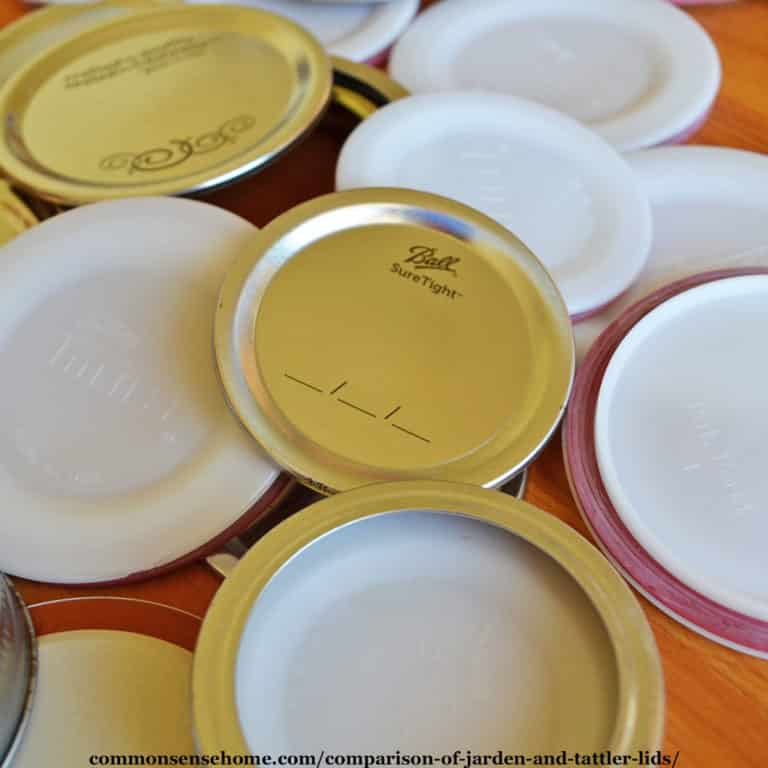
After reading rave reviews online about Tattler reusable canning lids, I took the plunge and ordered some with friends. My results were not as good as I had hoped. I noticed a significantly higher failure rate than standard canning lids, both during and after processing. The lids are also easily damaged if they are improperly removed from the jar (say by an eager little boy who is hungry for peaches). The National Center for Home Food Preservation has also documented higher levels of seal failure rates on Tattler lids than Jarden two piece lids.

Damaged Tattler Lid

Tattler lid damaged by over-eager eater

The Natural Canning Resource Book details further concerns:

“Tattler lids are composed of polyoxymethlylen copolymer, an acetal copolymer. Copolymers are linked plastics which contain two or more ingredients. … (The author’s father, a chemist) noted that the copolymer is made from a trimer of formaldehyde called trioxane and other compound variations. Formaldehyde is a highly-toxic substance long known to be carcinogenic. Some of the secondary additives are also potentially dangerous to human health and the environment.”

The book continues to give detailed evidence of uncombined formaldehyde in the lids. **Note – there has been some discussion about this on online forums since this post went live, noting that the temperatures involved in canning are not high enough to release the formaldehyde from its bonds in the copolymer.  This is accurate.  Of concern is the uncombined formaldehyde, which is explained in detail in the book.  Further, what happens to the workers who are exposed to the chemicals during the manufacture of these lids?  Is it alright to expose them to formaldehyde, as long as it doesn’t get into your food?  If you have further questions, I suggest you contact the author directly at her website.

The Tattler lids should not be used with alcohol, strong acids, chlorine or strong sunlight, which will break down the plastic of the lids. The plastic of the lids may contain melamine, which has been linked to potential organ damage with prolonged exposure. I won’t be ordering more of these lids.

In the coming weeks, we’ll be continuing the “Getting Started” series, with posts focusing on each type of food preservation. Next week, I’ll do a quick side trip to getting started gardening, but I wanted to give a brief overview of food preservation first so you could tie the two together for this year’s garden and food source planning. Many CSAs are taking on new client this time of year. It’s good to think ahead and know that you can preserve any excess produce you may have during the season.

I hope you find this post useful. Please consider sharing it if you do, and let me know if you have any “Getting Started” questions that you’d like answered.

View the first post in this series “Become More Self- Reliant – Start Here“.

This post has been added to Fight Back Friday at Food Renegade and             Simple Lives Thursday at GNOWFGLINS.

Simple Lives Thursday Featured Post

Related Posts Plugin for WordPress, Blogger...