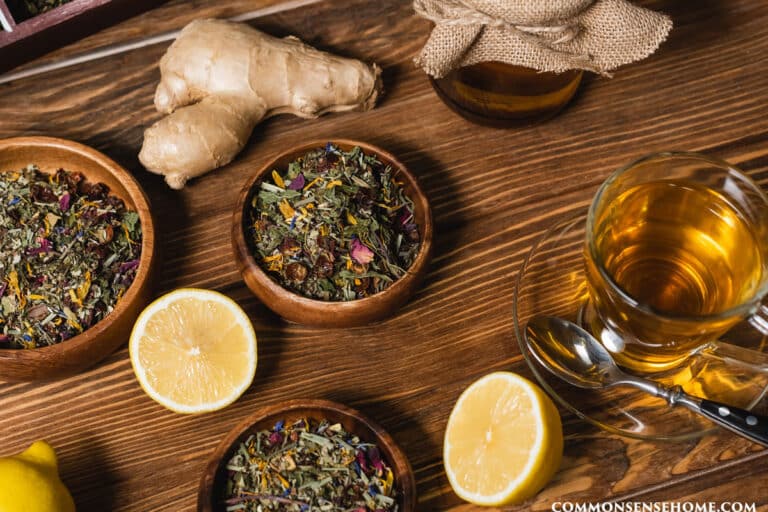
It’s that time of year again for many of us – less daylight, busy holiday schedules and colds and flus making the rounds. The discomfort (and even pain) associated with congestion is one of the most common symptoms. (Not to mention that the inability to breath is just plain annoying.) In this post I’ve gathered together several home remedies for congestion that will hopefully get you breathing right and on the fast track to healing the next time you’re battling congestion. Continue reading »
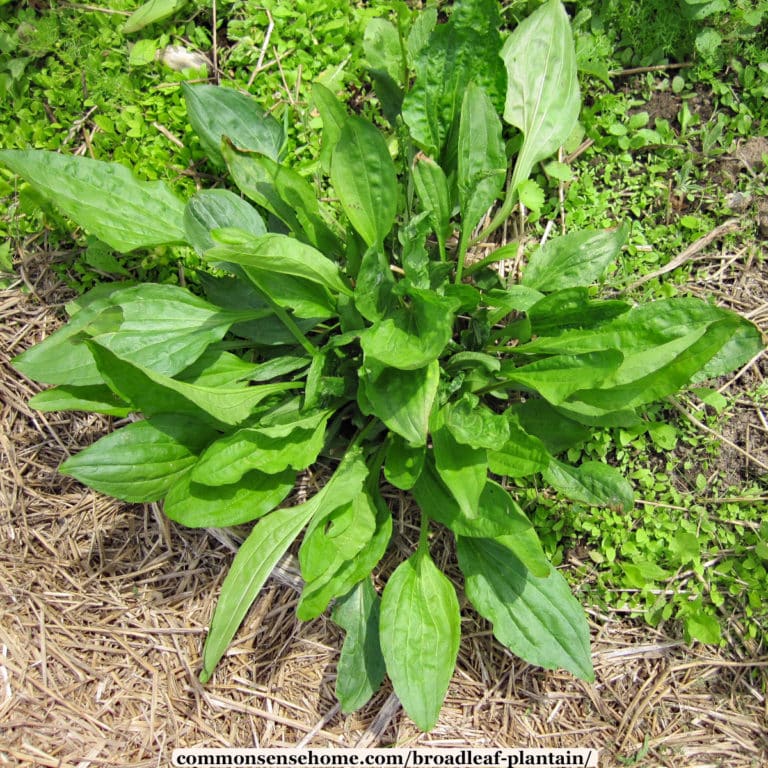
Today’s featured plant is Common Plantain, Plantago major.
Common Plantain is also known as broadleaf plantain, plantain, dooryard plantain, Ripple Grass, Waybread, Slan-lus, Waybroad, Snakeweed, Cuckoo’s Bread, soldier’s herb, Englishman’s Foot and white man’s foot. Continue reading »
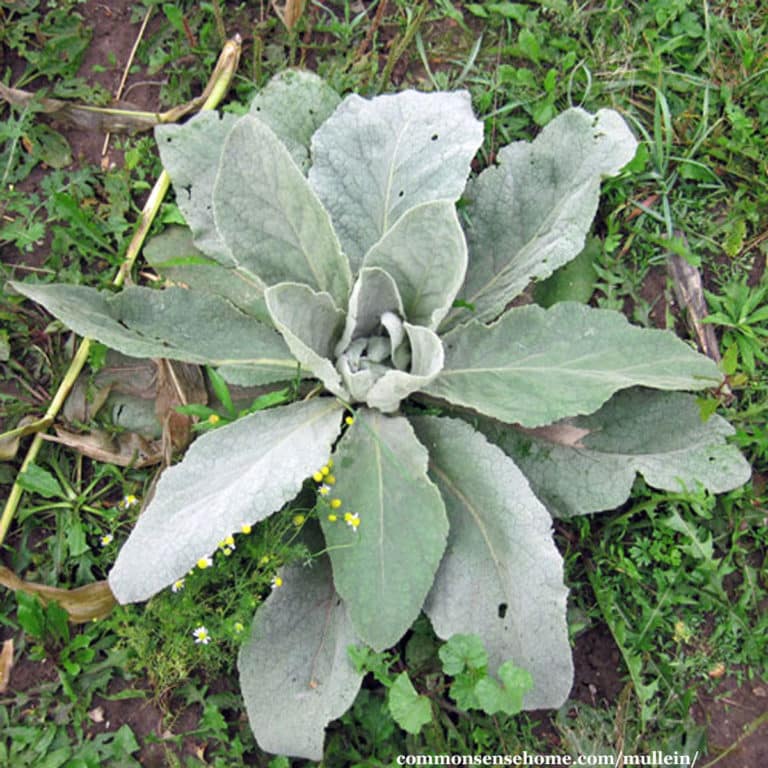
Today’s featured plant is Common Mullein, Verbascum thapsus.
Common Mullein is also known as Great Mullein, Aaron’s Rod, candlewick plant, flannel plant, flannel leaf, lungwort, feltwort, cowboy toilet paper, shepherd’s staff, velvet dock, woolly mullein, torch plant, torches, miner’s candle, big taper, blanket mullein, “Hig candlewick”, “Bullicks lungwort”, “Hare’s-beard”, “Ice-leaf”.”Beggar’s blanket”, “Moses’ blanket”, “Poor Man’s blanket”, “Our Lady’s blanket” or “Old Man’s Blanket”.
(There are more names, but this list is getting pretty long already. Do you get the impression this thing is pretty widespread?) Continue reading »
Today’s featured plant is New England Aster, Aster novae-angliae or Symphyotrichum novae-angliae , also known as starwort, blue chamomile, blue daisy, New England aster, fall-rose and frostweed.
Range and Identification of New England Aster
The New England Aster is native to North America east of the Rocky Mountains, but is now found throughout much of North America and in Europe. The USDA Natural Resources Conservation Service provides a range map. The plant prefers full sun and well-drained soil, and is commonly found in prairies and along roadsides and streams. It can grow in poor soil, but prefers a sand or clay loam. If you are cultivating the plant in a garden bed, most sources recommend dividing it every few years because it can be “aggressive”, but mine just pop up in small clumps here and there in the prairie.
Plant height is 3-7′ (90-210 cm) (by my place they tend to be fairly short, as we get a lot of wind). The leaves of the New England Aster are smooth and lance-shaped. Leaf attachment is alternate and leaves are 1-5″ (2.5-12.5 cm) long, clasped directly on the stem. (See in the photo below how the leaf wraps around the stem?) The author of Wisconsin Wildflowers points out that the lower leaves often fall off early, leaving “naked legs”.
Flowers are abundant, with 25-100 per plant, typically with bright purple petals and a yellow center, although they can also be pink, lavender, blue and white. Flowers stalks are coated with sticky hairs (very mildly sticky, as far as I could tell, not like pine tar or other really sticky plants). The plant is perennial, which means it comes back year after year. (Wildflowers of Wisconsin) Propagation instructions can be found in The University of Texas at Austin Native Plant Database.
New England Aster as Food and Habitat for Wildlife
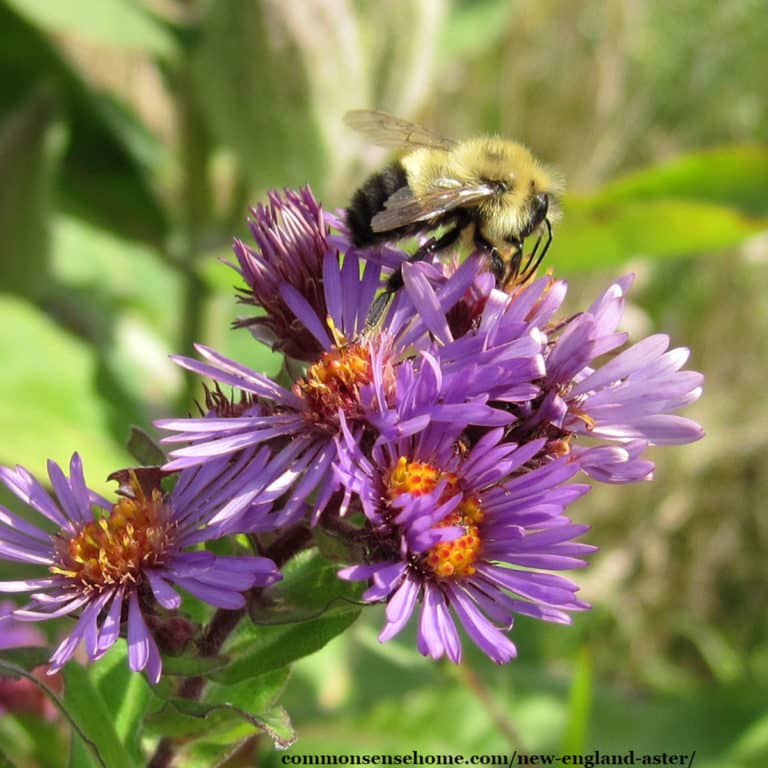
As you can see from the close up of the blossoms at the top of the post, these aster blossoms have a lovely open form that makes them an ideal nectar source for many bees, butterflies, flies, beetles and moths. They also have a long bloom time, and are available in fall when other nectar options are limited. They are particularly important as a nectar source for migrating monarch butterflies. The leaves of the plant act as a larval host for Pearl Crescent (Phyciodes tharos)and checkerspot butterflies.
Illinois Wildflowers states that “The seeds and leaves of this plant are eaten to a limited extent by the Wild Turkey, while deer, livestock, and rabbits occasionally browse on the foliage, sometimes eating the entire plant. However, New England Aster isn’t a preferred food source for these animals.” (They also have a photo of a pink blossom on this site.)
Medicinal Uses of New England Aster
Herbnet.com states:
Aster, New England (Aster novae-angliae): A poultice of the root has been used in the treatment of pain, fevers and diarrhea. The ooze of the roots has been sniffed in the treatment of catarrh. A decoction of the whole plant has been used in the treatment of all kinds of fevers and in the treatment of weak skin. Aster novae-angliae is deployed in decoction internally, with a strong decoction externally, in many eruptive diseases of the skin; it removes also the poisonous state of the skin caused by Rhus or Shumach.
Jim McDonald at Herbcraft.org gives a much more poetic and rambling explanation of the asters medicinal qualities. He talks about eating the whole flowers as a gentle sedative and anti-asthmatic, and teas and tinctures made from the roots and flowers having a similar effect. He states:
(The New England Aster) is uniquely antispasmodic for the lung tissue; it relaxes and dilates the respiratory passages.
One of the options he suggested was steam inhalation using the aster blossoms for treating congestion. Given that I’ve had a lovely cold for several days with symptoms that include moderate to heavy congestion, I figured I had the perfect opportunity to give this one a try. To do a steam inhalation, you simply place a small handful of blossoms in a heat resistant bowl, and pour boiling water over the top. Then you hold your head over the bowel and make a nifty tent with the decorative towel of your choice. Inhale the steam for around ten minutes.
Here we have our blossoms – I picked them late in the day, so they were already closed. Not optimal, but I wanted to try this for the post, and I was congested.
Here we have me, with my head under a towel, breathing flower steam. (I do my own stunts.
Guess what? It actually worked! At first, I felt things loosening up primarily from the steam, but as I’ve been sitting here typing, I can feel my head and chest relaxing and the sinus pain/pressure letting up. Cool beans!
Food Uses of New England Aster
Edible Wild Food.com states:
Flowers can be eaten fresh and added to a salad as can the leaves. When harvesting in September or early October be sure the plant is dry (dew is gone) and cut stem about 10 cm above the ground. Hang upside down in a cool, dark location until totally dried (crumbles easily). Most of the flowers will become white and fluffy but they can still be used. Add dried plant to salads, main dishes or make a cup of tea.
Other Uses of New England Aster
Like the wild plants butter and eggs, Canada goldenrod and many others, New England Aster can be used for dying fabric. Herb Rowe writes, “The stems, leaves and flowers of asters will produce a yellow-green with alum as a mordant, brassy gold with a chrome mordant, greenish-gold with a copper mordant, bright yellow-gold with a tin mordant, dark grey-green with an iron mordant and a yellow-green with no mordant.”
The Aster in Folklore
The West Virginia DNR site shares an interesting story about the aster in “Nature’s Last Hurrah” By Nanci Bross-Fregonara.
The word aster comes from the Greek word for star, which suggests the shape of the lovely flowerhead. According to legend, the aster is linked with the travels of the Wise Men to Bethlehem . It is said that when the three men arrived in the quiet town of Bethlehem they were surprised that there were no celebrations, which they would have expected with the birth of a new king. They thought, perhaps, they had the wrong town. But one of the Wise Men saw a star-shaped flower near the stable, its shape reflecting the star that had guided them from Persia , and proclaimed it as a sign that they were indeed at the right place.
Thanks for stopping by, and if you’ve enjoyed the post please pass it along. I’ll put up at least a few more post this season, while I’ve still got plants instead of snow.
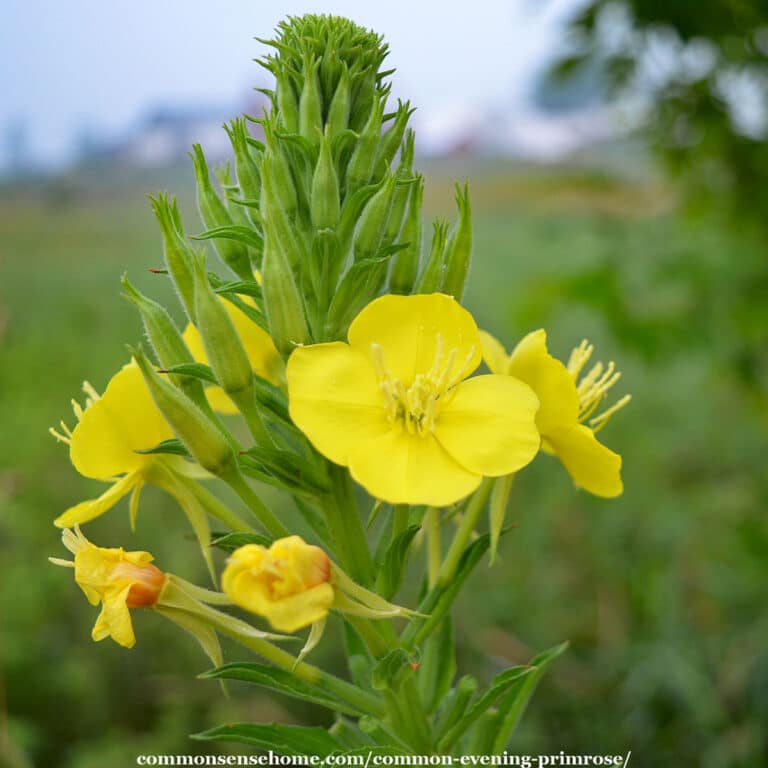
Today’s featured plant is Evening Primrose, Oenothera biennis.
Evening Primrose is also known as common evening primrose, hoary evening primrose, common primrose, German rampion, King’s Cure All, Fever Plant, Field Primrose, Night Willow-herb, hog weed, Primrose, Scabish, Scurvish, Sun Drop, and Tree Primrose.
Range and Identification of Evening Primrose
Evening primrose is native to North America, but is now found in Europe, Asia, New Zealand and Australia. The USDA Natural Resources Conservation Service provides a range map. The plant can be found throughout most of the U.S. and Canada, except the far north and some of the Rocky Mountain states. They are listed as potentially invasive/spreading, but I haven’t seen this in my yard.
The plant is a biennial, which means it grows over the course of two years. The first year it grows a small rosette at ground level, like a dandelion or chicory. The second year, it shoots up a flower stalk, commonly with multiple stems.
Blossom start opening at the lower end of the stalk first, working their way towards the top (similar to a hollyhock or gladiola). Flowers open in the evening (thus “evening primrose”), and last until about midday the next day. They are a favorite of sphinx moths, who pollinate them at night.
Leaf type is simple, leaf attachment is alternate, leaves are 4-8″ (10-20 cm) long and lance shaped . Oblong seed pods form along the stem as the flowers fade (you can see them just below the flower in the top photo). Plant height is 2-5′ (60-150 cm). Flowers have four heart shaped petals, flowers are regular and round, a bright sunshine yellow color. (Wildflowers of Wisconsin)
Evening Primrose as Food and Habitat for Wildlife
Evening primrose flowers are a nectar source for sphinx moths and other moths, and hummingbirds visit the flower both for nectar in insects to eat. The seeds provide winter food for a variety of birds. Small mammals will graze on young shoots and leaves, deer will graze on larger foliage. Japanese beetles are supposed to prefer this plant over garden plants – I haven’t seen this in my garden.
Medicinal Uses of Evening Primrose
Yes, this is the evening primrose that you see in supplement areas. Evening Primrose seed is very high in gamma-linolenic acid (GLA), in fact, it has the highest content of any known food source. Alternative Nature Online Herbal states:
GLA is an essential fatty acid that the body does not manufacture. This fatty acid is known to help prevent hardening of the arteries, heart disease, eczema, cirrhosis, rheumatoid arthritis, menopause, PMS, multiple sclerosis, and high blood pressure. It has a positive effect on sex hormone response including the hormones estrogen and testosterone, aids in lowering cholesterol levels, and is important in treating cirrhosis of the liver. Research also demonstrates that primrose oil helps relieve pain and inflammation. The oil also has a positive effect on the uterine muscles, nervous system and metabolism. The bark and the leaves are astringent and sedative. They have proved of use in the treatment of gastro-intestinal disorders, whooping cough and asthma. A tea made from the roots is used in the treatment of obesity. A finely ground powder made from the flowering stems is used cosmetically in face-masks to counteract reddened skins.
The Complete Herbal gives guidelines for harvesting seeds: “The seeds ripen from August to October and should be collected when ripe and pressed for oil. To be effective the seeds should contain 30-40% moisture.” To collect seeds, simply gather the seed heads in a clean bucket, break them open along the side, and pour the seeds out. You can sprinkle them over salads or on top of other dishes. They are mild in flavor.
Food Uses of Evening Primrose
Every part of the plant is edible, from root to flower. Roots should be harvested from one year old plants in early spring, like parsnips. In The Forager’s Harvest, Samuel Thayer gives detailed instructions how to prepare the various plant parts. He recommends boiling the root, as the flavor is very spicy. The growing flower stalks can be cut, peeled and gently cooked. Young flower buds can be used in soups and stir frys. The flowers are also edible, and make a bright addition to summer salads. As mentioned above, seeds can be sprinkled on just about anything “as is”, or they can also be lightly roasted.
To roast evening primrose seeds: Rotate and press dry seed capsules to release seed, roast in oven for 15 to 20 min. at 350 deg. Use on bread or in salad, sprinkle over any dish like pepper.
The only place I’ve been able to find evening primrose around here is at the edge of my driveway, so I’ve been hesitant to use those plants, but I’ve been on the lookout for cleaner spots and have spread some of the seeds around hoping that they will catch. This is a bit problematic, as the seed like open soil, but we’ll see what happens. If you’d like to read a rather fascinating article on the origins of evening primrose and its potential as an oil seed crop, check out “Evening Primrose – Origins and Cultivation“.
Thanks for stopping by, and if you’ve enjoyed the post please pass it along.
Featured at Homestead Barn Hop #28 at Homestead Revival and
Wildcrafting Wednesday #10.