Feb 012011
 

I had a large (two gallon) bag of plums rolling around in my freezer from last summer (thanks to my neighbor).  I used part of it to make Plum Preserves with Honey and Cardamom, and some in a plum crumble, but there were still quite a few plums left.  While my friend, Julie, was visiting last week, I decided to whip up a couple of batches of a plum conserve recipe that she really likes.

I found this recipe for Plum Rum Nutty Conserve in the booklet Gifts from the Harvest, which also has the recipes for Strawberry Banana jam, Strawberry Rhubarb jam and a number of other unusual combinations.  It is a traditional jam recipe (not low in sugar), but very tasty.  Enjoy in moderation.  :-)

Plum Rum Nutty Conserve

4 cups prepared fruit (about 2 pounds fully ripe plums)
1/2 cup finely chopped walnuts (I used crispy walnuts)
2 teaspoons grated lemon peel (preferably organic)
1 tablespoon fresh lemon juice
6 cups sugar
1 box fruit pectin
½ teaspoon butter
1/2 cup dark rum

Pit plums; do not peel.  Grind or finely chop.  Measure 5 cups into a 6- or 8- quart saucepot. Stir in walnuts, lemon peel and juice.

Prepare jars (wash, inspect rims, sterilize in boiling water or dishwasher). Keep lids hot until ready to fill jars.

Measure sugar into separate bowl. Stir fruit pectin into fruit in saucepot. Add butter. Bring mixture to full rolling boil on high heat, stirring constantly. Quickly stir in all sugar. Return to full rolling roil and boil exactly one minute, stirring constantly. Remove from heat.  Gently stir in rum.  Skim off any foam with a metal spoon.  (I usually skip skimming, unless I’m processing for the county fair.)

Ladle quickly into prepared jars, filling to within 1/8 inch of tope. Wipe jar rims and threads. Cover with two piece lids. Screw bands tightly. Invert jars 5 minutes, then turn upright, or follow water bath method recommended by the USDA. After jars are cool, check seals.

Makes about 8 (1 cup) jars.

My batches made seven jars each this time around, probably because the plums were frozen.

The Live in the Now website has some interesting tidbits of information on plums:

Like most fruits, plums are good for you and the health benefits of plums are worth your attention. They are a good source of unique phytonutrients called neochlorogenic and chlorogenic acid. These substances are especially effective in neutralizing a particularly destructive oxygen radical called superoxide anion radical, and they also help prevent oxygen-based damage to fats, such as the fats that comprise a substantial portion of our brain cells or neurons, the cholesterol and triglycerides circulating in our bloodstream, or the fats that make up our cell membranes.

The other health benefits of plums can be attributed to their excellent nutritional profile. Plums are good source of fiber, potassium, vitamin C, and lutein and zeaxanthin, pigments that help protect your vision. Eating three or more servings of fruit a day can lower by about one-third your risk of age-related macular degeneration, the primary cause of vision loss in older adults.

As I said, this is a “treat”  or gift type item, but the flavors are lovely together.  I passed the recipe along to the friend with the plum trees.  For an alternative that’s lower in sugar, do try the plum preserves with honey and cardamom.  The recipe book suggests it as a topping for ice cream or cheesecake, but I like it on toast with butter or nut butter, or mixed into yogurt.

Nov 012010
 

I love the book Wild Fermentation by Sandor Ellix Katz (AKA Sandor Kraut).  Mr. Katz explores where those who fear stomach pumps fear to tread.  In all seriousness, the book is a great resource for those who are new to fermenting.  He starts out with some history and health benefits of fermentation, then launches into a full scale barrage of fermentation recipes, as well as basic guidelines to ferment “almost anything”.

Topics covered include:

  • Vegetable Ferments
  • Bean Ferments
  • Dairy Ferments (w/ Vegan alternatives)
  • Breads (and Pancakes)
  • Fermented-Grain Porridges and Beverages
  • Wines (Including Mead, Cider and Ginger Beer)
  • Beers
  • Vinegars

Before I read Wild Fermentation and Nourishing Traditions, I hadn’t really thought much about fermenting for years.  When I was a girl, my mother had me scrub my feet extra clean and stomp the sauerkraut in her 15 gallon crock (sorry, no pictures on that one).  We also made a few batches of wines over the years, and some cucumber pickles, but that was about it.  Now I’m learning about live culture foods on a whole new level.

I’ve already posted in the past about kombucha, and I hope to do a post on water kefir in the next few weeks.  This post is about sauerkraut.

Sauerkraut has been around for at least a couple of thousand years.  If you’d like a more detailed history, you can take a peek at this article.  It was eaten by workers on the Great Wall of China, packed by Captain Cook to prevent scurvy, and valued by Northeastern Europeans as a staple food through the long winters.  While the name may mean “rotten cabbage”, if you do it right it should be quite the opposite, staying fresh for an extended period of time.

We began our sauerkraut adventure with a couple of heads of cabbage from the fall garden.  I’ve got a mix of pictures from this year and last year.  In 2009, I used my food processor to finely dice the cabbage, this year I just sliced it up by hand (I’m getting pretty good with REALLY BIG KNIVES).

Here are the official instructions from www.wildfermentation.com, which are the same as those in the book Wild Fermentation.

How to Make Sauerkraut

Timeframe: 1-4 weeks (or more)
Special Equipment:

  • Ceramic crock or food-grade plastic bucket, one-gallon capacity or greater
  • Plate that fits inside crock or bucket
  • One-gallon jug filled with water (or a scrubbed and boiled rock)
  • Cloth cover (like a pillowcase or towel)

Ingredients (for 1 gallon):

  • 5 pounds cabbage
  • 3 tablespoons sea salt

Process:

  1. Chop or grate cabbage, finely or coarsely, with or without hearts, however you like it. I love to mix green and red cabbage to end up with bright pink kraut. Place cabbage in a large bowl as you chop it.
  2. Sprinkle salt on the cabbage as you go. The salt pulls water out of the cabbage (through osmosis), and this creates the brine in which the cabbage can ferment and sour without rotting. The salt also has the effect of keeping the cabbage crunchy, by inhibiting organisms and enzymes that soften it. 3 tablespoons of salt is a rough guideline for 5 pounds of cabbage. I never measure the salt; I just shake some on after I chop up each cabbage. I use more salt in summer, less in winter.
  3. Add other vegetables. Grate carrots for a coleslaw-like kraut. Other vegetables I’ve added include onions, garlic, seaweed, greens, Brussels sprouts, small whole heads of cabbage, turnips, beets, and burdock roots. You can also add fruits (apples, whole or sliced, are classic), and herbs and spices (caraway seeds, dill seeds, celery seeds, and juniper berries are classic, but anything you like will work). Experiment.
  4. Mix ingredients together and pack into crock. Pack just a bit into the crock at a time and tamp it down hard using your fists or any (other) sturdy kitchen implement. The tamping packs the kraut tight in the crock and helps force water out of the cabbage.
  5. Cover kraut with a plate or some other lid that fits snugly inside the crock. Place a clean weight (a glass jug filled with water) on the cover. This weight is to force water out of the cabbage and then keep the cabbage submerged under the brine. Cover the whole thing with a cloth to keep dust and flies out.
  6. Press down on the weight to add pressure to the cabbage and help force water out of it. Continue doing this periodically (as often as you think of it, every few hours), until the brine rises above the cover. This can take up to about 24 hours, as the salt draws water out of the cabbage slowly. Some cabbage, particularly if it is old, simply contains less water. If the brine does not rise above the plate level by the next day, add enough salt water to bring the brine level above the plate. Add about a teaspoon of salt to a cup of water and stir until it’s completely dissolved.
  7. Leave the crock to ferment. I generally store the crock in an unobtrusive corner of the kitchen where I won’t forget about it, but where it won’t be in anybody’s way. You could also store it in a cool basement if you want a slower fermentation that will preserve for longer.
  8. Check the kraut every day or two. The volume reduces as the fermentation proceeds. Sometimes mold appears on the surface. Many books refer to this mold as “scum,” but I prefer to think of it as a bloom. Skim what you can off of the surface; it will break up and you will probably not be able to remove all of it. Don’t worry about this. It’s just a surface phenomenon, a result of contact with the air. The kraut itself is under the anaerobic protection of the brine. Rinse off the plate and the weight. Taste the kraut. Generally it starts to be tangy after a few days, and the taste gets stronger as time passes. In the cool temperatures of a cellar in winter, kraut can keep improving for months and months. In the summer or in a heated room, its life cycle is more rapid. Eventually it becomes soft and the flavor turns less pleasant.
  9. Enjoy. I generally scoop out a bowl- or jarful at a time and keep it in the fridge. I start when the kraut is young and enjoy its evolving flavor over the course of a few weeks. Try the sauerkraut juice that will be left in the bowl after the kraut is eaten. Sauerkraut juice is a rare delicacy and unparalleled digestive tonic. Each time you scoop some kraut out of the crock, you have to repack it carefully. Make sure the kraut is packed tight in the crock, the surface is level, and the cover and weight are clean. Sometimes brine evaporates, so if the kraut is not submerged below brine just add salted water as necessary. Some people preserve kraut by canning and heat-processing it. This can be done; but so much of the power of sauerkraut is its aliveness that I wonder: Why kill it?
  10. Develop a rhythm. I try to start a new batch before the previous batch runs out. I remove the remaining kraut from the crock, repack it with fresh salted cabbage, then pour the old kraut and its juices over the new kraut. This gives the new batch a boost with an active culture starter.

Here’s my five pounds of cabbage and my one gallon crock.  (Some of you might recognize the crock from the post on dandelion wine.)

I did measure my salt out beforehand and add it as I chopped, as I am a novice at this sort of thing.

Here we have my youngest helping me to tamp the cabbage into the crock.

Really, he’s normally a very sweet boy – see?

With enough pounding, you get a nice layer of juice on top.

I read another blog where the writer suggested simply leaving the cabbage to sit and letting it make its own juice, but that didn’t seem to work with my cabbage.  I didn’t get enough juice to cover the top of the kraut.

Put a plate on top to hold down the cabbage.

Put a bag of salt water on top of the plate.

In 2009 I just packed the crock with cabbage and salt.  In 2010, I did one batch plain and one batch with added dulse (on the left with the red flecks).  I’m thinking about doing a third batch with added caraway.  By the way, the container on the left is not ideal for a couple of reasons.  The taper near the top made it impossible for me to fit a plate in to help hold the kraut down.  It’s clear, so I really need to make sure it’s covered to keep out the light.   Nevertheless, it was non-reactive glass and it was handy, so I used it. (Can fermented vegetables be kept in the light?  Well, if you had no other choice, yes, but light exposure speeds up the decomposition of the food (it will rot faster).  Extended exposure to direct sunlight will kill off the very bacteria you’re try to cultivate.  Many vitamins are also broken down by the light.  In this case, vitamin C, one of the main health benefits of raw sauerkraut, is broken down by exposure to light, heat and oxygen.  Keep your ferments in the dark!)

This years crocks are safely tucked under old towels in the basement cool storage after three days on the kitchen counter.  Last year, I brought the batch up around mid-December to start eating. When I took the water bag and plate off, you can see the color of the kraut has darkened.

I packed one pint jar for the fridge and froze the rest, along with some red kraut I got from a friend.

As I understand it, freezing slows down the organisms responsible for the fermentation but doesn’t kill them, so the kraut is still alive, unlike canning, where the whole goal is to kill any live bacteria in the product.

What are some of the benefits of eating raw sauerkraut?  Joe Karthein explains in Raw Sauerkraut Rocks!:

The same beneficial microorganisms that create lactic acid in the colon are naturally present in all vegetables and are responsible for turning raw cabbage into highly-digestible sauerkraut. The fermentation process increases the number of microorganisms dramatically, digesting the cabbage and other vegetables and producing lactic acid.

This lactic acid works the same in a jar of fresh sauerkraut as it does in our large intestine; harmful bacteria cannot survive in the acidic environment.

When we eat unpasteurized sauerkraut we reap the benefits of absorbing an entire ecosystem into our own internal ecosystem. The lactic acid from the sauerkraut creates an environment where the introduced beneficial bacteria can reproduce and in turn create more lactic acid.

Lactic acid also helps digestion at an earlier stage–in our stomach. As we get older, our stomach’s natural secretions of hydrochloric acid decrease. Hydrochloric acid breaks down food so it can be more easily absorbed by the small intestine. It is also the most important defense we have against harmful bacteria and parasites often present in food. Lactic acid can partially compensate for reduced hydrochloric acid.

Another way unpasteurized sauerkraut benefits digestion in the stomach is by assisting the pancreas. The pancreas secretes essential digestive enzymes into the stomach.
Unpasteurized sauerkraut is very high in viable enzymes that work just like the ones from the pancreas. A friend with chronic pancreatitis who has been taking prescription enzymes for the last five years was able to reduce his dosage by eating fresh sauerkraut on a daily basis. But this is just the beginning; there are so many more reasons to include my favorite food in your diet!

I eat my kraut with my eggs in the morning for breakfast, or as a condiment with just about any meat (roast chicken being a favorite).  It makes a most excellent Reuben.


I hope this helps you take the plunge if you haven’t tried fresh kraut.  It’s fairly easy and very tasty.  What other veggies have you fermented, and how did you like the results?


PS – I quick note on the “tamper” I used to pound down the kraut, in response to Patty’s comment.  The tamper is actually the wooden pestle from my Mirro Canning Food Press.  The food press was handed down to me by my grandmother.  I don’t use it a ton since I got my food strainer, but it is handy for small batches of applesauce and such, and pounding on vegetables.

UPDATE:  You can see how the kraut looked after SEVEN months in the crock at this post.  Lacto-fermentation works for food storage.

Featured at Real Food Wednesday and Domestically Divine.

Sep 142010
 
Root Cellars 101 - Root Cellar Design and Use
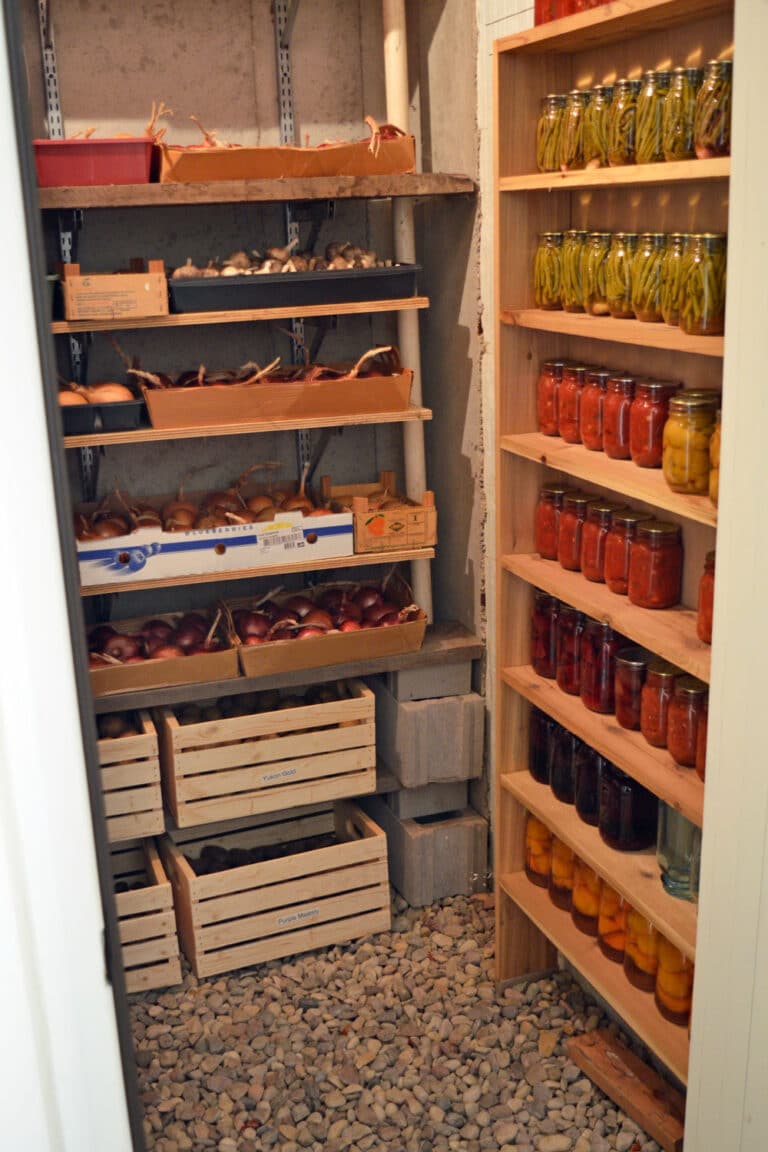
Looking into our root cellar

We built a root cellar under our front porch.  Typically, if you’re building new your porch floor is formed out of a concrete slab, you need to put a foundation wall under it anyway, so why not put this area to good use?  Even if you can’t deal with (or don’t want to deal with) traditional root cellaring (storing vegetables and fruit), you could use the space as a wine cellar, gun cabinet, place to brew beer, a battery room for your PV/Wind system or simply more storage.  I highly recommend including a root cellar as part of your emergency preparedness planning if you can, as it’s a great low-cost, no-energy way to store food and extend the shelf life of fresh produce.

Our root cellar measures about 8′x8′, which provides plenty of room for our stash of root veggies, plus gives a nice sized porch above.  We have simply shelving along the east wall (opposite the door) composed of rough cut 2″x8″ boards and cement blocks.  Produce that likes drier conditions (like onions, garlic and potatoes) is stored in trays on the shelves for better ventilation.  This way, if an onion or potato starts to go bad, they can be spotted and removed immediately before they spoil the whole batch.  My mom used to store hers in mesh sacks, but many times one bad roots would spoil a large number of those around it.  I cover the potatoes with burlap or landscape fabric or whatever else is handy to block out the light (and prevent green potatoes) but allow ventilation.  A few cabbage go on the top shelf, and apples go out in the garage.  Pumpkins and squash go on the floor of the canning pantry because they like it a little warmer and drier.

I store vegetables that need more moisture in buckets, bins or boxes packed with lightly dampened leaves.  For us this usually means beets and carrots (I overwinter parsnips out in the garden).  I tried packing these vegetables in sawdust and in sand, but prefer the leaves.  For me, sand stayed too moist and led to rotting, plus it made a terrible mess.  Sawdust was also very messy, but better than sand.  It really liked to cling in all the little root hairs.  The leaves provide moisture to keep your roots from shriveling up, but are easy to brush off with much less mess.  They can be recycled into the garden during the next planting season to enrich to the soil.  (I like to mix mine with the dirt I use to back fill my potato planting holes.  Leaves add acidity to the soil, which helps prevent scab on potatoes.)  Do use fresh leaves each year to prevent potential pathogen buildup.

View to the left

Locating the root cellar outside the footprint of the home permits the root cellar to maintain cooler temperatures more easily than a cellar located within the house, but even if you have a pre-existing home you may be able to section off a portion of your basement with good results.  Using an exterior grade door (preferably insulated) on your root cellar also helps to maintain proper temperature (both in the root cellar and in the house).  If you are building new, consider putting the root cellar door in the back of an unheated storage room so that the temperature difference is less.  You can use this room to store veggies that require somewhat warmer and drier storage than a root cellar provides, as well as canned goods and whatever else you may need to stash.

Root cellars must have ventilation!  This is one of most common mistakes that people make when designing/installing them.  Proper ventilation moves the ethylene gas that causes spoilage away from the produce, increasing your storage time and the quality of the items in storage.  It also slows down molds and mildews and other fuzzy things that thrive in dark, damp, still environments.  You need the equivalent of a low and high 2” PVC pipe, preferably placed so as to bring in fresh air low on one side and to vent stale air out high on the opposite side.    Don’t skip the vent pipes if you’re building new, or at least their penetrations, even if you’re not sure you want to use the space for a root cellar.  You can always cap them off and they’re much more difficult to add later.

The root cellar should have no “standard” heating or cooling, other than a way to introduce outside air to cool the space. A “finished” floor is optional, and in fact a simple gravel floor is probably your best option for controlling humidity.  Root cellar produce keeps best with high humidity and cool temperatures.  A gravel floor introduces ground moisture and allows you to sprinkle the floor to add moisture when needed.  A single incandescent light (switched on exterior) should provide adequate lighting (unless your room is really huge) and, if for some reason your storage gets too cold, you can always use it to introduce a little heat.

The best resource we have found on root cellars is the book Root Cellaring: Natural Cold Storage of Fruits & Vegetables by Mike and Nancy Bubel.  No matter what your location or how much space you have, the Bubels are likely to have a root cellar option that will work for you.  It contains detailed explanations of how to store vegetables and fruits without electricity with specific temperature and humidity recommendations for each variety.  There are also good photos and diagrams, which I really like.

Links

Yakhchal – Ancient natural refrigerators – who knew?

Keep Your Ice Cream Cold Without Electricity – Nifty article on a home built refrigerator substitute that uses no electricity or fuel.

Build a Basement Root Cellar by Steve Maxwell – Article from Mother Earth News

A Root Cellar for Your Homestead  by Victoria Ries – Some basic information on the cellar, more information on the proper storage of the fruits and veggies themselves.
The University of Missouri Extension Office suggests the following guidelines for storing food in root cellars:


Root Cellar storage requirements

Apples

  • Cold and moist
  • Do not store with vegetables
  • 32 to 40 degrees Farenheit
  • 80 to 90 percent relative humidity

Beans, dry

  • Cool and dry
  • Home and commercially prepared foods also need a cool, dry storage place
  • 32 to 50 degrees Farenheit
  • 60 to 70 percent relative humidity

Beets

  • Cold and very moist
  • 32 to 40 degrees Farenheit
  • 90 to 95 percent relative humidity

Brussels sprouts

  • Cold and very moist
  • 32 to 40 degrees Fahrenheit
  • 90 to 95 percent relative humidity

Cabbage

  • Cold and very moist
  • 32 to 40 degrees Fahrenheit
  • 90 to 95 percent relative humidity

Cabbage, Chinese

  • Cold and very moist
  • 32 to 40 degrees Fahrenheit
  • 90 to 95 percent relative humidity

Carrots

  • Cold and very moist
  • 32 to 40 degrees Fahrenheit
  • 90 to 95 percent relative humidity

Cauliflower

  • Cold and very moist
  • 32 to 40 degrees Fahrenheit
  • 90 to 95 percent relative humidity

Celeriac

  • Cold and very moist
  • 32 to 40 degrees Fahrenheit
  • 90 to 95 percent relative humidity

Celery

  • Cold and very moist
  • 32 to 40 degrees Fahrenheit
  • 90 to 95 percent relative humidity

Endive (Escarole)

  • Cold and very moist
  • 32 to 40 degrees Fahrenheit
  • 90 to 95 percent relative humidity

Garlic

  • Cool and dry
  • Home and commercially prepared foods also need a cool, dry storage place
  • 32 to 35 degrees Fahrenheit ideal
  • 60 to 70 percent relative humidity

Grapefruit

  • Cold and moist
  • Do not store with vegetables
  • 32 to 40 degrees Fahrenheit
  • 80 to 90 percent relative humidity

Grapes

  • Cold and moist
  • Do not store with vegetables
  • 32 to 40 degrees Fahrenheit
  • 80 to 90 percent relative humidity

Horseradish

  • Cold and very moist
  • 32 to 40 degrees Fahrenheit
  • 90 to 95 percent relative humidity
  • May be left in the ground undisturbed until needed. Digging can be done unless the soil is frozen hard. A thick layer of mulch may extend your harvest season.

Jerusalem artichoke

  • Cold and very moist
  • 32 to 40 degrees Fahrenheit
  • 90 to 95 percent relative humidity
  • May be left in the ground undisturbed until needed. Digging can be done unless the soil is frozen hard. A thick layer of mulch may extend your harvest season.

Kale

  • Cold and very moist
  • 32 to 40 degrees Fahrenheit
  • 90 to 95 percent relative humidity

Kohlrabi

  • Cold and very moist
  • 32 to 40 degrees Fahrenheit
  • 90 to 95 percent relative humidity

Leeks

  • Cold and very moist
  • 32 to 40 degrees Fahrenheit
  • 90 to 95 percent relative humidity

Onions

  • Cool and dry
  • Home and commercially prepared foods also need a cool, dry storage place
  • 32 to 35 degrees Fahrenheit ideal
  • 60 to 70 percent relative humidity

Oranges

  • Cold and moist
  • Do not store with vegetables
  • 32 to 40 degrees Fahrenheit
  • 80 to 90 percent relative humidity

Parsnips

  • Cold and very moist
  • 32 to 40 degrees Fahrenheit
  • 90 to 95 percent relative humidity

Pears

  • Cold and moist
  • Do not store with vegetables
  • 32 to 40 degrees Fahrenheit
  • 80 to 90 percent relative humidity

Peas

  • Cool and dry
  • Home and commercially prepared foods also need a cool, dry storage place
  • Airtight container
  • 32 to 50 degrees Fahrenheit
  • 60 to 70 percent relative humidity

Peppers, hot dried

  • Cool and dry
  • Home and commercially prepared foods also need a cool, dry storage place
  • 32 to 50 degrees Fahrenheit
  • 60 to 70 percent relative humidity

Popcorn

  • Cool and dry
  • Home and commercially prepared foods also need a cool, dry storage place
  • Airtight container
  • 32 to 50 degrees Fahrenheit
  • 60 to 70 percent relative humidity

Potatoes

  • Cold and moist
  • Do not store with fruits
  • 38 to 40 degrees Fahrenheit ideal
  • 80 to 90 percent relative humidity

Potatoes, sweet

  • Warm and moist
  • To keep sweet potatoes from spoiling in warm and moist storage, do not let temperatures drop below 50 degrees Fahrenheit
  • 80 to 90 percent relative humidity

Pumpkins

  • Warm and dry
  • 50 to 55 degrees Fahrenheit
  • 60 to 75 percent relative humidity

Radish, winter

  • Cold and very moist
  • 32 to 40 degrees Fahrenheit
  • 90 to 95 percent relative humidity

Rutabaga

  • Cold and very moist
  • 32 to 40 degrees Fahrenheit
  • 90 to 95 percent relative humidity

Salsify, oyster plant

  • Cold and very moist
  • 32 to 40 degrees Fahrenheit
  • 90 to 95 percent relative humidity
  • May be left in the ground undisturbed until needed. Digging can be done unless the soil is frozen hard. A thick layer of mulch may extend your harvest season.

Squash, winter

  • Warm and dry
  • 50 to 55 degrees Fahrenheit
  • 60 to 75 percent relative humidity

Tomatoes

  • Warm and moist
  • To keep green tomatoes from spoiling in warm and moist storage, do not let temperatures drop below 50 degrees Fahrenheit
  • 80 to 90 percent relative humidity

Turnip

  • Cold and very moist
  • 32 to 40 degrees Fahrenheit
  • 90 to 95 percent relative humidity

The length of time that fruits and vegetables keep well in root cellars depends on several factors:

    • Early or late crops (late-maturing crops store better)


  • Storage conditions (less-than-ideal conditions shorten storage life)
  • Fruit and vegetable condition at storage time (proper curing of damage-free produce results in longer storage life).


Vegetables and fruits should not be stored together even though temperatures and moisture requirements are similar. As fruits such as apples and pears ripen, they give off ethylene gas which decreases the storage life of vegetables. This is especially evident with potatoes which sprout early if stored near certain fruits. Also, the odor of strong smelling vegetables, like turnips and cabbage, can be absorbed by fruits and other vegetables. Store them away from other food and where the odor cannot waft into the house.

Do not allow fruits and vegetables to freeze.

This post has been added to Preparedness Challenge #7 at Homestead Revival,
Homestead Barn Hop #30 at The Prairie Homestead,
Fight Back Friday at Food Renegade
Sep 022010
 

I was cleaning out the freezer this week to make room for half a local grassfed steer, and I came across the very large bag of plums I froze last fall.  Whoops…I had intended to use them well before this, but better late than never.

This year I’m experimenting with using less refined sugars, so I thought I’d try sweetening a plum jam with honey.  I wanted to incorporate cardamom, too, as I felt the flavor would complement the plums.  A quick internet search came up with “Honey Plum Preserve” on Foodbuzz.  I’ll share the recipe here, along with my own notes.

Plum Preserves with Wildflower Honey & Cardamom

Ingredients

5 cups of plums, chopped and pitted
2 tbsp of freshly squeezed lemon juice
2 tbsp orange juice
1 packet powdered fruit pectin
1 cup wildflower honey
1/2 tsp cardamom powder (optional)
1/2 cup water

Directions

Cover the bottom of a saute pan with honey. Place over low heat to warm the honey. Then add the chopped plums, and let them cook for 8-10 minutes, tossing them over to evenly coat them with the honey.

Bring the mixture to a boil over low heat, stirring frequently. Add the lemon juice, orange juice and the cardamom powder and mix well. Now go ahead and add the water, and let it boil.

Keep removing the white foam that forms at the top of the jam while cooking. When the mixture appears soupy and slightly thick, increase the heat to bring the mixture to a full, rolling boil.

Once it becomes syrupy, the jelly is ready. As it cools down, it will transform into the sticky but thick jam texture that you are used to eating. Some people like it chunky, while others prefer it more even. If you fall in the second category, pass the fruit preserves through a sieve or colander, pressing hard to extract as much pulp as possible. Your jam is ready at this point, to eat right out of the pot!

Notes:   The original recipe didn’t say when to add the pectin, or what type of pectin to use.  Plums have some natural pectin, so if you have a plums that are less ripe you may not need commercial pectin.  My plums were very, very ripe, so I figured I would need some.  I did a gelling test to see if the mix of honey and chopped plums would set.  To do a gelling test, take a tablespoon of alcohol and drop in a tablespoon of the liquid you are testing.  Let it sit two minutes.  If a firm blob forms, it has enough pectin.  If not, you need to add pectin.  I did not get a blob, so I mixed in standard powdered pectin to the honey and plums, because that’s what I had on hand.  I also added a teaspoon of butter to the fruit to reduce foaming.

The ratio of sweetener to fruit is very low in this recipe, but the added lemon and orange juice makes it fairly acidic, which should help to preserve it.  I packed my boiling jam in very hot jars and processed them in a water bath canner for 10 minutes.  I ended up with about 4 1/2 cups of jam.  The partially filled jar went into the fridge.  The flavor is good, tart and spicy, almost a bit like a chutney.  My only question right now is how long will it keep?  I guess we’ll find out, if it doesn’t get eaten first.

This recipe has been added to the Nourishing Jams, Jellies and Preserves Blog Hop, Make Your Own Monday for 9/26/2011 at Nourishing Treasures and Real Food 101 at Ruth’s Real Food.

Sep 022010
 
No Canning Required Dill Pickles @ Common Sense Homesteading

My early attempts at dill pickles were not very successful.  I followed the FDA guidelines from the Ball Blue Book of Preserving, and ended up with tasty pickles with absolutely no crunch.  I love my Blue Book, but these were not the pickles I was looking for.  As I understand it, many commercial manufacturers add alum (basically aluminum) to give their pickles crunch.  Needless to say, I wasn’t going that direction.

Enter my neighbor Betty.  Betty and I have swapped a lot of produce and recipes over the years, and this is one my favorites:

Betty’s Open Jar Pickles

  • 9 cups water
  • 1 ½ cup vinegar
  • 1/3 cup salt (Do not use salt with iodine, it will give the pickles a brown tint, Real Salt also gives a slight brown tint, canning salt works best)
  • ½ cup sugar
  • Dill, 2-3 stalks
  • 2-4 inch long cucumbers, enough to fill a gallon jar

Directions
Combine the water, vinegar, salt and sugar and boil one minute. Cool slightly.  I used Real Salt for this batch, and it made my brine darker than normal.

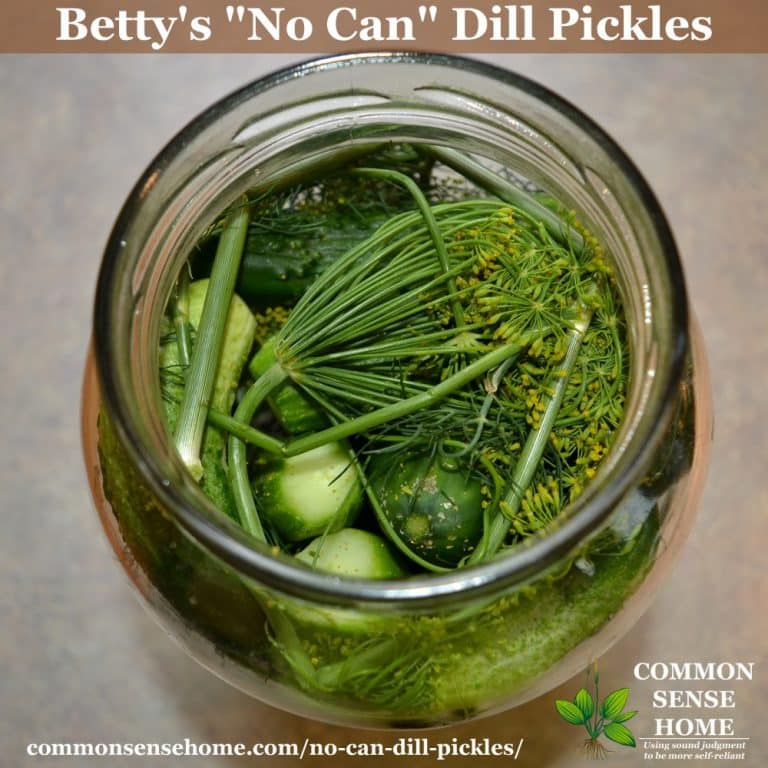
Wash the cucumbers and cut off about 1/16”from each end.  This gets rid of some enzymes that would soften the pickles, and allows better penetration of the brine.  Pack the cucumbers in a one gallon jar with the dill.

Note:  I like to curl up some of the dill in the top of the jar to pin down the cucumbers and make sure they all stay submerged in the brine.

Pour the warm brine over the cucumbers. Let stand, loosely covered, at room temperature for three days. (Drape a towel over the jar opening or let lid sit on loosely.)   I rubber band everything, especially in fruit fly season.

I had some extra brine and cucumbers, so I made up a couple of quart jars and added a garlic scape to each jar. (Top photo in post.)

Cover and store in refrigerator. They are ready to eat after the three days but the flavor improves after a week or two in the refrigerator.

That’s it!  No canning, no heat processing of any sort.  These pickles stay fresh and crisp tasty for months.  We’ve enjoyed them at Christmastime.  If you don’t have a lot of small cucumbers, you could cut the recipe in half, or make up a full batch of brine but process pickles by the quart and hold the reserve brine in the fridge for a couple of weeks.  Delicious!  Thanks, Betty.  I love my country neighbors!

This post has been added to Real Food Wednesday  at Kelly the Kitchen Kop.