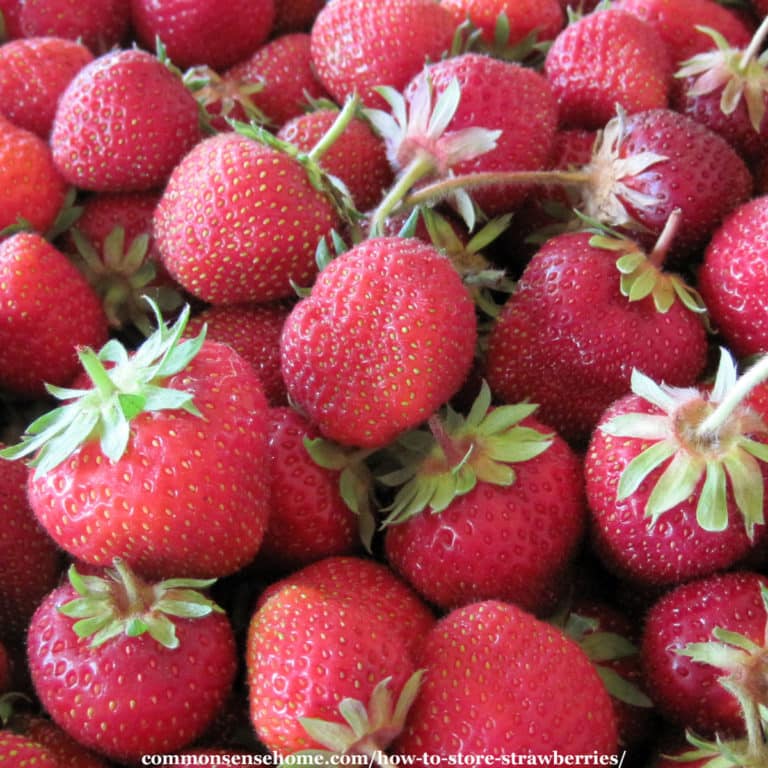
The boys and I went strawberry picking twice this season, and came home with two trays of berries each time. To put away some of these beautiful berries to enjoy for the rest of the year, we made two batches of low sugar jam (strawberry and strawberry-banana). We also used four other methods of preserving strawberries – freezing, drying, making fruit leather and flavoring kombucha. Continue reading »
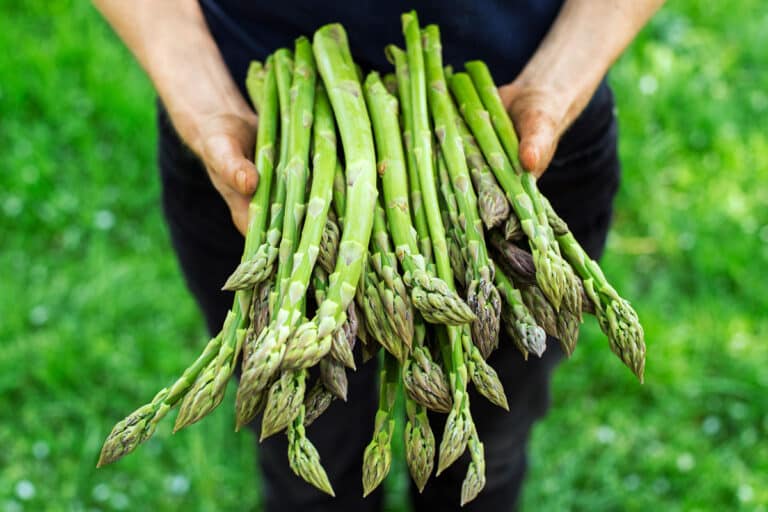
I had the opportunity to babysit my neighbors asparagus patch for two weeks earlier this season, and I was blessed with a bounty of asparagus like I have never seen. The photo above was just one picking – and it kept coming! For those who are not asparagus savvy, you need to keep the spears harvested during the production season, otherwise they will get tall and produce seed, and you will have no more asparagus to harvest. Thus, I was over picking every two to three days to keep the plants producing. The neighbors have a lovely 100+ year old farmhouse, and four different asparagus patches around the yard. As I was picking, the fresh spears looked so good that I decided to try one raw for the first time. It was really good! It tasted very much like fresh picked green peas, without much of the stronger “asparagus” taste that puts many people off. I ate several more.
Since there was such a bounty, I used several methods of preserving asparagus.
The first thing I decided to do with the excess asparagus was freezing.
How to Freeze Asparagus
From the Ball Blue Book of Preserving, one of my favorite preserving references, with my comments in parentheses.
Select young, tender asparagus with tightly wrapped tips. (Check – picked them fresh myself.
Wash thoroughly and sort into sizes. (Definitely needed to do this – the size variation in homegrown asparagus is quite substantial compared to commercial asparagus. I always went for the thinner stalks in the store, thinking they’d be more tender, but I found out while picking that they emerge from the soil at the width they will be as they grow. Thinner stalks are not any younger than fat ones, and the fat ones were often more tender and juicy. Don’t fear the fat asparagus, and don’t fear fat in general.)
Trim stalks by removing scales with a scarp knife. (This is done primarily to get any trapped dirt off that may be hiding underneath the scales, so I didn’t bother, as my asparagus were grown in grassy and mulched areas. you’ll be able to see how dirty your asparagus are.)
Cut into even lengths to fit in freezer containers. (I skipped this, too, since I wanted to pack whole spears in vacuum bags.)
Blanch small spears 1 1/2 minutes, medium spears 2 minutes and large spears 3 minutes. (This is where the sorting is needed.)
Cool. (I scooped mine out and plunged them into a cold water bath to halt cooking.)
Drain. (I first drained in a colander, and then placed them evenly space on a flour sack towel on top of an old, absorbent bath towel, to wick away as much excess moisture as possible before freezing.)
Pack asparagus into plastic freezer bags, can-or-freeze jars, plastic freezer boxes or vacuum bags. (I chose to lay out my asparagus on cookie sheets covered with reusable parchment paper (I use that stuff for everything.) and pre-freeze them before sealing them in vacuum bags the following day.
Seal, label and freeze. (I packed the frozen spears into meal sized packages with varying amounts per package and sealed them with my vacuum sealer. My goal was to have a product that looked as good when you brought it out of the freezer as when you put it in – no ice crystals, no mushy mass of green goo, just neat, tender spears ready to be heated in a pan with a bit of butter, salt and pepper. If you plan to keep produce frozen for any amount of time – for instance, in this case, I probably won’t pull this out until winter, when fresh veggies are gone – the investment in a vacuum sealer and the small amount of extra time involved is well worth it in the HUGE improvement in quality of frozen veggies and fruits.)
How to Dry Asparagus
Again from the Ball Blue Book of Preserving with my comments in parentheses.
Choose young, tender stalks. (The ones that taste like green peas.
Wash and cut off tough end. (Funny that they didn’t mention this for the freezing. Anyway, you can trim a little bit from the bottom as needed. With many of the younger stalks, I really didn’t need to trim at all, because there was no tough part at the bottom.)
Slice into one inch pieces. (Note – if you have really fat asparagus stalks, you probably want to cut them in half lengthwise, too, before loading them in the dehydrator. I didn’t do this initially, and ended up doing it at the end of the drying process to get those wider pieces to dry evenly.)
Steam blanch 3 to 4 minutes. (I just blanched them in a pot of boiling water for about two minutes, until they were bright green.)
I started with about six cups of chopped asparagus.
Here’s the whole batch in about 8 quarts of boiling water.
After blanching, I chilled them in a cold water bath to stop the cooking.
Drain well and spread evenly on dehydrator trays. I used the mesh inserts (the Clean-A-Screen trays) to make sure that no veggie parts fell through the screens as they dried.
Dry at 125F until brittle. Rehydrate and serve in soups or with seasoned cream sauce. Water content 92%. (I put mine in at night and they were done the next morning, except for the wide bits, which I split in half and dried for a bit longer. You want them to be very dry, so they snap easily in half, for optimum shelf life.)
Isn’t it amazing how much they shrink up? If you’ve get very limited food storage space, dehydrating is the way to go. Remember the six cups I started with? After drying, it all fit into one cup sized jar.
This was labeled and stuck in the pantry. If you want to boost shelf life even more, you can use the Foodsealer jar sealer attachment and vacuum seal the jar, too.
How to Lacto-Ferment (Pickle) Asparagus
This recipe is the love child of two different posts, one from Heartland Renaissance, and one from A Little Bit of Spain in Iowa. Since I scored some green garlic (immature garlic) from a neighbor (thanks, Deb), I figured I’d use it in the ferment. My neighbor, Betty, who provided me with the asparagus, had mentioned that she wanted to make some pickled asparagus. I’m pretty sure that she had standard pickled asparagus in mind, but I’ve been experimenting more with live cultured foods, so I used lacto-fermentation.
Lacto-fermentation is the use of water, salt, spices and sometimes whey to preserve food without heat canning. The lactobacilli bacteria that proliferate in lacto-fermented foods not only help to preserve it and give it that “pickle” flavor, they also act as little probiotic factories, making the food more digestible and increasing its nutrient value. Lacto-fermented food is loaded with healthy bacteria. I eat some every day, generally with every meal.
Lacto-Fermented Asparagus Recipe
For each quart jar:
1 teaspoon peppercorns
1/4 teaspoon celery seeds
1/2 teaspoon mustard seeds
1/2 teaspoon pickling spice
2 stalks green garlic, cut into 1 inch pieces
Enough asparagus to pack the jar tightly
4 tablespoons whey – If you do not have whey, add an extra tablespoon of salt to your salt water
Salt water – 2 tablespoons sea salt to one quart water, mix well to dissolve (you won’t need all of this to fill the jar, but it’s better to have a little extra than to run short)
Clean and trim asparagus so the spears will fit into the jars below the neck of the jar (you want to keep them covered with liquid during fermentation.) Put loose spices into jar, then pack asparagus into jars as tightly as possible (they will shrink during pickling and will want to float and pop up out of the liquid). Wedge in garlic pieces as you go. Pour in whey. Pour in enough salt water to completely cover the asparagus, but make sure to leave one inch of head space at the top of the jar. As it ferments, gas are produced and jar contents may expand. I used atlas jars, which have wider shoulders but narrow mouths, to help wedge the asparagus in so it stayed below the water level. You can also use a smaller jar with water in it nested in a wide mouth jar, or a clean stone, or other clean weight to hold the veggies under the brine. This worked out pretty well overall. Cultures for Health has a fermented vegetable master, which is designed to keep air out but allow gases to escape. It’s on my wish list.
Cover jars with a clean cloth (don’t seal tightly – they need to breathe), and place in a cool, dark place and allow to ferment for at least 3 days. After three days, you can continue fermenting, or cover tightly and move to the refrigerator to slow down the fermentation process. The flavors will get stronger and the asparagus will get softer the longer it ages at room temperatures. Heat dramatically speeds up the fermentation process, so warm weather ferments will have shorter shelf lives. I kept mine on the counter for three days under a dishcloth, then covered it tightly and moved it to the fridge.
One day three, I was a little freaked out when I took off the dishcloth and saw this:
At first, I thought it was mold. Although it is generally safe to eat fermented foods with mold on the surface (just scrape off the mold and eat the product underneath, as long as the smell and taste are not foul or “off”), I was surprised that it had molded so quickly. Upon closer examination, I found out that it was not mold, just milk solids from my whey, which could have been strained a little more finely. After a little judicious scraping, the tops looked like this:
Much less “Fear Factor”.
My final product turned out a little cloudy, probably due to the whey and the “pickling spices”, which had some finer bits, but the taste is delicious. Judging by the shelf life of other ferments I’ve tried, these should be good for several months – even a year – refrigerated, if they lasted that long.
I’m very grateful to have a stash of different types of asparagus that I can now enjoy for months to come.
I love the book Wild Fermentation by Sandor Ellix Katz (AKA Sandor Kraut). Mr. Katz explores where those who fear stomach pumps fear to tread. In all seriousness, the book is a great resource for those who are new to fermenting. He starts out with some history and health benefits of fermentation, then launches into a full scale barrage of fermentation recipes, as well as basic guidelines to ferment “almost anything”.
Topics covered include:
- Vegetable Ferments
- Bean Ferments
- Dairy Ferments (w/ Vegan alternatives)
- Breads (and Pancakes)
- Fermented-Grain Porridges and Beverages
- Wines (Including Mead, Cider and Ginger Beer)
- Beers
- Vinegars
Before I read Wild Fermentation and Nourishing Traditions, I hadn’t really thought much about fermenting for years. When I was a girl, my mother had me scrub my feet extra clean and stomp the sauerkraut in her 15 gallon crock (sorry, no pictures on that one). We also made a few batches of wines over the years, and some cucumber pickles, but that was about it. Now I’m learning about live culture foods on a whole new level.
I’ve already posted in the past about kombucha, and I hope to do a post on water kefir in the next few weeks. This post is about sauerkraut.
Sauerkraut has been around for at least a couple of thousand years. If you’d like a more detailed history, you can take a peek at this article. It was eaten by workers on the Great Wall of China, packed by Captain Cook to prevent scurvy, and valued by Northeastern Europeans as a staple food through the long winters. While the name may mean “rotten cabbage”, if you do it right it should be quite the opposite, staying fresh for an extended period of time.
We began our sauerkraut adventure with a couple of heads of cabbage from the fall garden. I’ve got a mix of pictures from this year and last year. In 2009, I used my food processor to finely dice the cabbage, this year I just sliced it up by hand (I’m getting pretty good with REALLY BIG KNIVES).
Here are the official instructions from www.wildfermentation.com, which are the same as those in the book Wild Fermentation.
How to Make Sauerkraut
Timeframe: 1-4 weeks (or more)
Special Equipment:
- Ceramic crock or food-grade plastic bucket, one-gallon capacity or greater
- Plate that fits inside crock or bucket
- One-gallon jug filled with water (or a scrubbed and boiled rock)
- Cloth cover (like a pillowcase or towel)
Ingredients (for 1 gallon):
- 5 pounds cabbage
- 3 tablespoons sea salt
Process:
- Chop or grate cabbage, finely or coarsely, with or without hearts, however you like it. I love to mix green and red cabbage to end up with bright pink kraut. Place cabbage in a large bowl as you chop it.
- Sprinkle salt on the cabbage as you go. The salt pulls water out of the cabbage (through osmosis), and this creates the brine in which the cabbage can ferment and sour without rotting. The salt also has the effect of keeping the cabbage crunchy, by inhibiting organisms and enzymes that soften it. 3 tablespoons of salt is a rough guideline for 5 pounds of cabbage. I never measure the salt; I just shake some on after I chop up each cabbage. I use more salt in summer, less in winter.
- Add other vegetables. Grate carrots for a coleslaw-like kraut. Other vegetables I’ve added include onions, garlic, seaweed, greens, Brussels sprouts, small whole heads of cabbage, turnips, beets, and burdock roots. You can also add fruits (apples, whole or sliced, are classic), and herbs and spices (caraway seeds, dill seeds, celery seeds, and juniper berries are classic, but anything you like will work). Experiment.
- Mix ingredients together and pack into crock. Pack just a bit into the crock at a time and tamp it down hard using your fists or any (other) sturdy kitchen implement. The tamping packs the kraut tight in the crock and helps force water out of the cabbage.
- Cover kraut with a plate or some other lid that fits snugly inside the crock. Place a clean weight (a glass jug filled with water) on the cover. This weight is to force water out of the cabbage and then keep the cabbage submerged under the brine. Cover the whole thing with a cloth to keep dust and flies out.
- Press down on the weight to add pressure to the cabbage and help force water out of it. Continue doing this periodically (as often as you think of it, every few hours), until the brine rises above the cover. This can take up to about 24 hours, as the salt draws water out of the cabbage slowly. Some cabbage, particularly if it is old, simply contains less water. If the brine does not rise above the plate level by the next day, add enough salt water to bring the brine level above the plate. Add about a teaspoon of salt to a cup of water and stir until it’s completely dissolved.
- Leave the crock to ferment. I generally store the crock in an unobtrusive corner of the kitchen where I won’t forget about it, but where it won’t be in anybody’s way. You could also store it in a cool basement if you want a slower fermentation that will preserve for longer.
- Check the kraut every day or two. The volume reduces as the fermentation proceeds. Sometimes mold appears on the surface. Many books refer to this mold as “scum,” but I prefer to think of it as a bloom. Skim what you can off of the surface; it will break up and you will probably not be able to remove all of it. Don’t worry about this. It’s just a surface phenomenon, a result of contact with the air. The kraut itself is under the anaerobic protection of the brine. Rinse off the plate and the weight. Taste the kraut. Generally it starts to be tangy after a few days, and the taste gets stronger as time passes. In the cool temperatures of a cellar in winter, kraut can keep improving for months and months. In the summer or in a heated room, its life cycle is more rapid. Eventually it becomes soft and the flavor turns less pleasant.
- Enjoy. I generally scoop out a bowl- or jarful at a time and keep it in the fridge. I start when the kraut is young and enjoy its evolving flavor over the course of a few weeks. Try the sauerkraut juice that will be left in the bowl after the kraut is eaten. Sauerkraut juice is a rare delicacy and unparalleled digestive tonic. Each time you scoop some kraut out of the crock, you have to repack it carefully. Make sure the kraut is packed tight in the crock, the surface is level, and the cover and weight are clean. Sometimes brine evaporates, so if the kraut is not submerged below brine just add salted water as necessary. Some people preserve kraut by canning and heat-processing it. This can be done; but so much of the power of sauerkraut is its aliveness that I wonder: Why kill it?
- Develop a rhythm. I try to start a new batch before the previous batch runs out. I remove the remaining kraut from the crock, repack it with fresh salted cabbage, then pour the old kraut and its juices over the new kraut. This gives the new batch a boost with an active culture starter.
Here’s my five pounds of cabbage and my one gallon crock. (Some of you might recognize the crock from the post on dandelion wine.)
I did measure my salt out beforehand and add it as I chopped, as I am a novice at this sort of thing.
Here we have my youngest helping me to tamp the cabbage into the crock.
Really, he’s normally a very sweet boy – see?
With enough pounding, you get a nice layer of juice on top.
I read another blog where the writer suggested simply leaving the cabbage to sit and letting it make its own juice, but that didn’t seem to work with my cabbage. I didn’t get enough juice to cover the top of the kraut.
Put a plate on top to hold down the cabbage.
Put a bag of salt water on top of the plate.
In 2009 I just packed the crock with cabbage and salt. In 2010, I did one batch plain and one batch with added dulse (on the left with the red flecks). I’m thinking about doing a third batch with added caraway. By the way, the container on the left is not ideal for a couple of reasons. The taper near the top made it impossible for me to fit a plate in to help hold the kraut down. It’s clear, so I really need to make sure it’s covered to keep out the light. Nevertheless, it was non-reactive glass and it was handy, so I used it. (Can fermented vegetables be kept in the light? Well, if you had no other choice, yes, but light exposure speeds up the decomposition of the food (it will rot faster). Extended exposure to direct sunlight will kill off the very bacteria you’re try to cultivate. Many vitamins are also broken down by the light. In this case, vitamin C, one of the main health benefits of raw sauerkraut, is broken down by exposure to light, heat and oxygen. Keep your ferments in the dark!)
This years crocks are safely tucked under old towels in the basement cool storage after three days on the kitchen counter. Last year, I brought the batch up around mid-December to start eating. When I took the water bag and plate off, you can see the color of the kraut has darkened.
I packed one pint jar for the fridge and froze the rest, along with some red kraut I got from a friend.
As I understand it, freezing slows down the organisms responsible for the fermentation but doesn’t kill them, so the kraut is still alive, unlike canning, where the whole goal is to kill any live bacteria in the product.
What are some of the benefits of eating raw sauerkraut? Joe Karthein explains in Raw Sauerkraut Rocks!:
The same beneficial microorganisms that create lactic acid in the colon are naturally present in all vegetables and are responsible for turning raw cabbage into highly-digestible sauerkraut. The fermentation process increases the number of microorganisms dramatically, digesting the cabbage and other vegetables and producing lactic acid.
This lactic acid works the same in a jar of fresh sauerkraut as it does in our large intestine; harmful bacteria cannot survive in the acidic environment.
When we eat unpasteurized sauerkraut we reap the benefits of absorbing an entire ecosystem into our own internal ecosystem. The lactic acid from the sauerkraut creates an environment where the introduced beneficial bacteria can reproduce and in turn create more lactic acid.
Lactic acid also helps digestion at an earlier stage–in our stomach. As we get older, our stomach’s natural secretions of hydrochloric acid decrease. Hydrochloric acid breaks down food so it can be more easily absorbed by the small intestine. It is also the most important defense we have against harmful bacteria and parasites often present in food. Lactic acid can partially compensate for reduced hydrochloric acid.
Another way unpasteurized sauerkraut benefits digestion in the stomach is by assisting the pancreas. The pancreas secretes essential digestive enzymes into the stomach.
Unpasteurized sauerkraut is very high in viable enzymes that work just like the ones from the pancreas. A friend with chronic pancreatitis who has been taking prescription enzymes for the last five years was able to reduce his dosage by eating fresh sauerkraut on a daily basis. But this is just the beginning; there are so many more reasons to include my favorite food in your diet!
I eat my kraut with my eggs in the morning for breakfast, or as a condiment with just about any meat (roast chicken being a favorite). It makes a most excellent Reuben.
I hope this helps you take the plunge if you haven’t tried fresh kraut. It’s fairly easy and very tasty. What other veggies have you fermented, and how did you like the results?
PS – I quick note on the “tamper” I used to pound down the kraut, in response to Patty’s comment. The tamper is actually the wooden pestle from my Mirro Canning Food Press. The food press was handed down to me by my grandmother. I don’t use it a ton since I got my food strainer
, but it is handy for small batches of applesauce and such, and pounding on vegetables.
UPDATE: You can see how the kraut looked after SEVEN months in the crock at this post. Lacto-fermentation works for food storage.
Featured at Real Food Wednesday and Domestically Divine.
I wasn’t sure how much of a corn harvest we’d have this year, as we were hit with heavy wind and rain about the time the corn was tasseling out. July 15th found much of my corn nearly flat on the ground.
Comments were flying around Facebook about how to cope with this, and most folks said just to leave it and hope it came back up, but the ground was so wet and the corn was so tall that I knew if I didn’t get it upright the stalks would grow curved. (I have had this happen before and ended up with a tangled mess.) The boys and I pounded in stakes at intervals along the rows. We then tied twines/ropes between the stakes, bracing the tipping corn against the twine.
We got hit bad one more time, but most of the corn stayed upright. We did end up with a few curved stalks, but nothing too serious.
My sister and her husband came to visit recently and were kind enough to pitch in with round one of corn harvesting (variety – Spring Treat from Fedco Garden Seeds). Never let it be said that I don’t know how to show someone a good time.
We ended up with a bumper crop, harvested in high heat and humidity. Husking the corn was sticky work.
Two five gallon tubs turned into a pretty sizable pile of corn – over twice the size of last year’s harvest.
I won’t get into the picking and processing details here (you can look at last year’s post for that information). As I said above, we ended up with more than twice the amount of corn harvested last season.
With this and second crop (Tuxedo), we should be more than set until next harvest.
I do want to point out something that is frustrating to me that I can’t do a darn thing about – genetic contamination. Take a look at this close up of a corn cob.
Every strand of silk forms a kernel. Corn pollen to fertilize those silks is borne on the wind and can travel for miles. Look at the center of the photo. See the darker kernel? That’s likely GMO (genetically modified organism) contamination from my neighbor’s field corn. The majority of field corn planted in the United States is now genetically modified. Although I’d prefer not to eat this, it’s not a huge deal for me on such a minimal scale. The same can’t be said for others. Bt corn (corn that is modified to produce it’s own insecticide) is making pests resistant to Bt, one of the only natural pest control methods available to organic farmers. (Bt is a naturally occurring organism that gives caterpillars “fatal tummyaches”.)
I’ve been suspecting for some time that the recent rise in allergies is influenced by the increased amount of GM corn and soy in our diets, and I’m not the only one. Further, for those that save seed, GMO corn is destroying heirloom varieties that have existed for generations, and contaminating non-GMO fields around the world. My favorite seed catalog, Fedco Garden Seeds, tests their seed corn each year for contamination. They regularly have to pull some varieties because they have been contaminated with GM seed. It’s pretty frustrating.
What can we do? Educate yourself. If you have a garden, look for seed sources that are not owned by the agri-business giants (my sidebar has my personal favorites). Try heirloom, open pollinated and standard hybrids. Buy organic when you can. Organic products (as of this writing) cannot use GMOs. The corporations are dominated by profits. If we won’t buy products, they loose money. If you feel inclined, write to the food manufacturer of your choice and tell them that you don’t want to eat genetically engineered food. Write to your congressman and tell them you support labeling of GM foods. It’s slow going, but people demanding real food are making a difference.
Want to know more?
This post has been added to: Simple Lives Thursday
Cold nights have set in hard this October. So far it’s the second coldest on record. Add to that, the rains that were scarce during the growing season have been putting in more regular appearances, making harvesting messy, at the very least. In spite of the weather, we’ve been working on cleaning up the garden and bringing in the fall harvest.
Some of our family favorites that were still going strong at frost time were the Fall Red and Fall Gold raspberries. I really like these everybearing varieties because they start producing in late June/early July and keep going until frost. I put down soaker hoses in the patches back in July after it became obvious that we were going to be short on rain this season, and that saved the crop. Over the course of the season, we gathered quite a few quarts of berries. Several of them went directly into tummies, into pie, and into the jam pot, but most went into the freezer.
Raspberries are very tasty, but they also pack a lot of nutritional punch.
From RaspberryLovers.com:
Antioxidants, Ellagitannins and Anthocyanins
Ellagic acid, as well as all the other antioxidants found in raspberries, are useful to prevent damage to cell membranes and DNA, since they prevent the action of free radicals by quenching their oxidant potential.
Other important phynutrients contained in raspberries are flavonoids: the most represented are quercetin, kaempferol and two cyanidin-containing molecules, cyanidin-3-glucosylrutinoside and cyanidin-3-rutinoside.
These two latter molecules belong to the family of anthocyanins, important pigments that are responsible for the color of raspberries and other berries.
Anthocyanins are not only pigments though, they also possess important antioxidant properties, and research has proven that they also work as antimicrobic agent both against bacteria and fungi.
Further research is being conducted, and preliminary results show that raspberries probably have cancer-protecting properties: berries appear to inhibit cancerous cell proliferation in animals diagnosed with cancer, that have been eating a diet rich in raspberries for at least 3 weeks.
According to research conducted in Netherlands, subsequently published in the journal Biofactors, the antioxidant content in raspberries is particularly high, clocking in at 50% higher than strawberries (a formidable antioxidant powerhouse themselves), up to three times higher than kiwifruit, and ten times higher than lycopene-rich tomatoes.
Their high content in antioxidants is probably due to the presence of ellagitannins: these compounds are particularly exclusive to the raspberry, and have been reported to have important anti-cancer activity. By exclusion, ellagitannins may provide up to 65% of the total antioxidant capacity of raspberries, with another 20% provided by Vitamin C (ascorbic acid), which is contained in quantities of 30mg per 100g.
The remaining 25% consists of anthocyanins (in particular pelagonidin glycosides and cyanidin).
Research has also observed that correctly frozen raspberries do not lose significant quantities of these important antioxidants (but processed raspberries do, so you should always prefer fresh berries to processed foods). The only exception appears to be vitamin C, which is approximately halved by the freezing process. If you correctly follow our freezing guidelines you’ll add vitamin C in the form of lemon juice, which is a common trick to both preserve their antioxidant content and keep a bright color.
Vitamin contentWhile discovering all these new and peculiar phytonutrients is cool, we shouldn’t forget about traditional nutrients, especially vitamins.
Raspberries are an excellent source of vitamin C, manganese, folate, riboflavin, magnesium, niacin, potassium and copper. This makes them a very good source of B class vitamins, as well as an excellent source of soluble dietary fiber.
A study published in the Cancer Letters showed that diets high in fruits (in particular, raspberries, blackberries and muscadine grapes) reduce the risk of developing cancer by inhibiting metalloprotease enzymes: these enzymes are normally present in moderate quantities, and are needed by our bodies to successfully develop tissues. If they’re produced in excessive quantities they are an important cause of cancer development, since they aid cancerous cells in invading other tissues.
Protection from Macular Degeneration
A study published in the Archives of Ophtalmology involving 110,000 subjects of both sexes evaluated the effects of consuming fruits, vegetables, antioxidant vitamins such as A,C and E and carotenoids on the risk of developing Age-Related Macular Degeneration.
Macular Degeneration is the primary cause of sight loss in adults, and the study found that by eating at least 1.5 servings of fruits daily, one can reduce the risk of developing the disease by 36%.
Risk reduction was not directly linked to consumption of vegetables, antioxidants and vitamins, but to the consumption of whole fruits: the optimal level, according to the study, is three servings a day, which can be easily reached by sprinkling raspberries on your morning cereal or dressing up salads with other fruits.
To freeze my raspberries, I first dump them out on the table to sort through them and pick out any questionable berries and foreign material.
As I sort through them, I lay them out on cookie sheets lined with Super Parchment. BTW, if you’ve never used this stuff, it’s amazing. You’ll never have to grease your pans again and I’ve reused mine for years.
I usually let these freeze on the cookie sheets overnight and then place them in vacuum seal bags the next day for long term storage. NOTE: I DON’T WASH THESE BERRIES. Washing makes them mushy, and my patch is usually well mulched and pretty clean. (Yes, I’m cheating the pictures and using different pickings, but they are all our raspberries.) The vacuum seal bags virtually eliminate freezer burn, which is a major problem with individually frozen fruits and veggies not protected by a sauce or syrup. I use these berries to flavor kombucha, to mix into yogurt and oatmeal, and in various other recipes.
Backtracking to the jam pot, seedless raspberry jam is a probably my boys’ (husband and sons) favorite fruit spread. I’m a traditionalist, thus far, when it comes to my jams and jellies, using either the pectin the fruit itself or standard powdered pectin and full sugar amounts. In the future I will probably experiment with options that use less sugar, but as we use these spreads sparingly I am not overly concerned.
The fruits destined for the jam pot do get a quick rinse in the sink. You never want to soak berries, as they will act like little sponges.
Then into the pot they go.
After they get nice and soft, we run them through the food strainer.
This gets out most of the seeds and leaves more pulp than straining through a jelly bag, which I think gives the final product a better flavor. To make red raspberry jelly, I start with around five pints of berries, which yields around six cups of finished product.
Red Raspberry Jelly Recipe
4 cups prepared juice
5 1/2 cups sugar
(I’m borrowing part of the directions from freshpreserving.com so I don’t have to type them all.)
Directions:
1.) PREPARE raspberries – clean, cook, juice.
2.) PREPARE boiling water canner. Heat jars and lids in simmering water until ready for use. Do not boil. Set bands aside. Measure juice and other ingredients. If you need more juice, simply add water to fruit pulp and extract.
3.) POUR prepared juice into a 6-or 8-quart saucepan. Gradually stir in pectin. Add up to 1/2 tsp. butter or margarine to reduce foaming, if desired. Bring mixture to a full rolling boil that cannot be stirred down, over high heat, stirring constantly.
4.) ADD entire measure of sugar, stirring to dissolve, Return mixture to a full rolling boil. Boil hard 1 minute, stirring constantly. Remove from heat. Skim foam if necessary.
5.) LADLE hot jelly into hot jars leaving 1/4 inch headspace. Wipe rim. Center lid on jar. Apply band until fit is fingertip tight.
6.) PROCESS jars in a boiling water canner for 10 minutes, adjusting for altitude. Remove jars and cool. Check lids for seal after 24 hours. Lid should not flex up and down when center is pressed.
When you’re all done, you can have a beautiful kitchen like this.
Oh, and several jars of very tasty jelly that your family will really enjoy.
I tried something different this year – preserving fruit in alcohol. I figure if they can make cherry bounce by putting Door County cherries in brandy and put Clementines in vodka, why not put some raspberries in Amaretto? Raspberries and almonds are very yummy, after all. So here you see it, my one experimental bottle of raspberries in Amaretto, which have now been capped and stashed in the basement fridge along with the storage apples.
I’m thinking this might be quite tasty over ice cream, or just on it’s own.
While we’re talking raspberries, let’s not forget about the leaves. From The Benefits of Red Raspberry Leaves (please visit the article for dosage recommendations):
Red raspberry leaves have been used for many years dating back to the ancient Greeks and Romans. Some of the illness they used red raspberry leaves to treat included the flu, gum disease, rubella, upset stomach, hangovers, diarrhea, fevers, vomiting, menstrual problems, and inflammation.
Red raspberry leaves have also been used for a mouth rinse to treat sore throats and irritations of the mouth. The most popular use of red raspberry leaves would be for pregnancy .It has been known to help with nausea associated with pregnancy and to ease the pains of delivery. For woman that are not pregnant and have menstrual issues red raspberry leaves are known to regulate the menstrual cycle and relive the symptoms of PMS. Red raspberry leaves can also be used on the skin as an astringent. It’s good for people suffering from acne and can improve skin firmness. Red raspberry leaves have also been found to lower blood sugars in people with diabetes. Beware though if taken in large does the red raspberry leaves could cause the blood sugar to drop to low. There have been few side effects reported when taking red raspberry leaves.
After I harvested the berries, I also gathered leaves from some young plants that had stayed outside the patch to load into the dehydrator to use later for tea.
These were dried and packaged in a glass jar, then labeled with date and contents (who knows what they will look like in a year).
BTW, when I stash my herbs in the walk-in pantry, which usually has the door left open because we are in and out so much, I started covering them with little “cozies” made out of my husband’s old mismatched socks to keep out the light.
If I was really crafty I’d embroider labels on them, but for now I just have to pull off the sock and take a look at what’s under it. Still, it’s crude but it works. Light is the enemy of dried herbs.
So, if you’re fortunate enough to have access to fresh raspberries, make sure to take advantage of them. If not, frozen raspberries still contain most of the nutrient value and raspberry leaf tea is available in many venues. I love it when the foods I enjoy the most turn out to be good for me (and my family) too.
Oh, and just in case you’re short on berry recipes, the North American Bramble Grower’s Association has a great list of recipes, including Beverages, Breads, Muffins and Pancakes, Cakes, Deserts with Cooked Fruit, Desserts with Uncooked Fruit, Frozen Desserts, Jams, Jellies, Preserves, Pies and Cobblers, Salads, Sauces, Vinegars, and Dips and Others (savory recipes and snack foods) .
This post is a part of Fight Back Fridays at Food Renegade.