
Knock Out Cold and Flu Germs with Essential Oils

This post may contain affiliate links. Read my full disclosure here.
This is a guest post by Jo from Jo’s Health Corner.
This installment of cold and flu fighters will show you how to knock out cold and flu germs with essential oils. We’ll also talk about essential oil safety, since anything strong enough to kill microbes should always be used with care and respect.
What are essential oils?
Essential oils are concentrated extracts that have been distilled from aromatic trees, herbs, and grasses. They are located in leaves, stems, fruits, roots, flowers, and bark of different plants. The essential oils are responsible for the plant’s unique aroma.
Some of the most powerful anti-microbials known today
Essential oils have been used in perfume making for a long time. It is easy to overlook the important fact that essential oils are some of the most powerful anti-microbials known today. I think they should be used in every home during cold and flu season since they are very important in fighting many types of infectious disease.
It is said that glove makers and perfume makers were spared in England during the plague. The entire city of Buklesbury, England, was spared from the plague because it was the center for the lavender trade. Lavender is a known for its anti-microbial properties.
Don’t wait until you get sick
You don’t have to wait until you are sick to take advantage of the healing benefits of the oils. Most essential oils are antiseptic and bactericides, which will inhibit bacterial growth. Some oils are also anti-fungal and antiviral, so you can see why they are beneficial during flu season. You can use essential oils in many ways around the house to boost your immune system.
I like to clean with my favorite bacteria busters such as cinnamon, clove, lemon, eucalyptus, lavender, thyme and pine. Not only do they assist in cleaning my house but they also benefit my immune system. I also like to diffuse oils in my diffuser several times a day. You can make a room spritzer and spray in the air if you don’t have a diffuser.
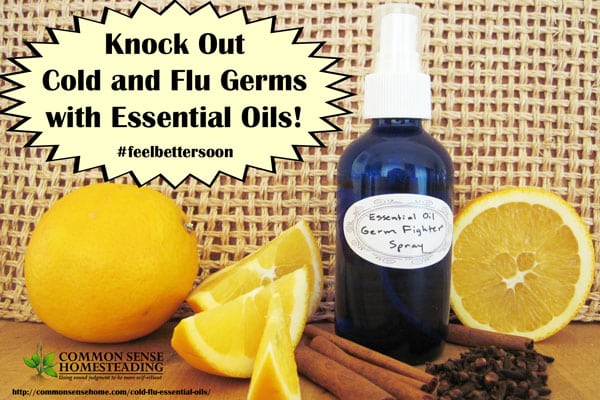
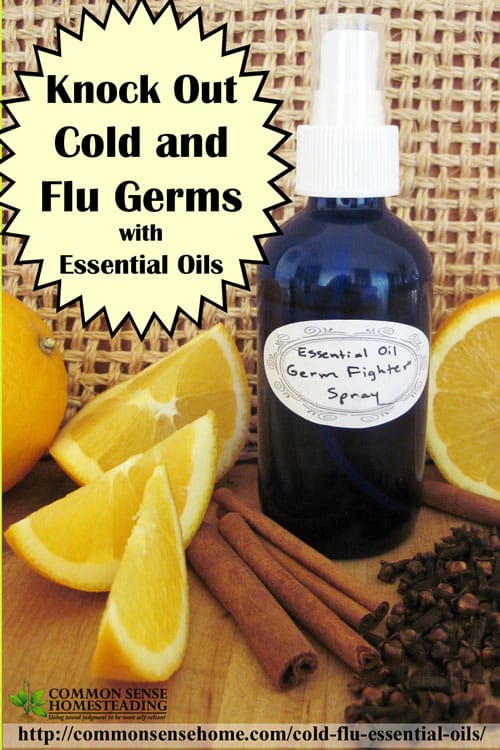
Essential Oil Germ Fighting Spray Recipe
For a 2 ounce glass bottle with spritzer/mister top
You will need:
- 1 ¾ oz ounces of distilled water
- 10-30 drops of various essential oils ( I use less when I use intense aromas)
- Optional: ¼ teaspoon vodka or witch hazel to emulsify the oils and water. This is important with thick oils like myrrh and jasmine.
Fill the bottle with water, add oils, and shake before each use.
Make your own blend or try my favorite spice recipe:
- 2 drops cinnamon essential oil
- 1 drop clove essential oil
- 2 drops mandarin essential oil
You don’t need to buy the whole store
It is not necessary to have a whole bunch of oils at home, it is more important to choose wisely what oils to buy. The oils need to be of high quality so they posses the therapeutic properties you want. Quality is very important since many companies dilute their oils with synthetic substances to cut cost. This can cause harm and change the therapeutic effect of an oil.
I put together a list of oils that are most useful during this time of the year. You don’t need all of them, but research has shown that there is a greater antimicrobial activity when several oils were combined. Therefore, I like to mix several different oils into one blend for enhanced therapeutic value.
Essential Oils Can Act as Immune Stimulants
I make sure that I have at least a couple of different immune stimulants at home during cold and flu season. Immune stimulants can strengthen the immune system by directly inhibiting the micro-organisms, or by stimulating the immune system.
Would you like to save this?
The essential oils of lavender, eucalyptus, lemon, rosemary, tea tree and thyme are considered immune stimulants. Dr. Jan Valnet, M.D, lists eucalyptus, garlic, sandalwood, cinnamon, lavender, German Chamomile and peppermint as being very useful.
Clove, thyme, oregano, cinnamon, mountain savory, and peppermint are said to have the strongest antimicrobial actions. Tea tree, pine, patchouli, lavender, cajuput, and black pepper are other oils with antimicrobial properties.
Essential Oils Can Act as Depuratives to Help Eliminate Toxins
Get rid of the toxins! Essential oils also have depurative (cleansing) properties that eliminate waste material and toxins. Germs don’t attack healthy tissues, so it is important to keep the internal environment clean. Angelica root, carrot seed, cypress, grapefruit, juniper berry, lemon, and rosemary have depurative properties. I like to add these oils to massage oil, unscented body lotions, bath salts, and body spritzers.
Be ahead of the game and use them before you need them. Be creative in how you use the essential oils during this time of the year:
- Make Homemade Cleaners with Essential Oils
- Make your own perfume
- Diffuse oils in your diffuser
- Use the essential oils for cleaning
- Sniff straight from the bottle
- Add essential oils to lotion, liquid soap, or shampoo (make sure they don’t cause skin sensitivity)
- Add a few drops to dishwashing soap
- Put a few drops on a handkerchief and inhale
- If the oil is not contraindicated, mix with bath salts and take a healing bath
How to Use Essential Oils When Someone is Sick
There are different things you can do if you get sick. Here are some of the things that I do:
- At the first sign of a stuffy nose I inhale deeply straight from the bottle. I also diffuse appropriate oils in my diffuser
- I mix the essential oils with massage oil and apply on affected areas such as chest, sinuses, or back
- I add a few drops on a handkerchief and inhale deeply. Sometimes I put 2 or more drops into the palm of your left hand, rub clockwise with the flat palm or your right hand. Cup your hands together over the nose and mouth and inhale deeply. Don’t touch your eyes!
- My son successfully cleared congested sinuses within a few hours by doing steam inhalations with anti-viral and expectorant oils last week. Add a few drops of oil to a bowl of warm but not boiling water. Inhale the steaming vapors from the bowl. To increase intensity, drape a towel over your head and bowl before inhaling.
- I add a few drops to drinking water and gargle for a few minutes if I have a sore throat.
- I often add essential oils to the Vita Flex points on the bottom of the feet. This is especially useful for children since some oils may be too strong to apply on other parts of the body.
- I used to drop cypress under my daughter’s pillow when we lived in Wales several years ago when she was coughing a lot due to moist weather.
Essential Oil Safety
Essential oils can be used in so many various ways so be creative. As mentioned above, you don’t need a lot of oils. The best anti-microbial oils are strong and may irritate the skin so inhaling and diffusing may be better choice when used as prevention.
Oregano, cinnamon, clove, black pepper, and thyme are some of my favorite oils but I don’t apply them topically unless necessary for a specific condition. I may include them in a rub used topically for a small area, but I would not add them to a bath or a whole body massage blend.
Spice oils are very intense so it is best to mix them up with some other oils before diffusing them in the room. For example, diffused clove oil can irritate the eyes so it should not be diffused more than a couple of minutes at a time. Spice oils such as cinnamon and clove can be mixed with citrus oils to make them less irritating.
Make sure you dilute the essential oils correctly and that you’re read the safety precautions before you start. Some oils are contraindicated in certain conditions. It’s a good precaution to perform a skin patch test when using a new essential oil topically.
Also, read this before you start using essential oils. Some oils should not be applied prior to sun exposure so make sure you check this list before spending time in the sun.
This week’s installment on prepping for cold and flu season is a guest post by my friend, Jo (Johanna), from Jo’s Health Corner. Jo has a TON of great information on her site about using essential oils, and she’s shared some of her experience preparing for cold and flu season with essential oils. Johanna is an aromatherapist and she blogs about health, essential oils, real food, natural remedies, and nutrition on Jo’s Health Corner.
This post is for informational purposes only and is not intended to diagnose or treat any illness. Please exercise good judgment and see a trained healthcare provider when needed.
Other posts in this series include:
- Preparing for Cold and Flu Season: Step 1 – Probiotics
- The Best Vitamins and Minerals for Fighting Colds and Flus
- The Best Herbs and Spices for Colds and Flus – Plus a “Secret Weapon”
- Stomach Flu Treatment – Why the BRAT diet may not be your best choice
- Thieves Vinegar – Immune Booster and Germ Killer
- Herbal Antibiotics
Updated January 6, 2016.

I want to share my formula for a super simple chest rub that I used when I was battling covid lungs for a month.
Materials needed:
Plant Guru Breathe Blend – Increase lung capacity to help breathing. Contains: Eucalyptus, Peppermint, Tea tree, Lemon, Lavender, Cardamom, Bay.
Plant Guru “Four Guru’s” (their version of Thieves Oil) – Anti-viral, Anti-microbial. Contains: Clove, Cinnamon Cassia, Lemon, Rosemary, Eucalyptus.
Fractionated Coconut Oil as a carrier oil. I can use You can use regular coconut oil or olive oil.
I have tried many other companies oils but I like these brands and they don’t cost a fortune.
Basic Recipe:
* 1 teaspoon carrier oil
* 10 drops Breathe Blend
* 6 drops Four Gurus
Note: If you want more finished oil, like 1 TBSP. Multiply ratios by x2 and so on.
How to use: Mix all ingredients together. Rub all-over chest, back, side of rib, neck, bottom of feet. Repeat 3x/daily.
Good luck
Now, I have a wild story about the use of plant oils from a young woman in Thailand. Here is her story. I was staying in the women’s quarters at a Thai forest monastery. I was alone. I got a terrible flu, extreme nausea, fever, aches, sore throat etc. I usually am sick for a week when I get the flu and this felt like it was going to be a bad one. It had just begun.
For whatever reason, in the nun’s quarters there were GIANT VATS of tiger balm such as I had never seen in my life. Gallons and gallons and gallons.
I got the crazy urge to cover myself in tiger balm. I don’t know why. So I did. I mean I used HANDFULS of the stuff and covered my skin head to toe with a thick layer. Almost immediately I began shivering like crazy. I felt hot and cold at the same time and crawled under all the blankets I had and lay there shivering and shivering (it was a hot tropical day outside) for about an hour or so.
Then, all of the sudden, it stopped.
And I was 100% better.
I ran to the outdoor shower stall (amid geckos) and turned on the water. I did not anticipate the CRAZY TIGER BALM BURN!! feeling that would happen with that much tiger balm on my skin. It was a memorable shower.
Ever since (and this was almost 20 years ago) I’ve been really curious as to how the tiger balm knocked that infection out of me so fast. What was the mechanism? I haven’t been able to find out because I’ve never met anyone who has not only used but even heard of using so much at once. The only bottles I’ve been able to find back in the states are tiny, so what I used would have cost hundreds of dollars here. It’s really insane. I’m still so curious. If anyone knows do let me know! And, if you ever catch a flu while surrounded by gallons of tiger balm, just know you’re all good.
Note: It is a common practice among local herbalist that are deeply religious to donate their time and medicines to help the monastery or covenant. The Tiger Balm she is referring to is NOT the same as bought in your local stores in western medicine countries. The FDA and other regulatory agencies impose limits on ingredients and strengths. In other words, they don’t want anyone CURED!
The reason WHY it worked against her illness is the medical properties of the ingredients.
As a Master Herbalist, I make my own version of Tiger Balm “RED” and it’s NUCLEAR! Nothing like the little tins sold at wal-mart.
I read a book a few years ago that a friend loaned to me that shared teachings from an old school medicine man down in South America. I can’t remember the name of it at the moment. The medicine man said colds and flu were needed and beneficial, as it was the body’s way of clearing out crap. I’m guessing that with the head to to balm application, you did a power flush and dramatically accelerated the process.
Given the current level of online censorship and FDA restrictions, I have to be very careful with how I phrase information for home remedies. That said, if someone shares their personal experience, well, that’s personal experience, and they allow that. So if you care to share any more of your personal stories on the site in comments, it’s welcomed and appreciated.
Thank you so much for such an informative post. I can only imagine the hard work you put into this.
How safe are essential oils when it comes to good bacteria? If some are anti bacterial does this mean good bacteria is killed off as well? I ask because I make Kefir, Kombucha and cultured vegetables and they are reliant on certain types of bacteria in order to thrive.
If you have open ferments, I wouldn’t use a diffuser, and I’d also avoid spraying within a few feet of the containers, just to be on the safe side.
Hi Laurie,
Thank you so much for such an informative post.
Can you tell me how to make the thieves vinegar please
You can see how to do a version of thieves vinegar at https://commonsensehome.com/thieves-vinegar/
Thanks so much for sharing this. I’ve been a nurse for 13 years but have been getting into natural healing over the past five plus years, and am so thankful for your website and information. My five yr old has strep throat. My problem is getting him to take anything. I make a tonic of garlic, onion, peppers, horseradish, ginger and ACV and I’ve been able to hide it in his chili and even a dip for crackers. I also made an herbal tea and try to hide it in grape juice, but he can still taste it. I also have been giving him raw honey with fresh minced garlic and cayenne at least three times a day, but it is such an ordeal to get him to take it. (Dr. Christopher’s recipe for strep throat). Is there an easier way?
Please do be careful and make sure to get medical attention if needed. As a nurse, I’m sure you have an idea of when to get extra help.
You might try some of the other options for immune boosting in the series, like vitamin C or zinc, or more honey, especially manuka honey. I’ve made up the thieves vinegar tonic and took some when I felt I was starting to come down with something and it knocked it out, but I can’t imagine trying to get it into a young child. You might try the immune boosting herbs in finger gelatin, which are more kid friendly and easy on a sore throat, or an herbal tincture that can be mixed into a favorite juice or other beverage. Also, if he’ll eat probiotics like yogurt or kefir or other live culture foods, getting more of those in can sometimes help speed recovery times.
Its great reading this informative article. Actually in today’s atmosphere where pollution is rising,these essential oils with herbal extracts guarantees good health.
Please can you tell me what ‘Thieves’ oil is, and where you purchase it from.
Thank you. 🙂
Thieves Oil is a propriety EO blend from Young Living that includes some of the top germ fighting oils. Young Living’s competitor who has requested that their name be removed from this post has a similar blend they call OnGuard. Both can be purchased from representatives of each company, respectively. Jo sells the Thieves Oil on her site, I have the other company’s product for sale. You can also do a homemade twist on the “Thieves blend” style remedy by making Thieves Vinegar.
Mountain Rose has a recipe for Thieves blend in one of their blogs.
There are several companies that sell thieves oils. Also if u search for thieves oil recipes you will find bloggers that have the oil recipe on their sites. Sparks is a good company that I have bought from and there are other non member companies. I joined the one u can’t use and young living but do not use nor sell either because I do not like MLM companies.
Hi, I’ve recently been introduced to EO’s, but there are SO many different companies out there claiming they are the best and have the best grade of EO’s, its so confusing! How do you know what companies are truly selling a good quality EO, especially since there is no accepted organization or government agency that “grades” or “certifies” them (even though some say “certified pure therapeutic grade”)?? Help!
My friend, Lea Harris, has organized some third party testing of a variety of essential oil brands at Learning About EOs.
“certified pure therapeutic grade” is a term used by certain Essential oil companies: it is what THEY say about themselves and their products. It is NOT certified by a third party, so, really, it is meaningless.
I have found Mountain Rose Herbs is a great company. they are local for me, so I have interacted with the employees frequently,**(Just ask them about “Carol!”) and they are the BEST! I’m not affiliated with them, but I just think they are a great company with great values. Their E.O.’s are reasonably priced and of good quality, and they list where they come from as well as how they are processed.
I like Mountain Rose Herbs, too. Although I sell oils from another MLM company who has called me by phone and asked me to remove their name from this post, I’m uncomfortable with some of the sales tactics used and promoted by the company – which is why you don’t see a huge focus on them here like some sites.
Hi Laurie, I’m curious to know if the MLM company you are involved in is the same as the one I am. I don’t really understand what the deal is with why we can’t use their name, which is the biggest reason I can’t get anyone to sign up. Kind of bizarre if you ask me and frustrating. I love their products and I use their essential oils too and I love them.
As far as I know there’s only one company who won’t let bloggers use their name, so it’s probably the same one. Instead of an MLM, I’ve been steering people to Mountain Rose Herbs. Their quality is good, no sign up required, and no silly shenanigans about not mentioning the company.
I use Thieves oil!! I work In a rest home & everyone is sick there! I keep a cotton ball tucked in my bra & the air vent in my car so far it has kept me healthy. I also make a foot oil of extra virgin olive oil tea tree oil & thieves oil I know this keeps me healthy I use it daily!!!
Hi:) Can I ask how many drops you put in your foot rub?
I currently use candle diffuser, beeswax candle on bottom, little bowl water on top. Does that disfuse okay or will the essential oils be destroyed?
I’m posting this question to an online oil forum to check for you, as I haven’t done a lot of diffusing.
Here is what everyone had to say:
“Most of the medicinal properties will be destroyed with that much heat. But they will still smell good. If she wants the medicinal properties as well, she should us them in a cool diffusing method.”
“Don’t heat them… you’d do better putting them on your hands and cupping them over your nose or putting them in a water sprayer and spritzing the room. Or… putting a couple drops on a cottonball and setting it by you/them. We put a peppermint cottonball in the car when we do windy twisty roads. Many other ways to use them aromatically besides smelly candles they give me a headache with their synthetic smells, etc.”
“Just a thought until she can purchase a different difuser. According to the “Cooking with Oils” class taught at Convention 2012 and was posted to the doterra blog, if the essential oils is added to a carrier oil with a higher smoke point – like olive oil, it takes on the carrier oils smoke point so the therapeutic properties aren’t lost. SO, do you think, that this would also work for a little candle diffuser. Do they get hotter than 400 degrees? Any thoughts?”
I’d personally lean towards a low temp option like a cotton ball or low temp diffuser, but for just the scent the candle should be fine for sure.
Great to read about essential oils, to see the smart safety guidelines and the benefits written about so clearly. I feel so happy cleaning with pure essential oils and natural products, the house smells amazing and i feel great!
Jordan – I hope everyone is feeling better soon! We got hit with a big last week, but seemed to get over it faster than the friends we caught it from, so I think the remedies helped.
Thank you so much for this. I have some sick kiddos so this is very helpful.