
Best First Aid Kits for Home, Car, Office and Travel

This post may contain affiliate links. Read my full disclosure here.
As part of our emergency preparedness preparations, we’ve been slowly beefing up our stash of emergency medical supplies. In this post we cover our recommendations for best first aid kit for different skill and preparedness levels.
We recommend a couple first aid kits for different skill levels, tips for first aid kit use and items missed in many kits. Get a kit, get prepared BEFORE emergencies happen.
These are suitable for car first aid kits, travel emergency kits or home and office. You should have at least one small Basic First Aid Kit for each vehicle, and one or more in your home. We do suggest adding certain items to the First Aid Kits, which are noted below the emergency kit lists.
Would you like to save this?
Table of contents
- Get First Aid Training!
- Test BEFORE it is a Real Emergency!
- How Much will a First Aid Kit Cost?
- How do I choose an Emergency First Aid Kit and Supplies?
- Recommended Small First Aid Kits
- Recommended Medium Sized First Aid Kits
- Recommended Extra Large First Aid Kits
- Not finding what you are looking for?
- What else should be in your First Aid Kit?
- Related Articles
Get First Aid Training!
We recommend you get basic first aid and medical training. Local organizations such as the Red Cross often offer basic first aid training, including programs targeted to teens who do babysitting.
There are a lot of good videos on Youtube, such as those hosted by Dr, Bones and Nurse Amy. Get books such as First Aid Fundamentals for Survival or Where there is No Doctor. The more you know, the easier it is for your to respond to emergencies, big or small.
Even with training, a fold out first aid guide is a good addition to your home first aid kit.
Some first aid kits include labeled pouches and step by step guides in the kit. These are great even for seasoned medical professionals, as the professional can hand the kit to a novice and get some level of assistance.
The bad news is the smaller kits don’t leave a lot of room for extra items, which we inevitably need.
Test BEFORE it is a Real Emergency!
Try all products on your skin BEFORE an emergency to ensure you are not allergic. Wear the gloves, try the meds etc (as appropriate). During good times, if you have an emergency, you can call 911 – which is much better than if you are in the middle of no-where and find out you are allergic to a medication or the gloves.
How Much will a First Aid Kit Cost?
A basic first aid kit could cost as little as $30 band-aids, gauze and wraps. If the kit can respond to a trauma it will cost more.
We estimate the basic kits will be $30 to $350, a full kit will be in the $350-$600 range and you can easily spend $1200+ especially if you include oxygen, a good BP cuff and/or surgical kits and specialized secondary kits (eye, dental, airway etc).
When we purchased everything that we needed for our first aid/trauma kit, the items cost about $250 including the case in 2005 – that would be $400 in 2024.
Remember, even if you can’t afford a quality pre-made first aid kit, you can build one, piece by piece as your funds permit. You can also substitute items. A clean rag or even feminine pad, can make a substitute trauma pad – add some medical tape, super glue and duct tape and you have a makeshift trauma pack. Skills win over “stuff”.
Most times, it is cheaper to build your own rather than buy a pre-made one. But for many of us building our own kit is not practical due to time, lack of experience or training, so if you need a kit NOW – consider one or more of the kits below.
How do I choose an Emergency First Aid Kit and Supplies?
There five factors that influence what kind of first aid items you will have in your first aid kits:
- Time – Time is life in a medical emergency. If you don’t expect a paramedic to show up for an hour – your kit is going to look a lot different than a 15 minute bag. If you are planning on holding out 24 to 72 hours in an emergency, the kit needs even more supplies. The kit gets huge if you need to survive a hurricane or extended disaster or you are out in the middle of nowhere waiting on extraction.
- Usage – Some people want a full surgery kit, others want enough to keep someone alive until help arrives. Do you have dangerous, snakes, ticks or spiders? Are you preparing supplies to be a midwife? Will you have trauma gear for a gunshot wound or sucking chest wound? Or gear for burns? Are you including dental supplies? Glasses repairs? What event(s) are you preparing for?
- Weight – Camping, hiking and other similar activities drive a focus on weight. If this is the issue, tiny/lightweight multi-function items are your goal and you will probably be willing to pay more to get the lighter weight. Large comprehensive bags weigh a lot.
- Funds – It is easy to spend hundreds if not thousands on medical kits, so money can be a limit. Know your need and focus on training first.
- Skills – Even if you have answers to the four items above, you still may not have the skills to appropriately use and maintain supplies. Training is a big part of a first aid kit. So if you can, you need an extra kit to train with.
No single kit will meet all your needs. That said, we identify a few of the better ones, plus a few higher quality empty bags, kits, backpacks and duffel bags that would be good if you want to build your own.
You could also buy a backpack and build specialty kits, such as: an every day “boo-boo kit for nicks, cuts, and scratches; a bug/snake bit kit; a trauma kit; a burn kit; a CPR kit and so on. For the more advanced responders, you could include a suture/surgery kit, an airway kit, and so on.
Recommended Small First Aid Kits
Rescue Essentials Covert Carry (best EDC)
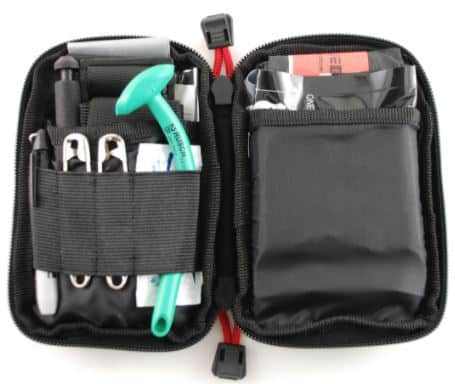
This expensive kit is best for every day carry (belt or purse). It is an excellent, very small first aid trauma kit.
Contents may vary:
1 SOFTT-W Windlass Tourniquet, 1 QuikClot Combat Gauze LE, 1 H&H Compression Bandage, 1 Petrolatum Dressing (4″ x 4″), 1 Duct Tape (2″ x 36″)
1 Nasopharyngeal Airway (28Fr) w/ lube, 1 Sharpie Marker, 2 Safety Pins, Large, 1 Rolled Pair, Nitrile Gloves (Lrg)
Rescue Essentials Covert Carry is an individual trauma first aid kit (iFAK) designed to be belt warn. It is 5.75″ x 3.75″ x 2.25″ (44 cu inch) and weighs 10.4 ounces. This excellent tiny trauma kit has everything you would need to handle a trauma or gunshot wound for one person. It was designed for police or Paramedic/EMT use.
The duct tape doubles as bandage, and entry/exit wound seal. This kit has no room for add on items but doesnt really need them either. Excellent but expensive. You might be able to add a LUMINTOP AAA LED flashlight. Rescue essentials has one a bit smaller also, the Advanced Patrol Officer’s Trauma Kit.
Northbound Train First Aid Kit
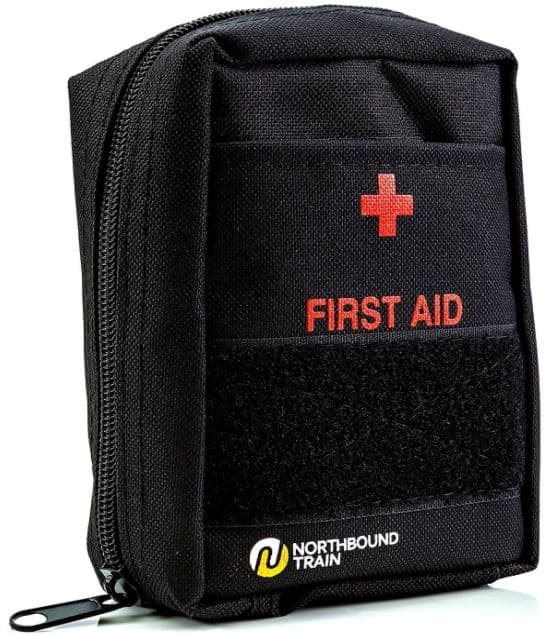
Best for Get Home or Bug Out Bag. Use this kit when weight and size are critical
Contents may vary:
(1) 6″ Stainless Steel Shears, (1) Stainless Steel Tweezers, (1) Mylar Emergency Blanket, (1) Triangular Bandage, (4) PVC Protective Gloves, (1) Medical Tape, (1) Conforming PBT Bandage, (1) Large Adhesive Wound Dressing, (4) Large Gauze Pads, (4) Medium Gauze Pads, (4) Antiseptic Towelettes, (4) Alcohol Towelettes, (3) Sting Relief wipes, (2) Antibiotic Ointments, (10) Medium Adhesive Bandages, (5) Small Adhesive Bandages, (5) Butterfly Bandages, (5) Safety Pins, (2) Large Laminate Bags for Contents, (2) Medium Laminate Bags for Contents, (5) Poly bags for medicine
Northbound Train First Aid Kit 3x5x7 inches (105 cubic inches) 11 ounces. This is a good starter first aid kit but it has no labeling or guides. You will need to figure out your own labeling. It is well rated, is extremely small, and very lightweight. There are no separate internal pouches. This kit can support an individual trauma but it needs most of the Group 1 items added.
NOTE: We recommend that you add items to this kit see Group 1 (scroll down)
Surviveware Small First Aid Kit (best small car kit)
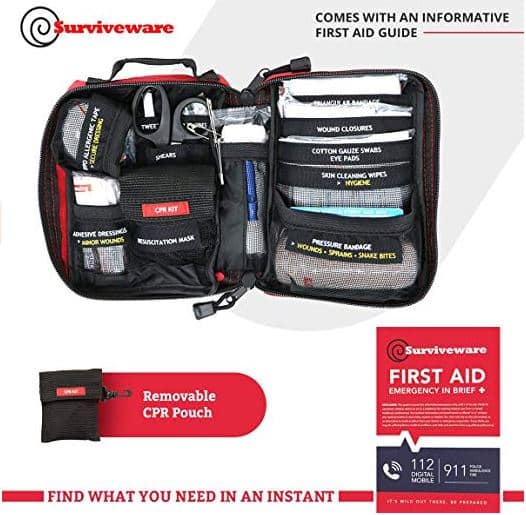
Good for a basic car first aid kit or short hikes, well stocked and labeled. It could also be a starter home emergency kit.
Contents may vary:
6” Shears(1), 600D Polyester Bag(1), Alcohol Wipes(3), Antiseptic Wipes(4), Adhesive Bandages: Butterfly Closures(5), Butterfly(5), H-Shape(5), Large(2), Standard(20), Mini(5), Square Shape(5), Cotton Gauze Swabs(3), Cotton Swabs(10), CPR Pouch with Instructions(1), CPR Breathing Mask(1), Crepe Bandage(1), Emergency Blanket(1), Eye Pads(2), Hypoallergenic Tape(1), Nitrile Gloves(1), Personal Medicine Laminate Bag(1), Personal Medicine Mini Bags(5), PBT Conforming Bandage(1), Safety Pins(4), Splinter Probes(2), Strip Wound Closures(3), Sting Relief Wipes(3), First Aid Guide(1), Triangular Bandage(1),Tweezer(1), Whistle(1)
Surviveware Small First Aid Kit, 5.5 x 7.5 x 3.5 inches (144 cubic inch) 16 ounce, excellent little, organized kit, that is well labeled which is a advantage in an emergency.
It has a built in quick CPR guide sewn right into the resuscitation pouch that has the Adult rules on the front of the flap and Child rules on the back. It’s bit small, so small it might not hold everything an intermediate responder might want.
Like the Survival solutions kit it would have trouble. This kit can support a single trauma and basic family emergencies.
An alternate for the Surviveware is the Survival Solutions Handy First Aid Kit this is similar to the SurviveWare but its weighs 2.2 pounds and is 7.1 inches x 3.5 inches x 8.7 inches. We like it but this is regularly out of stock.
Another good alternative is the Adventure Medical Kits Sportsman Series Whitetail First Aid Kit 7.5 x 5.5 x 3.5 inches (144 cubic inches) at 2 pounds it is a very complete kit and well rated.
NOTE: We recommend that you add items these Group 1 items to the SurviveWare, Suvival Solutions or Sportsman Series Whitetail kits.
Recommended Medium Sized First Aid Kits
12 Survivors First Aid Rollup Kit (best for make your own Home Kit)
Our number one recommendation for a build your own kit is the 12 Survivors First Aid Rollup Kit. Best kit for a family, a camp, car or storm/disaster. The Amazon rating is low because people expect it to be fully stocked. You are basically buying a mostly empty kit.
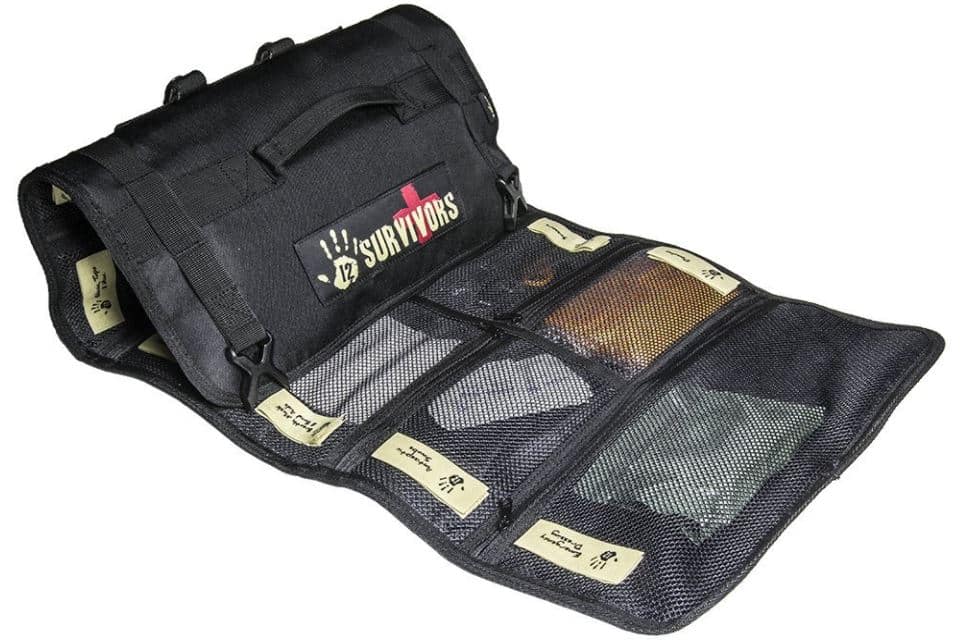
It is a 15 inch wide kit that rolls out to 33 inches long for 450 to 550 cubic inches of storage. There are 12 labeled pockets, 10 smaller and 2 bigger for easy access.
It has a carry handle, clips, and straps to allow it to connect to a backpack, and Velcro to keep it closed. This kit can be used to support an entire family for trauma and basic emergencies. This roll out kit gives you fast, visible access, is customize-able and still fairly small.
Contents may vary: 1 Emergency blanket, 1 Poncho, 8 PBT elastic bandages, 4 Sterile non woven gauze pads, 2 Wet cleaning wipes, 4 BZK antiseptic swabs, 4 Alcohol prep pads, 1 Pair of PVC gloves, 10 Adhesive band aids, 1 Breath mask for mouth to mouth, 1 Pair of tweezers, 1 Zinc oxide adhesive plaster (tape), 1 Pairs of scissors, 1 Pair of Shears, 1 Tourniquet band, and 1 Emergency dressing. You will need to add items it is not a complete kit.
You can customize the velcro labels on each of the mesh pockets. Each mesh pocket has the zippers along the long side (not top narrow side) which gives wider, easier access to contents.
The straps are adjustable, so you can add more items to the kit and it will still close. This is the best kit currently, if you want labeling AND customization.
The bad news is that this is NOT a waterproof first aid kit. If you want to protect items from rain everything will need to be in ziplock bags inside the kit.
You will want to replace a couple of the items it comes with and you will need to add a number of items.
If there was a version of this kit that had the top row of zipper pouches smaller and bottom bigger, and one of the side pouches was slightly larger – it would be perfect.
What we added? We added nearly everything from Group 1 and Group 2 and we recommend you consider doing the same.
SurviveWare Large First Aid Kit (Best Car Kit)
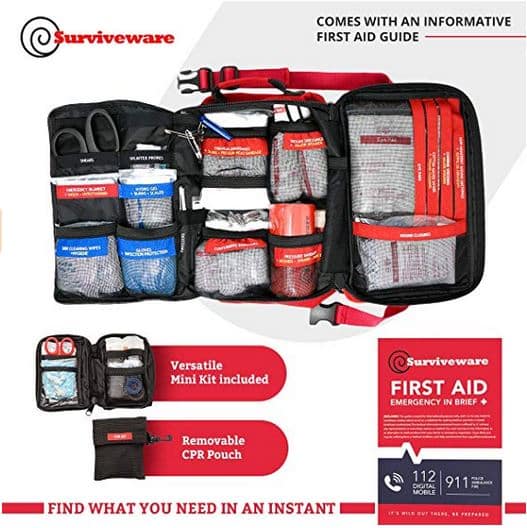
Good car first aid kit, or a basic home first aid kit. Well stocked for its size, well labeled, and leaves some room for extra items from Group 1 and possibly Group 2. Has a small bonus kit.
Main Kit Contents may vary:
600D Polyester Bag(1), 7.5″ Shears(1), 18″ Splint (1), Alcohol Wipes(10), Adhesive Bandages: Butterfly – Large(5), Butterfly – Medium(5), Large(5), Standard(30), Square(5), Mini(5), H-Shape(5), Cold Pack(1), Combine Dressing(1), Conforming Bandages(6), Gauze Swabs(5), CPR Bag with Instructions(1), CPR Mask(1), Ear Buds(20), Emergency Blanket(1), Eye Pads(4), Fever Strips(3), First Aid Handbook(1), Nitrile Gloves(4), Hydro Gel(5), Hypo-Allergenic Tape, Non-Adhesive Dressings(10), Pencil(1), Laminate Baggies(6), Refuge Bag(1), Pressure Bandage(1), Safety Pins(10), Skin Cleaning Wipes(10), Spinter Probes(10), Sting Relief Wipes(10), Strip Closures(9), Triangular Bandage(2), Tweezer(1), Whistle(1), Wound Dressings (2).
Bonus Mini Kit Contains: 600 D polyester Bag(1), Small Shears(1),Nitrile Gloves(1 Pair), Conforming Bandage(1), Hypo-Allergenic Tape(1),CPR Mask(1),Cotton Gauze Swabs(1), Combine Dressing(1), Splinter Probes(2),Skin Cleaning Wipes(3), Safety Pins(5), Q-Tips(10), Standard Adhesive Bandages(22) .
Details: SurviveWare Large First Aid Kit 3 fold, 12″ x 8″ x 6″ (576 cubic inch). Mid sized, organized kit. We have one like this in our van. Everything is labeled and color coded and and there is a first aid guide included. This kit can support a single trauma and basic family emergencies.
If you buy the SurviveWare or other larger kits, we recommend you add items you might need from group 1 and group 2 (see below)
Adventure Medical Kits Mountain Series Guide Medical Kit – 163 Pieces

This is a great large car kit, camping kit, or a good home first aid kit, very well stocked and well labeled.
Contents
Cuts & Scrapes: 10 – Easy Access Bandages®, 1″ x 3″ Fabric, 5 – Easy Access Bandages®, Knuckle Fabric, 10 – Antiseptic Wipe, 3 – Triple Antibiotic Ointment, 4 – Alcohol Swab, 2 – Tincture of Benzoin
Fracture / Sprain: 1 – C-Splint™, Aluminum & Foam Padded, 4″ x 36″, 1 – Triangular Bandage, 1 – Elastic Bandage with Hook & Loop Closure, 3″
Instruction / Instrument: 1 – Wilderness & Travel Medicine: A Comprehensive Guide, 1 – Digital Thermometer, 90°F – 105°F, 1 – CPR Face Shield, 1 – EMT Shears, 4″, 1 – Duct Tape, 2″ x 2.5 yd., 1 – Splinter Picker/Tick Remover Forceps, 3 – Safety Pin, 2 – Plastic Vial (Large Flip-top), 1 – Patient Assessment Form, 1 – Pencil, 1 – Register Your Kit Card
Medication: 3 – After Bite® Sting & Bite Relief Wipe, 4 – Diamode (Loperamide HCI 2 mg.), 4 Pkg./1, 8 – Aspirin (325 mg.), 4 Pkg./2, 4 – Antihistamine (Diphenhydramine 25 mg.), 4 Pkg./1, 16 – Ibuprofen (200 mg.), 8 Pkg./2, 8 – Acetaminophen (500 mg.), 4 Pkg./2
Stop Bleeding Fast: 1 – QuikClot® Gauze, 3” x 24”, 1 – Trauma Pad, 8″ x 10″, 1 – Trauma Pad, 5” x 9”, 4 – Nitrile Glove
Wound Care / Blister / Burn: 1 – Wound Irrigation Tool, 20cc. with 18 Gauge Tip, 10 – Wound Closure Strip, 1/4″ x 4″, 6 – Sterile Gauze Dressing, 4″ x 4″, 6 – Sterile Gauze Dressing, 2″ x 2″, 3 – Sterile Non-Adherent Dressing, 3″ x 4″, 2 – Conforming Gauze Bandage, 3″, 1 – Tape, 1″ x 10 yd, 2 – GlacierGel™ Blister & Burn Dressing, (Small Rectangular), 28 – Moleskin, Pre-Cut & Shaped Pieces, 4 – Cotton Tip Applicator
Details: Adventure Medical Kits Mountain Series Fundamentals First Aid Kit 10 x 5.5 x 7 inches, 385 Cubic inches; 2.15 pounds. Fold out kit. It is well rated, well stocked and very organized kit. It is reasonably waterproof also. It has labeling and an included first aid guide. (Note: the Amazon version is slightly different than Adventure Medical Website one). This kit is geared for family traumas and simple emergencies.
If you buy this kit we recommend you add anything missing from Group 1 and Group 2 (see below)
Lightning X “Small” First Responder EMT EMS Trauma Bag
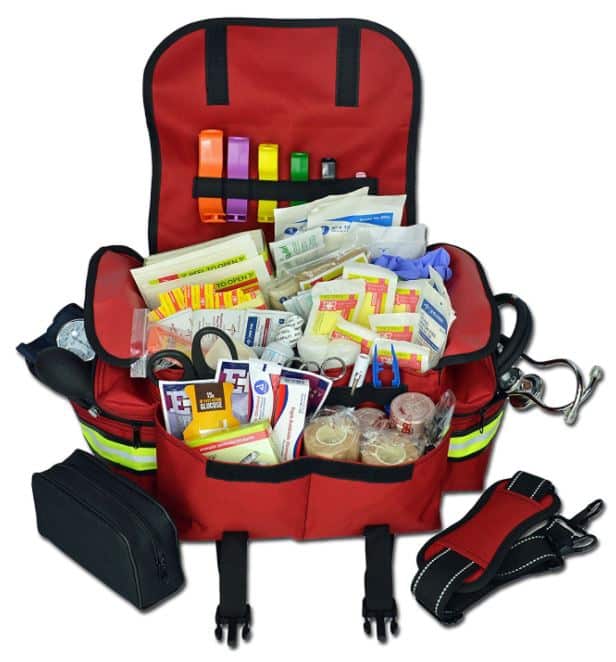
This is an excellent large, advanced home or car kit, extremely well stocked but you need to know your way around as nothing is labeled. It is not small (even though it is labeled small).
Contents may vary:
Tweezers, Kelly Hemostats, Trauma Sheers, Bandage Shears, Penlight, Ammonia Ampules (10), Band-Aids (100), 4” x 4” Gauze Pads (50), 2” Roll Gauze (2), 3” Roll Gauze (2), 4” Roll Gauze (2), 2” Self-Adherent Bandage (2), 2” Elastic Ace Bandage (2)
5” x 7” ABD Pad (2), 8” x 10” ABD Pad (2), 1” Roll Cloth Tape, Triple Antibiotic, Ointment 1/2 oz, Instant Cold Packs (2), Isopropyl Alcohol Wipes (10), Eye Pads (2)
Triangle Bandage (2), Eye Wash Irrigation Solution, Exam Gloves (4), Universal SAM Finger Splint, Oral Glucose Gel, Sting & Bite Relief Pads (9), Sting & Bite Relief Pads (10), Adult Blood Pressure Cuff w/ Case, Sprague Stethoscope, CPR Mask, Oropharyngeal Airway Kit (6), and Iodine Wipes (10).
Details: Lightning X Small First Responder EMT/EMS Bag This duffel bag first aid kit is 17″ x 9″ x 11″ (1683 cubic inches). This is a very complete but disorganized kit, and you will probably still need to add things. There is no labeling, so you will need to label your own sub-kits. This is a First Responder/EMT type kit. Although much more complete, you need to know what you are doing to use it all. This kit can support family traumas and simple emergencies.
Even though the kit is great, if you buy this kit we recommend you add anything missing from Group 1, Group 2 and Group 3 (see below).
An alternate to this kit is the less expensive MFASCO – First Aid Kit it is 13 x 9 x 6 inches (720 cubic inches) and weighs 5.5 pounds. It is large bag type kit. It will need items from Groups 1, 2 and 3.
Recommended Extra Large First Aid Kits
Adventure Medical Kits Mountain Series Mountaineer First Aid Kit – 218 Pieces
This is a large, organized, advanced camping, trauma or car kit. Designed for teams or larger groups.
Contents may vary: 10 – Easy Access Bandages®, 1″ x 3″ Fabric; 10 – Easy Access Bandages®, Knuckle Fabric; 10 – Antiseptic Wipe; 3 – Triple ; Antibiotic Ointment; 4 – Alcohol Swab; 2 – Tincture of Benzoin; 1 – C-Splint&reade;, Aluminum & Foam Padded, 4″ x 36″; 2 – Triangular Bandage; 1 – Elastic Bandage with Hook & Loop Closure, 3″; 1 – Wilderness & Travel Medicine: A Comprehensive Guide; 1 – Digital Thermometer, 90F – 105F; 1 – CPR Face Shield; 1 – Sterile Scalpel, #11 Blade; 1 – EMT Shears, 4″; 1 – Duct Tape, 2″ x 2.5 yd.; 1 – Splinter Picker/Tick Remover Forceps; 3 – Safety Pin; 2 – Plastic Vial (Large Flip-top); 2 – Plastic Vial (Small Flip-top); 3 – Patient Assessment Form; 1 – Pencil; 1 – Register Your Kit Card; 3 – After Bite® Sting & Bite Relief Wipe; 4 – Diamode (Loperamide HCI 2 mg.), 4 Pkg./1; 8 – Aspirin (325 mg.), 4 Pkg./2; 4 – Antihistamine (Diphenhydramine 25 mg.), 4 Pkg./1; 16 – Ibuprofen (200 mg.), 8 Pkg./2; 8 – Acetaminophen (500 mg.), 4 Pkg./2; 10 – Medicidin-D (Acetaminophen 325mg., Chlorpheniramine Maleate 2mg., Phenylephrine HCl 5mg.), 5 Pkg./2; 12 – Antacid (Calcium Carbonate 420mg.), 6 Pkg./2; 3 – Cortisone Cream 1%, 1/32 oz (.9 g); 2 – Oral Rehydration Salts; 1 – Glucose Powder, 15g; 1 – Filling Mixture with Pain Relief; 1 – SWAT-T Tourniquet; 2 – QuikClot® Gauze, 3” x 24”; 1 – Trauma Pad, 8″ x 10″; 1 – Trauma Pad, 5″ x 9″; 6 – Nitrile Glove; 1 – Wound Irrigation Tool, 20cc. with 18 Gauge Tip; 1 – Sterile Scrub Brush; 10 – Wound Closure Strip, 1/4″ x 4″; 8 – Sterile Gauze Dressing, 4″ x 4″; 8 – Sterile Gauze Dressing, 2″ x 2″; 4 – Sterile Non-Adherent Dressing, 3″ x 4″; 2 – Sterile Eye Pad; 2 – Conforming Gauze Bandage, 3″; 1 – Tape, 1″ x 10 yd.; 1 – AfterBurn® Aloe Vera Gel with Lidocaine, 2 oz.; 28 – Moleskin, Pre-Cut & Shaped Pieces; 2 – GlacierGel&reade; Blister & Burn Dressing, (Small Rectangular); 4 – Cotton Tip Applicator;
Details: Adventure Medical Kits Mountain Series Mountaineer First Aid Kit – 218 Pieces is 10.5″ x 6.5″ x 7.5″, 511 cubic inches and weighs 3.1 pounds. It is a comprehensive medium size foldout kit designed for a group of people. This kit can support family traumas and simple to moderate emergencies.
If you buy this kit we recommend you add anything missing from Group 1, Group 2 and Group 3 (see below).
Lightning X Extra Large Medic First Responder EMT Trauma Bag
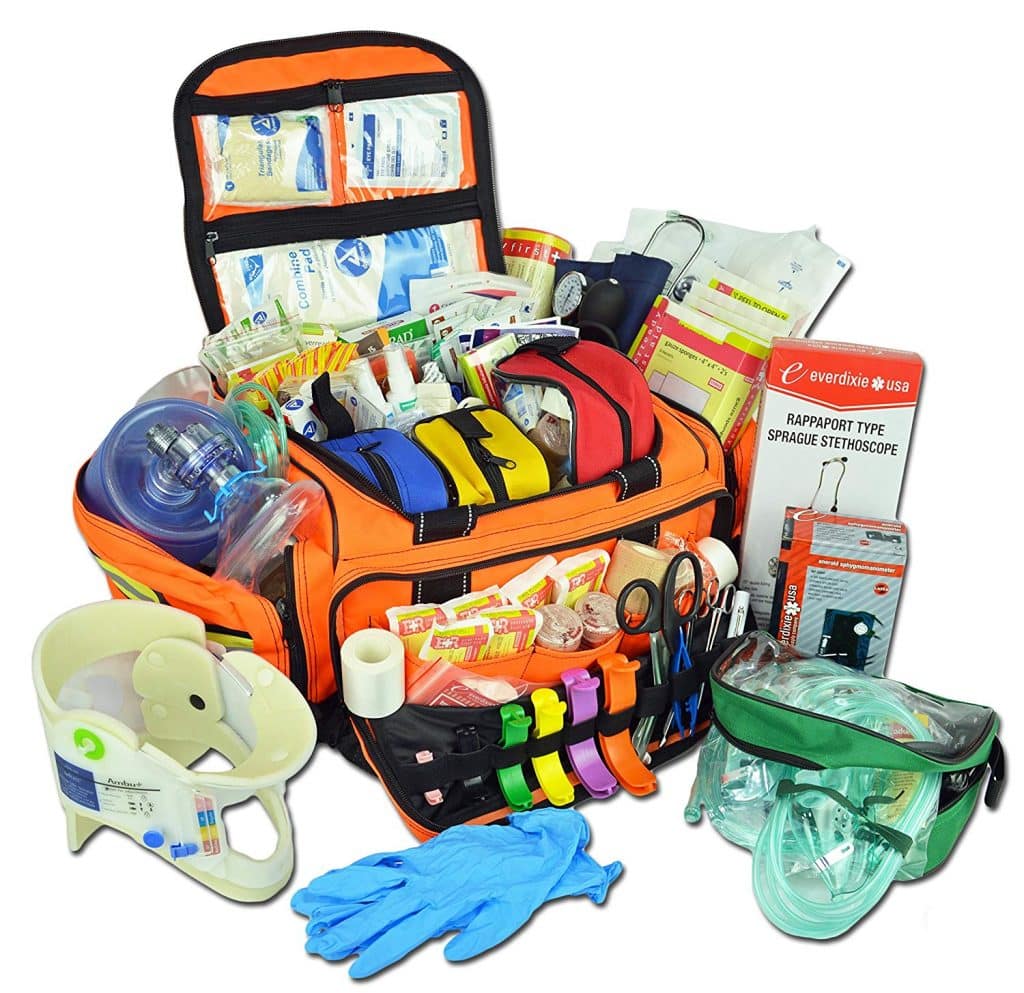
This is a great kit if you are a first responder or EMT. Best to support multiple incidents or a severe incident.
Contents May Vary:
Deluxe Kit (the bag itself), Tweezers, Kelly Hemostats, Trauma Shears, Bandage Shears, Penlight, Am Ampules, Band-Aids (100), 4″ x 4″ Gauze Pads (50), 2″ Roll Gauze (2), 3″ Roll Gauze (2), 4″ Roll Gauze (2), 2″ Self-Adherent Bandage (2), 2″ Elastic Ace Bandage (2), 5″ x 7″ ABD Pad (2), 8″ x 10″ ABD Pad (2), 1″ Roll Cloth Tape, 2″ Roll Cloth Tape, Iodine Wipes (10), Isopropyl Alcohol Wipes (10), Triple Antibiotic Ointment 1/2 oz, Instant Cold Packs (2), Eye Pads (2), Triangle Bandage (2) , Eye Wash, Exam Gloves (4), Universal SAM Finger Splint, Glutose, Sting Pads (10), Adult BP Cuff, Sprague Stethoscope, Barrier Mask, OPA Kit, (6) 10″ x 30″ Trauma Dressing, NC Tubing (2), NRB Mask (2), BVM Bag, 4-1/4″ x 36″ Roll Splint, 4″ x 4″ Occl Seal, Adjustable C-Collar, 2oz Burn Spray, 2oz First Aid Spray, Emergency Blanket, Quick Stop Hemostatic Blood Stop Spray, Buckle Tourniquet, First Aid Guide Booklet, Vaseline Gauze Pads (2), and (4) Color Coded Removable Pouches w/ Clear Vinyl Window & Zipper.
Details: The Lightning X Extra Large Medic Bag is 20″(L) x 16″(W) x 10″(H) 12 pounds. This is a full EMT bag and is designed for trauma level emergencies. For the price this kit provides a lot of what are necessary items if you are out in the middle of nowhere.
If you buy this kit, it still needs a few things from Group 1, Group 2 and Group 3.
Stomp First Aid Kit

This is a massive, complicated, advanced home or car kit. This kit is stocked to support teams or larger groups. It is a good kit if you:
- are a First Responder or EMT
- plan to provide care in extended disasters
- run a camp or host large events
- or you are far from help
Contents may vary: 1 16oz. Skin flushing solution, 1 4oz. Eye wash, 1 Hand soap, 1 6oz. Calamine lotion, 2 Lip Treatment, 1 Burn spray, 1 Instant Glucose, 20 pain reliever, 20 Ammonia inhalants, 1 Blood clotting spray, 2 Sam/universal splint, 2 Field dressing 11″ sq., 4 Field dressing 7.5″x8″, 3 Triangular bandages, 1 Cervical collar, 2 4″x4yds. Gauze roll, 3 6″ Elastic bdge., 3 4″ Elastic bdge, 5 4″x4″ Sterile pads, 6 2×2 Gauze sponges, 10 5″x9″ Abdominal pads, 2 Blood stopper kits, 4 Eye pads, 100 Bandage strips 3″x1″, 20 Butterfly strip, 20 Bandage strips 2″x3″, 20 Knuckle bandages, 3 Instant ice pack, 3 Roll of 1″ tape, 1 Stethoscope, 1 Blood pressure kit, 2 EMT shears, 4 Hemostats, 1 SS tweezers, 1 SS probe, 1 Scalpel handle #3, 6 Scalpel blades, 1 Pen light, 1 First aid book, 6 Safety pins, 5 Pair latex gloves, 2 Irrigation syringe, 20 Triple antibiotic packages, 10 Burn aid packages, 25 Alcohol wipes, 100 Iodine PVP wipes, 25 Antiseptic BZK wipes, 9 After bite wipes, 3 CPR mask/face shield, 4 Airways, 5 Tongue depressor, and 5 Lab sponges
Details: The Stomp kit is an excellent large backpack 10 x 14 x 19 inches (4522 cubic inches). It weighs 17+ pounds. This is a huge kit in a good backpack.
It opens completely in the front or back compartment, and has multiple mesh pockets. There is basically no labeling so you need to know what is where. It is probably the most fully stocked and complete kit short of EMT bags costing even more.
Although this is an excellent kit, unless you have training this kit is probably overkill. For many people, the same investment will let you build your own kits to supply your car, your house and add most of the missing items in Group 1, Group 2 and Group 3.
This comprehensive kit can support everything from small injuries to multi-person traumas. There is an alternate even more advanced Stomp Medical Kit. There is also a larger Stomp kit which is excellent the Stomp Medical Kit Bag With CAT Tourniquet Bundle.
Professional Mountain Medic
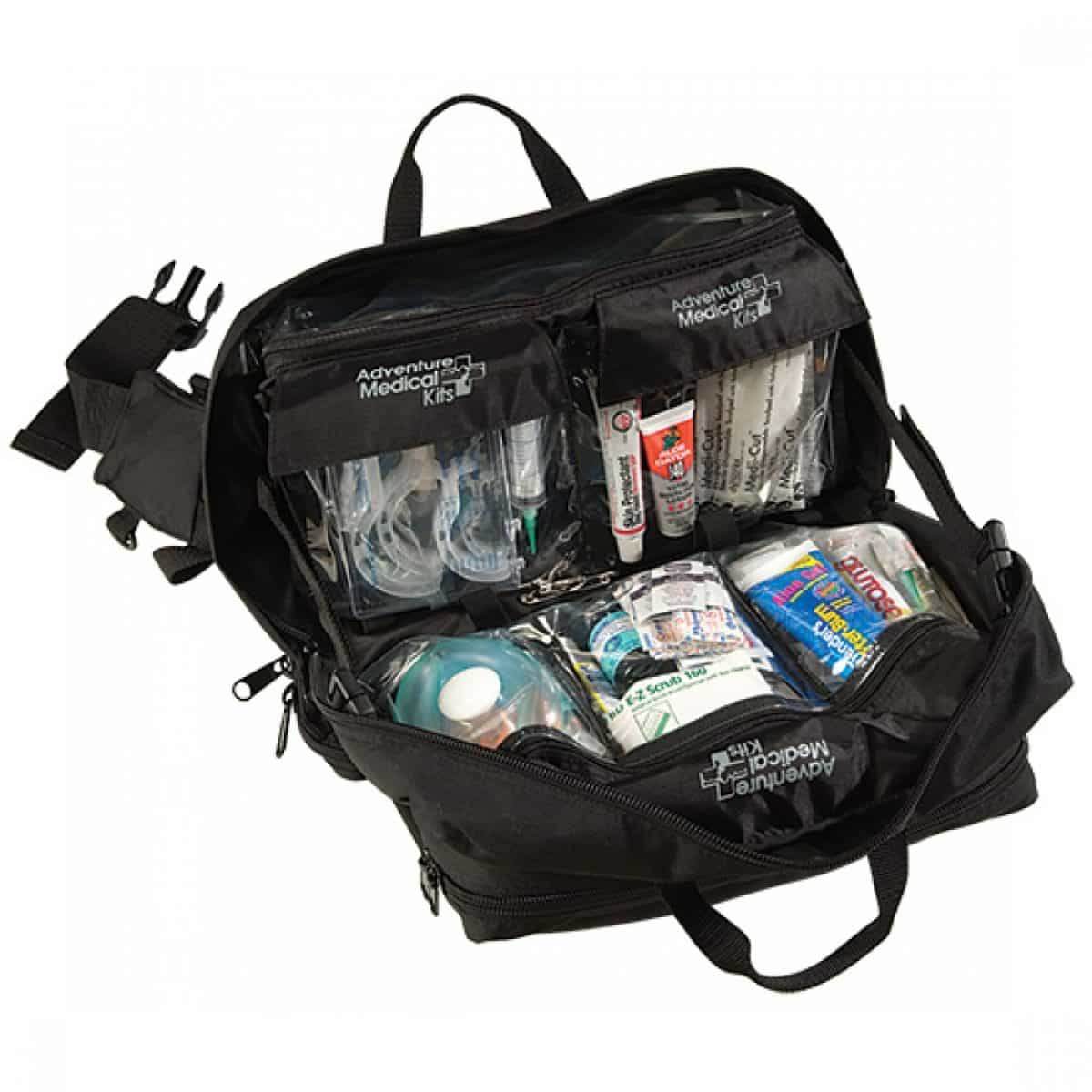
Best for long camping trips. Other physically larger kits are probably better for around the home use and disasters.
Contents may vary: 10 – Bandage, Adhesive, Fabric, 1″ x 3″, 10 – Bandage, Adhesive, Fabric, Knuckle, 4 – Bandage, Conforming Gauze, 3″, 16 – Dressing, Sterile, Non-Adherent, 3″ x 4″, 20 – Dressing, Gauze, Non-Sterile, 4″ x 4″, 2 – Eye Pad, Sterile, 6 – Gloves, Nitrile (Pair), Hand Wipe, 1 – Trauma Pad, 5″ x 9″, 1 – Trauma Pad, 8″ x 10″, 1 – Aloe Vera Gel with Lidocaine, 2 oz., 2 – Dressing, Burn, WaterJel, 4″ x 4″, 4 – GlacierGel (Large Oval), 6 – Moleskin, Pre-Cut & Shaped (14 pieces), 1 – CPR Pocket Mask, 1 – Temporary Cavity Filling Mixture, 1 – Bandage, Elastic with Velcro, 3″, 1 – Bandage, Elastic with Velcro, 4″, 2 – Bandage, Triangular, 1 – C-Splint™, 4″ x 36″, 1 – Airway, Nasal, 7.0 mm, 1 – Airway, Nasal, 7.5 mm, 1 – Airway, Oral, (Set of 6 sizes), 1 – Blood Pressure Cuff, 1 – EMT Shears, 4″, 1 – Pencil, 3 – Safety Pins, 1 – Splinter Picker/Tick Remover Forceps, 1 – Stethoscope, 1 – Thermometer, Digital, 1 – Comp. Guide to Wilderness & Travel Medicine, 3 – Patient Assessment Form, 10 – Acetaminophen (500 mg), Pkg./2, 6 – After Bite Wipe, 7 – Antacid, Pkg./2, 20 – Antihistamine (Diphenhydramine 25 mg), 10 – Aspirin (325 mg), Pkg./2, 5 – Cold Medicine, Medicidin-D, Pkg./2, 10 – Diamode (Loperamide HCI 2 mg), Pkg./1, 5 – Diotame (Bismuth Subsalicylate), Pkg./2, 1 – Eye Wash, 2/3 oz, (20 ml), 1 – Glutose Paste (Glucose 15 g), 12 – Ibuprofen (200 mg), Pkg./2, 2 – Oral Rehydration Salts, 4 – Plastic Vial, Flip-top, Large, 1 – Sunscreen, SPF 40, 1 oz, 1 – Zinc Oxide, 1 oz. 1 – Emergency Reflective Blanket, 56″ x 84″, 1 – Mayo Heger Needle Holder, 5″, 4 – Scalpel, Sterile, Disposable, #11 Blade, 18 – Antiseptic Wipe, 3 – Cotton Tip Applicator, Pkg./2, 3 – Povidone Iodine, .75 oz., 1 – Scrub Brush, Sterile, 1 – Syringe, Irrigation, 20 cc, 18 Gauge Tip, 2 – Tape, 1″ x 10 Yards, 1 – Tincture of Benzoin Topical Adhesive, 2 oz., 8 – Triple Antibiotic Ointment, Single Use, 1 – Wound Closure Strips, 1/4″ x 4″, Pkg./10.
Details: This is an excellent but expensive kit. It is 16″ x 10″ x 8″ and weighs 7 pounds 12 ounces. It can support a camping trip up to 30 days for 1-7 people.
Even though it is a great kit and costs $400+, you will still need to add items from Group 1 , 2 and 3. For example, it doesn’t have duct tape, QuikClot gauze/sponge and a couple Sharpie pens. We would probably add more non-prescription meds also if it was for a 30 day trip. They don’t weigh a lot and it gives you options. If you buy this kit, it still needs a few things from Group 1, Group 2 and Group 3.
Not finding what you are looking for?
If these kits don’t meet your needs, consider other kits from: Rescue Essentials, North American Rescue, Survival Solutions, SurviveWare, Dixiegear and Adventure Medical.
What else should be in your First Aid Kit?
Nearly every first aid kit is missing some items. Before you purchase any of the items in this list, check the items included in the kit (or kits) you are considering, so you don’t end up buying duplicate items.
Some of these items are more advanced, so only buy the ones you know how to use, or ones you plan to get training on. The items noted below in Group 1, Group 2 and Group 3 are the most common items from our full list in the Build Your Own First Aid Kit post.
GROUP 1: MUST HAVE ITEMS IN ANY FIRST AID KIT
- A Sharpie Marker – these can be used to write on nearly anything which is useful in an emergency. We have one or two Sharpie markers in every medical kit and car kit.

- Prescription and Non-Prescription Meds. Make your own mini med bags with 2″ x 3″ zip lock bags. You can also buy a small pack of Rescue Essentials generic single use packs. Either the pre-made or zip lock bags can be kept in small separate labeled bags for the smaller kits. The links below are the single use packages, this allows you to keep a few of each without large bottles. Consider buying the zip lock bags or these pre-made packs and sharing the packages with family, neighbors or friends so everyone’s first aid kit is stocked.
- Include an epi-pen, diabetic kit and/or emergency inhaler if you or a family member require it
- Quik Clot gauze , they are simple. Clean the wound, rip the package open and press until bleeding stops then wrap with any bandage or even duct tape to keep it in place. Note a single Quik clot package will fit inside the smaller kits with the existing items. We recommend two per vehicle and multiple at home. Note: these are for extreme wounds, they will likely cause scarring.
- Alcohol wipes & Anti-bacterial wipe or buy the the Rescue Essentials Wound Prep module
- Polysporin packets or Polysporin .5oz tube (depending on kit size). We recommend polysporin because it reduces the likelihood of allergy or skin irritation compared to neosporin.
- LUMINTOP AAA LED flashlight fits inside the small kits.
- Regular Tweezers and needle tweezers
- The small Leatherman Micra multi-tool or the larger Leatherman Wingman for larger kits
- A sturdy fingernail clipper
- Polysporin recommended as it is less likely cause skin irritation and allergic reactions
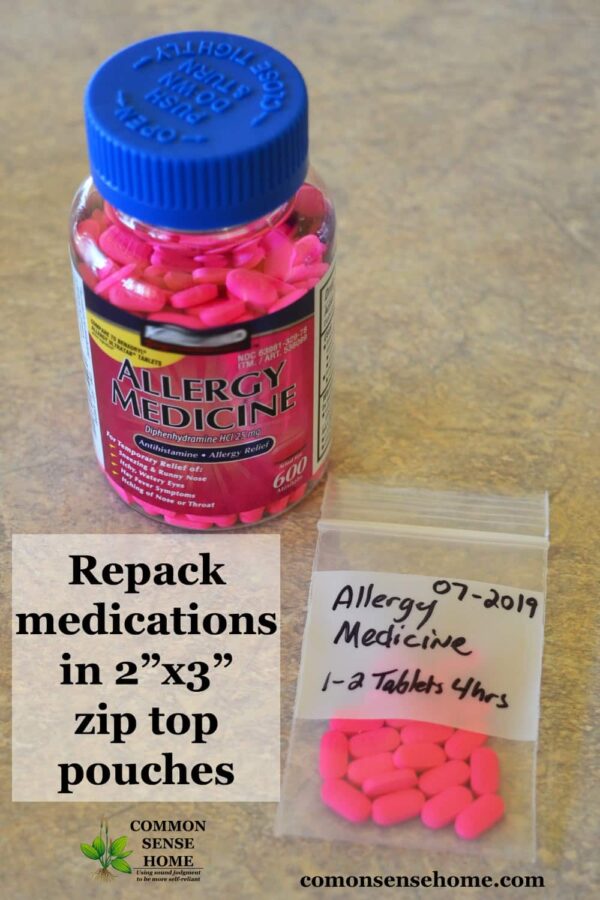
GROUP 2: OPTIONAL ITEMS FOR MEDIUM SIZE FIRST AID KITS
Note these are optional first aid supplies that are a good addition to any first aid kit. Some of these items may not fit in the smallest of the first aid kits.
- Cold pack
- Warm pack
- Nexcare 3-M liquid bandage spray no sting. If you are in a pinch superglue will work (but it hurts) – but superglue gives you the ability to make small repairs – so it is multi-function
- A small AAA flashlight such as:
- a penlight with pupil gauge could fit inside the kit (the two pack is ok, as you can put one in the car, office or camping kit and one in your home kit.
- Lumintop EDC 01 fits inside the small kits. This is an amazing tiny fully functional twist flashlight for the larger kits consider the 18650 Thrunite TN12 (neutral color so it doesn’t mess with your patient assessment) – remember to store the flashlights with the batteries OUT or with isolation so the batteries don’t corrode in storage.
- Scalpel #10
- Clipper Lighter fire will sterilize metal instruments, cauterize a wound, melt water and about 100 other things. (We like Clipper lighters more than BIC)
- Tick Spoon
- Eye wash or Eye Wash Kit & Eye pad
- Safety Pins
- Mylar Space Emergency blanket, to wrap up the patient and discourage shock. We suggest the silver ones, as it will reflect sun in the summer – these have many uses including temporary shelter, ground liner, raincoat etc.
- Couple rolls of 3M Surgical Tape get whatever width you choose (softer stuff) or Medical Tape a bit simpler paper tape
- A few 4inch non adherent Elastic Bandage Wrap
- triangle bandage
- Wash cloths a couple of these in a kit for cleanup, or a gauze for worst case situations
- Assorted Band Aid Bandages (add to every kit)
- Wound Closure
- Steri-Strips
- QuikClot 3×24 Gauze (clotting gauze – if you can only get one get the gauze over the sponge)
- QuikClot 50g sponge (clotting dressing)
- Chest entry-exit wound seal
- Frame Wound 6”x8” Dressing
- Nylon sutures with needles
- Plaing gut 3-0 suture kits
- Gauze
- 3×4-inch non-stick gauze pads
- 4in x 4ft gauze roll (PBT Conforming)
- 8×10-inch trauma pad gauze
- Non-latex gloves pack in sets of 2 in zip lock bags (extra pair)
- Ammonia inhalant (to revive the patient)
- Pac-kit Disposable Thermometer for the small kits
- Lip balm
- mini CPR mask
- burn gel packet
- No Rinse Bath Wipes
GROUP 3: OPTIONAL ITEMS FOR LARGE FIRST AID KITS AND HOME
These items are more bulky and are likely to only fit in the larger medium, large and extra large kits.
- Israel 6” bandage or the Israeli 4″ bandage – These are useful to wrap various wounds, can be turned into a sling or even a tourniquet – put one in each vehicle, and put extras in your home medical kit.
- Topical Treatments pack
- SAM Splint – these are larger
- A VALLENN Digital Infrared Thermometer (may be out of stock)
- Flint/magnesium and steel or Larger fire starter
- Tongue depressors
- Stethoscope
- Povidone Surgical Scrubs
- A Snake Bite Kit? We don’t recommend any. Instead take a picture of the snake if possible. Remove any rings, watches, tight clothing and anything else from the bitten limb, because the swelling will make it a lot bigger soon. Draw a circle around the wound with a Sharepie, and write near the wound date/time of the bite. If you are going to buy a kit, consider the Sawyer Extractor or LIVABIT
- Full size CPR mask
- Skin Stapler
- ** see the Build Your Own First Aid Kit for a comprehensive list of kit items
Use First Aid Kits in Rotation
Whether you buy your kit or build your own, keep a First Aid Kit at home. Use up the “house” kit(s) first. When the house kits need to be replenished, take one out of a vehicle and put the “fresh one” in the vehicle.
Another rotation tip – refresh your kits when you change the batteries in your smoke detectors on daylight savings in spring and fall. Swap out batteries, check medications for expiration and replace missing items.
Also update the kit when you swap out your summer and winter car kits.
First Aid Related Tips
We don’t recommend loose anti-coagulant powder. It seems like it would be good, but it can blow around and seal your eyes shut. Instead, use a Quikclot gauze or sponge. Or simple gauze bandages or pads.
Clean the wound and press until bleeding stops, then wrap with pretty much anything until the professionals arrive. Note Quikclot is likely to cause scaring so it should NOT be used unless truly needed.
Polysporin is better than Neosporin if you have concerns about allergies and skin irritation. You might want to put some liquid skin or superglue in your kit. Superglue is multi-function and liquid skin and superglue are good fire starters.
Sharpie markers can be used to label zip lock bags for sub-kits in your first aid kit. Sharpie markers can also be used to write critical information directly on the patient – to ensure other medical professionals get key information. Mark a spider or snake bite circle it and write date and time.
Snake Bite – Although we list kits we do not recommend using them. Leave it alone but write date/time and location near your bite. Take a picture of the snake if you can (cellphone). Remove any rings, watches, tight clothing and anything else from the bitten limb, your limb will swell significantly.
Duct Tape can be used in many ways such as as:
- chest seal (if you burp it as needed)
- medical tape to keep gauze in place protect a wound
- go over Burn Gel pad or other wet application items
- create or secure a splint
- to fix glasses or seal a tear in a jacket
- makeshift sling
The Brightly colored duct tape can color code the bags into groups, and you can use the Sharpie to label the bags.
As mentioned, a feminine pad can be used as good substitute for a trauma gauze. Tear it open put it on the wound and tape or wrap it in place.
“Trick” to check a child for extremity problems/mobility:
Get two pieces of chocolate or two popsicles (two of some type of treat). If both arms are operational, the child will grab one with one with one hand and the other with the 2nd.
If they protect one hand/arm but still go for sweet, you can estimate where the injury is and help the child settle at the same time. This allows you to better assess if the crying is from fear or pain.
We used this trick when our eldest broke his collar bone, and another time when a friend’s child fell off a horse and broke an arm bone.

Related Articles
- Bug Out Bag (BOB) or “Get Home Bag” DIY Checklist
- Winter Car Kit and Winter Vehicle Maintenance Checklist
- Roadside Emergency Kit Recommendations and Checklist
- Emergency Water Storage and Filtration – What You Need to Know Before Emergencies Hit
- When the Power Grid Fails – 10 Things You Need to Prepare
- Build your own first aid kit
How can we help you with every day preparedness issues? As we’ve seen in abundance in 2017, disasters can strike anywhere, any time. It’s up to us to be ready for trouble, big or small.

This post was written by August Neverman IV. August has a strong background in emergency preparedness. He served on several emergency preparedness teams during his tenure at Brown County WI Government, the Medical College of Wisconsin, HSHS, a 13-hospital system and emergency response training during his time with the Air Force and Air National Guard. Learn more about August.
I linked my similar blog post here but just wanted you to know I loved your post so much I had to go back and edit one of my own posts (in my URL link) to include a link to yours, this is awesome and a great job. I’m a mother of three and I believe you should always always be prepared for anything!
Hi, I just came across a pin to your site. I have a bit of an issue with the ‘Crisis Preparedness Handbook’ first aid kit list. Having things like povidone surgical scrubs and sutures is ridiculous. The average person at home is not going to be performing surgery, nor will they have the skills necessary to suture wounds. I am going to give the author of said book the benefit of the doubt and assume that he is a catastrophist who believes the end of civilisation is coming.
Karen – I agree that some of his recommendations are over the top for the average person. For instance, where are you supposed to find all the hardcore medications, unless you’re shopping illegally? We don’t eat a lot of the food items he recommends, but I think his lists give a good starting point to give people an idea of how much food is really needed. For me, that’s what I take from the book – it’s a good overview of topics you need to consider, and you can take what’s practical for you and apply it. Maybe once harvest season is over I can hunt down some other preparedness books to review and compare them, but I don’t care to invest big money in it as I am fairly comfortable with where my family is at. If you know any preparedness authors who’d like to host a review, send them this way!
I like you on FB. :o)