
Non-toxic Home Pest Control

This post may contain affiliate links. Read my full disclosure here.
Unwanted six legged visitors driving you “buggy”? Use these simple, non-toxic home pest control methods to eliminate and reduce common household bugs and avoid standard, neurotoxic organophosphate pesticides.
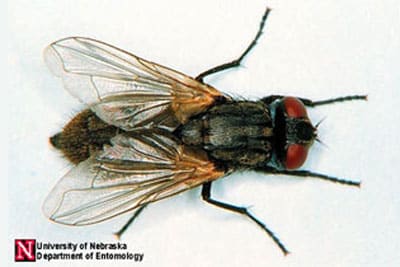
Keep flies and biting flies away
A time honored trick for keeping common flies away from animals and outdoor activities is to hang gallon plastic bags half filled with water with a penny in the bottom near the area you want fly free.
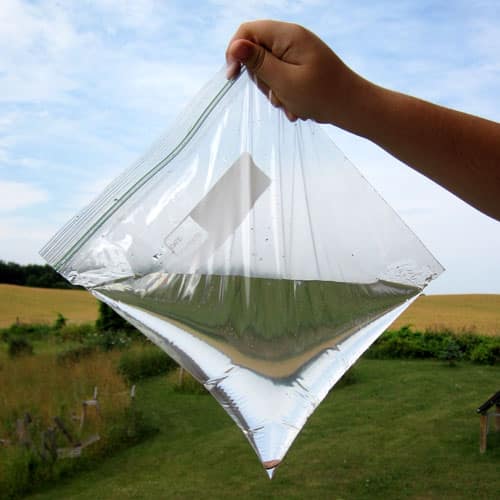
Apparently, the reflection of light off the water keeps the flies away. (It might be sensory overload of their compound eyes?) Make sure to hang the bag in the sun to get the best effect. I have not tried this, because we usually don’t have much trouble with flies, but have seen it recommended on several sites. Let me know if you’ve tried it and how it worked for you.
Fly traps are another great option to reduce fly populations. They contain an attractant that draws flies in, with a one way opening that keeps them in.
Use screens/caulk, etc, to keep flies out of the home, and utilize good sanitation to reduce breeding areas. Keep compost piles actively working, and cover soft food waste with rough/course plant materials such as leaves or grass.
For biting flies that circle around the head (deer flies) that make a nuisance of themselves when you’re working outside or out camping and hiking, I recommend an old Boy Scout trick. Simply place a feather or other tall object on your hat. The flies are drawn to the tallest part of a moving target, and will circle the feather rather than your face.
Get Mosquitoes to Buzz Off with Catnip
Catnip oil contains a compound that is 10 times more effective than DEET for deterring mosquitoes. It’s a very easy to grow plant, so I always have some in my garden. When I’m out working and mosquitoes start moving in, I grab a couple of handfuls of catnip and rub it all over my exposed skin.
If you don’t grow your own catnip, you can purchase ready-made sprays online, or buy some catnip essential oil and mix a few drops in a spray bottle with olive oil. Alternatively, you can mix 1 cup alcohol (such as rubbing alcohol or vodka), 1 cup water and 40 drops catnip essential oil in a spray bottle and shake well. The oil based formula works well on bare skin, the alcohol based one can be used on skin or clothes.
The Easiest Fruit Fly Trap Ever
It doesn’t get much simpler than this. To make a basic fruit fly trap, take a small bowl or empty container (like a cottage cheese container). Place a small amount of fruit juice, apple cider vinegar or kombucha in the bottom of the bowl (about 1/8 inch). Put a small drop of dish soap into the juice, swirl it around gently. The soap breaks the surface tension so the flies go in for a drink but don’t come out again. My favorite juices to use for this are cantaloupe juice or tomato juice. Mildly fermented juice is even more effective.
Would you like to save this?
Keep Yellowjackets Away from Your Picnic
I don’t mind yellowjackets, in general. They tend to be quite docile, and they eat cabbage worms in my garden. However, when their population booms in late summer/autumn, they can do a lot of damage to ripening fruit and make themselves a real nuisance at outdoor events.
For short term use, a simple yellowjacket trap can be made by taking a small plastic bottle, such as a 16 ounce water bottle, cutting off the top (about one inch into where the bottle widens below the neck), and inverting it into the bottom. Then place about 1 inch of sugar water (1 part sugar to 4 parts water – think hummingbird nectar) into the bottom of the bottle. Set on the table slightly away from the food. The yellowjackets crawl in, but can’t make their way back out again.
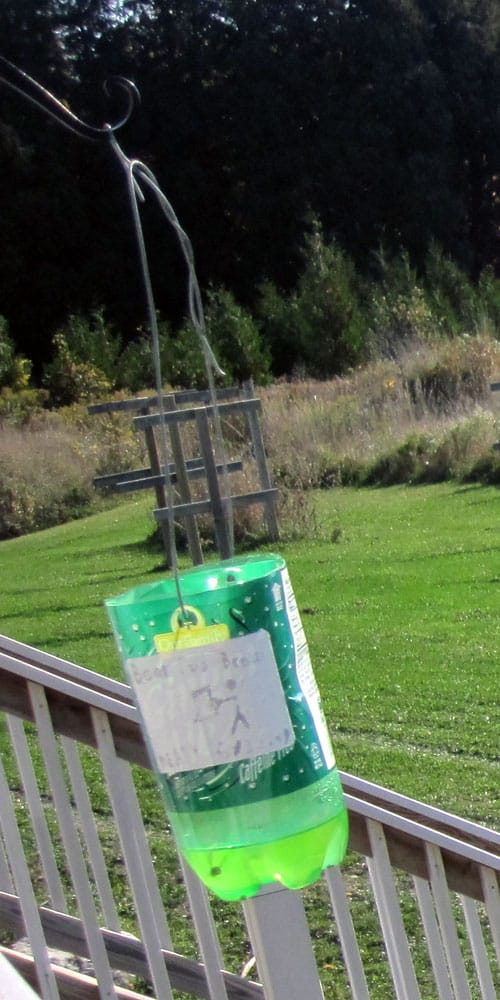
For a larger, sturdier trap, use the same method on a 2 liter bottle. You can also add wire to the bottle and hang it off the porch or near your fruit patch. (Yellowjackets can cause major damage in fall fruits around our area if left unchecked, especially raspberries.)
For garden pests, please visit “DIY Natural Pest Control in the Garden” to get tips for controlling cabbage butterflies, potato beetles, cucumber beetles, squash bugs, slugs and other garden troublemakers. Remember, many commercial insecticides are potent neurotoxins – chemicals you don’t want anywhere near you or your food.
Why Should I Bother with Non-toxic Home Pest Control? I want to kill the bugs.
The National Pesticide Information Center states:
“Since the removal of organochlorine insecticides from use, organophosphate insecticides have become the most widely used insecticides available today. More the forty of them are currently registered for use and all run the risk of acute and subacute toxicity. Organophosphates are used in agriculture, in the home, in gardens, and in veterinary practice. all apparently share a common mechanism of cholinesterase inhibition and can cause similar symptoms. Because they share this mechanism, exposure to the same organophosphate by multiple routes or to multiple organophosphates by multiple routes can lead to serious addictive toxicity.”
You can follow the link to NPIC for a list of currently available organophosphate pesticides. The article also discusses pesticide health effects such as:
- liver damage
- weakness or paralysis and paresthesia of the extremities
- problems with memory, concentration and mood
- persistent headaches, blurred vision, depression, irritability
- cranial nerve palsies
- lung disease
…the list goes on and on. Organophosphate pesticides readily store in fat tissue, so they stick around and keep causing damage. Standard pesticides don’t just kill bugs – they can also kill us. Non-toxic home pest control is essential because standard pesticides can affect the body via both skin and inhalation. You don’t want any sort of prolonged contact with organophosphate products.
Any other quick and easy tips you’d like to share for the critters that are bugging you? Or maybe you’re looking for ideas to ditch a pest? Leave a comment and share your thoughts.
Great advice from everyone. I enjoyed reading all of them. Several years ago we used the bags tied around doorways at Boy Scout summercamp and I’d say it worked to a degree. We made up fly traps like the ones talked about and had great success with them.
BTW…I’m still looking for a cabin/small house in northern Mi. where I hope I can put to use some of your wonderful ideas. I’m still in Florida and trying some gardening ideas. A little different down here,however. I’ve grown bananas, blueberries,citrus,grapes ,tomatoes etc.
By the time I retire I hope I’m not too old to enjoy some homesteading. I’m 61 now and hope to retire in a couple of years.
Hi Jerry! Nice to hear from you again. I noticed a nice farmhouse went on the market recently about five miles from us. They have a very nice garden. I’ve admired it many times. Are you set on freezing your tail off in the UP? Odds are it is cheaper up there, but it sure gets cold.
HOW DO GET RID OF RODENTS. MICE. AND KEEP THEM GONE. .
I did a detailed post on rodent control at Wild Sage Homestead titled, “How to Keep Mice Out of Your Home and Garage“.
We are invaded with ladybug since 2 years during summer and they come into the house as soon as we open the door. We also have some during winter but no so many than summer. If you have a trick to get rid of them please advice me.
Since we only have a few, I catch them and put them outside. Friends and family who have a ton of them in their homes vacuum them up.
Any thoughts on ticks and fleas? I have three four-legged part Germans ranging in age from a few weeks to 16 years.
Here are some ideas for using essential oils for tick and flea control: http://thewholedog.org/EOFleas.html
Great tips- I’m going to use a few of them in my garden =) I would like to add a bit to the gallon bag with the penny in it fly repellent. When I lived in Georgia I would very often see these bags tied to the doors or hanging near them in grocery stores, businesses and local produce stands. I thought, being in the area I was and since the people are very traditional and a bit superstitious that it was some sort of mountain folklore thing. But I asked one day and found out it was a fly trap. She explained to me that the flies are threatened by it (you actually twist the top of the bag and secure it with a twist tie) because the reflection of the penny through the water and gathering of the bag tricks the fly into thinking he is outnumbered. I have actually used this method and can attest to the fact it works ‘like a charm’ .. *smiles* …
We get flies coming in our house a lot in the summer. I expected to have a good deal more this year with 2 the new neighbors 2 dogs. I thought I would try the bag of water trick (I heard to put pennies in it) by the outside door we use most often. Happy to say that this year we didn’t have any flies come in so I say it worked for us.
I have tried the water in a bag for flys and it didn’t work that great for me. For one thing, it’s hard to get the bag to stay put, but really, I couldn’t tell it did much at all.
Joyfully,
Jackie
My Attempt at Blogging
Quaint Scribbles and 3 D Learners
Hmmmmm…sounds like the fly traps are a better bet. I guess if something sounds too good to be true, it probably is. Funny, I saw the recommendation on several sites, with many people saying it had worked for them.
We have used the water bags in our stall doors for our horses and it worked well. If you have trouble hanging them you can make a basic sling out of string (using just enough to support the bag for haniging). You don’t want to defeat the purpose of the bag’s reflection.
Bags of water does not work.
http://dsc.discovery.com/tv-shows/mythbusters/videos/no-fly-zone.htm
On the fly traps put 3 pennies spread out. 1 on each side and 1 in the middle. You can use gallon or quart ziplock bags. Use tacks or push pins to hang up evenly. The flies thing the pennies in the bags are wasps and they try to avoid them. After a while though the flies get used to it and you have to go to the fly traps which work great but hang them away from where you are outside becuase they get very rancid.
[WORDPRESS HASHCASH] The poster sent us ‘2039932379 which is not a hashcash value.
I don’t know what’s wrong with the spray pesticides . . .twitch, twitch.
Just kidding. I learned a lot here, a couple I’d seen but not all. Cinnamon has done wonders to rid the kitchen and bath of ants, it messes up their scent trail apparently.
Thanks for all the good info!
After reading the info at that pesticide link, I think you’d be lucky if you were still twitching after excessive pesticide exposure. Yikes! thanks for sharing the cinnamon tip. 🙂
You always have great info and new ideas. Any thoughts on how to deal with spiders in the house?
Thank you! How many and what type? If I’ve got a stray, I’ll often scoop them up and toss them outside. If I’ve been invaded by cobwebs (like in the basement by the woodpile), they generally get the broom and vacuum. Our house is pretty tight, so most come in with the wood or with garden produce.
Apparently conkers around the window and door openings stop them coming In.
Great tips! Thank you!
Thank you for this info. Now can you tell me how to get rid of roaches safely!
Mary – I haven’t had to deal with them, but it looks like that book I linked at the bottom, “Least Toxic Home Pest Control” may have some ideas, and it’s pretty inexpensive.
For roaches, boric acid is the classic non-toxic control. You spread it around the places where they crawl (in NYC, it’s poured into the walls). It gets on their legs, and they have to clean it off (because they breathe thru special pores in their legs), and it poisons them. You wouldn’t want young children to get into it, but otherwise it’s safe.
I finally found the answer for roach’s…..boil one onion, 5 cloves garlic, 1 tablespoon cayenne pepper for 1 hr…..cool, strain and add 1 tablespoon Dawn dish liquid……….we spray each evening around the sink and along the wall they seem to be coming from…Works great.