
Rain Barrels – DIY, Cheap, Decorative Options (+ Care Tips)

This post may contain affiliate links. Read my full disclosure here.
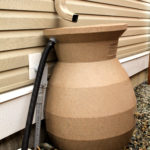
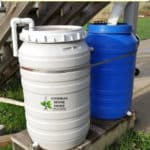
Rain barrels are a great water conservation option, but there are a few things you need to know to avoid a mess and get the most out of your storage. We’ll share how to make a rain barrel (or get one cheap or decorative), plus installation and maintenance tips for rain water collection.
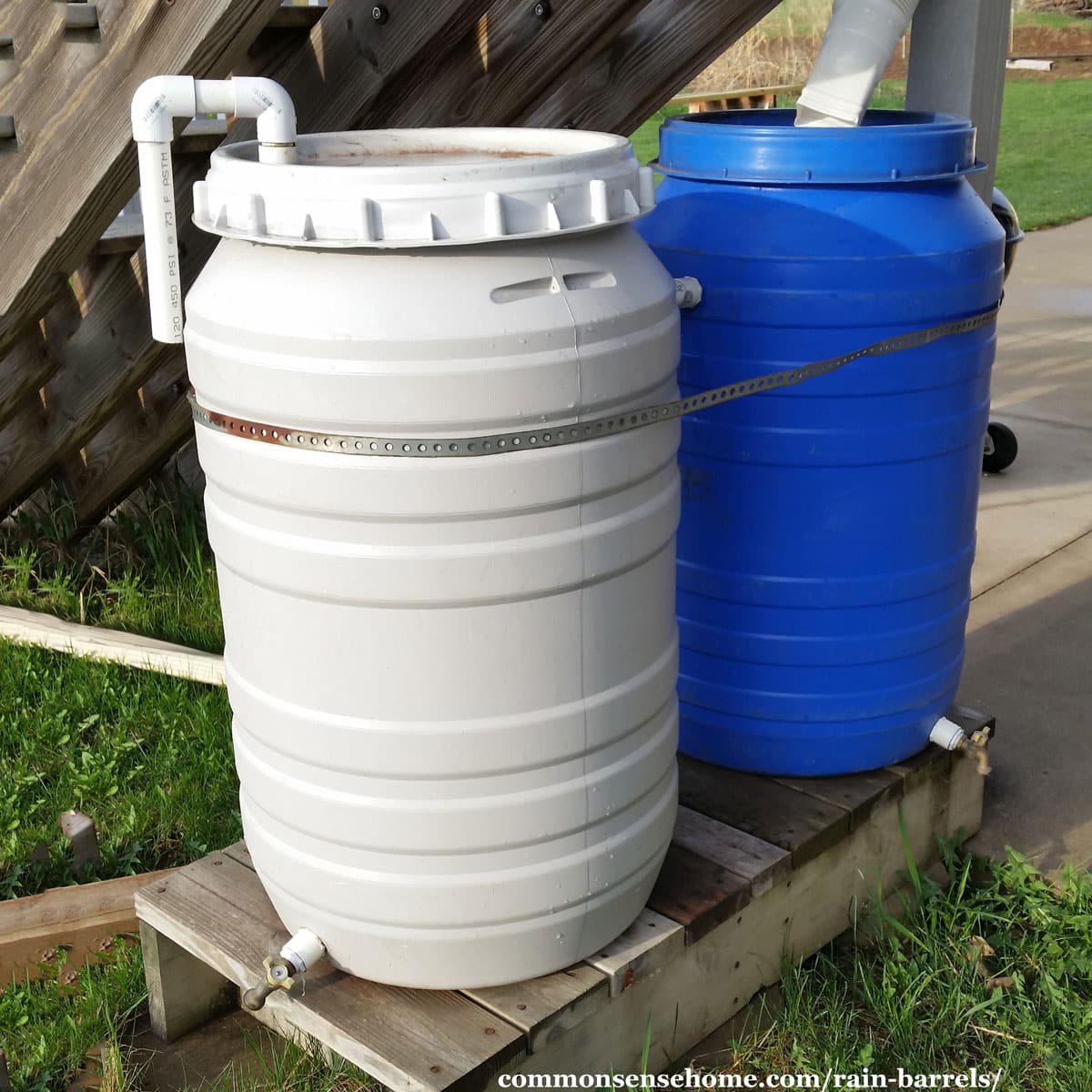
How to Make a Rain Barrel for Rainwater Collection
There are three key elements in every rain barrel system.
You need:
- a way for the water to get in, with a screen to keep debris out
- a spigot to use your collected rainwater
- an overflow, in case your rain barrel gets too full
For a system like ours, you need:
Tools
Supplies
- 55 gallon plastic drum (or food grade barrel from large restaurant)
- brass faucet with fittings
- Fiberglass window screen
- Second ¾ inch faucet or PVC pipe for overflow
Optional supplies
- Bulkhead fitting to attach barrels to each (if you have more than one barrel) or to act as the back for the faucet
- Roll of Teflon tape and Caulk or plumbing sealant, to provide a more snug fit
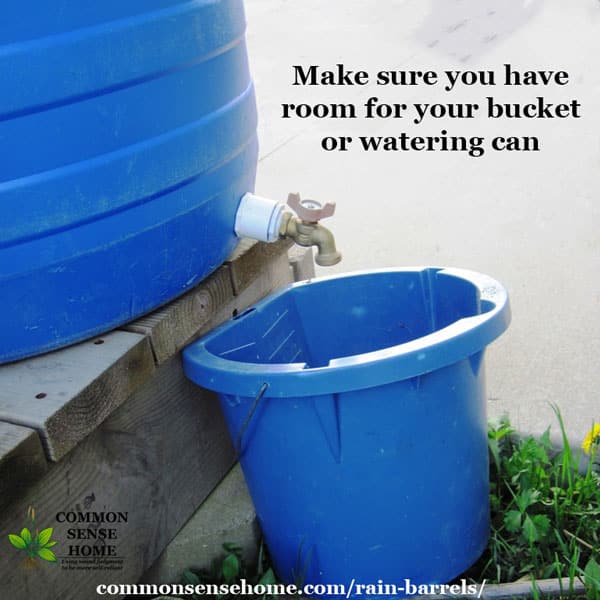
Rain Barrel Stands
We want to get our rain barrels high enough that we can get a bucket under the spigot. This means we need a stand.
Keep in mind that water weighs about eight pounds per gallon, so whatever you use for a rain barrel stand; make sure that it’s sturdy.
A 55 gallon drum full of water will weigh over 450 pounds. Make sure your stand is strong and level – you don’t want those barrels tipping over on someone.
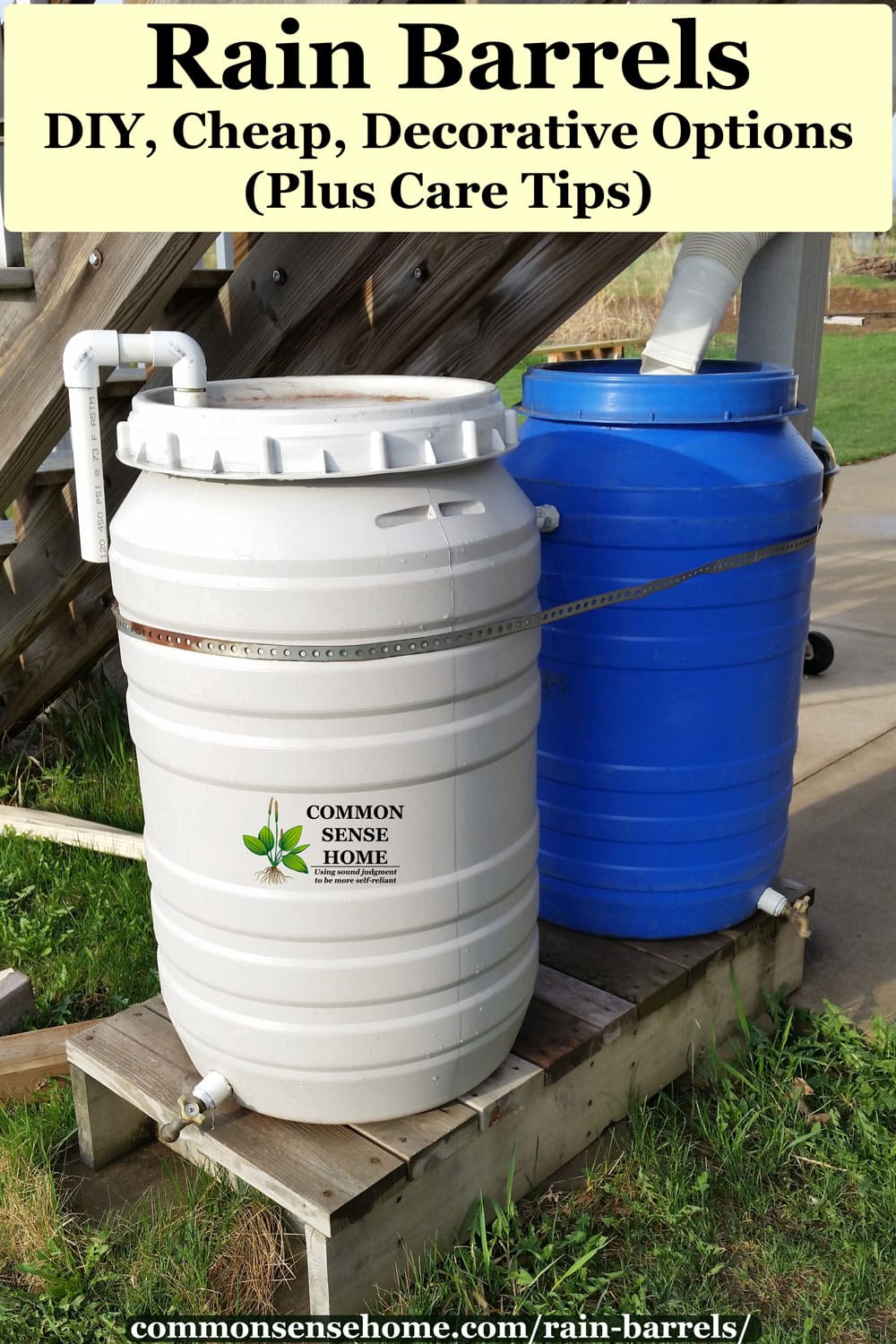
We paired up six concrete deck footings with a small reinforced treated wood deck. You could also use concrete blocks, or a combination of concrete blocks and pavers, as shown in the video below.
Downspout Filters
We don’t recommend downspout filters on the roof. They are hard to clean, and can create ice damns in your gutters and downspouts.
A couple of options for downspout and gutter filters include:
- Gutter cap or Gutter Filter to keep leaves and debris out of the downspouts (requires a ladder to clean them)
- Downspout filters (not roof mounted) (these are within reach for cleaning)
Rainwater Inlet
For our rain barrel, we cut around the inside of the cover. Then we inserted a sheet of fiberglass window screen to keep out debris. I’ve also seen small holes cut in the top to fit a skimmer basket covered in fiberglass screen.
You don’t want to have an open top, because this is an invitation to mosquitoes and other bugs.
Make sure your opening is big enough to capture all the rainwater from your downspout. You also want to be able to clean your filter or screen.
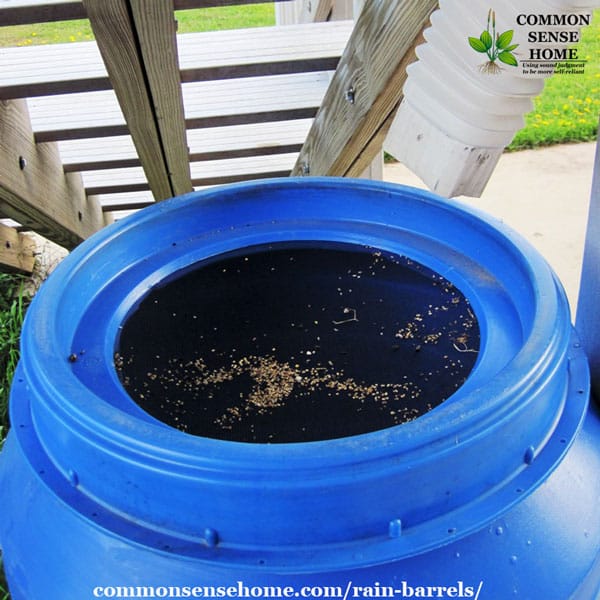
Do not skip adding a screen to your rain barrel! I’ve seen guides that don’t use a screen because they route the water directly in through a tight opening. This is a bad idea.
We have a high roof, with no trees around, and yet we still get bits of branches, leaves, tree seeds and other debris in our screen.
I don’t know if the birds drop them or the wind blows them, but there are chunks that would build up in your rain barrel.
You can include a roof washing system that diverts the first round of rain from your roof around your barrels so you store cleaner rainwater, but for garden use it’s not critical.
The book “Rainwater Collection for the Mechanically Challenged” has a great tutorial on building your own roof washer, or there are roof washer kits available online.
If you want to collect rainwater for potable use, a roof washer is essential.
If you don’t want to reroute your downspout to the rain barrel, there are downspout diverter kits that insert into the side of a downspout.
Rainwater Outlet/Drain
Mark a spot at least two inches from the bottom of the water barrel. Why two inches above the bottom, instead of closer?
That spacing will give you room to mount your faucet, plus it’ll help you avoid any sediment that builds up in the bottom of your rain barrel. Even with a screen, some sediment will build up – not a ton, but some.
If you get a good quality brass faucet, you should be able to screw it directly into the wall of your barrel wall once you’ve drilled your hole to match the faucet, as demonstrated in the video below.
If you find that you need a tighter fit, or want to extend the faucet farther out, you can use PVC fittings and Teflon tape.
Would you like to save this?
Rain Barrel Overflow
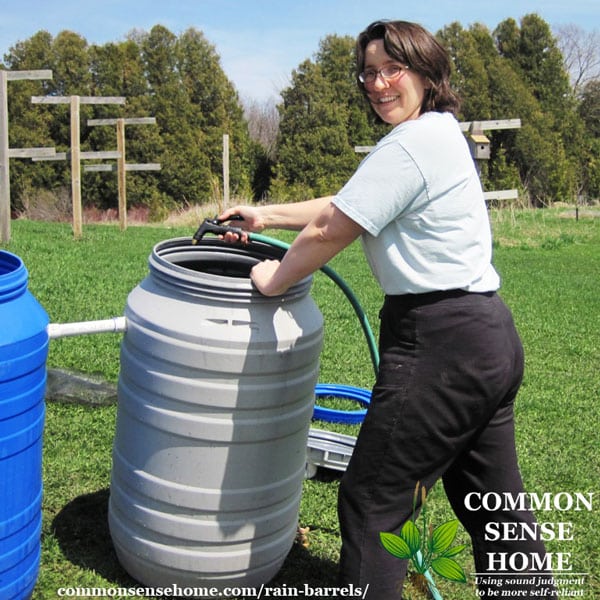
We have a two barrel system, with the first barrel connected to the second barrel via PVC fittings. The friend who built our rain barrel system fitted the overflow to the top of the second rain barrel because it was quick an easy.
It would work better located on the side, slightly above the PVC connection between the two rain barrels (this is where you use the bulkhead connectors – one per barrel).
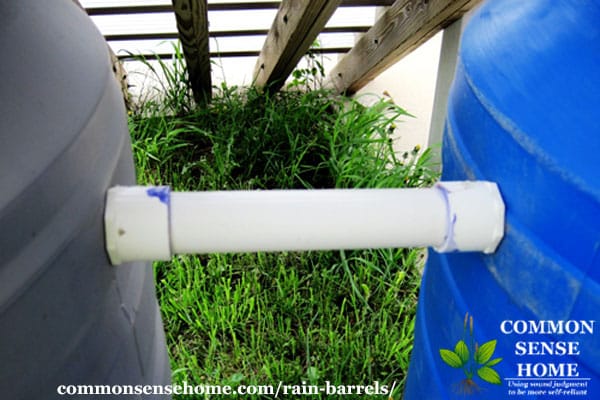
Whatever you decide to rig up for an overflow, whether it’s a garden hose or PVC fittings, make sure the water flows away from your building, just as you would a downspout. You may even decide that you’d like to add a rain garden off of the overflow.
Maintaining Your Rain Barrel System
Because we have high winds, we added strapping to hold the barrels down when they’re not filled. For winter, we drain the rain barrels and bring them into the greenhouse.
Water expands about 11% when it freezes, so a frozen rain barrel is likely to have damaged fittings.
If you don’t have a spot to move your barrels inside for winter, drain them and cover them so they can’t gather water or snow, and divert your downspout to its normal course.
We add a downspout extension for winter, and take it off again in the spring when the barrels go out.
In spring, before putting the rain barrels back into action, give the barrels a good cleaning. You want to scrub them out at the beginning of the season to make sure you’re not starting off with contaminated water.
For cleaning your rain barrels, you’ll need a long handled scrub brush, or you’ll have to crawl in to your barrel. I improvised by duck taping a piece of firewood to a brush with a shorter handle.
Make sure to clean your screens, too, and double check that your faucet and overflow are clear of obstructions.
Algae in Your Rain Barrel
If you use a translucent barrel, you’re more likely to algae growth due to sun exposure. Try covering your rain barrels with a tarp, painting your water barrels or using a wooden surround to block the light.
If you’re not opposed to goldfish in your rain water, they will eat the algae, as well as mosquito larva. Just make sure that your rain barrels don’t run dry, or you’ll kill your fish.
Keeping Mosquitoes out of your Rain Barrels
Use a screen to keep mosquitoes from having easy access to your rain barrels.
If you find that they still somehow manage to get in, a couple drops of vegetable oil on the water surface will prevent them from laying eggs. (This will make your rain barrels messier, so you need to clean them more frequently. You’ll also need to add more oil from time to time.)
Another option is to add a couple of goldfish to your rain barrel. They’ll eat the larva and add some fish poop fertilizer to your water. (This is not recommended if you think you may need to drink the water.)
Mosquito dunks are another commonly recommended option, but not my top choice. The active ingredient in mosquito dunks is “Bacillus thuringiensis subspecies israelensis” (Bt), which attacks the larval stage of mosquitoes.
Bt occurs naturally in soil bacteria. Now it’s being genetically engineered into corn and other crops, and some insects are becoming resistant. I prefer to stick to simpler control method.
Finding Rain Barrels for Sale, Cheap Rain Barrels or Decorative Rain Barrels
Many home improvement stores now offer plain and decorative rain barrels and rain barrel kits, or they can be purchased through catalogs or online. There are decorative rain barrel options now, such as:
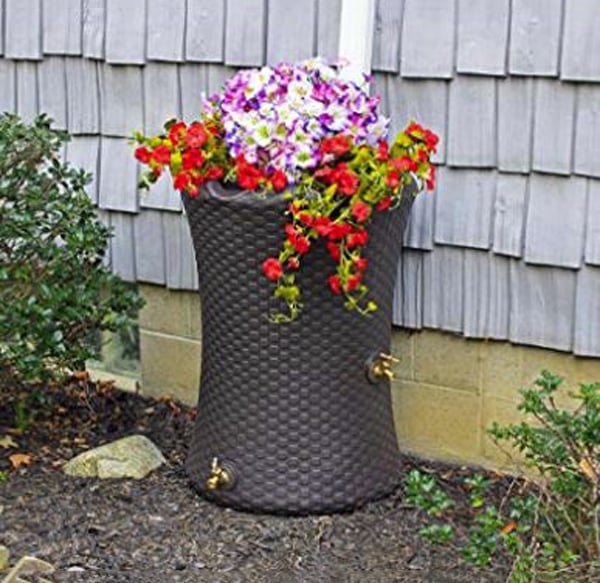
Where space is limited, there are rain barrels that are flat on one side to sit flush against a building.
There are also some local programs that supply rain barrels at reduced cost to encourage rainwater collection.
For free and cheap water barrels, inquire at local food processors. Often they receive ingredients in 55 gallon drums. For instance, we were able to get the barrels we used for our rain collection system for free from a nearby meat shop.
Make sure you use FOOD GRADE BARRELS, not barrels that may have contained toxic substances.
Are you ready for Rain Barrels?
Natural rain water is softer and easier on your garden plants. My grandmother always washed her hair every Saturday night with water from her rain barrel.
If you happen to have a good water filter such as a Berkey, you can use it for drinking water in case of emergencies.
I hope you found this post helpful. Drop a note below if you have any questions or tips to share.
You may also find useful:
Rainwater Collection Guide – Common Questions Answered (Is it legal? How much water can I collect?)
The Bio-Integrated Farm – Water Gardening Like You Never Imagined
Emergency Water Storage and Filtration – What you need to know before emergencies hit.
Too Much Rain in the Garden – Managing Wet Dirt and Waterlogged Plants
3 Emergency Water Filtration Options to Get the Funky Chunks Out
Originally published in 2011, last updated in 2020.
What are your thoughts on collapsible rain barrels?
I haven’t worked with them, but the main issues I’m seeing in online reviews are stability issues and leakage. It may be a quality control issue, where some people get “better” barrels than others from any given batch of barrels.
Is there any reason why you can’t use a clean cheap plastic trash can for a rain barrel?
Also I recommend using a cheap pump to get the water out. Better than drilling holes in your barrel.
I don’t recommend using a cheap plastic trash can for a rain barrel because trash bins are not food grade, and may leach toxins into your water storage. Trash bins, especially cheap ones, are made of plastic that is not designed to hold up to the pressure exerted from being filled by water. Water is heavy.
Pumps, especially cheap ones, have moving parts. Moving parts mean more opportunities for breakage – especially when dealing with cheap products.
Faucets are easy to install, easy to use, and durable, especially a well built brass faucet. Ours are over 10 years old and still completely functional. We had the misfortune of having a frog crawl into the rain barrel and die and get stuck in the faucet one year. A simple cleaning, and the faucet was functional again. If that same frog had been sucked into a pump, the pump would likely be out of service, and may or may not be able to be repaired.
Further, a faucet works via gravity. When I’m filling bucket after bucket of rain water, all I have to do is open and close the faucet. Gravity does the work. With a pump, either I’d need to be pumping, or it would need power. Why make things more complicated when there’s a simple, reliable, resilient solution?
Now if I had a large system that utilized rain water inside the home or for large scale irrigation, then there would be merit to a pump. For a small system, simple and robust is best.
I don’t think the roof washing system is necessary if you have a flat roof with the new white foam type of coating. I got a 5 star rain barrel with the spigot already mounted. I live in the southwest in the U.S. so the freezing will not be a problem either. The only thing I didn’t think of is putting it on a pedestal. I can get a hose onto the spigot at least. Next time my rain barrel(s) are empty, I will arrange platforms for them. I think it will also help the water flow faster. All my rain barrels are stand-alone, with screens on their open top so I don’t think there will be any drowning casualties to worry about. I found this article interesting and informative. I was encouraged by your recommendation of a Berkey Water Filter for use with it. I had just purchased one of those, but wasn’t sure it was suitable for this.
The roof washers are really a help in areas where more airborne debris is likely to get on the roof. No debris = little need for a roof washer.
I have two black 45 gal rain barrels that are connected into each other and connected to the gutter. I know the water cannot be used for drinking unless purified because of the asphalt shingles. What would you recommend for purification regarding the chemicals from the roof? What do you recommend for treating the water while in the barrel to prevent mold and other issues from forming? The top of the barrels are either a lid or the lid turned upside down and secured to be used as a planter which is how I’m using it. Thank you.
The dark color of the barrels will keep sunlight out, which prevents algae growth. Other than that, I haven’t had issues with water fouling as it sits. We use the water regularly and rain keep coming (hopefully), so it doesn’t stay stagnant.
For drinking water, a Berkey Water Filter or something similar should deal with any impurities. We keep our Berkey on our kitchen counter to filter the well water.
I clean the rain barrel out at the end of the year.With the window screen filter I have never had a hose blockage with the spiot on the bottom. During the winter I just turn the disconected empty barrel upside down.
One year we somehow ended up with tree frogs inside the barrel (the must have crawled in the overflow). Unfortunately, though we found several of them and got them out, one died and fell into the bottom of the barrel. A tree frog skeleton, although small, can clog a drain.
Why would anyone put a valve on a round surface when you have a nice flat surface on the bottom. The common sense way would stack it on 2 concrete blocks.keep the brass valve open and attached to a garden hose and keep other end hooked up high using a broke spigot. As far as drinking it I avoid it.you must have a way to purify the bird poop off a metal roof and never use water off shingles unless you only use it to flush a toilet. ..You don’t mention using 55 gallon barrel’s would eventually burst in the cold and leave you without water.
As noted in the post:
“Mark a spot at least two inches from the bottom of the water barrel. Why two inches above the bottom, instead of closer? That spacing will give you room to mount your faucet, plus it’ll help you avoid any sediment that builds up in the bottom of your rain barrel. Even with a screen, some sediment will build up – not a ton, but some.”
If someone were to put the drain in the bottom of the barrel as you suggest, they’d likely end up with sediment clogging their faucet.
RE: drinking the water:
The setup we have is not intended for potable water use. It’s for watering the garden. Given that birds crap in the garden already, a little bird poop is not a concern.
As noted in the post:
“Ideally, you would include a roof washing system that diverts the first round of rain from your roof around your barrels so you store cleaner rainwater. The book “Rainwater Collection for the Mechanically Challenged” has a great tutorial on building your own roof washer, or there are roof washer kits available online. If you want to collect rainwater for potable use, a roof washer is essential.”
You’d also want a potable water filtration system. In our case, we have a gravity based Berkey water filter. For a house sized system, you’d want something more robust. That’s beyond the scope of this post.
RE: cold
As mentioned in the post:
“For winter, we drain the rain barrels and bring them into the greenhouse. Water expands about 11% when it freezes, so a frozen rain barrel is likely to have damaged fittings. If you don’t have a spot to move your rain barrels inside for winter, simply drain them and cover them so they can’t gather water or snow, and divert your downspout to its normal course. (We screw on a downspout extension for winter, and take it off again in the spring when the water barrels go out.)”
The house I grew up in had a stone cistern as the main water supply source (even today, there is no city water provided in that area) ~ if something gets in the water or the cistern needs sterilized for something ~ oi! what an ordeal that can be. Fortunately in the 20 years I lived there, there were only two major incidents that we had to hire help to deal with. We did have to order water delivery fill ups during a few dry spells, but not very often.
Our current home is definitely in need of some rain water collection and storage, so I really appreciate this collection of ideas and instructions.
Great article, thanks! I’m trying to get a handle on how often the tanks need to be drained. I just installed a couple of free standing (not attached to a downspout) 55 gallon barrels out next to planters that are up by the road and a couple hundred feet from the closest faucet. I live in a rainy area (central NC) but because the surface area of capture is low, I expect to have to supplement the rainfall with filling by hose. I just set up the drip system and running it for twenty minutes, which was plenty, might have used 5-10 gallons tops. So, how long can the water sit in there without getting nasty? It will be a lot of extra work each time to drain and fill them by hose. Thanks!!
I clean mine each year, but not more than that. As you mention, it’s a big job. The opaque sides of the barrel inhibit algae growth, and the screen on top keeps the bugs out. You might need to clean it more frequently because of the heat, or because of particulates in your water. I’d keep an eye on them and do a visual inspection and a sniff test once a month or so.
Live in SW NM and am totally rainwater dependent. A well was a challenge. Seven hundred feet maybe. The cost and the possible future drop of the water table led us to rainwater harvesting. Currently the system capacity is at 23000gal. There is additional tankage for about 10000gal. which for various reasons is not being used. They are black polypropylene and some are over twenty years old and still holding up. Collection is from metal roofs on barn and cabin via 6″ pipes from gutters. Supply lines are 1″ polypropylene tubing. Tanks are set on 1′ sand beds. By interconnecting the outlet valves water only has to be directed to one tank. The second or third are then filled from the bottom up. The barn tanks are at the high spot of the property and with the additional height of the water in the tanks(~10′) gravity flow is all that is needed. Livestock(dogs and goats) barrels are fit with float valves. While the above ground poly tubing can handle freezing temps without harm, I typically drain them so that I can have water whenever needed during the winter months.
The thing about using 55gal. barrels is that they fill in no time and are questionable as to their benefit for the expenditure. Ibc totes(250-300gal.) seem to be a more realistic starting point. Now you’re talking about something to work with. The Texas Water Development Board has a free PDF download of the Texas Rainwater Harvesting Guide. A wealth of information.
Agreed. The larger tanks are more effective for the south, other dry areas or areas with very deep water tables. The larger IBC tanks are 275 gallons which are better. But for areas with low rain that comes all at once, large cisterns or tanks are necessary. As you noted 80 gallons isn’t enough if you don’t have another source. The 10,000 gallon tanks run $5000 to $8000 and the 20,000 gallon tanks are about $20k – and if they are buried you have that cost, plus the plumbing. You will want a tank that you can get inside of to clean (rare but necessary). At even more cost, you can combine a large cistern with 275 to 500 gallon elevated tank (requiring heavy beam supports) and a windmill with drain loop back to the main cistern gives you a fully functional water pressure system. Oh and add on a couple of Big Berkey’s for drinking/food prep and you are set.
I really like this design. My wife and I started a garden recently and was inspired by this barrel to create one of our own.
We have a rain barrel but, living in S.Cal, we mostly capture washing machine water. We have a 2x sized lot and our water bill is easily half that of my friends because we don’t use metered water to water our landscaping.
Anyway, I feel like the next step is to set up a human-powered pump – maybe a stationary bicycle? Do you know anyone who has done such a thing?
Cheers,
Alissa
I don’t know anyone personally, but it has been done – http://newenergyandfuel.com/http:/newenergyandfuel/com/2010/06/04/the-pedal-powered-water-pump/
Alissa – another option is a solar powered pump like this: http://www.amazon.com/RainPerfect-Solar-Powered-Rain-Barrel/dp/B004RAIQSM
I have a rain barrel that a gutter on our shed runs into. It is not nearly as fancy as yours and the next time it is empty I need to fix the blocks underneath because our ground is clay and they are leaning. Right now the barrel is full. I have a spicot on the bottom that has a hose on it that runs down to the garden and makes it easy to water. No filtering (though I had plans to put a type of filter on it, Phil got ahead of me and I didn’t get the chance), no killing mosquitoes as we live by the lake so can’t see the point.
Living by a lake is not the same as living with standing water. The lake is full of fish & other creatures that consume adult mosquitos. Mosquitos lay eggs in stagnant water. With the resurgence of West Nile, it’s always best to either enclose the barrel or treat with bacillus.
Tina – I just added a link in the post to the book “Rainwater Collection for the Mechanically Challenged”. It gives detailed information on designing all sorts of rainwater collection systems.
Oooo I need that book being mechanically challenged, myself.
Very straightforward and easy to follow. 🙂
I have wanted rain barrels for a couple years now. The thing that stops me is, our roof is a shingled roof, so I worry about how that would affect the run off from the roof to the down spouts.
It's looking good..