
Spaghetti Sauce for Canning (Use Fresh or Frozen Tomatoes)

This post may contain affiliate links. Read my full disclosure here.
My husband came in from outside the first time I was canning spaghetti sauce, smiled and said the house smelled like an Italian restaurant – a good Italian restaurant. I had to agree.
This sauce takes a while to cook, but the end result is delicious! It’s great for pasta sauce, pizza or topping spaghetti squash. Gluten free and meatless (you can add meat just before serving if you like).
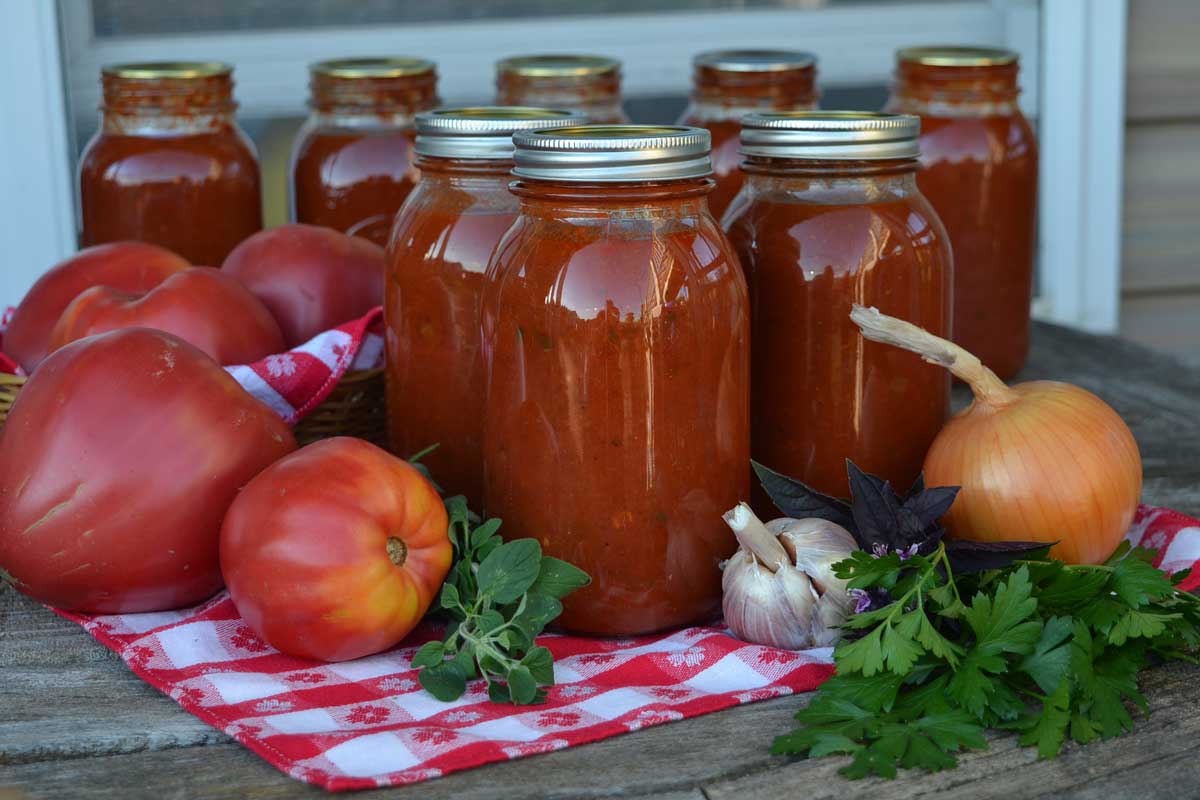
We take you through the recipe step by step with photos, plus share tips for working with frozen tomatoes. A good homemade spaghetti sauce recipe for canning is a must in our house, because many store bought spaghetti sauces use ingredients like genetically modified high fructose corn syrup and soybean oil – not things we normally eat.
I start a batch in the morning, and slow cook it while I’m working on other things in the kitchen, like prepping the rest of the ingredients and canning equipment. Paste tomatoes yield a thicker sauce with less cooking, but you can use any tomatoes that you have available.
Spaghetti Sauce Recipe for Canning with Fresh Tomatoes – Step By Step Instructions
(Scroll down to bottom of post for print friendly version of recipe.)
My favorite canning spaghetti sauce recipe is adapted from The Encyclopedia of Country Living by Carla Emery. This recipe is very close to the “Spaghetti sauce without Meat” recipe listed on the National Center for Home Food Preservation website, so you know it’s a safe canning recipe.
Salt and pepper can be adjusted to taste, or substitute Italian seasoning for the oregano. It’s okay to substitute an equal amount of fresh basil for some of the celery, green peppers or mushrooms.
You can also cut this spaghetti sauce recipe in half or to a fourth. Just keep the processing time the same, or freeze the marinara sauce in freezer bags or freezer safe containers instead of canning.
When we’re ready to serve the spaghetti sauce, we open a jar and heat it up, or brown some ground beef or Italian sausage and add the sauce to the skillet.
Ingredients
- 30 pounds tomatoes
- 1/4 cup butter or olive oil
- 1 cup chopped onions
- 5 minced garlic cloves
- 2 tablespoons salt
- 1 cup chopped celery or green pepper
- 1 pound sliced mushrooms (optional)
- 2 teaspoons black pepper
- 2 tablespoons oregano flakes
- 1/4 cup minced parsley
- 1/4 cup brown sugar or unrefined cane sugar
Directions
Wash 30 pounds of tomatoes. Remove cores and quarter tomatoes.
Cook 20 minutes, uncovered, in large pan or pans to soften tomatoes. I cook mine at medium high heat in an assortment of heavy bottom stainless steel pots. I have also used a Nesco roaster and a slow cooker.
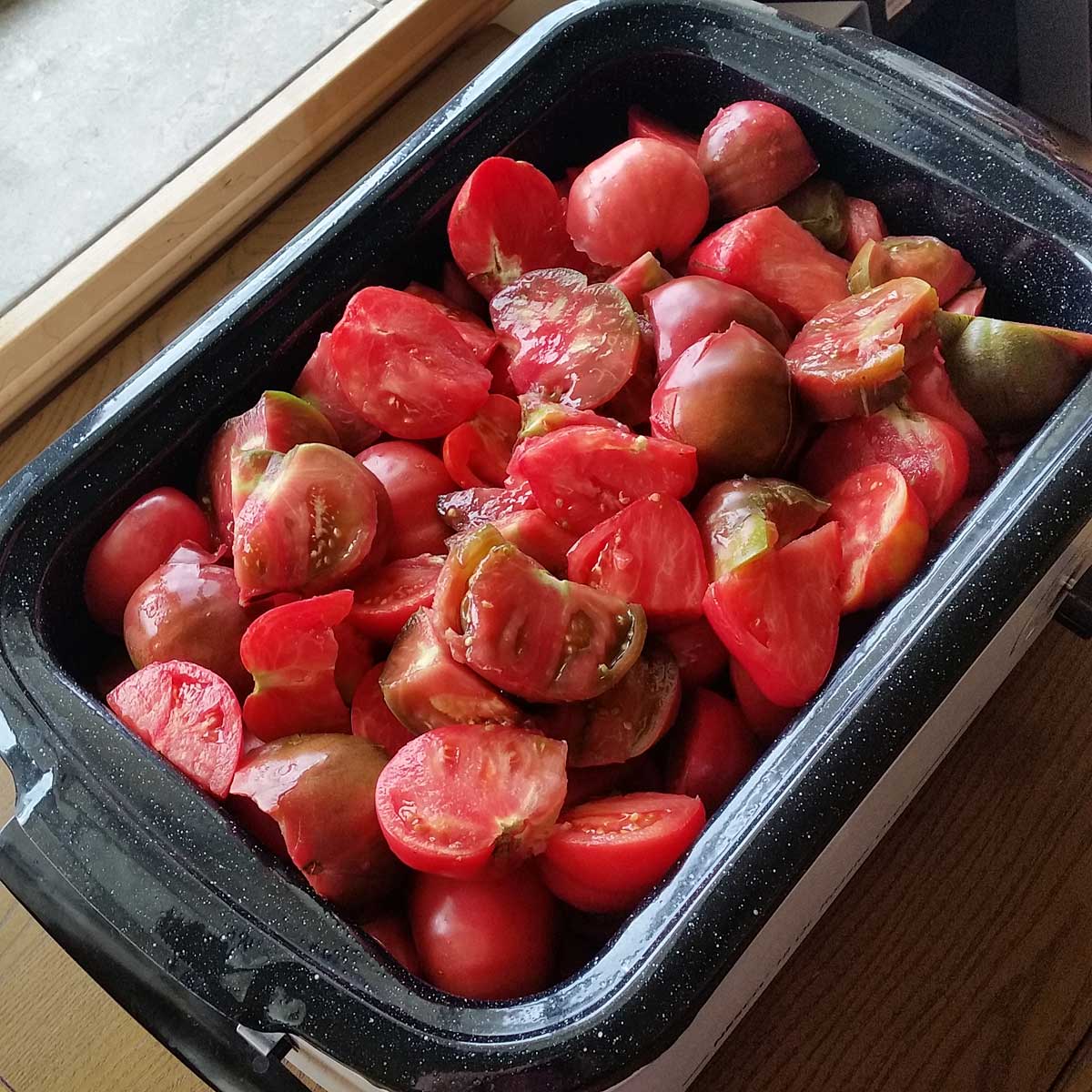
Thick bottom pans prevent accidental scorching, frequent stirring is recommended. Don’t use aluminum – it will react with the acid in the tomatoes. When I cook on the stove top, I start with four pans and cook the sauce down to one 8 quart stockpot.
Put tomatoes through a food strainer or food mill. I have a Back to Basics food strainer that works beautifully. (The Back to Basics strainer isn’t available anymore, but this Norpro strainer is similar.) We feed the seeds and skins to the chickens, or you can put them in the compost.
Years ago I used a chinois strainer. I still use it for small batches, but for large batches the food strainer can’t be beat. It’s so much faster! KitchenAid also makes a strainer attachment for their mixers.

Cook down the strained tomatoes to reduce volume and make a thicker sauce. We start with four pots and end up with one. This is the base of your spaghetti sauce.

While the tomato sauce is cooking, you can do the rest of the prep work, like chopping the rest of your veggies, filling the canner, and getting the lids and jars ready.
My pressure canner uses three quarts of water, to which I add one tablespoon of white vinegar to reduce hard water build up on the jars. I wash my jars in the dishwasher and keep them hot until I’m ready to fill.
I keep my lids in hot water in a one quart saucepan (do not boil lids), and use kitchen tongs for lifting them out of the water. The latest generation of canning lids from Ball do not require preheating, but I have a stock of lids that I am still working through.
To Finish the Sauce
Sauté in 1/4 cup butter or olive oil until tender: onions, garlic, celery or green pepper, and mushrooms. Combine sautéed vegetables and strained tomatoes. Add salt, black pepper, oregano, parsley and sugar.
Bring to a boil. Stir frequently to avoid burning. Reduce heat to simmer, keep hot while waiting to process.
Canning the Spaghetti Sauce
Fill jars, leaving 1 inch headspace. Adjust lids. Process in a pressure canner 20 minutes for pints, 25 minutes for quarts.
If using a weighted-gauge canner, set at 10 pounds pressure at 0-1,000 feet above sea level; set at 15 pounds pressure at higher altitudes.
If using a dial-gauge canner; set at:
- 11 pounds pressure at 0-2000 feet above sea level
- 12 pounds at 2,001-4,000 feet
- 13 pounds at 4,001-6,000 feet
- 14 pounds at 6.001-8,000 feet
- 15 pounds above 8,000 feet
Allow canner to cool and release pressure. Remove jars and set on towel on counter. Let rest until cool, or overnight.
Remove rings, wipe any spills. Date and label and store in a cool, dry location, out of direct sunlight. Best used within 1-2 years.
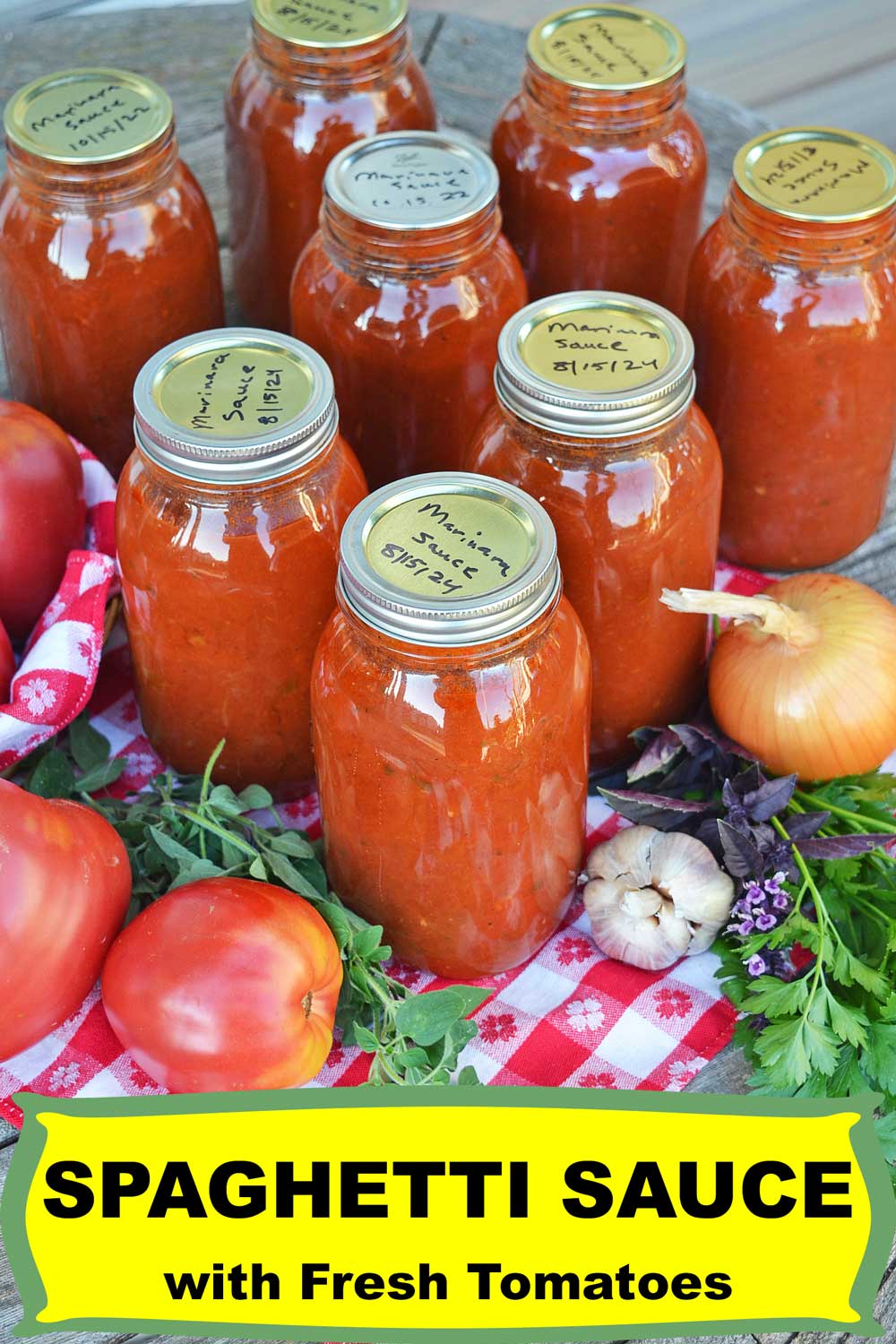
Yields around eight pints of home canned spaghetti sauce.
Would you like to save this?
What About Canning Spaghetti Sauce Without a Pressure Canner?
You need to use a pressure canner for canning this spaghetti sauce recipe, since it contains low acid ingredients like oil and onions. Freezing spaghetti sauce is a good option if you don’t have a pressure canner.
To use a water bath canner, the food you’re canning must have a pH of 4.6 or lower.
The homemade spaghetti sauce recipes with lemon juice added to make them safe for water bath canning taste like lemons to me, not tomatoes. I’ve tried them, but I can’t recommend them.
Citric acid lowers acidity without changing the flavor of the sauce, but there’s still the issue of the oil. Use the freezer instead.
See “How to Can Food at Home” for a review of safety basics.
How long does home canned spaghetti sauce last?
The flavor and nutrient levels in your home canned spaghetti sauce are best when used within one to two years. If you store the sauce in the freezer, try to use it within six months.
We’ve used a few home canned items at five years of age, but the flavor is not as good.
Never use a canned product with a broken seal, bulging lid or other obvious signs of damage or spoilage.
How do you thicken homemade spaghetti sauce for canning?
Low, slow cooking is my default option to thicken the sauce and concentrate the flavor of the tomatoes.
Other options include:
- Weigh and freeze the tomatoes, and then allow them to thaw in a colander to remove excess liquid before proceeding with the recipe.
- Can the sauce when it is somewhat thin, and then add tomato powder or dehydrated tomato puree to thicken when you heat the sauce for serving. I use this option when I make sauce out of cherry tomatoes or other very juicy tomatoes instead of paste tomatoes.
Some people grind up the skins and seeds to thicken the sauce. For our tastes, this made the sauce so bitter that we couldn’t eat it. Also, the skin and seeds of the tomatoes are where most of the lectins are.
Why Remove the Seeds and Skin?
Lectins are a type of protein that can bind to carbohydrates, and act as part of the plant’s self defense mechanism. They are difficult to digest, and may contribute to leaky gut syndrome. They may also have a negative effect on the immune system in sensitive individuals.
By removing the skin and seeds, we remove the majority of the lectins, making the tomato sauce easier to digest.
If You Don’t Have Enough Ripe Tomatoes from One Picking
If you don’t have enough ripe tomatoes at one time for canning spaghetti sauce, you can store tomatoes that are very ripe or damaged into the freezer, until you have enough for the recipe.
Our ripe, undamaged tomatoes will easily keep for a week or more at room temperature. Cracked or otherwise damaged tomatoes will only last a day or two before spoiling and/or attracting fruit flies. They should be processed in some manner within 24 hours, if possible.
I usually core the tomatoes and half or quarter them (depending on the size) before freezing. Then, when I am planning on canning spaghetti sauce the next day, I place them in the sink overnight to thaw. In the morning, you can pour off some of the clear juice if you like so that the cook down quicker. Weigh them out, dump them into your stockpot, and start cooking.
If you have fruit that’s refusing to ripen, check out “4 Reasons your Tomatoes Aren’t Ripening – And What You can Do About it“.
If you have tomato blossoms, but no fruit, we have help for that, too.
PrintCanned Spaghetti Sauce Recipe – Fresh or Frozen Tomatoes
Never buy spaghetti sauce from the store again.This homemade canning spaghetti sauce recipe is slow cooked and loaded with flavor. May also be used fresh or frozen if you don’t have a pressure canner.
- Prep Time: 5 hours
- Cook Time: 20 minutes
- Total Time: 5 hours 20 minutes
- Yield: 8 pints 1x
- Category: Sauce
- Method: Canning
- Cuisine: American-Italian
Ingredients
- 30 pounds tomatoes
- 1/4 cup butter or olive oil
- 1 cup chopped onions
- 5 minced garlic cloves
- 2 tablespoons salt
- 1 cup chopped celery or green pepper
- 1 pound sliced mushrooms (optional)
- 2 teaspoons black pepper
- 2 tablespoons dried oregano flakes
- 1/4 cup minced parsley
- 1/4 cup brown sugar or unrefined cane sugar
Instructions
- Wash 30 pounds of tomatoes. Remove cores and quarter tomatoes. Boil 20 minutes, uncovered, in large pan (or pans).
- Put through food strainer or food mill. Cook down tomatoes to reduce volume and make a thicker sauce. Reduce volume by 1/2 to 2/3rds.
- While the sauce is cooking, finish the remaining prep work, like chopping your veggies and getting the lids and jars ready. Prepare pressure canner according to manufacturer’s instructions.
To Finish the Sauce
- Saute in 1/4 cup butter or olive oil until tender: onions, garlic, celery or green pepper, and mushrooms.
- Combine sauteed vegetables and tomatoes.
- Add salt, black pepper, oregano, parsley and sugar.
- Bring to a boil. Stir frequently to avoid burning. Reduce heat to simmer, keep hot while waiting to process.
- Fill jars, leaving 1 inch headspace. Adjust lids.
- Process in a pressure canner 20 minutes for pints, 25 minutes for quarts. If using a weighted-gauge canner, set at 10 pounds pressure at 0-1,000 feet above sea level; set at 15 pounds pressure at higher altitudes. If using a dial-gauge canner; set at 11 pounds pressure at 0-2000 feet above sea level; 12 pounds at 2,001-4,000 feet; 13 pounds at 4,001-6,000 feet; 14 pounds at 6.001-8,000 feet; or 15 pounds above 8,000 feet.
- Allow canner to cool and release pressure. Remove jars and set on towel on counter. Let rest until cool, or overnight. Remove rings, wipe any spills. Date and label and store in a cool, dry location, out of direct sunlight. Best used within 1-2 years.
Nutrition
- Serving Size: 1 cup
You may also enjoy:
- Home Canned Salsa Recipe – Plus 10 Tips for Canning Salsa Safely
- 2 Homemade Ketchup Recipes
- Home Canned Tomato Soup
- How to Can Tomatoes
- Pickled Cherry Tomatoes for Canning, Plus More Cherry Tomato Ideas

This article is written by Laurie Neverman. Laurie grew up in the kitchen, learning baking and home cooking from her momma. At age 15, she and her mom and two sisters created Irene’s Custom Cakes & Catering. This was her summer job through most of high school and college.
Originally published in 2009, last updated in 2024.
I have a question. I froze my tomatoes and due to time I haven’t used them to create this sauce recipe yet. I am wondering, if I defrost them now (they were frozen during the summer and early fall) can I still make this recipe and can the sauce. I am wondering if it will have the same flavor since it has been almost 6 months since they were frozen especially if I can the sauce. I have never canned sauce and loved your easy tutorial.
The flavor won’t be exactly the same as fresh, but it should still be good. Slow simmering brings depth of flavor back, even after the deep freeze.
You can weigh before thawing to get total weight, and if you want to speed up the process, you can pour off some of the clear juice after thawing, before cooking down. I wouldn’t pour it all off, as the goal is cooking it down to concentrate the flavor, but a third or a quarter shouldn’t make a major difference.
This is by far the best tasting spaghetti sauce I’ve ever made. Get so many compliments. easy to make. The longer it simmer the tastier it is. I don’t have to reduce it as much as recipe calls for, only by an inch. It makes9 -10 pints.
I’m glad it works well for you.
I love this recipe but I’m so confused when you say cook the sauce down…layer add veggies and tomatoes.
Do we had back in the strained/seedless tomatoes once the sauce has cooked down?
Hi Leah.
We cook the tomatoes, and then remove the seeds and skins. The seeds and skins are fed to chickens or composted.
The strained (skinless, seedless) tomatoes are returned to the stove, and slowly simmered until greatly reduced in volume. You want your runny tomato juice to get fairly thick. We cook four pots of juice until it fits in one pot.
While the strained tomatoes are cooking down, I do all the rest of the prep work – cooking the other veggies, preparing the jars and canner, etc.
Once the juice is thickened to a more sauce-like consistency, I add the cooked vegetables, fresh herbs and seasonings to the tomatoes to complete the sauce.
Does this make more sense?
Can I use a water bath canner instead of pressure cooker
You need to use a pressure canner for canning this spaghetti sauce recipe, since it contains low acid ingredients like oil and onions. Freezing spaghetti sauce is a good option if you don’t have a pressure canner.
To use a water bath canner, the food you’re canning must have a pH of 4.6 or lower.
The homemade spaghetti sauce recipes with lemon juice added to make them safe for water bath canning taste like lemons to me, not tomatoes. I’ve tried them, but I can’t recommend them.
Citric acid lowers acidity without changing the flavor of the sauce, but there’s still the issue of the oil. Use the freezer instead.
Can I follow the exact recipe using frozen tomoratoes? I have so many in my freezer but have never canned before so this would be a first time for me! Thank you for your help.
Sure. Just weigh out the correct amount of tomatoes and go from there. Frozen tomatoes soften as they thaw, so you don’t even need to quarter and core them if you don’t want to, unless they have very hard cores. After cooking for a while, they should be soft enough to go through a food mill or food strainer.
Can I use the kitchen aid saucer/juicer attachment instead of the food mill?
KitchenAid KSM1JA Masticating Juicer and Sauce Attachment, 1L, Silver
Thank You!
Absolutely! I’ve been considering getting one myself, but I do like my old Back to Basics strainer.
Do I have to strain the seeds out? I am using a roaster to cook the tomatoes and I am using a Cuisinart smart stick immersion blender to sped up the condensing process.
It’s up to you. The sauce will still be safe to can if you leave them in and grind them.
As I noted in the article, we strain them rather than grinding them, because they make the sauce bitter. They also contain lectins, which are difficult to digest and may contribute to leaky gut syndrome.
thank you. ai did train alot of them out.
Hmm, I usually leave mine in, because I’m lazy. But I don’t do the immersion part, so maybe that’s why I’ve never found it bitter. Thanks for the info, though!
Everyone in our family falls someone in the “supertaster” range, so we notice it more than most, I suspect. Either way, it’s safe, so that’s the most important part.
how many jars will this make
It makes 8 to 10 pints, depending on how meaty the tomatoes are.
This information is very helpful! I did not weigh my tomatoes, so now I have a massive amount of tomatoes but don’t know what ratios to use. It’s also very confusing bc everyone cuts out more or less amounts of a tomato and I like to strain the liquid after I have frozen the tomatoes to skin them…
so my question is, what are my ratios if all I have is tomatoes sauce?
I don’t have a simple one to one exchange, because, as you noted, different tomatoes and different cuts will give different yields.
I’ve found that a gallon freezer bag, moderately full, weighs about 5 pounds. So six gallon freezer bags of tomatoes would be roughly 30 pounds of tomatoes. If you take the time to freeze in five pound bags, then you can grab and thaw them as needed for sauce making and have an easy way to keep track.
After straining, but before final cook down, I usually have two 8 quart stockpots full of tomato juice and other ingredients, so 16-20 quarts of juice to start should get you near similar ratios. The final sauce gets pressure canned, so there’s some wiggle room in the pH.
My husband loves spicy spaghetti sauce but I can’t find a recipe for it. Do you have any recommendations to add spice/heat to this recipe and should I omit anything in order to add the spice? Thank you in advance.
Officially, the food police don’t like substitutions, and only suggest using “tested” recipes.
Unofficially, it’s a sauce (plenty of liquid for heat transfer), and you have a nice, long processing time in the pressure canner, so as long as you don’t get too crazy, you should be fine.
Dry spices are the simplest addition, and get a thumbs up from the canning police, because they don’t change pH. Red pepper flakes are an easy way to add some heat. You might like some basil (fresh or dry), too. It looks like those are the most common additions for spicy spaghetti sauce. Try around 3-4 teaspoons of pepper flakes, depending on how much heat you prefer, and around a tablespoon of basil. (You can add more to taste.)
Maybe you have already addressed my question but there were so many postings I honestly didn’t feel like trying to read through them all. my question is does it make any difference which type of tomatoes you use? does it have to be romas or can you use any type of tomatoes?
You can use any tomato variety, but the meatier the tomatoes, the less cooking your sauce will require to get thick. We use paste tomatoes, generally Opalka or Amish Paste, because they grow very well in our garden.
Extremely juicy tomatoes will take much longer to cook down to a thick sauce.