
How to Can Food at Home – Quick Guide to Safe Home Canning

This post may contain affiliate links. Read my full disclosure here.

To can food at home, you combine canning safe glass jars, lids with rubber gaskets, food that’s safe for canning and the right heat processing. Home canning allows you to preserve almost any food – even entire meals – but you need to follow the rules.
In this post I’ll discuss how to can food at home safely, basic equipment for home canning, canning tips and recipes.
Would you like to save this?
Once your jars are sealed, all you need is a cool, dark space to stash your bounty. No electricity is required for storage (unlike freezing) and no water is needed to serve (unlike dehydrating).
This makes home canned goods an excellent storage food for times when the power is out or water service is interrupted. If you can cook basic recipes, you should be able to can food at home.
How to Can Food at Home – Quick Guide
- Decide what food you want to can.
- Find a safe canning recipe for that food.
- Assemble your canning supplies such as a water bath or pressure canner, jars, lids, funnel, jar lifter, etc. (See full list below.)
- Gather your produce and other ingredients and prepare according to safe canning guidelines.
- Process your home canned goods in a boiling water bath canner, steam canner or steam pressure canner for recommended processing time and rest time.
- Remove jars from canner and place on a towel to cool (12-24 hours). Try to avoid tipping jars too much as you remove them from the canner so you don’t get food in the jar seal.
- Check seals on jars. If jar has not sealed properly, refrigerate and consume within a couple of days. Remove rings for storage, wipe any spills or drips.
- Store jars in a cool, dry location, out of direct sunlight. Use within 1-2 years for best quality.
Recommended Resources:
- Ball Blue Book Guide to Preserving
- Ball Complete Book of Home Preserving
- The Organic Canner
- Food in Jars: Preserving in Small Batches Year Round
- Simply Canning: Survival Guide to Safe Home Canning
How Does Home Canning Work?
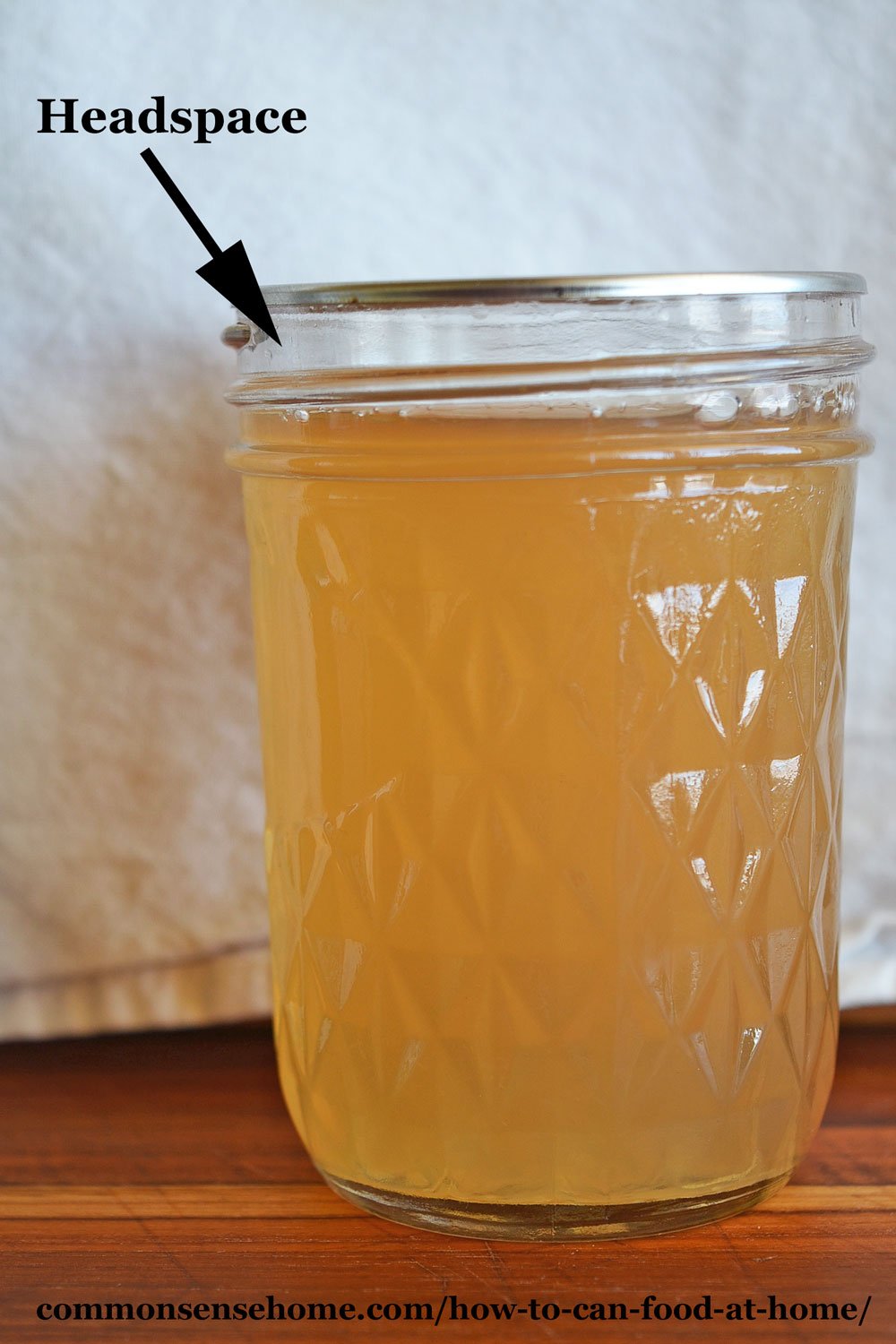
In simplest terms, you put food in a jar and heat treat for a certain amount of time to kill off microbes that will spoil it. When processed correctly, air is driven out from the headspace (the area between the top of the food and the jar lid), and a partial vacuum is formed.
Cooling completes the seal (the “plink” sound when the lid pulls down). No air + no microbes = preserved food.
The acid in foods that are safe to water bath can also inhibit the growth of bad microbes. Some microbes are really tough – like botulism spores – and require heat AND pressure to kill. (More on this below in the pressure canning section.)
Originally, this type of preservation was done with tin cans, thus the term, “canning” versus “jarring”. The Mason jar was introduced in 1858.
There are three types of home canning – water bath canning. steam canning and pressure canning.
Water Bath Canning
What foods can be canned in a water bath?
Use water bath canning for canning high acid foods (foods that have a pH of 4.6 or lower). This includes:
- Fruits
- Most soft spreads
- Tomatoes (with added lemon or citric acid)
- Pickles and other high acid foods
Do I need a special canner for water bath canning?
For water bath canning, you can use a commercial water bath canner or any large pot, as long as you have enough room in the pot to cover the jars with at least one inch of water.
You must not allow jars to sit directly on the bottom of the pot, or they will be more likely to break. (One option to keep jars off of the bottom of the pot is to make a “rack” of canning rings.) You can use your pressure canner for water bath canning – just leave the vent open.
If you plan to do any amount of canning, a standard water bath canner is fairly inexpensive and well worth the investment.
Steam Canning
Steam canning is another option for preserving high acid foods. This should not be confused with pressure canning. Steam canning was re-approved for home food processing in 2018, after being out of favor for some years.
In a steam canner, jars are processed in pure steam at 210-212 °F, but they are not under increased pressure. Water is placed in the bottom of the canner to generate steam. The jars are not submersed in water.
Processing times must be limited to 45 minutes or less, to avoid the canner boiling dry. Use the processing time and headspace specified for water bath canning for steam canning.
See full safety guidelines at “Safe Preserving: Using a Steam Canner“.
Pressure Canning
What foods can be canned in a pressure canner?
Use pressure canning for low acid foods (foods with a pH higher than 4.6). This includes:
- Meats
- Seafood
- Poultry
- Dairy products* (Canning dairy is not generally recommended. Try freeze drying instead.)
- Vegetables
- Soups and Meals
Why do we need to pressure can these foods? We pressure can because of Clostiridum botulinum – otherwise known as botulism toxin – which can be deadly. This bacteria lives in soils and sediments, so it’s everywhere, but most of the time it doesn’t cause trouble, because it lives with lots of other bacteria.
Here’s the problem – botulism grows at temperatures between 40-120°F (5-49ºC) and oxygen levels below 2 percent – like the inside of a sealed canning jar. High acid foods (pH ≤ 4.6) keep botulism spores from germinating into live cells.
To destroy the botulism spores, process low acid foods at 240-250°F (116-121°C) under pressure of 10-15 pounds per square inch (psi) at sea level. Always follow a tested recipe when canning low acid foods.
What Vegetables can be Canned?
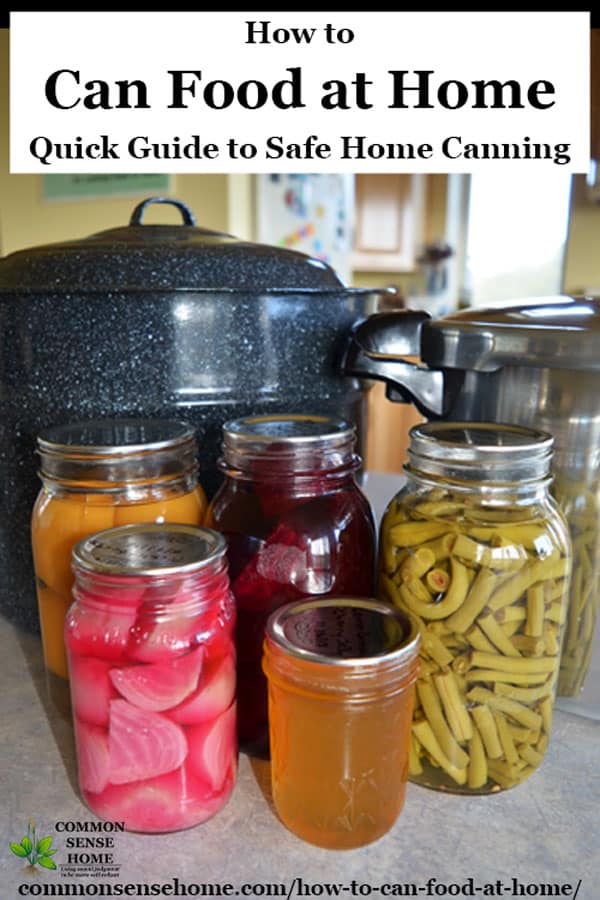
Remember, vegetables are low in acid and must be processed in a pressure canner, unless they are pickled with added acid. The National Center for Home Food Preservation notes that that following vegetables can be canned in a pressure canner:
- Asparagus, Spear or Pieces
- Shelled, Dried Beans or Peas – All Varieties
- Baked Beans
- Dry Beans With Tomato or Molasses
- Fresh Lima Beans – Shelled
- Beans, Snap and Italian – Pieces, Green and Wax
- Beets – Whole, Cubed, or Sliced
- Carrots – Sliced or Diced
- Corn – Cream Style
- Corn – Whole Kernel
- Mixed Vegetables
- Mushrooms – Whole or Sliced
- Okra
- Peas, Green or English – Shelled
- Peppers
- Potatoes, Sweet – Pieces or Whole
- Potatoes, White – Cubed or Whole
- Pumpkins and Winter Squash – Cubed
- Soups
- Spinach and Other Greens
- Succotash
- Tomatillos
Note that pumpkins and other winter squash can only be canned as cubes, not as puree. Although you may purchase canned pumpkin puree, we can’t ensure uniform heat transfer to puree in a home kitchen. When ready to used canned pumpkin cubes, simply drain, mash and proceed with your recipe.
How long do you boil a jar to seal it?
Although boiling a jar in a water bath canner does seal it, that’s not the only reason we boil our canning jars during the canning process.
We determine the processing time (time to boil a jar during canning, or time to process at the required pressure) based on the type of food and the head space.
Head space is the distance from the top of the food to the jar lid.
During processing, we want to drive the air out of the jar headspace. This creates a partial vacuum in the top of the jar, and a tight, long lasting seal.
A typical processing time for jams and jellies is 10 minutes. You begin timing when your canner is at full boil. When using a pressure canner, processing time begins when the required pressure is reached.
Heating the food also kills off harmful microbes. Some foods require heat and high pressure. (See Pressure Canning, above.) Always follow tested recipes and use full processing times.
Many people swear by simply screwing the canning lids onto hot jars with hot contents. This will often seal the jars, but it does not create a vacuum, which increases risk of spoilage. There is also an increased risk of seals failing during storage.
Can you reuse lids for canning?
It depends on the lid. Basic metal lids with a rubber gasket are meant for only one use. During the home canning process, the rubber gets deformed, and it’s unlikely to make a good seal if reused.
Tattlers reusable canning lids are plastic and have a separate rubber ring gasket. Tattler lids are intended for reuse, although some users report higher levels of seal failure. I don’t find them to be quite as reliable as single use lids.
See “Comparison of Jarden Metal Lids and Tattler Reusable Canning Lids” for more information.
Weck canning jars come with a glass lid and separate rubber gasket. Their lids are also intended for reuse.
Below I cover some basic canning equipment that you can buy online or in most hardware stores. You may also be able to find some of it used.
How long does home canned food last?
The quality of home canned food is best within one year of processing. As more time passes, the color and flavor of the food will fade, and the food will get softer over time.
People have eaten home canned food that was 5 or even 10 years old or more, but I wouldn’t recommend it.
Always check to make sure the lid is on tight, and that there is no mold or other signs of spoilage. When in doubt, throw it out.
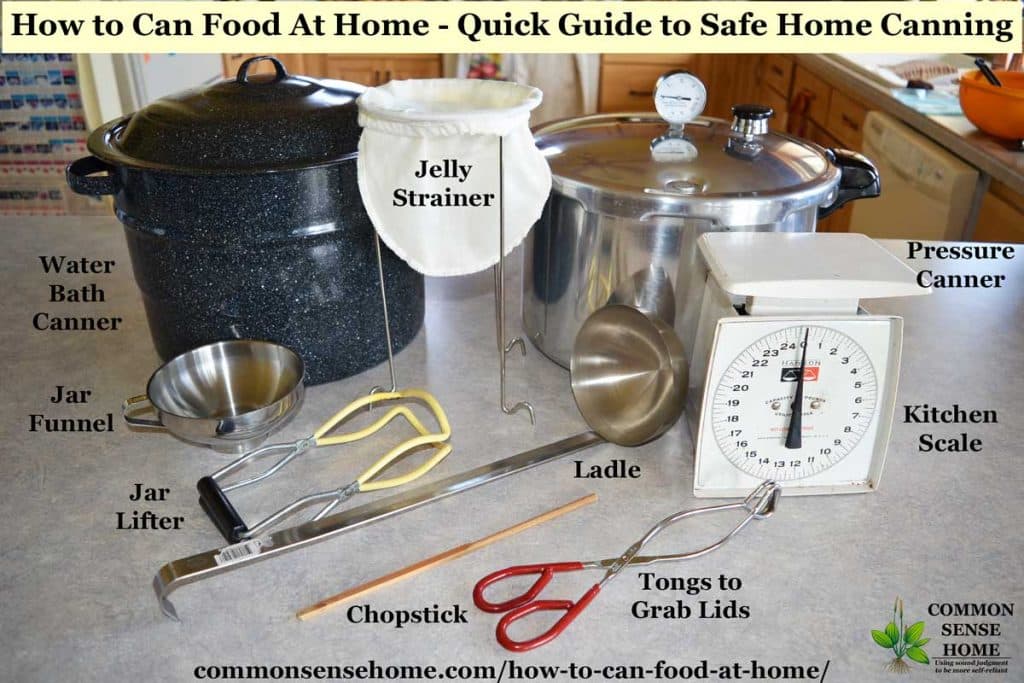
Basic Equipment Needed for Home Canning
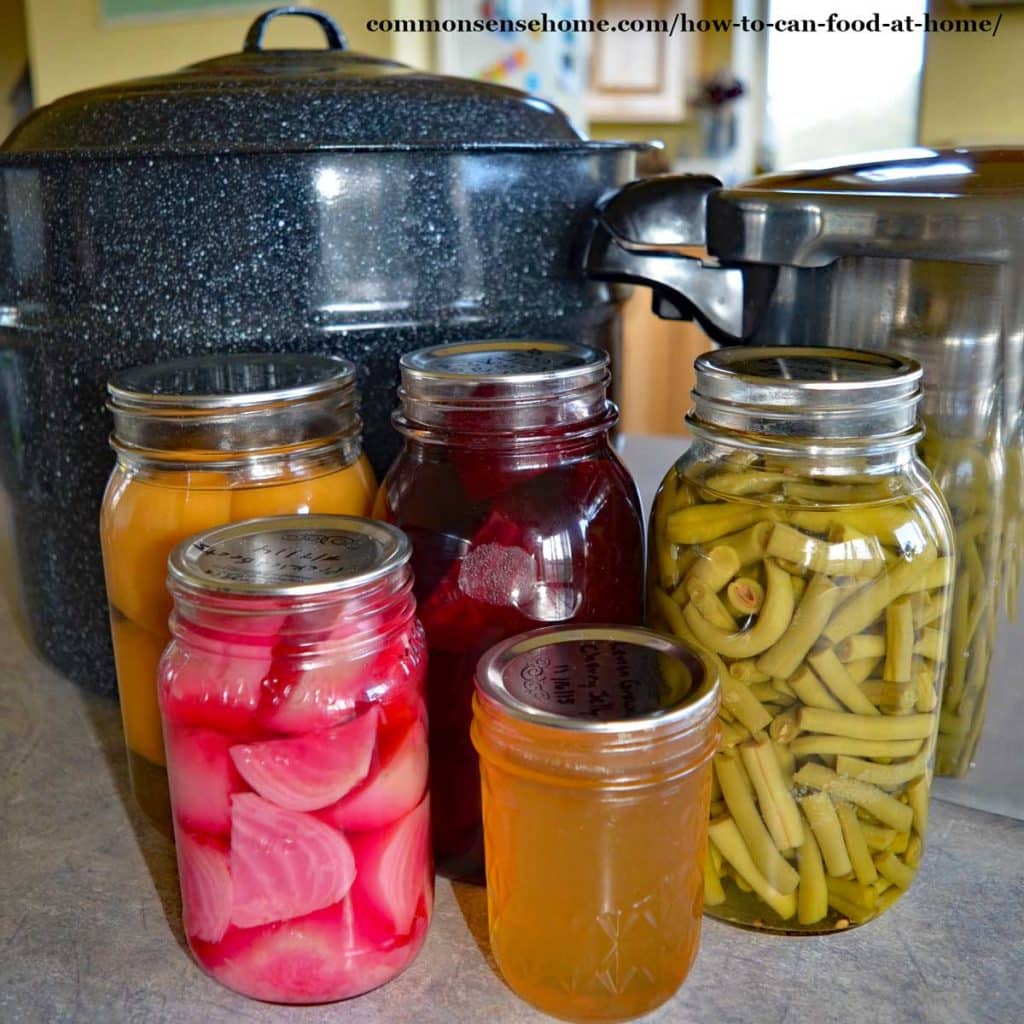
Starting at top left in the above photo and working clockwise.
Water Bath Canner
Water Bath Canners are used for canning high acid foods (having a pH of 4.6 or lower). They are a large pot with a lid and a rack in the bottom to keep the jars off the bottom of the canner.
Jelly Strainer Bag
The white baggie thing in the middle of the photo is a jelly strainer bag. I love this thing. Not only to I use it for straining jellies, I also use it for straining stocks and herbal infusions.
Pressure Canner/Steam Pressure Canner
A steam pressure canner is required for all low-acid foods, such as veggies, meat, soups and stews. I don’t recommend canning things like bread, pumpkin butter or chocolate syrup at home. Botulism can be deadly.
If I had a nickel for every time I’ve heard someone say, “Well I know so-and-so who has done it this way for years and they never got sick”, I could retire early.
One batch of bad food can kill or make you sick. What’s your family’s health worth to you? Get your canner tested every 3-5 years at a local extension office to make sure it is holding pressure properly.
Kitchen Scale
Kitchen scales are a necessity when you get into recipes like salsas or sauces, but they also come in handy for gauging how many jars you’ll need for the amount of produce you have, for knowing how much syrup to make to cover your fruit or for measuring sugar for jams and jellies.
The scale I have used to be my grandmother’s. It’s been around a while (okay, it’s much older than my kids), but it still works just fine.
Canning Ladle
A big, stainless steel ladle that holds at least 1 1/2 to two cups of product will allow you to fill jars much faster than a standard kitchen ladle.
Chopstick or thin non-metal spatula
You need some sort of long, thin object to run around the outside of jars to remove air bubbles. We have chopsticks on hand, so I just use one of those.
Don’t use a knife or other metal object, as you may scratch the inside of the jar and damage it.
Kitchen tongs or a magnetic jar lid lifter
Again, since I have kitchen tongs on hand, I just use those, but magnetic jar lid lifters can also be used. You want to hold your lids in nice hot water (not boiling) to get them ready to seal. It’s a little hot to stick your fingers into.
Jar lifter
Another must have – canning jars get wicked hot, so you really need a proper jar lifter to move them about.
Jar Funnel
A good jar funnel will make it MUCH easier to fill jars, even wide mouth ones. Big ladle + big funnel = fast jar filling.
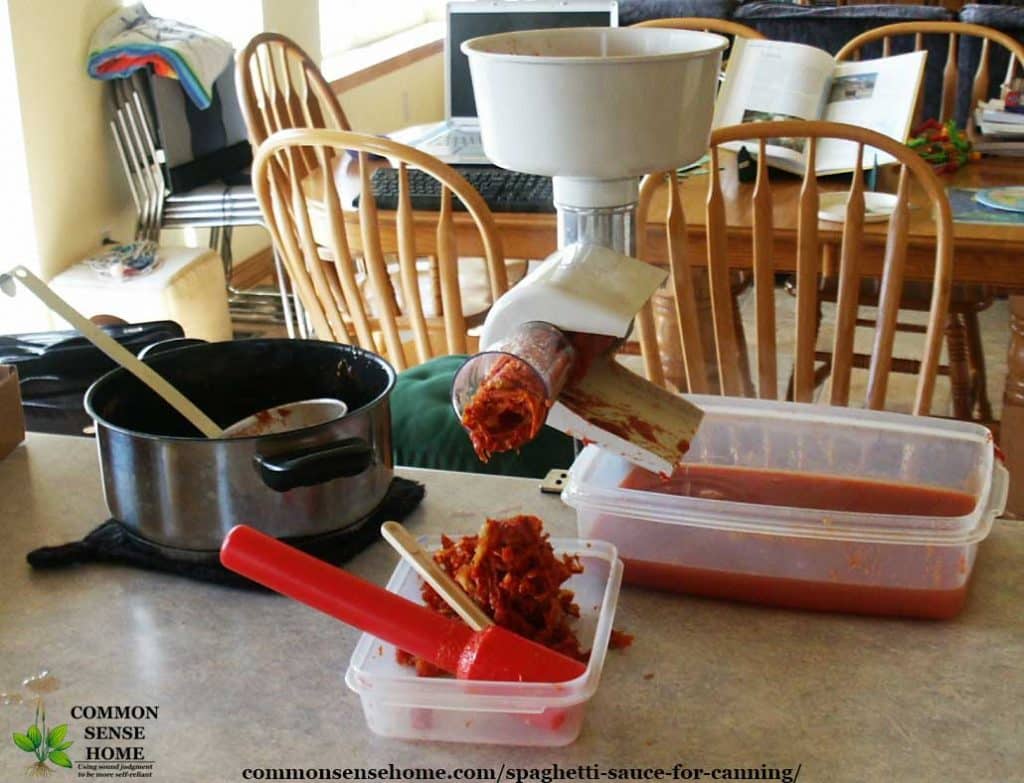
Food strainer
Food strainers are useful for making sauces. I use mine mostly for marinara sauce and apple sauce, and store it in the box to keep the parts together.
Apple Peeler/Corer/slicer
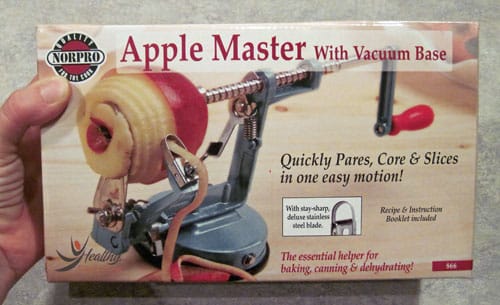
I use my apple slicer mostly for dehydrating, but it would be great for canning apple pie filling, too. (Norpro Apple Master).
Steam Canner – There are not many steam canners on the market at this time, but the Victorio Aluminum Steam Canner is well rated and available.
What Foods Are Easiest to Can?
Full sugar jams and jellies are probably the easiest foods to start with, because they process for only short amounts of time in a water bath canner and are really hard to screw up. Low sugar versions are only a bit trickier. Plain tomatoes or tomato juice is also very simple, as are fruits and fruit juices.
I do the bulk of my home canning during harvest season, but it’s okay to delay until cooler weather – if you have freezer space. Simply toss whole fruit (like tomatoes) or fruit puree into the freezer, and then finish processing when the weather has cooled.
General Canning Tips
- Prepare your jars, lids and all your equipment before you prepare your food.
- Work from one direction to the other. Don’t cross back and forth – it gets messy.
- Keep everything hot. You’ll remember this tip very quickly if you lower a cold jar into boiling water, or ladle hot syrup into a cold jar. Jars break rather impressively and make a huge mess.
- Always check and double check the edges of your jars and your lids. Any imperfection along the edge of a jar, and it is unlikely to seal properly. Put it in the recycling bin.
- Keep everything clean. You’ll have drips and spills, sure, but remember this is food prep, so try to keep your work space clear of outside contaminants such as hair or dirt.
For additional information on canning and other home food preservation methods, see “Home Food Preservation – 10 Ways to Preserve Food at Home“. Also, “The Natural Canning Resource Book” answers nearly every question I’ve ever had about canning.
Home canning and other home food preservation allows you to stock your pantry with quality food at affordable prices – with no mystery ingredients.
If you have canning questions, just ask, and I’ll do my best to help. I’ve been canning ever since I was a little girl (many decades ago), and keep op to date on the latest canning safety guidelines.
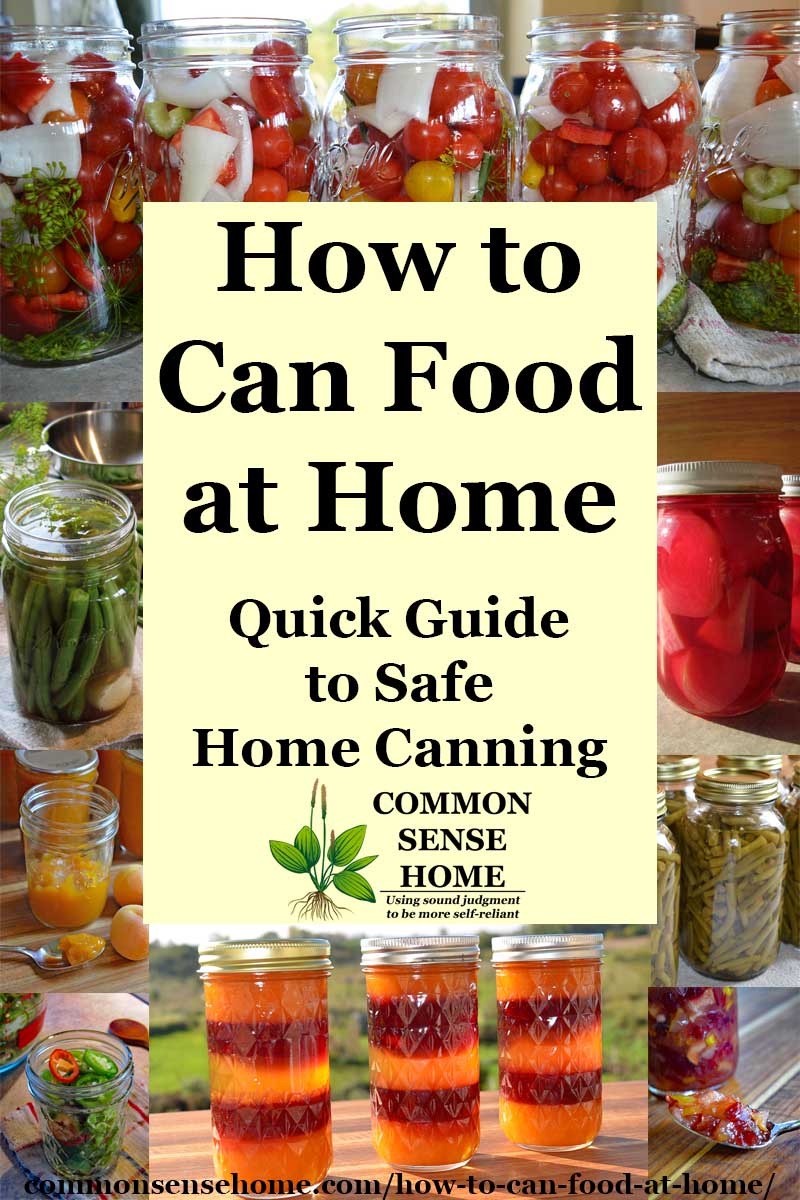
Canning Recipes
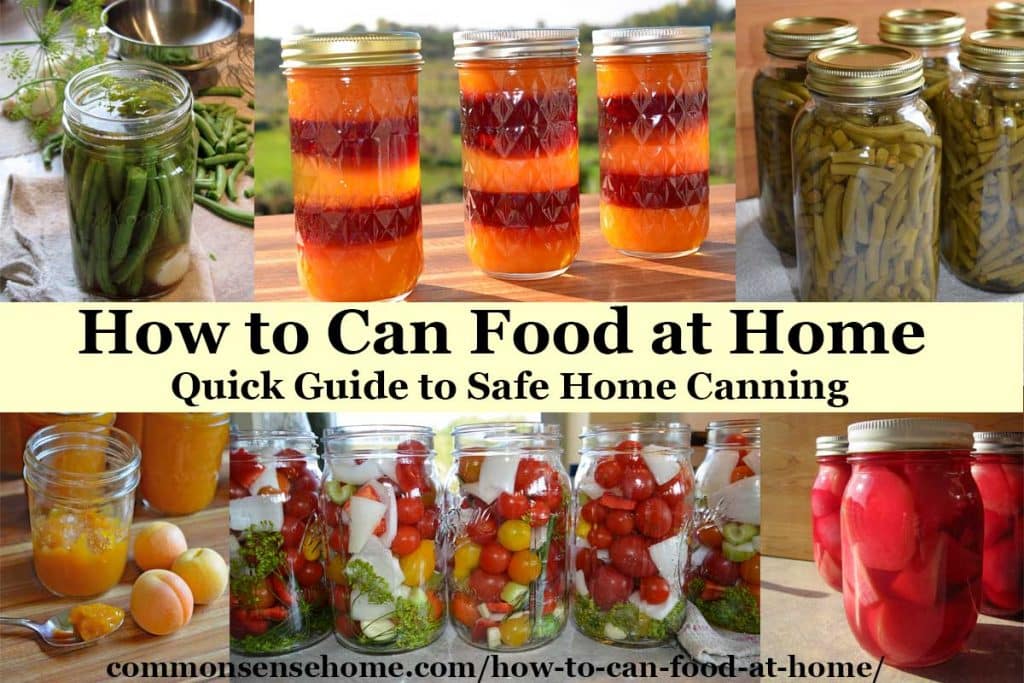
Pictured in the horizontal photo above, starting at top left and moving clockwise:
- Pickled Dilly Beans with Garlic and Cayenne Pepper
- Striped Jelly – Makes a One of a Kind Homemade Gift
- Home Canned Green Beans
- Gram Irene’s Pickled Beets
- Pickled Cherry Tomatoes for Canning, Plus More Cherry Tomato Ideas
- Low Sugar Apricot Jam Recipe – Sweeten with Sugar or Honey
Photo at top of post also includes:
- Pickled Peppers (bottom left corner)
- Cranberry-Pear Jam – Traditional and Low-Sugar (bottom right corner)
Vegetables and Condiments
- Green Tomato Pickles
- Spaghetti Sauce from Fresh Tomatoes
- Salsa for Canning – Plus 10 Tips for Safe Salsa Canning
- Homemade Ketchup – Canned
- Tomato Soup – Tastes Like a National Brand, Except Better
- How to Can Tomatoes in a Canner or Large Pot
- Pickle Relish Sweetened With Honey
- How to Can Green Beans
- Pickled Dilly Beans with Garlic and Cayenne Pepper
- Pickled Cherry Tomatoes for Canning, Plus More Cherry Tomato Ideas
- Gram Irene’s Pickled Beets
- Rhubarb-B-Q Sauce and Rhubarb-Orange Compote
- Pickled Peppers
Fruit
- Home Canned Peaches
- How to Can Pears in a Water Bath Canner
- Almond Pears
- Spiced Crabapples and Honey Cinnamon Crabapples
Jams and Jellies
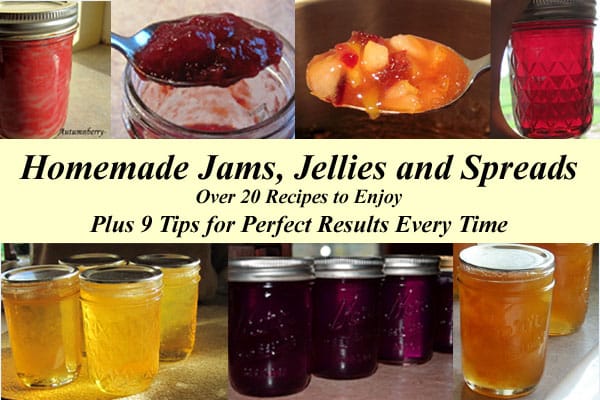
Full Listing of All Our Jam, Jelly and Spread Recipes with Photos
See “Common Sense Homesteading Recipes and Kitchen Tips” for more home food preservation recipes and tips.
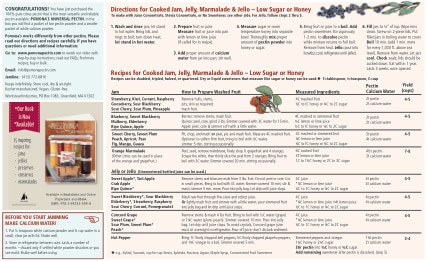
You can download a set of pdf instructions for making and creating your own low and no-sugar jams and jellies with Pomona’s Pectin (my favorite low sugar pectin) by clicking on the image or text below. Shared with permission from Pomona’s Pectin.
You may also enjoy:
- Home Freeze Drying – The Good, The Bad and The Ugly
- Home Food Drying – 6 Things You Need to Know to Dehydrate Food at Home
- Canning Questions Answered – Q&A session answering reader questions

Originally published in 2012, last updated in 2019.
So my wife is the gardener and I am the cook. I have a traditional mother sauce tomato recipe that I use from canned San Marzano tomatoes and my wife is growing San Marzano tomatoes. Can I use this recipe and follow the pressure canning procedure you have listed on your recipe. I’ve looked all over the internet and they all seem to say I have to add lemon juice or some sort of acid, but I don’t want to have the acid flavor in my sauce. And the canned tomatoes I used to buy have no acid added. My recipe only uses tomatoes, double concentrated tomato paste, onions, garlic, and fresh basil. And if I could use it, would headspace be the same? And I also have a salsa verde recipe from fresh tomatillos, Serrano peppers and onions. Could I pressure can this recipe as well without the added acid? And if it would be fine, what would the headspace measurement be? I will be using an All American weighted gauge pressure canner.
Hi Brandon.
The added acid is needed if you are doing water bath canning – BUT – if you don’t want to screw with the flavor, get some citric acid to replace the lemon juice or vinegar. You can substitute 1 teaspoon citric acid for 1/4 cup lemon juice.
Officially, you’re only supposed to use tested recipes. Unofficially, as long as your sauce isn’t so thick it won’t move in the jar, it’s probably safe to pressure can it. The sauce we can (and canning instructions) are here – https://commonsensehome.com/spaghetti-sauce-for-canning/
For your tomatillo salsa, I’d opt for citric acid and water bath canning. I think the flavor and texture will be better. We have a recipe with canning instructions here – https://commonsensehome.com/tomatillo-salsa/
is this guide available as a PDF file?
No, but you could copy and paste into a word processing program for personal use.
I am 76 years old! As a child our family garden took up 1/4 of the city block my folks owned. Needless to say,..harvesting, and canning was always a plus! My job was to work the soil, lay-out, and plant, making sure plants that required the most Sun, got plenty, and. provided shade for other plants that do bust in partial sun or shade! Also helped mom in canning! Now I plan to introduce my Daughter-inl-law, and Grand-daughter to canning? Their generation is (Just go to the store!) …Wish me luck!.. I will keep you posted on their success? Love your post’s.
That’s great that they have you as a resource.
Hi Laurie,
I always read all of your articles and want to stay on your email list please
Double checked, and you are good to go.