
No Can Dill Pickles – Just Stick Them in a Jar!

This post may contain affiliate links. Read my full disclosure here.
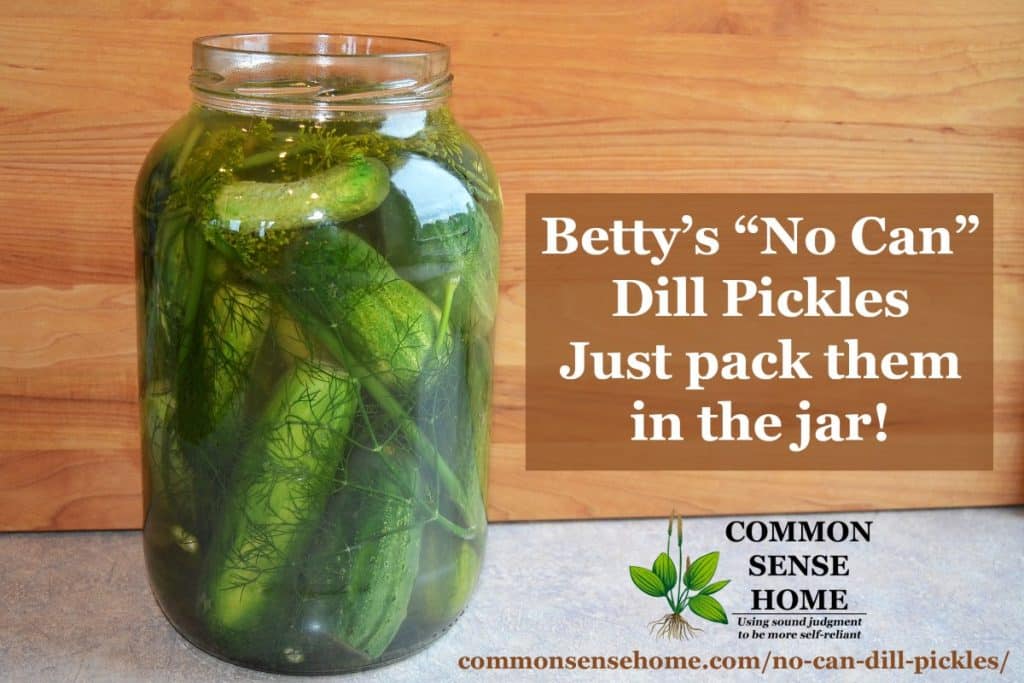
This recipe is from my neighbor Betty. Betty and I have swapped a lot of produce and recipes over the years (she’s also my son’s piano teacher and has become like a grandmother to him). Betty makes a simple old-fashioned brined dill pickle that doesn’t require canning, and couldn’t be easier to make.
My early attempts at dill pickles were not very successful. I followed the FDA guidelines from the Ball Blue Book of Preserving, and ended up with tasty pickles with absolutely no crunch.
I love my Blue Book, but these were not the pickles I was looking for. As I understand it, many commercial manufacturers add alum (aluminum potassium sulfate) to give their pickles crunch.
Needless to say, I wasn’t going that direction. These no can dill pickles bring the crunch without the aluminum.
Betty’s No Can Dill Pickles
Ingredients
- 9 cups water
- 1 ½ cup vinegar
- 1/3 cup salt (Do not use salt with iodine, it will give the pickles a brown tint, Real Salt also gives a slight brown tint, canning salt works best)
- ½ cup sugar
- Dill, 2-3 stalks
- 2-4 inch long cucumbers, enough to fill a gallon jar
Directions
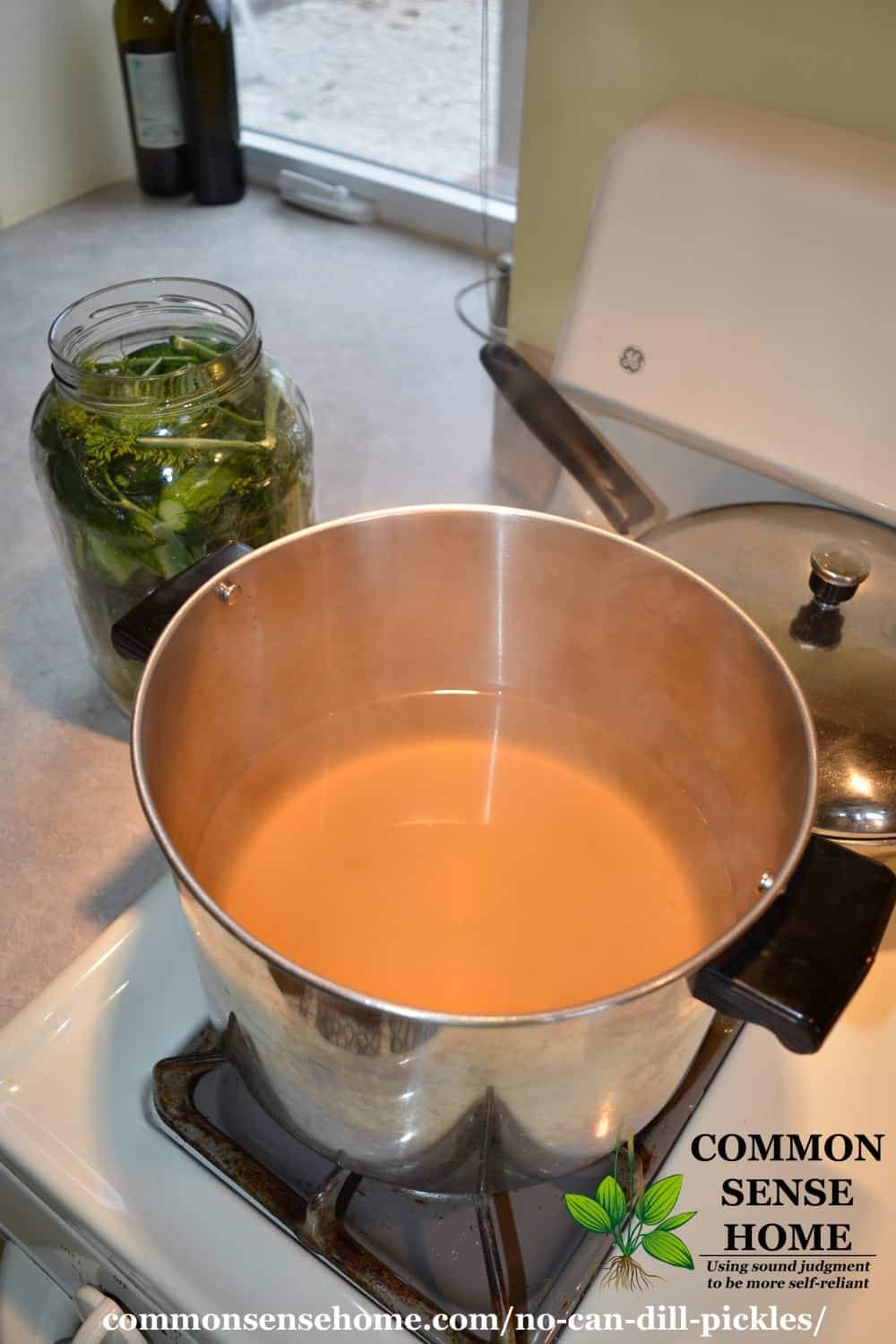
Combine the water, vinegar, salt and sugar and boil one minute. Cool slightly.
Wash the cucumbers and cut off about 1/16”from each end. This gets rid of some enzymes that would soften the pickles, and allows better penetration of the brine. Pack the cucumbers in a one gallon jar with the dill.
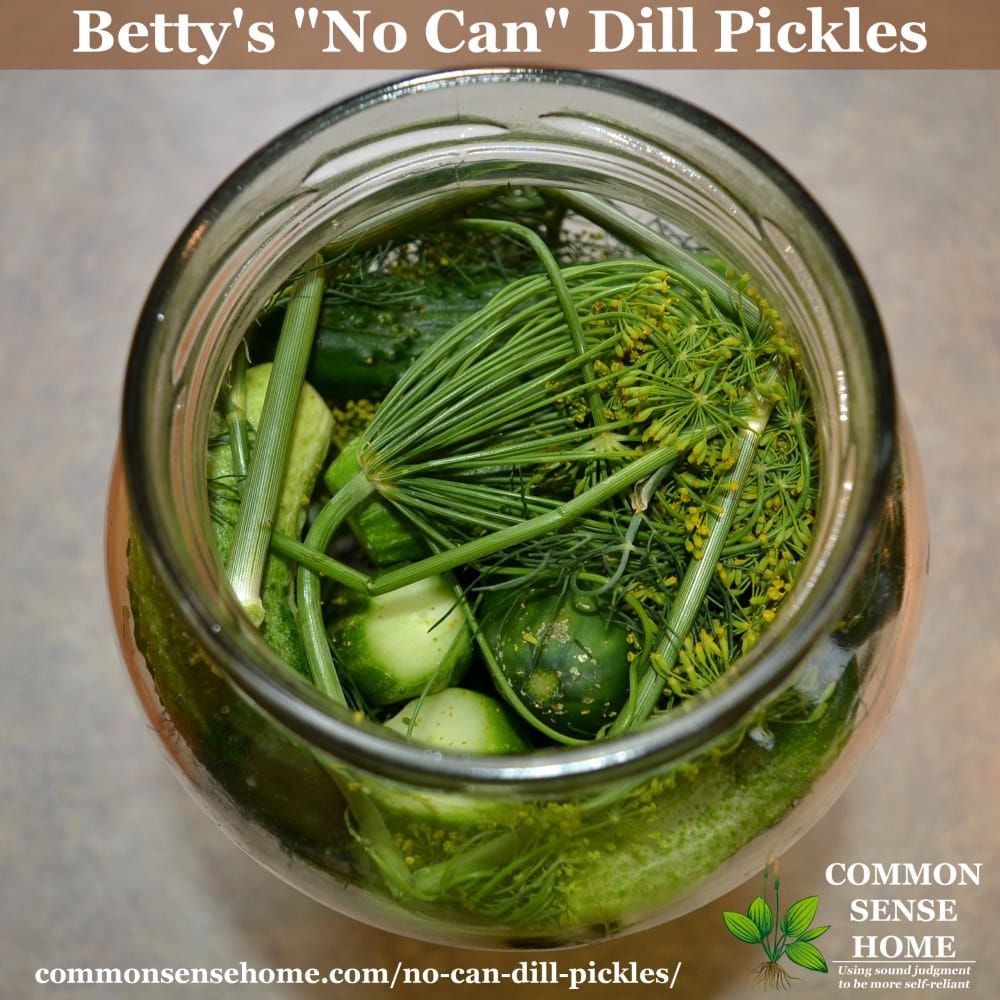
Note: I like to curl up some of the dill in the top of the jar to pin down the cucumbers and make sure they all stay submerged in the brine.
Would you like to save this?
Pour the warm brine over the cucumbers. Let stand, loosely covered, at room temperature for three days. (Drape a towel over the jar opening or let lid sit on loosely.) I rubber band everything, especially in fruit fly season.
You could also use something like the Picklemeister Glass Fermenter Jar, which in addition to being fun to say, comes with its own airlock built right into the lid.
Cover and store in refrigerator. They are ready to eat after the three days but the flavor improves after a week or two in the refrigerator.
That’s it! No canning, no heat processing of any sort. These pickles stay fresh and crisp tasty for months. We’ve enjoyed them at Christmastime.
If you don’t have a lot of small cucumbers, you could cut the recipe in half, or make up a full batch of brine but process pickles by the quart and hold the reserve brine in the fridge for a couple of weeks. Delicious!
Thanks, Betty. I love my country neighbors!
If you don’t have fresh dill
Fresh dill is preferred, but if you don’t have any available, you can substitute 4-6 tablespoons of dill seed. (Adjust as needed depending on your flavor preferences.)
PrintEasiest Ever, No Canning Required Dill Pickles
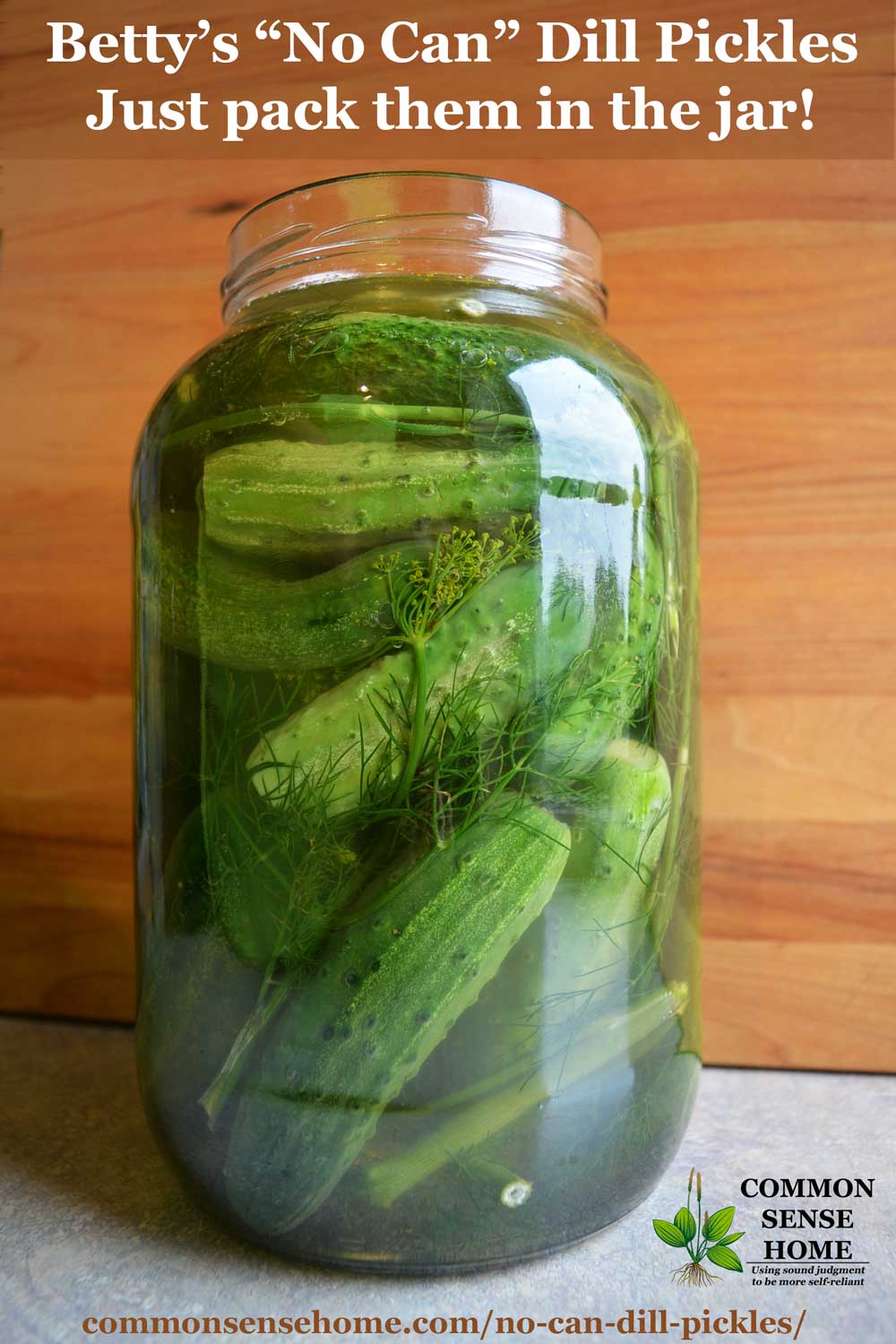
Super easy no-canning required dill pickles. No canning required, store in the fridge for months.
- Prep Time: 15
- Total Time: 15 minutes
- Yield: 1 1x
Ingredients
- 9 cups water
- 1 1/2 cup vinegar
- 1/3 cup canning salt
- 1/2 cup sugar
- Dill, 2-3 stalks
- 2–4 inch long cucumbers, enough to fill a gallon jar
Instructions
- Combine the water, vinegar, salt and sugar and boil one minute. Cool slightly.
- Wash the cucumbers and cut off about 1/16”from each end. This gets rid of some enzymes that would soften the pickles, and allows better penetration of the brine. Pack the cucumbers in a one gallon jar with the dill.
- Pour the warm brine over the cucumbers. Let stand, loosely covered, at room temperature for three days. (Drape a towel over the jar opening or let lid sit on loosely.) I rubber band everything, especially in fruit fly season.
- Cover and store in refrigerator. They are ready to eat after the three days but the flavor improves after a week or two in the refrigerator.
Notes
- I like to curl up some of the dill in the top of the jar to pin down the cucumbers and make sure they all stay submerged in the brine.
- Fresh dill is preferred, but if you don’t have any available, you can substitute 4-6 tablespoons of dill seed.
You may also enjoy:
- Pickle Relish Sweetened With Honey
- Home Canned Salsa Recipe – Plus 10 Tips for Canning Salsa Safely
- Pickled Dilly Beans with Garlic and Cayenne Pepper
- Creamy Cucumber Salad with Sour Cream Dressing
Originally published in 2010, updated 2016.
Can the pickles be stored in a cool, dark basement?
For a while, yes. The warmer it is about refrigerator temps, the faster they’ll soften.
I would not advise it. I’ve been making refrigerated pickles for several years now. And they keep in the refrigerator for a long time, I have some a year old and the jar sealed in the fridge lol. But unless it’s processed, you’ve got a nasty experiment and it could make someone very sick if you do not process and store in a basement.
Before refrigeration, cool storage was the default. A springhouse was better, but folks made do with what they had.
The salt and sugar in the recipe are hygroscopic, tying up free water, which inhibits microbial growth. The vinegar lowers the pH, which also inhibits pathogenic microbial growth. So the pickles will keep for a while, though the fridge is a much better option for longer storage.
As the pickles sit, they will start to ferment over time. Odds are that once they start to spoil, the signs will be quite obvious – mold, soft pickles, strong odor and off flavor and texture. It’s not going to be a botulism situation. The conditions aren’t right. Spoilage will be clearly visible.
This recipe is similar to one I have used many times over the years that I got from my aunt. The only difference is a night spent covered in ice (melts to cold ice water) that keeps the pickles even crisper. It is a never fail recipe that I enhance with lots of garlic in the jars.
One question I do have, is it best to store cucumbers off the vine on the counter or in the crisper to get enough to actually keep them fresh for your method or canning to fill the jars?
The crisper drawer or some other cool, slightly moist location is a better spot to gather enough cucumbers to make a batch. If left out too long, the smaller cucumbers tend to wilt. More mature cucumbers have thicker skins and will hold better at room temperature.
can I use sea salt for this recipe?
I do. I don’t recommend iodized salt, as it will discolor over time.
Hi Laurie,
Can this recipe be used for green tomatoes?
I haven’t tried it, but it should be safe. If you give it a go, could you let me know how it turns out?
Will the pickels continue to get more salty in a week?
The pickles can only absorb so much salt, then they reach homeostasis and don’t get any saltier. They might get a little bit saltier past the first week, but it won’t be a huge difference.
If you wanted to add salt you could. It would not make the recipe unsafe.
Hi. Thanks for the recipe. We love pickles and pickled foods in general and this is our first homemade attempt. I think I might have messed things up though because I used ACV and decided not to heat it with the salt water. Will this mean that my pickles will be unsafe to eat? I didn’t boil the ACV because I wanted to preserve the enzymes and benefits of the mother, but then I read your comments to others who had used ACV and now I’m worried that the pickles will not be safe to eat. Appreciate and advice and info. Thanks, again.
If it’s commercial ACV, the acidity levels should still be safe. I think the heating is primarily to help dissolve the salt and sugar. The brine gets cooled some before it goes on the cucumbers, so it should be okay. If it starts to spoil, the signs should be obvious. (For example, mold.)
Sterilize the jars. Closely pack jars. Pour boiling brine over the packed jars, seal and put in the cupboard. Keeps for years.
Can i ask is it necessary to use water when making pickles or can you just use vinegar only? I notice that most recipes seem to use a mix of water and vinegar but i am wondering if it would work without the water using just vinegar? Obviously it would probably give more of a stronger vinegary acidic taste (which i quite like) but other than that is there any reason why this would not work?
Hmmmm…
I haven’t seen this specifically discussed anywhere, but extra vinegar would lower the pH, so I don’t see a problem with it from a food chemistry perspective. I think most people would simply find the taste to be too strong.
Thank you for your quick reply. I had wondered this for a while as i was unable to find anything online regarding this either. I like my pickles to be extra vinegary so perhaps next time i make them i will give it a go and see what it tastes like and how strong it makes them. Maybe it will be too strong but it is worth a try. Good to know there is no problems with trying this from a food chemistry prospective. Great recipe by the way. I made this recipe a few weeks ago and the pickles turned out well.
If you do give it a try, I’d love to hear the results. There might be some other factors like osmotic pressure that I’m not considering, but pH is the main factor for safety. Salt and sugar draw water out of the cucumbers, also inhibiting microbe growth.
I shall give it a try and report back! I will probably make some more next week and give this method a try! I will let you know how they turn out!
Thanks!
My family don’t like sweet pickles, do you have to put sugar in dill pickles? I’ve never heard of that!
There isn’t enough sugar to make the pickles sweet, it just helps to balance the flavors and pull more water out of the cucumbers. (Both sugar and salt are hydrophilic.) Maybe make a half batch and see how you like the flavor?