Category Archives: freezing

Preserving Strawberries Four Ways – Freezing, Drying, Fruit Leather and Kombucha

The boys and I went strawberry picking twice this season, and came home with two trays of berries each time.  To put away some of these beautiful berries to enjoy for the rest of the year, we made two batches of low sugar jam (strawberry and strawberry-banana).  I also froze and dried some berries, and used some to flavor kombucha.

How to Freeze Strawberries

I prefer to have my berries individually frozen for use in smoothies, flavoring kombucha or pouring out only what I need for a particular recipe.  I start by gently rinsing the berries under running water in a colander. (I invested in an over the sink colander several years ago and I use it all the time for fruit and vegetables.)  I don’t recommend washing your berries in a basin of water, as they will act like little sponges and soak up additional water, making them mushy and tasteless.  I place the washed berries on a couple of layers of old t-shirts next to the sink to drip dry.  Each berry is then hulled and any damaged spots are removed with a paring knife before they are placed on a sheet pan covered with reusable parchment paper.  If you know you will only be using your berries for smoothies or another application where they will be well blended, it’s fine to leave the tops on as strawberry leaves are rich in vitamins and minerals plus ellagic acid, a highly touted cancer preventive.

Here’s the tray of berries ready to go into the freezer. I typically load them into the freezer on trays one day and vacuum seal them the next.

When vacuum sealing, make sure that you keep the opening of your bag completely clear of moisture to get a good seal.   Don’t try vacuum sealing unfrozen berries.  As the sealer pulls air out of the bag, the berries will compress and juice will be squeezed out of your berries and into the vacuum sealer.  You’ll make a rally big mess and your bags won’t seal.  (Yes, I did try this when I first got my vacuum sealer.)  Write the contents and date with a Sharpie marker somewhere on the bag, just in case they disappear into the bowels of the freezer and are uncovered much later.

Properly vacuum sealed, these berries will last well over a year with no appreciable ice crystal formation and very little visible deterioration.  If you don;t have a vacuum sealer, you may want to crush the berries before packaging, as the juice will help protect the berries and prevent ice crystal formation, or package in a light sugar syrup, which will also help prevent ice crystal formation.

How to Dry Strawberries

For individually sliced and dried berries, clean berries as for freezing, then slice vertically to a uniform thickness (roughly 1/4 to 1/8 inch thick).  Uniformly sized pieces will dry more evenly.  Load pieces on a dehydrator tray (clean-a-screen inserts will help to keep the dry fruit from falling through the trays) so that they are evenly spaced and not touching.  Dry at 135F/58C for around eight hours or overnight, until fruit is brittle and crisp and will break instead of bending.

Strawberries are 91% water, so they will shrink up a lot!

How to Make Strawberry Fruit Leather

Strawberries are low in pectin, so a strawberry only leather will tend to be brittle instead of supple/more leathery.  If you want a more pliable finished product, you can mix your strawberry puree half and half with applesauce.  For a strawberry only leather, puree fruits, tops and all, in a good quality blender such as a Vitamix.  Oil your fruit leather sheet with coconut oil to prevent sticking.  Pour strawberry puree on the sheet to a thickness of around 1/8 to 1/4 inch.  Thinner puree will result in a crisper end product, like a chip, thicker will give you a product more like fruit leather.

I loaded my trays while they were still damp from washing, so when morning came I needed to peel the leather off the trays and flip it over to finish drying.

How to Make Strawberry Flavored Kombucha

Strawberry flavored kombucha couldn’t be simpler.  Just add whole strawberries or strawberry puree to your finished kombucha when you bottle it after the initial brewing period.  I add approximately 1/2 cup of fruit per quart, sometimes a bit more.  Strawberries are quite tart, even though they are high in sugar, so you may wish to use a younger brew (7-10 days) instead of an older brew, otherwise the finished product may be overly acidic.  If you are using a bail top bottle, please be aware that the high sugar content of the berries will make your kombucha very active and potentially cause high CO2 build up – beware exploding bottles!

Here’s a gorgeous glass of strawberry kombucha my friend, Tami, made recently.  Doesn’t that look cool and refreshing for a hot summer day?

I’ve kept kombucha for several months in the refrigerator.  The yeast and bacteria in the drink act as a natural preservative for the fruit.  It just gets stronger and more fizzy over time.

Well, that’s about it for this year’s strawberry season.  Raspberries, blueberries and cherries will be coming in next.  Don’t forget to check out the gluten free strawberry shortcake and strawberry rhubarb crumble recipes.  I’m sure you could adapt both of these recipes for other summer fruits.

Next up, I’ll be talking about our 1.75 ton bulk grain order (nothing like a little stocking up) and writing reviews of Deep Nutrition and Food Rules (I bet you’ll like Dr. Cate as much as I do).  We’re giving away not one, but three copies of Deep Nutrition (love, love, love this book), so keep your eyes open.

Remember, if you enjoy the posts, please share on your favorite social networking site.  :-)

This post has been added to Fight Back Friday for July 22, 2011 at Food Renegade.
This post has been added to Preparedness Challenge #18 at Homestead Revival.

Preserving Asparagus Three Ways – Freezing, Drying and Lacto-Fermenting

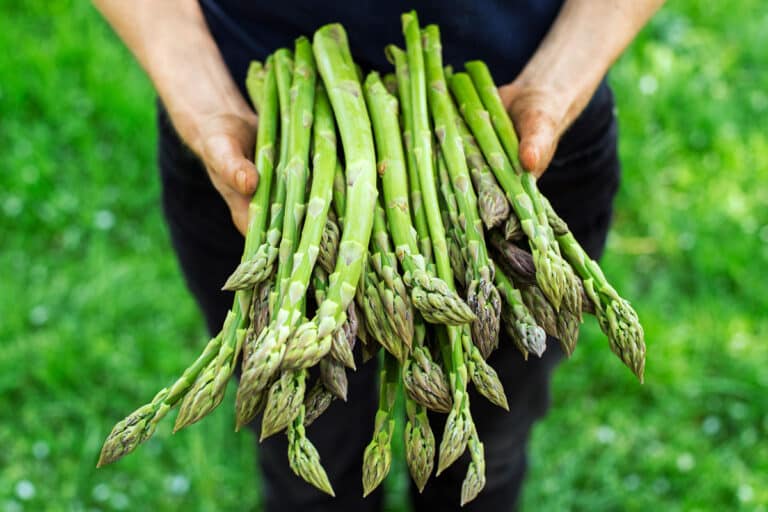
I had the opportunity to babysit my neighbors asparagus patch for two weeks earlier this season, and I was blessed with a bounty of asparagus like I have never seen.  The photo above was just one picking – and it kept coming!  For those who are not asparagus savvy, you need to keep the spears harvested during the production season, otherwise they will get tall and produce seed, and you will have no more asparagus to harvest.  Thus, I was over picking every two to three days to keep the plants producing.  The neighbors have a lovely 100+ year old farmhouse, and four different asparagus patches around the yard.  As I was picking, the fresh spears looked so good that I decided to try one raw for the first time.  It was really good!  It tasted very much like fresh picked green peas, without much of the stronger “asparagus” taste that puts many people off.  I ate several more.  :-)

The first thing I decided to do with the excess asparagus was freezing.

How to Freeze Asparagus

From the Ball Blue Book of Preserving, one of my favorite preserving references, with my comments in parentheses.

Select young, tender asparagus with tightly wrapped tips.  (Check – picked them fresh myself. :-)

Wash thoroughly and sort into sizes.  (Definitely needed to do this – the size variation in homegrown asparagus is quite substantial compared to commercial asparagus.  I always went for the thinner stalks in the store, thinking they’d be more tender, but I found out while picking that they emerge from the soil at the width they will be as they grow.  Thinner stalks are not any younger than fat ones, and the fat ones were often more tender and juicy.  Don’t fear the fat asparagus, and don’t fear fat in general.)

Trim stalks by removing scales with a scarp knife.  (This is done primarily to get any trapped dirt off that may be hiding underneath the scales, so I didn’t bother, as my asparagus were grown in grassy and mulched areas.  you’ll be able to see how dirty your asparagus are.)

Cut into even lengths to fit in freezer containers.  (I skipped this, too, since I wanted to pack whole spears in vacuum bags.)

Blanch small spears 1 1/2 minutes, medium spears 2 minutes and large spears 3 minutes.  (This is where the sorting is needed.)

Cool.  (I scooped mine out and plunged them into a cold water bath to halt cooking.)

Drain.  (I first drained in a colander, and then placed them evenly space on a flour sack towel on top of an old, absorbent bath towel, to wick away as much excess moisture as possible before freezing.)

Pack asparagus into plastic freezer bags, can-or-freeze jars, plastic freezer boxes or vacuum bags.  (I chose to lay out my asparagus on cookie sheets covered with reusable parchment paper (I use that stuff for everything.) and pre-freeze them before sealing them in vacuum bags the following day.

Seal, label and freeze. (I packed the frozen spears into meal sized packages with varying amounts per package and sealed them with my vacuum sealer.  My goal was to have a product that looked as good when you brought it out of the freezer as when you put it in – no ice crystals, no mushy mass of green goo, just neat, tender spears ready to be heated in a pan with a bit of butter, salt and pepper.  If you plan to keep produce frozen for any amount of time – for instance, in this case, I probably won’t pull this out until winter, when fresh veggies are gone – the investment in a vacuum sealer and the small amount of extra time involved is well worth it in the HUGE improvement in quality of frozen veggies and fruits.)

How to Dry Asparagus
Again from the Ball Blue Book of Preserving with my comments in parentheses.

Choose young, tender stalks.  (The ones that taste like green peas. :-)

Wash and cut off tough end.  (Funny that they didn’t mention this for the freezing.  Anyway, you can trim a little bit from the bottom as needed.  With many of the younger stalks, I really didn’t need to trim at all, because there was no tough part at the bottom.)

Slice into one inch pieces.  (Note – if you have really fat asparagus stalks, you probably want to cut them in half lengthwise, too, before loading them in the dehydrator.  I didn’t do this initially, and ended up doing it at the end of the drying process to get those wider pieces to dry evenly.)

Steam blanch 3 to 4 minutes.  (I just blanched them in a pot of boiling water for about two minutes, until they were bright green.)

I started with about six cups of chopped asparagus.

Here’s the whole batch in about 8 quarts of boiling water.

After blanching, I chilled them in a cold water bath to stop the cooking.

Drain well and spread evenly on dehydrator trays.  I used the mesh inserts (the Clean-A-Screen trays) to make sure that no veggie parts fell through the screens as they dried.

Dry at 125F until brittle.  Rehydrate and serve in soups or with seasoned cream sauce.  Water content 92%.  (I put mine in at night and they were done the next morning, except for the wide bits, which I split in half and dried for a bit longer.  You want them to be very dry, so they snap easily in half, for optimum shelf life.)

Isn’t it amazing how much they shrink up?  If you’ve get very limited food storage space, dehydrating is the way to go.  Remember the six cups I started with?  After drying, it all fit into one cup sized jar.

This was labeled and stuck in the pantry.  If you want to boost shelf life even more, you can use the Foodsealer jar sealer attachment and vacuum seal the jar, too.

How to Lacto-Ferment (Pickle) Asparagus

This recipe is the love child of two different posts, one from Heartland Renaissance, and one from A Little Bit of Spain in Iowa.  Since I scored some green garlic (immature garlic) from a neighbor (thanks, Deb), I figured I’d use it in the ferment.  My neighbor, Betty, who provided me with the asparagus, had mentioned that she wanted to make some pickled asparagus.  I’m pretty sure that she had standard pickled asparagus in mind, but I’ve been experimenting more with live cultured foods, so I used lacto-fermentation.

Lacto-fermentation is the use of water, salt, spices and sometimes whey to preserve food without heat canning.  The lactobacilli bacteria that proliferate in lacto-fermented foods not only help to preserve it and give it that “pickle” flavor, they also act as little probiotic factories, making the food more digestible and increasing its nutrient value.  Lacto-fermented food is loaded with healthy bacteria.  I eat some every day, generally with every meal.

Lacto-Fermented Asparagus Recipe

For each quart jar:

1 teaspoon peppercorns
1/4 teaspoon celery seeds
1/2 teaspoon mustard seeds
1/2 teaspoon pickling spice
2 stalks green garlic, cut into 1 inch pieces
Enough asparagus to pack the jar tightly
4 tablespoons whey – If you do not have whey, add an extra tablespoon of salt to your salt water
Salt water – 2 tablespoons sea salt to one quart water, mix well to dissolve (you won’t need all of this to fill the jar, but it’s better to have a little extra than to run short)

Clean and trim asparagus so the spears will fit into the jars below the neck of the jar (you want to keep them covered with liquid during fermentation.)  Put loose spices into jar, then pack asparagus into jars as tightly as possible (they will shrink during pickling and will want to float and pop up out of the liquid).  Wedge in garlic pieces as you go.  Pour in whey.  Pour in enough salt water to completely cover the asparagus, but make sure to leave one inch of head space at the top of the jar.  As it ferments, gas are produced and jar contents may expand.  I used atlas jars, which have wider shoulders but narrow mouths, to help wedge the asparagus in so it stayed below the water level.  You can also use a smaller jar with water in it nested in a wide mouth jar, or a clean stone, or other clean weight to hold the veggies under the brine.  This worked out pretty well overall.  Cultures for Health has a fermented vegetable master, which is designed to keep air out but allow gases to escape.  It’s on my wish list. :-)

Cover jars with a clean cloth (don’t seal tightly – they need to breathe), and place in a cool, dark place and allow to ferment for at least 3 days.  After three days, you can continue fermenting, or cover tightly and move to the refrigerator to slow down the fermentation process.  The flavors will get stronger and the asparagus will get softer the longer it ages at room temperatures.  Heat dramatically speeds up the fermentation process, so warm weather ferments will have shorter shelf lives.  I kept mine on the counter for three days under a dishcloth, then covered it tightly and moved it to the fridge.

One day three, I was a little freaked out when I took off the dishcloth and saw this:

At first, I thought it was mold.  Although it is generally safe to eat fermented foods with mold on the surface (just scrape off the mold and eat the product underneath, as long as the smell and taste are not foul or “off”), I was surprised that it had molded so quickly.  Upon closer examination, I found out that it was not mold, just milk solids from my whey, which could have been strained a little more finely.  After a little judicious scraping, the tops looked like this:

Much less “Fear Factor”. ;-)

My final product turned out a little cloudy, probably due to the whey and the “pickling spices”, which had some finer bits, but the taste is delicious.  Judging by the shelf life of other ferments I’ve tried, these should be good for several months – even a year – refrigerated, if they lasted that long.

I’m very grateful to have a stash of different types of asparagus that I can now enjoy for months to come.

How to Make Sauerkraut

I love the book Wild Fermentation by Sandor Ellix Katz (AKA Sandor Kraut).  Mr. Katz explores where those who fear stomach pumps fear to tread.  In all seriousness, the book is a great resource for those who are new to fermenting.  He starts out with some history and health benefits of fermentation, then launches into a full scale barrage of fermentation recipes, as well as basic guidelines to ferment “almost anything”.

Topics covered include:

  • Vegetable Ferments
  • Bean Ferments
  • Dairy Ferments (w/ Vegan alternatives)
  • Breads (and Pancakes)
  • Fermented-Grain Porridges and Beverages
  • Wines (Including Mead, Cider and Ginger Beer)
  • Beers
  • Vinegars

Before I read Wild Fermentation and Nourishing Traditions, I hadn’t really thought much about fermenting for years.  When I was a girl, my mother had me scrub my feet extra clean and stomp the sauerkraut in her 15 gallon crock (sorry, no pictures on that one).  We also made a few batches of wines over the years, and some cucumber pickles, but that was about it.  Now I’m learning about live culture foods on a whole new level.

I’ve already posted in the past about kombucha, and I hope to do a post on water kefir in the next few weeks.  This post is about sauerkraut.

Sauerkraut has been around for at least a couple of thousand years.  If you’d like a more detailed history, you can take a peek at this article.  It was eaten by workers on the Great Wall of China, packed by Captain Cook to prevent scurvy, and valued by Northeastern Europeans as a staple food through the long winters.  While the name may mean “rotten cabbage”, if you do it right it should be quite the opposite, staying fresh for an extended period of time.

We began our sauerkraut adventure with a couple of heads of cabbage from the fall garden.  I’ve got a mix of pictures from this year and last year.  In 2009, I used my food processor to finely dice the cabbage, this year I just sliced it up by hand (I’m getting pretty good with REALLY BIG KNIVES).

Here are the official instructions from www.wildfermentation.com, which are the same as those in the book Wild Fermentation.

Timeframe: 1-4 weeks (or more)
Special Equipment:

  • Ceramic crock or food-grade plastic bucket, one-gallon capacity or greater
  • Plate that fits inside crock or bucket
  • One-gallon jug filled with water (or a scrubbed and boiled rock)
  • Cloth cover (like a pillowcase or towel)

Ingredients (for 1 gallon):

  • 5 pounds cabbage
  • 3 tablespoons sea salt

Process:

  1. Chop or grate cabbage, finely or coarsely, with or without hearts, however you like it. I love to mix green and red cabbage to end up with bright pink kraut. Place cabbage in a large bowl as you chop it.
  2. Sprinkle salt on the cabbage as you go. The salt pulls water out of the cabbage (through osmosis), and this creates the brine in which the cabbage can ferment and sour without rotting. The salt also has the effect of keeping the cabbage crunchy, by inhibiting organisms and enzymes that soften it. 3 tablespoons of salt is a rough guideline for 5 pounds of cabbage. I never measure the salt; I just shake some on after I chop up each cabbage. I use more salt in summer, less in winter.
  3. Add other vegetables. Grate carrots for a coleslaw-like kraut. Other vegetables I’ve added include onions, garlic, seaweed, greens, Brussels sprouts, small whole heads of cabbage, turnips, beets, and burdock roots. You can also add fruits (apples, whole or sliced, are classic), and herbs and spices (caraway seeds, dill seeds, celery seeds, and juniper berries are classic, but anything you like will work). Experiment.
  4. Mix ingredients together and pack into crock. Pack just a bit into the crock at a time and tamp it down hard using your fists or any (other) sturdy kitchen implement. The tamping packs the kraut tight in the crock and helps force water out of the cabbage.
  5. Cover kraut with a plate or some other lid that fits snugly inside the crock. Place a clean weight (a glass jug filled with water) on the cover. This weight is to force water out of the cabbage and then keep the cabbage submerged under the brine. Cover the whole thing with a cloth to keep dust and flies out.
  6. Press down on the weight to add pressure to the cabbage and help force water out of it. Continue doing this periodically (as often as you think of it, every few hours), until the brine rises above the cover. This can take up to about 24 hours, as the salt draws water out of the cabbage slowly. Some cabbage, particularly if it is old, simply contains less water. If the brine does not rise above the plate level by the next day, add enough salt water to bring the brine level above the plate. Add about a teaspoon of salt to a cup of water and stir until it’s completely dissolved.
  7. Leave the crock to ferment. I generally store the crock in an unobtrusive corner of the kitchen where I won’t forget about it, but where it won’t be in anybody’s way. You could also store it in a cool basement if you want a slower fermentation that will preserve for longer.
  8. Check the kraut every day or two. The volume reduces as the fermentation proceeds. Sometimes mold appears on the surface. Many books refer to this mold as “scum,” but I prefer to think of it as a bloom. Skim what you can off of the surface; it will break up and you will probably not be able to remove all of it. Don’t worry about this. It’s just a surface phenomenon, a result of contact with the air. The kraut itself is under the anaerobic protection of the brine. Rinse off the plate and the weight. Taste the kraut. Generally it starts to be tangy after a few days, and the taste gets stronger as time passes. In the cool temperatures of a cellar in winter, kraut can keep improving for months and months. In the summer or in a heated room, its life cycle is more rapid. Eventually it becomes soft and the flavor turns less pleasant.
  9. Enjoy. I generally scoop out a bowl- or jarful at a time and keep it in the fridge. I start when the kraut is young and enjoy its evolving flavor over the course of a few weeks. Try the sauerkraut juice that will be left in the bowl after the kraut is eaten. Sauerkraut juice is a rare delicacy and unparalleled digestive tonic. Each time you scoop some kraut out of the crock, you have to repack it carefully. Make sure the kraut is packed tight in the crock, the surface is level, and the cover and weight are clean. Sometimes brine evaporates, so if the kraut is not submerged below brine just add salted water as necessary. Some people preserve kraut by canning and heat-processing it. This can be done; but so much of the power of sauerkraut is its aliveness that I wonder: Why kill it?
  10. Develop a rhythm. I try to start a new batch before the previous batch runs out. I remove the remaining kraut from the crock, repack it with fresh salted cabbage, then pour the old kraut and its juices over the new kraut. This gives the new batch a boost with an active culture starter.

Here’s my five pounds of cabbage and my one gallon crock.  (Some of you might recognize the crock from the post on dandelion wine.)

I did measure my salt out beforehand and add it as I chopped, as I am a novice at this sort of thing.

Here we have my youngest helping me to tamp the cabbage into the crock.

Really, he’s normally a very sweet boy – see?

With enough pounding, you get a nice layer of juice on top.

I read another blog where the writer suggested simply leaving the cabbage to sit and letting it make its own juice, but that didn’t seem to work with my cabbage.  I didn’t get enough juice to cover the top of the kraut.

Put a plate on top to hold down the cabbage.

Put a bag of salt water on top of the plate.

In 2009 I just packed the crock with cabbage and salt.  In 2010, I did one batch plain and one batch with added dulse (on the left with the red flecks).  I’m thinking about doing a third batch with added caraway.  By the way, the container on the left is not ideal for a couple of reasons.  The taper near the top made it impossible for me to fit a plate in to help hold the kraut down.  It’s clear, so I really need to make sure it’s covered to keep out the light.   Nevertheless, it was non-reactive glass and it was handy, so I used it. (Can fermented vegetables be kept in the light?  Well, if you had no other choice, yes, but light exposure speeds up the decomposition of the food (it will rot faster).  Extended exposure to direct sunlight will kill off the very bacteria you’re try to cultivate.  Many vitamins are also broken down by the light.  In this case, vitamin C, one of the main health benefits of raw sauerkraut, is broken down by exposure to light, heat and oxygen.  Keep your ferments in the dark!)

This years crocks are safely tucked under old towels in the basement cool storage after three days on the kitchen counter.  Last year, I brought the batch up around mid-December to start eating. When I took the water bag and plate off, you can see the color of the kraut has darkened.

I packed one pint jar for the fridge and froze the rest, along with some red kraut I got from a friend.

As I understand it, freezing slows down the organisms responsible for the fermentation but doesn’t kill them, so the kraut is still alive, unlike canning, where the whole goal is to kill any live bacteria in the product.

What are some of the benefits of eating raw sauerkraut?  Joe Karthein explains in Raw Sauerkraut Rocks!:


The same beneficial microorganisms that create lactic acid in the colon are naturally present in all vegetables and are responsible for turning raw cabbage into highly-digestible sauerkraut. The fermentation process increases the number of microorganisms dramatically, digesting the cabbage and other vegetables and producing lactic acid.

This lactic acid works the same in a jar of fresh sauerkraut as it does in our large intestine; harmful bacteria cannot survive in the acidic environment.

When we eat unpasteurized sauerkraut we reap the benefits of absorbing an entire ecosystem into our own internal ecosystem. The lactic acid from the sauerkraut creates an environment where the introduced beneficial bacteria can reproduce and in turn create more lactic acid.

Lactic acid also helps digestion at an earlier stage–in our stomach. As we get older, our stomach’s natural secretions of hydrochloric acid decrease. Hydrochloric acid breaks down food so it can be more easily absorbed by the small intestine. It is also the most important defense we have against harmful bacteria and parasites often present in food. Lactic acid can partially compensate for reduced hydrochloric acid.

Another way unpasteurized sauerkraut benefits digestion in the stomach is by assisting the pancreas. The pancreas secretes essential digestive enzymes into the stomach.
Unpasteurized sauerkraut is very high in viable enzymes that work just like the ones from the pancreas. A friend with chronic pancreatitis who has been taking prescription enzymes for the last five years was able to reduce his dosage by eating fresh sauerkraut on a daily basis. But this is just the beginning; there are so many more reasons to include my favorite food in your diet!

I eat my kraut with my eggs in the morning for breakfast, or as a condiment with just about any meat (roast chicken being a favorite).  It makes a most excellent Reuben.


I hope this helps you take the plunge if you haven’t tried fresh kraut.  It’s fairly easy and very tasty.  What other veggies have you fermented, and how did you like the results?


PS – I quick note on the “tamper” I used to pound down the kraut, in response to Patty’s comment.  The tamper is actually the wooden pestle from my Mirro Canning Food Press.  The food press was handed down to me by my grandmother.  I don’t use it a ton since I got my food strainer, but it is handy for small batches of applesauce and such, and pounding on vegetables.

UPDATE:  You can see how the kraut looked after SEVEN months in the crock at this post.  Lacto-fermentation works for food storage.


This post has been added to Real Food Wednesday  at Kelly the Kitchen Kop,
 Domestically Divine at Far Above Rubies and
Make Your Own Monday at Nourishing Treasures.


Related Posts Plugin for WordPress, Blogger...